SRINAGAR: A research paper by Rameez Ahmad Sudhan, an educator from Boniyar in Baramulla district, has been selected for presentation at the prestigious Comparative and International Education Society (CIES) Northeast Regional Conference, scheduled to be held from November 13 to 15, 2026, at Teachers College, Columbia University, New York.
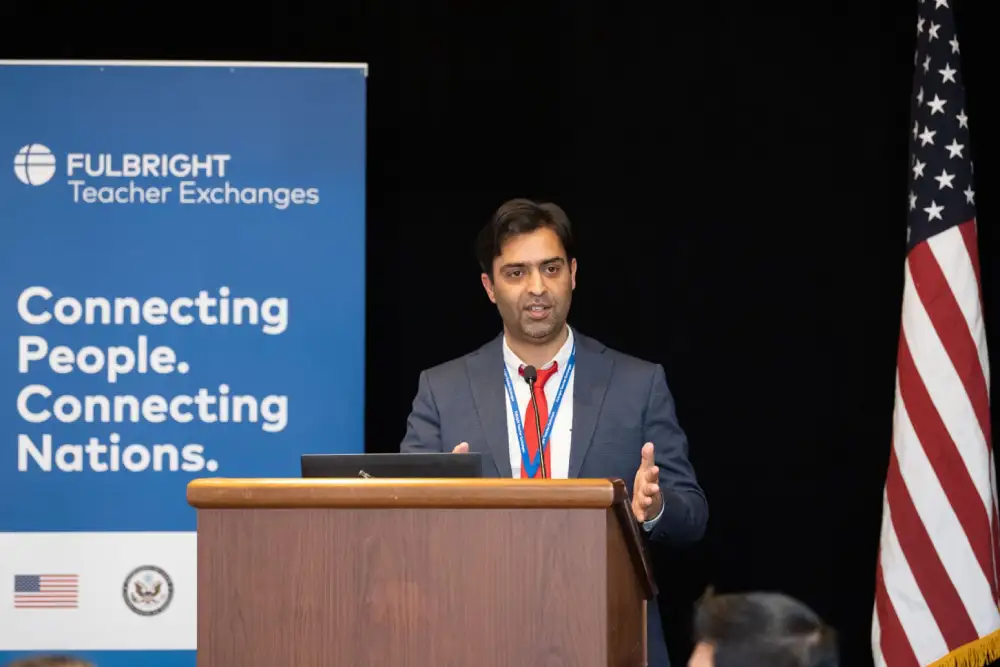
The paper will be presented before education researchers, policymakers and scholars from across the world. The conference, themed “Education, Migration and Displacement”, will examine how education systems respond to challenges arising from conflict, disasters, migration and humanitarian crises.
Rameez is currently serving at the District Institute of Education and Training (DIET), Baramulla, where he works to improve the quality of education by promoting teachers’ professional development, developing innovative educational resources and supporting schools in implementing competency-based learning. His work aligns with the objectives of the National Education Policy (NEP) 2020 and the NIPUN Bharat Mission, helping educators adopt modern teaching practices that enhance student learning and strengthen foundational education.
Born and brought up in Boniyar, a remote area of Baramulla district, Rameez completed his schooling there before pursuing higher education in Baramulla town. Growing up in a border village, where education was frequently disrupted by disturbances, he made learning the central focus of his life.
“From my school days, I was inspired by the teachers I met. They shaped my thinking and encouraged me to pursue education as a career. Whatever I have learned has been because of them,” he said.
Coming from a remote area, he often felt that students from rural backgrounds were expected to lag behind their urban counterparts.
“I wanted to prove that where you come from should never decide how far you can go. For me, knowledge was the only way to compete,” he said.
In 2016, he became part of an experimental project at a government laboratory school in Old Town Baramulla. The initiative sought to improve teaching practices and demonstrate that government schools, with the right support and resources, could compete with private institutions.
Over nearly two years, teachers adopted innovative classroom methods, focused on improving student learning outcomes and introduced a range of extracurricular activities to create a more engaging school environment. The initiative resulted in noticeable improvements in student learning, increased community participation and gradually changed public perceptions of government schools. One of its most significant achievements came when 65 students transferred from private schools to the government school after witnessing its transformation.
“That experiment gave me hope. People realised that public schools can compete if teachers are supported and communities believe in them,” Rameez said.
The project later became the subject of a research paper that he presented at a conference hosted by the Indian Institute of Management (IIM), Ahmedabad, in 2019.
Growing up in the Uri region, Rameez witnessed first-hand the devastation caused by the 2005 Kashmir earthquake, which claimed thousands of lives and brought the education of countless children to an abrupt halt. In the years that followed, repeated disruptions caused by natural disasters and security-related incidents continued to interrupt schooling across border areas of Jammu and Kashmir.
These experiences led him to reflect on a fundamental question: How can education continue even in times of crisis?
According to Rameez, rebuilding damaged schools is essential, but ensuring that children continue learning during emergencies is equally important. This belief became the foundation of the research paper that will now be presented at Columbia University. His study explores the concept of Emergency Education, an approach aimed at ensuring continuity of learning during disasters, conflicts and other crises.
The research argues that emergencies affect far more than classroom instruction. During crises, children often face challenges that impact their emotional well-being, sense of safety and long-term educational development. The study focuses on school safety and security, as well as protecting the social and emotional well-being of children.
It examines practical issues such as how teachers can continue education when schools are closed, how learning can be sustained in temporary shelters or relief camps, what systems governments should establish before disasters occur and what training educators require to respond effectively during emergencies.
Rameez’s work in school safety and emergency education also earned him the prestigious Fulbright Fellowship in 2023, a joint initiative of the Governments of India and the United States. The fellowship enabled him to engage with education experts from around the world, study international approaches to educational resilience and strengthen his research on school safety, emergency education and children’s social and emotional well-being.
He said the experience helped him connect the challenges faced by schools in Jammu and Kashmir with global discussions on ensuring continuity of education during crises.
Rameez believes education must become an integral part of disaster preparedness. He says schools in disaster-prone and conflict-affected regions should be equipped with appropriate safety measures, while teachers should receive specialised training to respond effectively during emergencies. More importantly, he emphasises that protecting children’s education requires the collective efforts of teachers, education departments, disaster management authorities, communities and policymakers.
For him, the research paper is not merely an academic exercise but a commitment to ensuring that children living in difficult circumstances are not deprived of their right to education.
“Education should not stop because of an emergency,” he said. “If we prepare our schools and teachers well, we can protect not only children’s learning but also their hope for the future.”