by Farzana Nisar
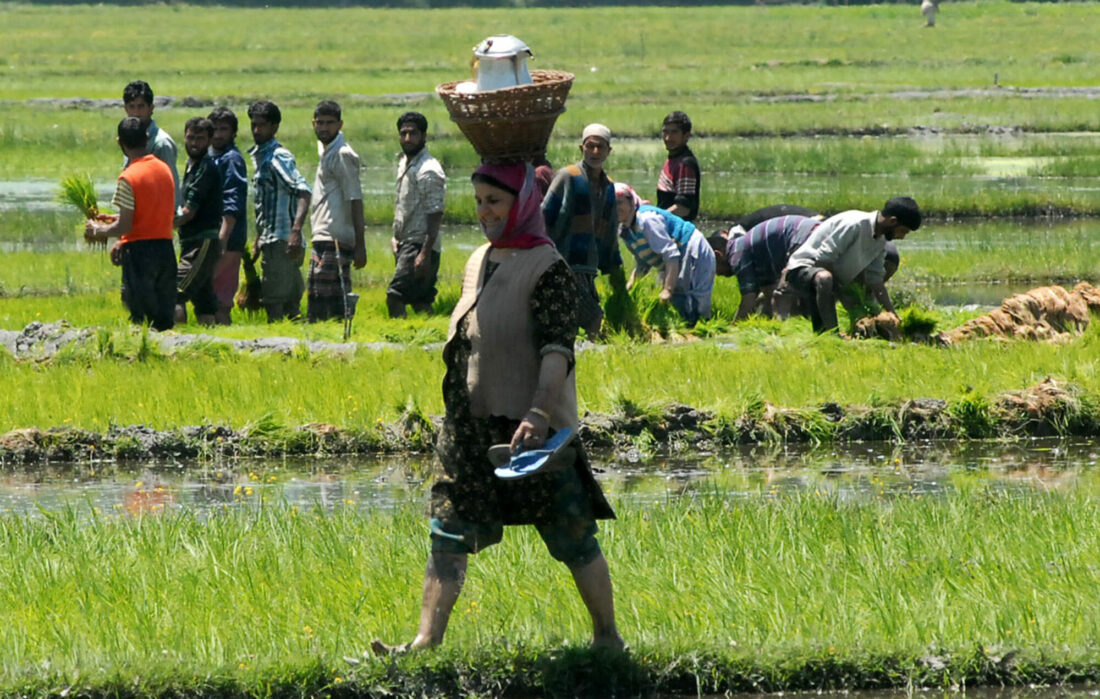
SRINAGAR: “Twenty years ago, all this was paddy,” says Nazir Ahmad, a farmer from Qaimoh, a village in south Kashmir’s Kulgam district, pointing at the rows of apple saplings that now cover his land. Today, much of that landscape has changed. The irrigation channels set up for paddy still exist, running through the fields as they always have. However, the paddy they once fed has given way to apple plantations.
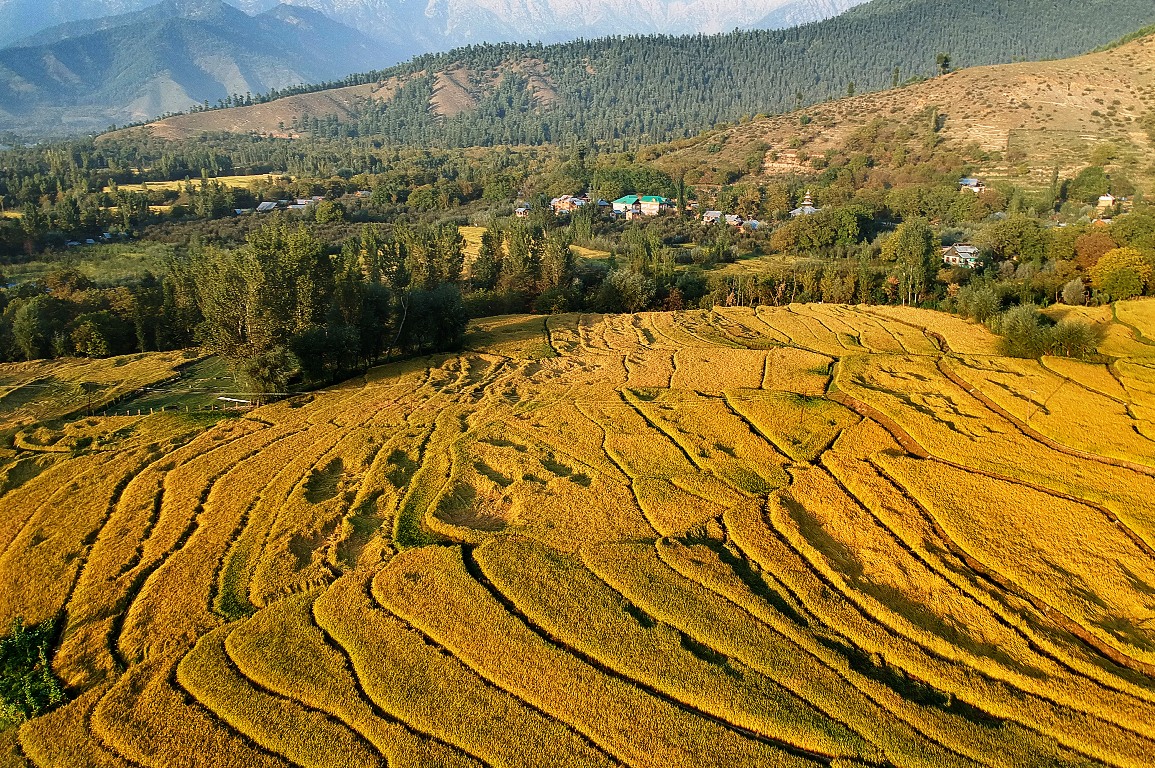
Across Kashmir, farmers are increasingly replacing food crops with horticulture, especially apple orchards, as they seek higher returns amid rising cultivation costs.
For many growers, the calculation is straightforward. Paddy offers modest returns, while apples, particularly high-density plantations, promise significantly higher earnings. The move makes economic sense for individual farmers. However, this is now leading to Kashmir Valley becoming increasingly dependent on outside states for its staple food — rice.
Nisar Ahmed from Kulgam district in Kashmir, used to cultivate paddy on his nine-kanal (0.46 hectares) farmland, which earned him between Rs 30,000 and Rs 50,000 annually. A few years ago, he converted the land into a high-density apple orchard because he was facing losses. After the shift, Nisar and his family saw a considerable increase in their earnings. “Every season, we earn around Rs 4 lakhs to Rs 5 lakhs (Rs 400,000-500,000),” he said.
Fareed Ahmed Wagay, a farmer who converted six kanals (0.30 hectares) of paddy land into an apple orchard also said that paddy cultivation could not fetch healthy returns. “As a result, hundreds of farmers are now shifting towards horticulture and planting high-density apple trees.”
A changing agricultural map
The transformation has been underway for decades. A 2019 study based on Landsat satellite imagery found that agricultural land in Kashmir Valley declined by around 28% between 1992 and 2015, while plantation cover increased by about 88%. The expansion of plantations was part of a broader shift in land use that came alongside a decline in agricultural land, the study said.
The latest official figures suggest the trend has continued. Jammu and Kashmir’s paddy acreage has fallen to 258,840 hectares in 2024-2025 from 304,500 hectares in 2015-2016, a drop of around 15%. Conversely, the area under apple increased to 173,073 hectares in 2024-2025 from 107,930 hectares in 2004-2005, an increase of around 60%.
Another study examining land-use changes across the Kashmir Himalaya between 1990 and 2017 found that cropland agriculture declined by around 5%, while horticulture expanded by around 4.3%. The researchers linked the changes to economic, demographic and natural drivers and warned that declining agricultural land could pose a threat to regional food security.
The contrast is particularly visible in Kashmir’s traditional rice-growing belts — Anantnag, Kulgam, Pulwama, being a few districts.
In Kulgam, the area under apple is now more than twice the area under paddy. According to government data, only 6,951 hectares remained under paddy in 2024-2025, compared to 18,255 hectares under apple. In the neighbouring Pulwama district, paddy covered 10,990 hectares, while apple orchards occupied 15,928 hectares.
A spatial land-use analysis published in 2020 found that the area under rice cultivation in Kulgam district declined from 18,500 hectares to 12,900 hectares between 2011 and 2020, a loss of 5,600 hectares. Over the same period, land under apple orchards increased from 14,667 hectares to 20,787 hectares.
A 2022 study of Anantnag found that around 6,908 hectares of agricultural cropped area had shifted towards horticulture. Among surveyed farmers, the area under paddy fell from around 83% in 2000-2001 to 40% in 2014-2015, while apple cultivation increased from around 16% to 59%.
Yet, the precise scale of paddy-to-orchard conversion for the whole of Kashmir Valley remains difficult to establish. That is because the Agriculture Department does not maintain data on how much paddy land has been converted into orchards, according to Sartaj Ahmad Shah, Director Agriculture in Kashmir. He, however, acknowledged that Kashmir’s dependence on rice supplies from outside the region has increased, as paddy cultivation has declined.
While a regulation from 2022 addresses the conversion of agricultural land for non-agricultural purposes, which requires permission from the concerned District Collector, no other policy specifically looks at paddy-to-orchard conversion to protect paddy regions.
The economics of the shift
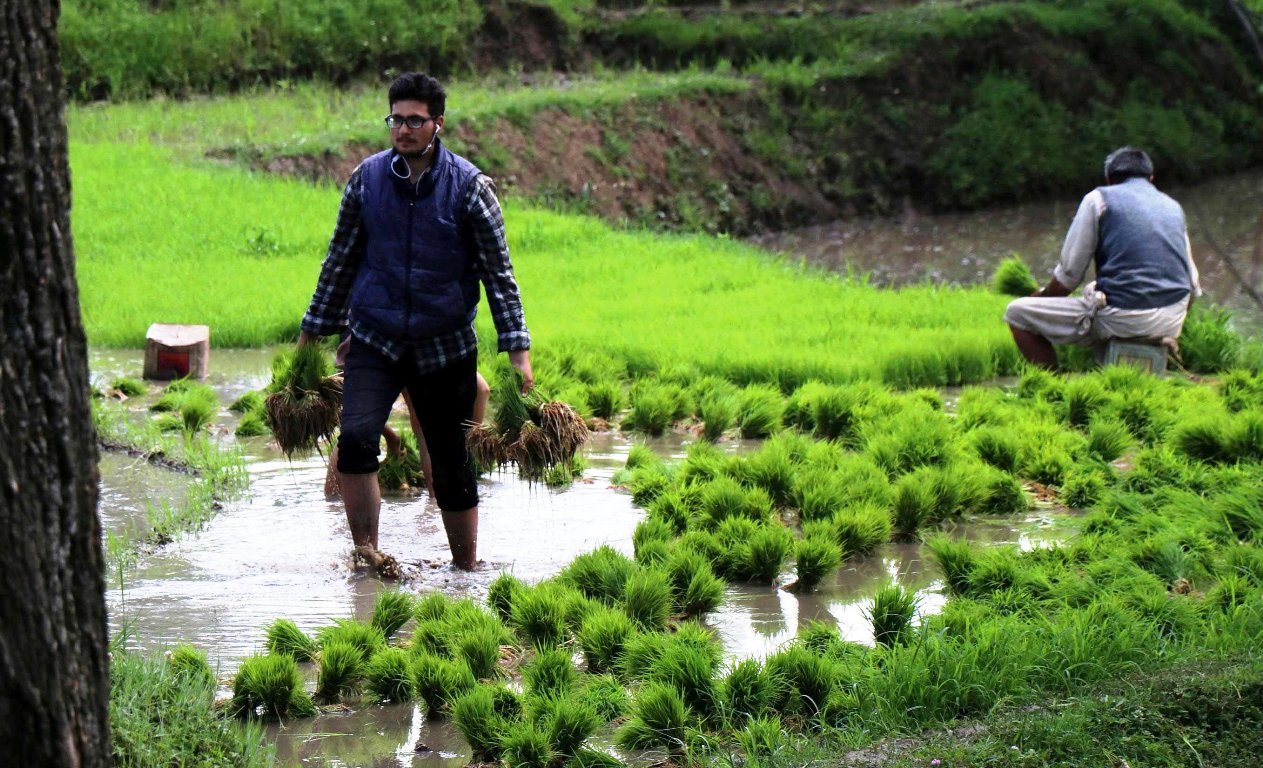
For farmers, the move is largely about returns. Sameena Lone, a researcher at the Sher-e-Kashmir University of Agricultural Sciences and Technology of Kashmir (SKUAST-K), said the shift reflects rational economic choices rather than a rejection of food crops.
“Apple orchards can generate several times the returns from paddy per unit of land, while shrinking landholdings due to fragmentation push farmers towards higher-value crops,” Lone told Mongabay-India.
A study of household-level paddy production in Kulgam between 2007 and 2014 also found that farmers were already moving away from food crops towards cash crops, particularly apple, almond and walnut, as horticulture was considered more remunerative.
“Converting paddy fields into perennial orchards changes soil structure and moisture regimes,” Lone said. Orchards require less standing water than paddy, but depend on irrigation at critical stages and are vulnerable to weather events during flowering.
As orchards expand, she said, the cropping pattern is also narrowing, potentially increasing farmers’ exposure to market fluctuations, pests, disease and climate-related shocks.
A recent hailstorm in South Kashmir illustrates that vulnerability. Several apple-growing villages in Shopian and Kulgam suffered extensive crop damage, with some areas reporting losses for the third time that season. For grower Mohammad Shafi Wagay, the damage threatened his family’s annual income. “Almost our entire orchard is completely damaged,” he said.
A changing water landscape
The agricultural transition is also unfolding against a changing water landscape.
A 2020 study of the Lidder watershed in Anantnag district found that agricultural land declined by 39% between 1980 and 2018, while orchard area expanded by 176%. The researchers linked the conversion of irrigation-intensive rice paddy to less water-intensive orchards to both economic considerations and declining streamflow.
The shift from paddy fields to orchards could also alter the Valley’s groundwater recharge patterns. According to Pir Rayees Ahmad, a hydrogeologist at Central Ground Water Board, paddy fields can act as natural recharge zones, as standing water during the growing season allows water to infiltrate the soil and replenish shallow aquifers.
“Orchards generally require less standing water and increasingly rely on localised irrigation methods. Consequently, opportunities for groundwater recharge decline,” he said.
Pir Rayees added that paddy fields also act as natural flood buffers by temporarily storing rainfall and irrigation water, slowing runoff and reducing flood peaks. Their conversion can reduce this storage capacity, potentially increasing flooding and waterlogging, particularly within the Jhelum floodplain, he said.

PHOTO BY BILAL BAHADUR
The food-security trade-off
Government data reports that Jammu and Kashmir produced around 6.5 lakh (650,000) tonnes of rice in 2024-2025. Yet the region also relies heavily on government food supplies from outside.
Ashaq Hussain, a professor of agronomy at SKUAST-K, primarily attributes the reason for paddy decline to orchard conversion, followed by urbanisation and the expansion of roads and railway infrastructure.
“The conversion had affected Kashmir’s capacity to produce rice locally, although improvements in varieties and farm-management practices had helped raise productivity,” Hussain said.
He estimates that Jammu and Kashmir produces roughly 50-55% of its own rice requirement, with 45-50% coming from other states, particularly Punjab, through the Food Corporation of India. But not all agricultural land is equally suited to orchards, Hussain added.
“Lower-lying areas with high soil moisture are particularly suited to paddy, while converting such land to orchards can create problems including excess moisture, root rot and disease.”
Data from the Food, Civil Supplies and Consumer Affairs Department show that 4.86 lakh tonnes of rice were largely brought in from surplus states, particularly Punjab and Haryana, during 2024-2025, compared with 4.36 lakh tonnes in 2023-2024 and 3.74 lakh tonnes in 2022-2023.
Waseem Hassan, an FMCG wholesaler, described what he sees as growing demand for rice outside the ration system. “The ration is never sufficient for a household’s entire requirement, so people have to buy additional rice from the market,” he said.
The increasing reliance on rice from outside the region raises a larger question: How resilient is a food system when a staple that was once produced locally in abundance has to now increasingly be sourced through external supply chains?
Lone describes this as structural vulnerability, arguing that greater dependence on outside food supplies ties the Valley’s food security to transport networks, market conditions and the stability of supply routes.
Ejaz Ayoub, a Kashmir-based economist, argues that the movement away from paddy is a rational response to market forces. “Labour and resources flow towards things which have more returns,” he said.
From an economic perspective, Ayoub said, Kashmir need not produce everything it consumes. Instead, it can focus on crops in which it has a comparative advantage, such as apples, saffron, almonds and walnuts, and use the income generated from these crops to purchase commodities such as rice from elsewhere in the country.
However, another associate professor in the Department of Economics, University of Kashmir – Javaid Iqbal Khan, called the shift a “macro-level structural hazard.”
“The shift has accelerated with the spread of high-density apple plantations, which allow farmers to plant more trees per unit of land and are promoted as a more remunerative model of horticulture,” he said. “At the micro level, it is a rational and income-maximising decision. But when these individual decisions aggregate, they can create a macro-level structural hazard.”
The cumulative shift away from paddy can reduce the region’s capacity to produce its staple food, even as individual households become more prosperous. According to him the implications of this change need to be viewed in a social and dietary context. Unlike a commodity that can simply be substituted through trade, rice is a culturally entrenched staple in the Valley.
Khan cautioned that this model could create another form of vulnerability if household purchasing power for food becomes increasingly dependent on the performance of the apple economy.
Apple production, he noted, is itself vulnerable to spring hailstorms, autumn temperature fluctuations and global demand cycles. “A poor horticultural year could therefore reduce both farm incomes and the purchasing power available to buy food from outside.”
He described this as a “negative covariance” risk, in which the two sides of the food system become linked through the same vulnerable income stream.
A transition to be managed
This transition could become increasingly difficult to reverse, Khan explains. “It is very easy to move from paddy to apple, but it is increasingly going to be difficult to move from apple to paddy,” he said.
Apple is a perennial crop: once an orchard is established, returning the land to paddy is not as simple as changing the crop in the next planting season.
Lone argues, the solution is not to reverse Kashmir’s shift towards horticulture. “That would neither be realistic nor necessarily desirable given the importance of horticulture to farmers’ livelihoods,” she said.
Instead, she advocates protecting strategic paddy-growing areas as a food-security buffer, promoting diversified horticulture rather than excessive dependence on apples, investing in climate-resilient varieties and developing water-efficient irrigation systems suited to orchards.
At SKUAST-K’s Rice Research Station at Khudwani, scientists are pursuing another way of responding to the shrinking land base: producing more rice from the land that remains. The Vice Chancellor, Professor Nazir Ahmad Ganaie, said the station has developed high-yielding, disease-resistant and climate-resilient paddy varieties, with some showing yield potential of up to 12 tonnes per hectare. He also pointed to technologies such as direct-seeded rice that can reduce water and labour requirements.
“On the one hand, our population is increasing, agricultural land is shrinking, and climate change and global warming are creating new challenges,” Ganaie said. “On the other hand, our food requirements are increasing.”
Meanwhile not all farmers are moving away from paddy. Bashir Ahmad, a farmer from Bijbehara, continues to cultivate rice, citing assured irrigation, manageable costs and the needs of his family of nine.
“I grow paddy because I have assured irrigation and the costs are manageable,” Bashir said, adding that the fruit economy was riskier because of climate uncertainties. He said high-density apple plantations require significant investment, while traditional orchards can take years to become productive.
For Bashir, paddy also provides food security, particularly as rice prices rise and ration supplies do not meet his family’s entire requirement. He said some farmers also grow traditional Kashmiri rice varieties for the market, where they can fetch good prices and are sought after for occasions such as weddings.
“If we lose the crop, we could lose both our income and the food we produce,” he said.
(The report was first published on the Mongabay website and is reproduced under Creative Commons Attribution-No Derivatives 4.0 International License.)