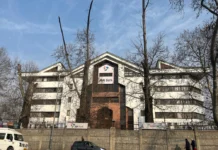
SRINAGAR: The long-promised All India Institute of Medical Sciences (AIIMS) at Awantipora in Pulwama, once hailed as a landmark healthcare project for South Kashmir, remains incomplete even a decade after its foundation. The issue exploded into the political and public arena this week when the Jammu and Kashmir Legislative Assembly’s Committee on Petitions summoned AIIMS authorities over the “scandal of neglect”, after the institution itself admitted that the project is still far from finished.
The matter was brought into the Assembly spotlight by a petition filed by Pulwama resident Arif Amin, who highlighted what he described as “inordinate and continuing delay” in the execution of AIIMS Pulwama. Amin’s submission pointed to the repeated missed deadlines, poor pace of construction, and administrative mismanagement that have left the project languishing despite being sanctioned under the Prime Minister’s Development Package (PMDP).
The petition also spelt out the impact of the delay: patients from South Kashmir continue to travel long distances to Srinagar or outside the Union Territory for specialised treatment, incurring heavy financial and emotional costs. The prolonged inaction has also meant lost employment opportunities for the local population, while aspiring medical students remain deprived of the academic and training facilities the institute was supposed to provide. Amin further stressed that the absence of transparency, public updates, and fixed accountability has only deepened people’s distrust of official assurances.
Committee Chairman and MLA Tangmarg, Farooq Shah, took serious note of the petition and called in AIIMS authorities to the Assembly Secretariat. Shah directed them to furnish explanations for the delay, provide a fresh timeline, and ensure that nationally significant projects such as AIIMS are not left to drift.
The issue gained sharper political tones when MLA Waheed Parra called the situation a “scandal of neglect” and alleged that the disparity between the completed AIIMS Jammu and the stalled AIIMS Pulwama smacks of “political discrimination and administrative apathy”. Parra reminded that the Awantipora project was the dream of former Chief Minister Mufti Mohammad Sayeed to transform healthcare in Jammu and Kashmir. “While development has been paraded as a slogan, Kashmir’s most vital healthcare project is left in ruins of delay. This is not just failure, it is criminal,” Parra said, demanding that AIIMS Pulwama not be reduced to a “monument of neglect”.
In its official response to the petition, AIIMS Awantipora admitted that while about 65 per cent of physical infrastructure is complete, significant challenges have pushed the completion date well beyond the sanctioned timeline. Originally scheduled to be finished within 72 months — by March 2025 — the project is now expected to be ready by June 2026, subject to timely handovers by the Central Public Works Department (CPWD) and resolution of bottlenecks.
The authorities listed a litany of reasons for the slippage. Among them were a 1.5-year delay in securing land-related clearances from military authorities, a prolonged wait for a No Objection Certificate from the Victor Force, and delays in finalising the site master plan. The Covid-19 pandemic further derailed work, with lockdowns, movement restrictions, and labour shortages paralysing construction through 2020 and 2021.
Geographic and climatic conditions have posed their own hurdles. The site, located in hilly terrain with prolonged winters and frequent rainfall, often turns slushy, limiting the use of heavy machinery and restricting workforce mobilisation. Seasonal closures of National Highway 44, landslides, and Yatra-related restrictions repeatedly disrupted the transport of construction materials. Added to this were security concerns in the sensitive region, which in May and June 2025 alone forced stoppages in the labour movement and supply chains. Harsh conditions also contributed to high attrition rates among skilled labourers, while inter-agency coordination problems between central and UT-level departments slowed the resolution of issues.
Despite these setbacks, AIIMS authorities assured the Committee that corrective measures are underway. Recruitment of faculty and non-faculty staff has been initiated, and MBBS classes are targeted to begin from the next academic year, provided infrastructure readiness. A phased operational plan is being drawn up to activate critical hospital services before the entire project is completed. Monthly review meetings, chaired by the Executive Director and monitored by both the Ministry of Health and Family Welfare and the Chief Secretary of Jammu and Kashmir, have been instituted to track progress.
Still, for many in South Kashmir, these assurances ring hollow after years of delay. The petition has underlined not just the failures in execution but also the larger implications for governance credibility. For a region grappling with health crises, security challenges, and the added responsibility of managing tourist and Yatra inflows, the AIIMS project was seen as a lifeline. Its languishing state has now become a symbol of administrative paralysis.
As the matter stands, the Assembly’s Petitions Committee has sought clear commitments, while political voices like Waheed Parra continue to demand accountability and prioritisation. Whether AIIMS Pulwama meets its new June 2026 deadline remains to be seen, but the decade-long wait has already eroded public trust and sharpened perceptions of neglect in South Kashmir.