by Haseeb Ashraf Shah
SRINAGAR: On the vast Karewas of Newa, locally called Wudur, the almond orchards stretch across the highlands, carrying centuries of tradition. Families of Newa in Pulwama district have cultivated these trees for generations, passing down the labour and the pride of almond farming.
The trees are valued not only for their fruit but also for their beauty. Each spring, as winter loosens its grip, buds appear in March and the barren landscape turns into a sweep of pink and white. The blossoms draw both locals and visitors, who breathe in the fragrance that fills the air. Mohammad Yousuf, a farmer, said the sight in March and April was so pleasing that more tourists had begun to come simply to watch the bloom and savour its scent.
The rhythm of the trees follows the seasons. Blossoms of spring mature into nuts through summer, and by August, the crop is ready. Harvesting in Newa remains rooted in traditional practice. Farmers climb into the orchards with long sticks and strike the branches gently, spreading large sheets beneath to catch the falling almonds. The method prevents damage and keeps the fruit clean.
Back home, the harvest moves into processing. For generations, families spent weeks peeling away the green outer shells by hand. Now, machines have transformed the work. Orchard owner Shah Raja Hafiz explained that what once took months could now be done in minutes.
Almonds are prized for their flavour and their health benefits. They are packed with Vitamin E, fibre, magnesium, and healthy fats that lower cholesterol, regulate blood sugar, and strengthen the heart. Antioxidants fight cell damage, while nutrients support bones and improve brain function. With careful storage, almonds last up to a decade.
Farmers in Newa point out another advantage: almonds demand less fertilizer and labour than other fruits. Abdul Wahid Shah said this was why it mattered to protect the trees and continue the tradition.
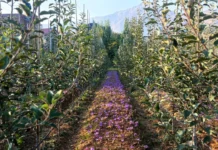
Despite their value, the orchards face an uncertain future. Farmers are cutting almond trees and planting high-density apple saplings instead. Government schemes favour apples, and established marketing platforms guarantee higher returns. Apples reach markets in almost every district, while almonds lack such a system.
Abdul Majeed Khan, another farmer, said people were replacing almonds with apples because the latter promised more profit. If the trend continued, he warned, almond trees could disappear entirely. He urged the government to provide almonds with the same kind of platform that apples enjoy, which would encourage farmers and keep prices reasonable.
For many in Newa, almond orchards represent more than a livelihood. They are woven into family traditions, carrying stories of toil and resilience. Unlike apples, which dominate Kashmir’s fruit trade, almonds reflect a subtler legacy.
Farmers insist that the government’s role should not only be to expand market access but also to preserve a culture. Subsidies, export facilities, and support schemes could carry Kashmiri almonds to markets beyond the Valley, just as apples have already done.
For now, the orchards of Newa bloom each spring and bear their fruit in summer. Every harvest gives farmers joy but also reminds them of what may be lost. Abdul Wahid Shah spoke with firmness: “Almonds are part of our roots. They have sustained our families for generations. We must not let them vanish.”
Despite challenges, the people of Newa tend their trees with pride. For them, the orchards are not only about income but also heritage. With the right support, the blossoms of Newa may continue to brighten Kashmir’s landscape for generations to come.