JAMMU KASHMIR
Financial fraud in Jammu and Kashmir is taking a curious turn: the number of reported cases is falling, but the money involved is soaring. In 2025-26, scheduled commercial banks and All India Financial Institutions reported 103 fraud cases involving Rs 193.49 crore, more than double the Rs 81.27 crore involved in 298 cases the previous year. Only Rs 6.92 crore was recorded as recovered.
Over three years, Jammu and Kashmir reported 868 fraud cases involving Rs 322.31 crore, but recoveries amounted to just Rs 12.80 crore, roughly 4 per cent of the money involved. The trend is striking: cases fell from 467 in 2023-24 to 298 and then 103, while the value of fraud climbed from Rs 47.55 crore to Rs 81.27 crore and then Rs 193.49 crore. The data, however, does not show how much of the recovered amount was actually returned to victims. Ladakh, meanwhile, recorded 39 cases involving just Rs 0.10 crore over the three years, with no recovery shown.
Northern Railway’s Jammu Division collected around Rs 78 lakh in fines from over 10,000 ticketless and irregular travellers in July 2026.
BISHNAH
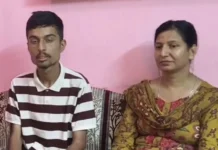
The killing of an 11-year-old boy in Jammu has raised troubling questions over how an early warning was treated. Rohit Kumar was allegedly taken from his home near Bari Brahmana by his stepfather Ravi Kumar, who later called the boy’s mother and claimed to have killed him and dumped the body. She approached police and urged them to trace her son, but was allegedly told that he was probably joking. No trace of Rohit was found during the initial search. The matter took a grim turn when Ravi surrendered at Bishnah Police Station and confessed to killing the boy by repeatedly smashing his head with a brick before dumping the body in marshy fields at Chak Murar. Police recovered the body and registered an FIR under Section 103 of the BNS. The investigation is underway.
Jammu and Kashmir Police detained 21 suspected Bangladeshi nationals, including three women and seven children, travelling from Jammu to Srinagar without valid identity documents.
JAMMU
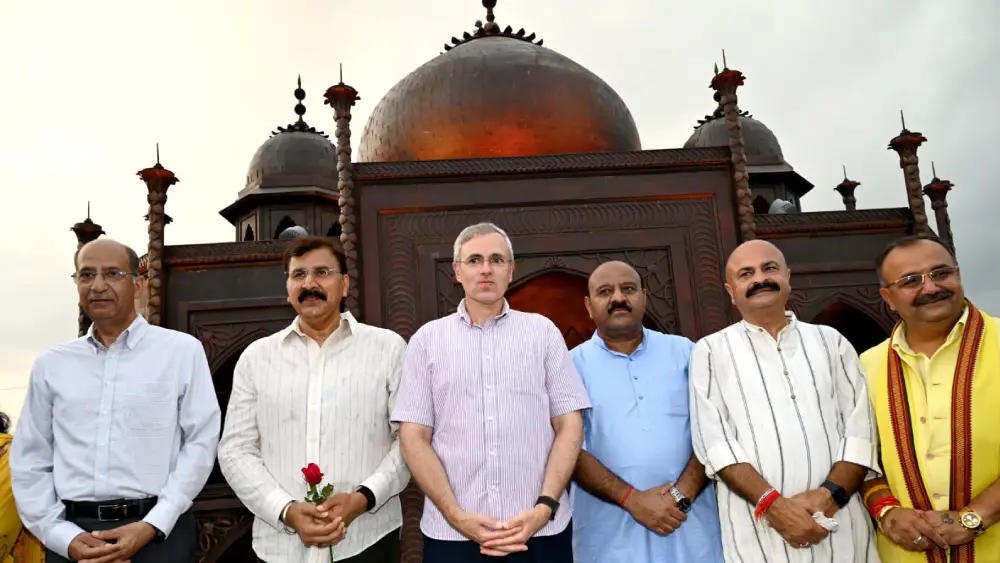
Jammu’s new Tawi Wonderland is less a conventional park than a giant showcase of what discarded material can become. Spread over 40 kanals on the Tawi riverfront, the Rs 11-crore attraction has recreated 14 monuments using steel and iron waste, used tiles, broken cycles, vehicle scrap, tyres, plastic bottles and other discarded material. Visitors can see scaled replicas of the Eiffel Tower, Taj Mahal, Colosseum, White House, Sphinx, Angkor Wat, Statue of Unity, Hawa Mahal, Jantar Mantar and Gateway of India, alongside the Chenab Railway Bridge and Akhnoor Fort. The park also has an 800-square-metre water body, with water kept at 2-2.5 feet for safe boating, children’s play zones, an open-air theatre, cafeteria, kiosks, toilets and food outlets serving Dogra cuisine. Built through a PPP, Jammu Smart City Limited spent Rs 8 crore and Z-Tech India Limited Rs 3 crore. Z-Tech will operate and maintain it for 10 years, with a possible three-year extension. Entry tickets and parking will be paid, though the rates have not been specified. Chief Minister Omar Abdullah formally threw open the park, which was once used as a waste-disposal site.
Jammu and Kashmir Police announced a Rs 15 lakh reward for information leading to the arrest of proscribed Lashkar-e-Taiba commander Latif Bhat.
SHOPIAN
Four years after the Shopian administration attached a Jamat-e-Islami office under the UAPA, a breakaway group, the Justice and Development Front (JDF), has established its presence on the premises, prompting questions over how an attached property could be occupied. Former Jamat members have approached the Deputy Commissioner seeking details of the authority under which the occupation took place. Authorities say a notice has been served on the JDF and warned of an FIR if it fails to vacate. The JDF has also taken rooms in a Falah-e-Aam Trust building in Srinagar, claiming it has a valid rent deed.
Jammu and Kashmir has 2,200 ‘seasonal teachers’ who school 42,000 tribal students in meadows and forests.
KASHMIR
August 5, the seventh anniversary of the abrogation of Article 370, passed in Kashmir under an unusually heavy security blanket, with large police deployments effectively shutting down the possibility of street protests. Police refused permission to a human rights group to release its report on the eve of the anniversary. The most striking response came from the ruling National Conference, which marked the day with a protest confined to its party headquarters, a demonstration that stayed indoors while the streets remained heavily policed. Omar Abdullah said Jammu and Kashmir has not reconciled to the August 5 decision-making. He was touring Poonch on the day.
The Peoples Democratic Party attempted to take its protest beyond the confines of its office. Mehbooba Mufti and her daughter Iltija were among those who took part in a sit-in, but the protest ran into police restrictions when demonstrators tried to move towards Lal Chowk. The confrontation later turned into a police case, with Mehbooba and Iltija booked over allegations of assaulting a police officer. Iltija, who said she was manhandled during the incident, was also questioned while undergoing treatment.
Away from Kashmir, NC dissident MP Ruhullah Mehdi provided a markedly different setting for political expression, holding a seminar at Delhi’s Constitution Club that offered a platform for a broader discussion on the political and constitutional consequences of August 5.
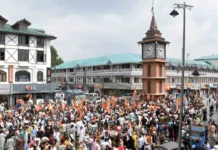
The BJP, meanwhile, took its celebration to the streets of south Kashmir. At an Anantnag rally, however, slogans referring to the honour of “Azi” and “Fazi”—traditional names symbolising Kashmiri mothers and women—triggered outrage. The party subsequently distanced itself from the slogans, saying they did not represent its position.
The contrast was hard to miss: one side was kept off the streets, another confined its protest indoors, while the party celebrating August 5 marched through Kashmir, only to find its own rhetoric becoming the controversy of the day.
Jammu and Kashmir lost 35 persons in 45 cloudbursts so far in 2026.
MUZAFFARABAD
An election is unfolding in PoK even as the death toll from weeks of unrest has crossed 86, raising questions about the timing and conduct of the exercise. Voting is being held in three phases, with results from the first two declared the same evening, meaning the outcome of one phase is already visible to voters preparing to cast ballots in the next. The third and final phase is still to be held on August 10. The Pakistan Muslim League-N has taken a commanding lead, winning 24 of the 34 seats decided so far. The election has been held amid protests, clashes and a boycott call by the banned Joint Awami Action Committee, which has opposed, among other issues, reserved seats for displaced Kashmiris. With the first two phases already producing a clear political trend, the remaining electorate is going to the polls with a result that is no longer entirely unknown.
GMC Srinagar has emerged as Jammu and Kashmir’s top-ranked medical college, securing the 80th spot among India’s leading MBBS colleges in the latest IIRF rankings.
BARAMULLA

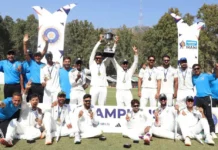
Auqib Nabi’s maiden call-up to India’s Test squad has turned a modest village in Baramulla into the unlikely centre of a national cricketing story. The 29-year-old pacer from Sheeri has been drafted in for the Sri Lanka series after Jasprit Bumrah was ruled out with a knee injury, but the selection is hardly a sudden reward. Nabi has taken 104 wickets in the last two Ranji Trophy seasons, including 60 in the 2025-26 campaign that helped Jammu and Kashmir win its maiden title.
His rise is rooted in persistence rather than privileged facilities. He travelled kilometres to practice on modest grounds, while his father initially wanted him to pursue medicine and even tried to stop him playing cricket. Eventually, the family backed his obsession. In Sheeri, his grandmother Fazi Begum received the news with tears, recalling years of prayers that her grandson would one day wear the Indian jersey.
Nabi’s selection is also a milestone for Jammu and Kashmir cricket: he is the third cricketer from Jammu and Kashmir after Parvez Rasool and Umran Malik to earn a senior national call-up.
In Jammu and Kashmir, only 21.5 per cent of students pursue higher education, resulting in one of the lowest Gross Enrollment Ratios (GERs) in India.
SRINAGAR
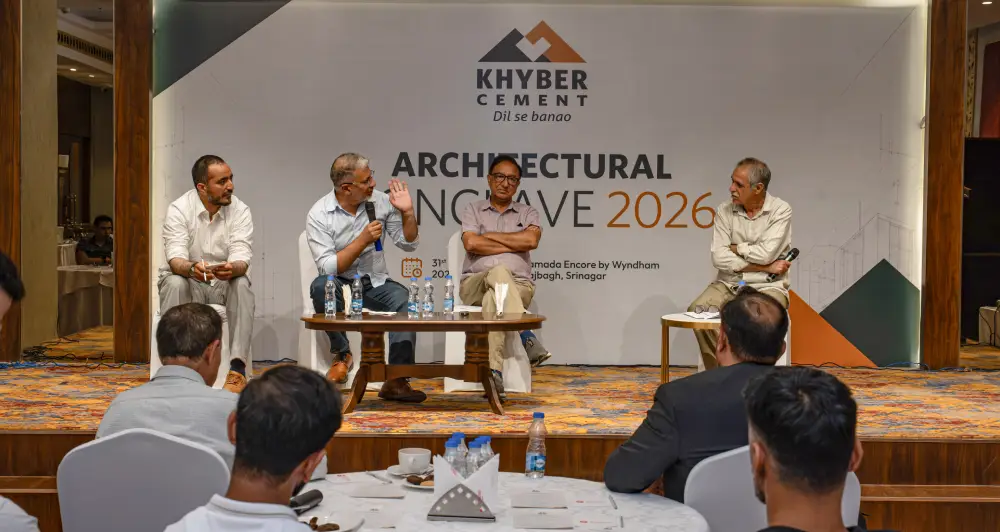
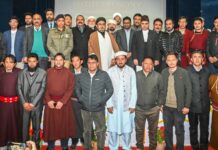
The Khyber Cement Architectural Conclave has created a much-needed stakeholders’ space for thinking about Kashmir’s rapidly changing built environment. Bringing architects, planners, conservationists, engineers and former policymakers together, the inaugural forum opened discussion on issues extending beyond construction materials to seismic safety, climate resilience, urban planning, heritage and architectural identity. The idea is to make the conclave an annual platform where the region’s real-estate and building ecosystem can collectively debate how, and in what direction, Jammu and Kashmir should build. With expanding cities and mounting pressure on land and infrastructure, such a conversation is increasingly relevant. The next edition is expected to widen participation across the sector.
Jammu and Kashmir has installed 39,160 rooftop solar systems under PM Surya Ghar and commissioned 4,876 solar pumps under PM-KUSUM.
ANANTNAG
A rare genetic finding from Government Medical College Anantnag has reached the pages of Kidney International, one of the world’s leading nephrology journals. Doctors have reported what they describe as the first genetically confirmed case of a PAX2-related disorder involving iris coloboma, a congenital defect in which part of the iris fails to develop normally. The case involves a 22-year-old man with chronic kidney disease, gout and bilateral cataracts. Genetic testing identified a previously unreported PAX2 variant, classified as likely pathogenic. Published online on July 27, the report suggests that the finding expands the recognised clinical spectrum of PAX2-related disorders and highlights the value of genetic testing when kidney and unexplained eye abnormalities occur together.
Jammu and Kashmir is bringing nearly 50,000 migrant families under the National Food Security Act database to strengthen their social protection.
LANGATE
In Langate, the death of 90-year-old Kashmiri Pandit Mohan Lal brought hundreds of Muslims and Pandits together at his final rites in Khanoo, Babagund. One of the few Pandits who remained in his ancestral village after the displacement of 1990, Lal had lived there for decades, known for his simplicity, intellectual outlook and warm ties across communities. His last rites were performed according to Hindu traditions, with local Muslims joining the family in large numbers to offer condolences and stand beside them. For many villagers, the gathering was more than a farewell; it was a reaffirmation of an old Kashmiri bond built on affection, trust and coexistence.