by Mahendra Tiwari
Sonia Gandhi’s autobiography explores love, identity, family tragedies and political responsibilities, offering a personal account of her journey from Italy to India’s political centre while leaving questions for readers.

A person’s life is not defined merely by their birthplace, family, language, or citizenship. Sometimes, the greatest journey in life is the search for a sense of belonging. Finding a home in a country whose language, culture and way of life are different from one’s own is never easy. It becomes even more challenging when that individual eventually emerges as one of the most influential figures in that country’s political landscape.
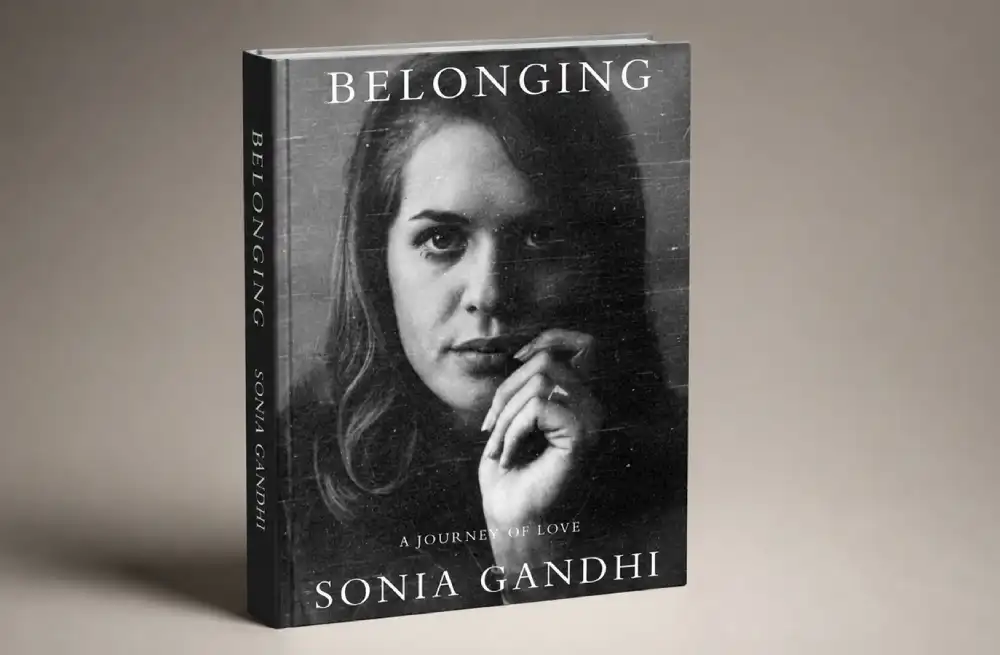
Sonia Gandhi’s autobiography, Belonging: A Journey of Love, is best understood from this perspective. It is not merely the life story of a political personality, but also an account of love, identity, family relationships, personal tragedies and the long journey of making a new country one’s own.
The book has been published by HarperCollins India. Earlier, Penguin India was associated with its publication, but following editorial differences, the publisher was changed. This development itself reflects the extent of public, political and literary interest surrounding Sonia Gandhi’s personality and the material associated with her life.
Personal Journey
One of the most striking features of the book is its personal tone. Sonia Gandhi acknowledges that writing about her own life was not an easy experience. Bringing memories, experiences and emotions preserved within her for decades into the public domain was a challenging process.
Despite spending decades at the centre of Indian politics, Sonia Gandhi has largely maintained silence about her private life. Much has been written and said about her, and numerous perceptions have been shaped through political debates. However, this time, she has attempted to tell her story in her own words. That is what makes this autobiography particularly significant.
The book begins with her childhood in the Veneto region of post-war Italy. Growing up in an ordinary Italian family, Sonia Maino’s journey eventually takes her to Cambridge. It was there, in 1965, that she met Rajiv Gandhi. Their acquaintance gradually developed into love and ultimately led to marriage. Falling in love with a young Indian man whose family belonged to one of India’s most prominent political dynasties gave a completely new direction to Sonia’s life.
Coming to India was not merely a geographical transition for her. It marked the beginning of accepting a new language, a different culture, an unfamiliar social environment and new family responsibilities. Her first meeting with Indira Gandhi, her efforts to learn Hindi, her adoption of the sari as traditional Indian attire, and her gradual familiarity with Indian food and lifestyle all reflect the journey of a young foreign woman slowly adapting to a new environment.
These episodes are not simply about becoming a daughter-in-law in an Indian family; they reveal the process of retaining one’s original identity while gradually building a new one.
Family Tragedies
However, life does not always follow the easy path of love and belonging. The Gandhi family experienced a series of tragedies that deeply affected Sonia Gandhi’s life. The death of Sanjay Gandhi in an aircraft accident, the assassination of Indira Gandhi in 1984 and, subsequently, the assassination of Rajiv Gandhi in 1991 were not merely significant events in India’s political history. Behind these events lay the unbearable grief of a family, the loneliness of a wife and the suffering of a mother.
After Rajiv Gandhi’s assassination, Sonia Gandhi faced the greatest challenge of holding her family together and rebuilding her personal life. She wanted to remain away from active politics. However, circumstances and the demands of time repeatedly drew her towards public life.
An important aspect of this autobiography is that her entry into politics is presented not as the outcome of a predetermined political ambition, but as a consequence of circumstances, responsibilities and events connected with her family’s legacy.
Political Choices
One of the most widely discussed episodes in the book concerns her decision to decline the post of Prime Minister in 2004. Following the electoral victory of the Congress-led alliance, there was widespread speculation that Sonia Gandhi would become the Prime Minister of India. However, she chose not to accept the position.
According to her account, she had made this decision several months before the elections. The Congress presented this episode as an act of sacrifice and moral courage, while political opponents interpreted it from different perspectives. Some described it as a political strategy, while others considered it a consequence of prevailing circumstances.
Here, readers need to understand an important point: an autobiography is not an impartial textbook of history. It is a personal account shaped by the author’s memories, experiences, beliefs and perspectives. Therefore, the events and conclusions presented by Sonia Gandhi should be understood as her personal account rather than accepted as the final historical verdict on every controversy.
The book also touches upon several significant subjects, including the Emergency of 1975, the Babri Masjid controversy, the anti-Sikh riots of 1984, her role during the Manmohan Singh government, Pranab Mukherjee’s aspirations to become Prime Minister, the 2008 agreement between the Communist Party of China and the Congress, and her relationship with Prime Minister Narendra Modi.
These references take the autobiography beyond personal memories and connect it with the wider discourse on contemporary Indian politics.
Unanswered Questions
However, while reading these subjects, certain questions naturally arise. Does the book discuss all controversies with equal depth and clarity? Are there episodes on which the author has consciously chosen to remain silent? Does her personal perspective sometimes take precedence over objective facts while interpreting political events?
To find answers to these questions, readers must also refer to other historical documents, contemporary news reports and books written from different ideological perspectives. The credibility of any autobiography depends not only on the author’s sincerity but also on the reader’s ability to examine its claims against other sources.
Another important dimension of this book concerns a woman’s identity and her struggles. An Italian woman who was initially unfamiliar with India’s language and political culture gradually became part of Indian society and eventually emerged as one of the most prominent leaders and the longest-serving president of the country’s largest political party.
This journey is extraordinary in itself. It reflects a woman’s love, commitment to family, personal sacrifices and her struggle to establish her place in public life while confronting changing circumstances.
Nevertheless, it would not be appropriate to view this entire journey merely through the lens of sacrifice and dedication. Sonia Gandhi’s political career has also been associated with power, organisational leadership, decision-making and public accountability. Therefore, while evaluating her autobiography, it is essential to consider both her personal emotions and her public responsibilities. It is entirely possible to be sensitive towards an individual’s personal suffering while simultaneously examining their political decisions critically.
Two Journeys
In my opinion, Belonging should be read as two parallel journeys. The first is the journey of love and belonging, encompassing the relationship between Sonia and Rajiv and her experience of making India her home. The second is the journey through power and public life, tracing the emergence of a woman at the centre of Indian politics, despite her initial desire to remain away from politics.
While reading this book, neither should admiration become so overwhelming that every statement is accepted as unquestionable truth, nor should political opposition become so dominant that the author’s personal experiences are dismissed altogether.
The purpose of literature and autobiography is not merely to praise or criticise, but also to develop a deeper understanding of human beings and the times in which they live.
Ultimately, the significance of Belonging: A Journey of Love lies in the opportunity it offers readers to look into the inner world of a personality whom they have mostly encountered on political platforms, through public statements and in the corridors of power.

How many historical truths the book brings to light and how many questions it leaves unanswered are matters that readers must decide through their own study and judgement. However, the journey of a young woman who came from another country, developed an emotional bond with India and eventually became an important part of its political life is undoubtedly a subject worthy of study and discussion.
Accepting a country as one’s own does not simply mean acquiring its citizenship. It also means developing an emotional connection with its joys and sorrows, its language, its memories and its people.
Perhaps this is where the title Belonging acquires its deepest meaning. It is not merely the story of living in India, but of embracing India as one’s own and discovering a sense of identity through that relationship. This, perhaps, is the book’s greatest literary and human achievement.
(A former Indian Air Force personnel, the author is currently serving at the National Archives, New Delhi. Ideas are personal.)