A molecular survey across eight Kashmir districts has detected Babesia and Theileria parasite DNA in livestock ticks, identifying Haemaphysalis as the predominant genus and highlighting the need for stronger surveillance.
SRINAGAR: A molecular study examining ticks collected from livestock across eight districts of Kashmir has detected genetic material belonging to two groups of potentially disease-causing parasites, Babesia and Theileria, highlighting the need for stronger surveillance of tick-borne infections in the region.
The study, Phylogenetic Profiling and Molecular Detection of Babesia and Theileria spp. in Ticks Infesting Livestock Across Kashmir Valley, India, examined 4,965 cattle, sheep and goats and found that 1,800 animals were infested with ticks, representing an overall infestation rate of 36.27 per cent.
Researchers detected Babesia DNA in 19 of the 1,800 individual ticks examined, while 10 ticks tested positive for Theileria. The findings provide molecular evidence of the circulation of these parasites in ticks associated with domestic livestock in Kashmir.
The research is particularly significant because molecular information on tick-borne parasites in the high-altitude Kashmir Valley has remained limited.
The study was authored by Altaf Hussain Khan and Indrani Jadhav of the School of Life and Basic Sciences, Jaipur National University, Jaipur; Bashir Ahmad Fomda, Uksim Qadri and Qounsar Nisar of the Department of Microbiology, Sher-i-Kashmir Institute of Medical Sciences, Srinagar; Idrees Mehraj Allaie of the Division of Veterinary Parasitology, Faculty of Veterinary Sciences and Animal Husbandry, Sher-e-Kashmir University of Agricultural Sciences and Technology of Kashmir, Srinagar; Tahseen Bilal Rather of the Department of Biochemistry, Government Medical College, Handwara; and Yaawar Mir of the Department of Biotechnology, Faculty of Veterinary Sciences and Animal Husbandry, Sher-e-Kashmir University of Agricultural Sciences and Technology of Kashmir, Srinagar.
Eight Districts
The cross-sectional survey covered Srinagar, Pulwama, Budgam, Ganderbal, Baramulla, Anantnag, Kupwara and Shopian.
Researchers collected ticks from cattle, sheep and goats raised under traditional husbandry systems. Sampling was conducted across all four seasons to account for variations in tick activity.
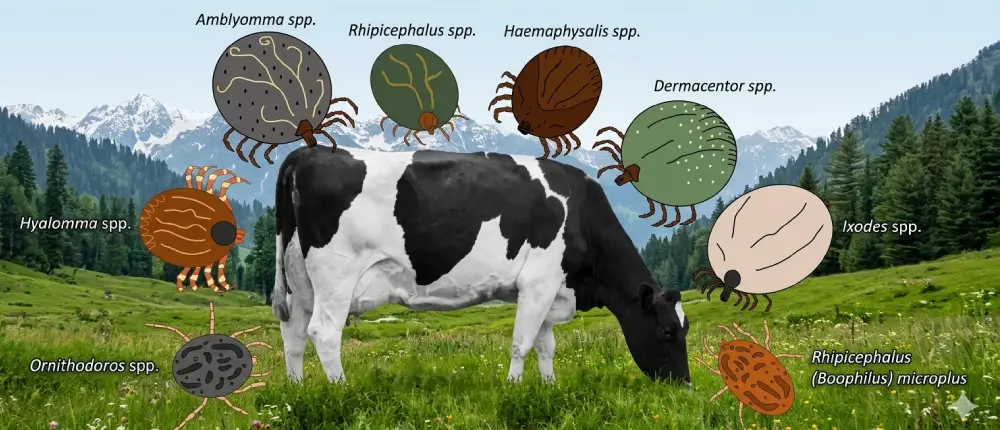
Of the 1,800 ticks collected, 1,529 (84 per cent) belonged to the genus Haemaphysalis. Another 171 (9.5 per cent) were identified as Rhipicephalus, while 100 (5.5 per cent) belonged to Ornithodoros.
The predominance of Haemaphysalis was one of the important findings of the investigation. The researchers also detected both Babesia and Theileria DNA in ticks belonging to this genus, while no PCR-positive samples were found among the Rhipicephalus and Ornithodoros ticks examined.
The findings suggest that Haemaphysalis ticks may have particular epidemiological importance in the region’s livestock-associated parasite surveillance.
Sheep Findings
The distribution of the two parasite groups varied across livestock species.
Babesia DNA was detected in 14 of the 720 ticks collected from sheep, giving a positivity rate of 1.94 per cent. Two of the 360 ticks collected from goats tested positive, while three of the 720 ticks associated with cattle were positive.
In comparison, Theileria DNA was detected in five of the 720 ticks collected from cattle and five of the 360 ticks collected from goats. No Theileria-positive ticks were detected among those collected from sheep.
Overall, the molecular positivity rate was 1.06 per cent for Babesia and 0.56 per cent for Theileria.
The researchers noted that the detection of these parasites in ticks associated with different livestock hosts demonstrates their circulation across the region’s domestic ruminant population.
However, the findings represent parasite DNA detected in ticks and should not be interpreted as the prevalence of active infection among the livestock animals themselves.
Female Ticks
The study also identified differences in parasite detection according to the sex of adult ticks.
Female ticks showed significantly higher Babesia positivity than males. Of the 648 female ticks examined, 13 (2.01 per cent) tested positive, compared with three (0.38 per cent) of the 792 male ticks.
The difference was statistically significant, with a P-value of 0.004.
The researchers suggested that the longer feeding duration and larger blood meals of female ticks could help explain the higher detection rate.
For Theileria, five female ticks (0.77 per cent) and three male ticks (0.38 per cent) tested positive. However, the difference was not statistically significant.
The study also found that most positive samples were obtained from the ear region of livestock, compared with other anatomical locations examined.
Summer Peak
Tick infestation followed a distinct seasonal pattern, with numbers beginning to increase in March and reaching their highest levels in July.
The number of ticks subsequently declined during autumn and winter, with January recording the lowest collection numbers before a moderate increase in February.
The authors observed that the seasonal pattern was consistent with previous studies in other parts of Asia, where tick activity tends to increase during warmer months.
They suggested that tick-control measures and habitat management could be particularly relevant during late spring and early summer, when tick abundance was highest.
However, the researchers cautioned that the seasonal findings reflected variations in tick abundance rather than monthly changes in parasite prevalence. The study therefore does not establish that livestock faced a higher risk of infection during July.
Geographical differences were also observed. Babesia positivity was higher in ticks collected from hilly areas (1.53 per cent) than from plains (0.40 per cent). For Theileria, positivity was 0.47 per cent in hilly areas and 0.67 per cent in plain areas.
The authors said these differences should be interpreted cautiously because the number of positive samples was small and detailed environmental factors were not assessed.
Genetic Links
To establish the genetic identity of the parasites, researchers used polymerase chain reaction (PCR) testing targeting the 18S ribosomal RNA gene, followed by DNA sequencing and phylogenetic analysis.
The analysis showed that the Kashmir Babesia sequences clustered closely with reference sequences of Babesia bovis reported from the United States, China and South Africa.
The clustering had strong statistical support, with bootstrap values ranging from 81 to 100 per cent, indicating substantial genetic similarity between the sequences.
The findings provide molecular evidence of B. bovis-related sequences in ticks collected from livestock in Kashmir.
The Theileria sequences, meanwhile, clustered with Theileria luwenshuni and related T. cf. luwenshuni reference sequences, including those previously reported from China.
These sequences showed more than 98 per cent nucleotide similarity with the reference sequences.
However, the researchers cautioned that the grouping had relatively low bootstrap support, ranging from 47 to 50 per cent. This limits the reliability of definitive species-level identification.
Consequently, the study describes the detected organisms as Theileria species closely related to T. luwenshuni, rather than confirming them as the species itself.
The authors also emphasised that genetic similarity does not establish geographical transmission routes or demonstrate that the parasites were introduced into Kashmir from the countries where related sequences had previously been identified.
Surveillance Need
The researchers said the findings provide baseline molecular information for monitoring tick-borne parasites in livestock across Kashmir.
They noted that conventional microscopic examination of blood samples can have limitations, particularly in detecting infections with low parasite levels or distinguishing between closely related species.
Molecular techniques, including gene sequencing and phylogenetic analysis, offer a more sensitive approach to identifying parasite groups and examining their genetic relationships.
The study also highlighted the importance of paying greater attention to tick-borne infections affecting sheep and goats, which have historically received comparatively less research attention than cattle.
The authors said further investigations using higher-resolution molecular markers, including multilocus genotyping and mitochondrial markers, would be necessary to establish more precise species-level identification, particularly for the detected Theileria sequences.
They also acknowledged limitations in the investigation. Sampling was restricted to accessible livestock herds and animals whose owners provided consent, potentially introducing selection bias.
Additionally, individual testing was conducted only on ticks from PCR-positive pools. Ticks belonging to PCR-negative pools were not individually tested, which could have resulted in missed low-level infections and an underestimation of parasite positivity.
Despite these limitations, the researchers concluded that the detection of Babesia and Theileria DNA in livestock-associated ticks establishes a molecular baseline for future surveillance in Kashmir.
They recommended further molecular characterisation to improve understanding of the genetic diversity and epidemiology of tick-borne parasites in the region.