A 2024 study identifies high feed and seed costs, inadequate hatchery capacity and weak marketing infrastructure as major constraints on Kashmir’s trout industry, recommending local feed production and greater investment to unlock its growth potential.
SRINAGAR: A study on trout farming in the Himalayan region has identified the high cost and unreliable supply of fish feed and seed as the biggest obstacles to expanding the industry, estimating that the two inputs together account for nearly 70 per cent of total production costs. The researchers have called for locally formulated feed, improved hatchery capacity, private investment in seed and feed production and better marketing infrastructure to make trout farming more profitable and sustainable.
The review paper, Trout Farming: A Comprehensive Analysis of the Current Landscape and Future Opportunities, has been authored by Ishfaq Hamid, Zaheer Abass, Adnan Abubakr, Ishtiyaq Ahmad, Adnan Amin, Imtiyaz Qayoom, Monisa M. Malik, Ubaid Shakeel and Rinkesh Nemichand Wanjari of Sher-e-Kashmir University of Agricultural Sciences and Technology of Kashmir (SKUAST-K), Shalimar. Published in the Journal of Indian Fisheries Association, (Volume 51, Issue 2), the paper examines the growth of trout farming globally and in India, with particular emphasis on Jammu and Kashmir and Himachal Pradesh.
Cost Burden
The researchers identify feed and seed expenses as the most pressing constraints on trout farming, arguing that the industry’s dependence on artificial feeding makes farmers particularly vulnerable to fluctuations in feed prices.
“Feed and seed alone constituting about 70% of total costs,” the paper observes, underlining the financial pressure facing trout farmers.
The study points out that feed mills operating below their capacity, partly because of limited demand, contribute to higher prices. At the same time, trout seed remains considerably more expensive than carp seed, largely because government-run hatcheries are not functioning at full capacity.
The authors suggest that greater private-sector participation in seed and feed production could help stabilise prices and improve availability.
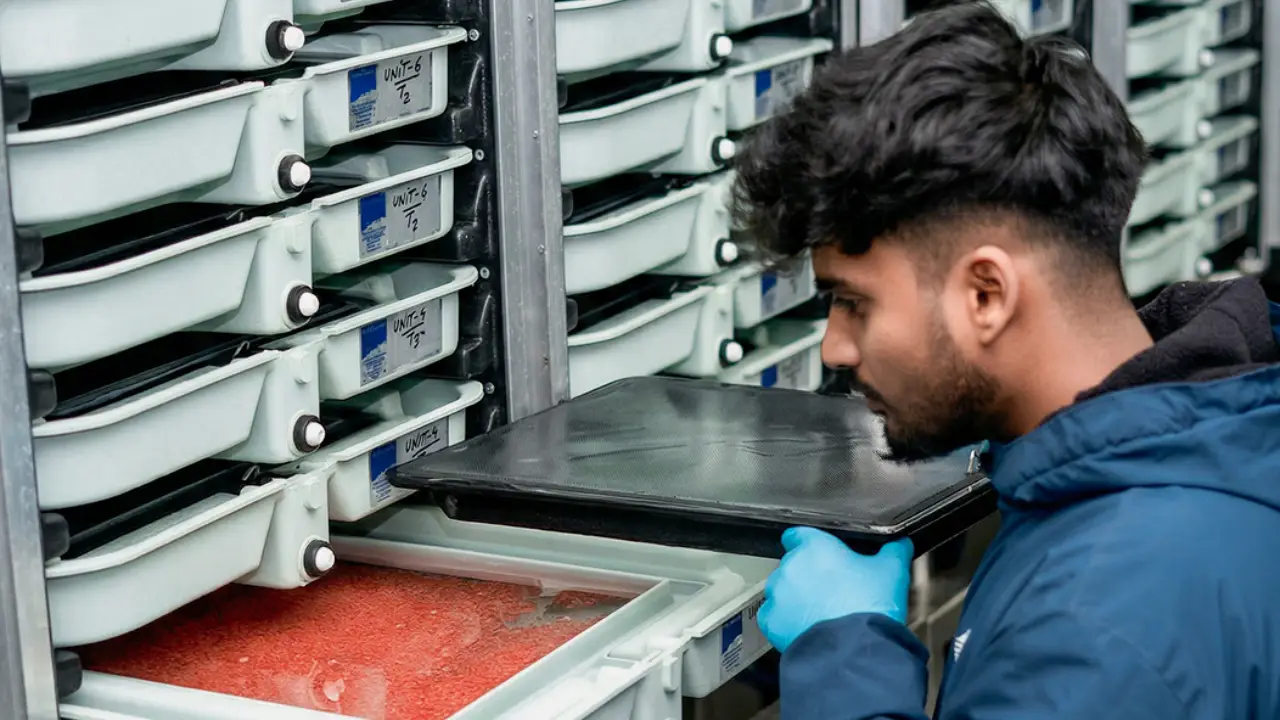
Delayed delivery of feed, inconsistent seed quality and difficulties in transporting fingerlings have added to the operational problems. Transporting young trout requires specialised handling to maintain oxygen levels, and farmers often struggle to secure viable supplies.
Production Potential
Despite these constraints, the researchers describe the Himalayan region as having considerable untapped potential for expanding cold-water fisheries.
The paper highlights the natural advantages of Jammu and Kashmir, including its snow-fed rivers, streams, springs and lakes, which provide the cold, oxygen-rich water required for trout cultivation.
It identifies Jammu and Kashmir and Himachal Pradesh as the country’s principal trout-producing regions, together accounting for approximately 81 per cent of national production in the 2015-16 figures cited by the researchers. Himachal Pradesh contributed 50 per cent, Jammu and Kashmir 31 per cent, while Sikkim accounted for 14 per cent and other states the remaining five per cent.
The paper also cites fisheries department figures for 2022-23, according to which Jammu and Kashmir produced 1,990 tonnes of trout, followed by Himachal Pradesh with 849.7 tonnes and Sikkim with 340 tonnes.
The authors attribute the region’s suitability to its natural water resources and favourable climatic conditions, which allow the cultivation of rainbow trout, scientifically known as Oncorhynchus mykiss.
Demand Gap
The study highlights a persistent gap between domestic trout production and consumption requirements.
Citing national production figures for 2015-16, it puts India’s annual trout output at 842 tonnes against an estimated demand of around 1,000 tonnes.
The researchers say this shortfall offers considerable scope for expanding production, particularly in Himalayan states where suitable water resources remain underutilised.
The paper traces the growth of rainbow trout production in India from 147 tonnes in 2004-05 to 602 tonnes in 2013-14, 755 tonnes in 2014-15 and 842 tonnes in 2015-16.
However, the annual growth rate fell from 25.42 per cent in 2014-15 to 11.52 per cent in 2015-16, indicating that expansion has not been uniform.
The researchers argue that bridging the supply-demand gap will require sustained investment in production infrastructure, affordable inputs and better access to markets.
Local Feed
One of the principal recommendations is to develop locally sourced feed formulations using indigenous ingredients available in the Himalayan region.
The authors argue that the high cost of formulated feed makes it necessary to explore alternative ingredients without compromising the nutritional requirements of trout.
Rainbow trout require a carefully balanced diet containing essential amino acids, proteins and omega-3 fatty acids. The paper notes that reducing fishmeal and incorporating plant-based protein sources can create nutritional challenges, particularly in meeting the requirements for lysine, methionine and arginine.
It also explains that trout farming in flow-through systems is largely intensive because the fish have limited access to natural food sources. Consequently, all essential nutrients must be supplied through formulated feed.
The establishment of modern feed mills has improved feed availability and affordability, the authors note, but they recommend greater government intervention to ensure reliable supplies.
The paper specifically suggests that the government should monitor feed availability and establish at least one feed mill within the state to address the problem of high prices and delayed supplies.
Infrastructure Deficit
Beyond production costs, the study identifies inadequate transportation, poor marketing channels and limited aquaculture infrastructure as major obstacles to developing the sector.
Farmers in remote Himalayan areas face difficulties accessing production facilities and transporting fish to urban markets. Trout, being highly perishable, requires efficient cold storage, transportation and distribution systems.
The researchers observe that farmers in the Trans-Himalayan region are largely restricted to farm-gate sales despite strong demand in urban centres such as Srinagar.
They recommend developing cold-storage facilities, improving road connectivity and establishing proper marketing channels to enable farmers to access larger markets.
The paper also proposes establishing district-level retail fish shops to make locally produced fish more accessible to consumers while creating additional marketing opportunities for farmers.
Hatchery Constraints
The availability and quality of trout seed is another major concern identified by the researchers.
The paper notes that government hatcheries are not operating at full capacity, contributing to higher seed costs and irregular supplies. The transportation of fingerlings also requires specialised technical knowledge and facilities to ensure their survival.
The authors suggest that private participation in seed production could improve availability and stabilise prices.
They also highlight the need to strengthen hatchery infrastructure, develop brood banks and improve the quality of breeding stock to increase productivity.
The study points out that modern trout farming requires careful management of breeding, fertilisation, hatching and rearing processes. It explains that rainbow trout do not typically reproduce naturally in culture systems, making artificial breeding and hatchery management essential for commercial production.
Disease Risks
The intensive nature of trout farming also makes farmed fish vulnerable to diseases, particularly when water quality and stocking conditions are not properly maintained.
The paper identifies bacterial and fungal infections, parasitic diseases and viral infections among the major threats to trout production.
Among the diseases discussed are bacterial dropsy, fish ich, saprolegniasis, argulosis, whirling disease, furunculosis and infective pancreatic necrosis.
The authors stress that maintaining good water quality, adequate oxygen circulation, avoiding overcrowding, providing balanced nutrition and regularly cleaning raceways and tanks are essential preventive measures.
The paper also highlights the importance of disease surveillance and improved technical knowledge among farmers to reduce production losses.
Policy Support
The researchers identify government intervention as essential for addressing the structural constraints facing trout farming.
They refer to the Pradhan Mantri Matsya Sampada Yojana (PMMSY), which provides financial assistance for raceway construction, hatchery development, brood banks and farmer training programmes. The scheme also facilitates the import of genetically superior trout strains to improve productivity.
The authors recommend more efficient utilisation of untapped water resources, greater awareness about aquaculture among young people and improved access to credit and skilled labour.
They also call for crop insurance and better institutional support to protect farmers against production risks.
Growth Prospects
Concluding that cold-water fisheries in the Himalayas have recorded consistent growth over the past two decades, the researchers say the region has considerable potential to expand trout production.
They argue that the industry’s future depends on addressing the cost of inputs, strengthening production infrastructure and improving access to markets.
The paper notes that the establishment of modern feed mills has already improved the availability of affordable feed, making trout farming an attractive livelihood opportunity, particularly for young entrepreneurs.
“Continued focus and investment in this area can bridge the supply-demand gap, promote sustainable production, and further contribute to the overall development of fisheries in the region,” the authors conclude.