A researcher traces Kashmiri leader’s role in secular politics, Naya Kashmir and socialist economic thinking; says his insistence on self-determination eventually pushed him to the political margins
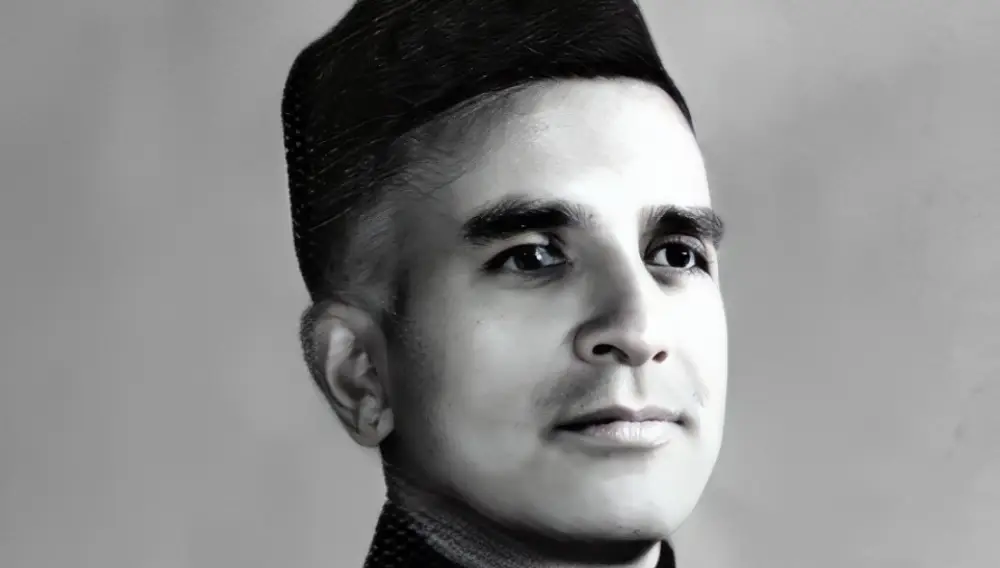
SRINAGAR: Prem Nath Bazaz, the Kashmiri political thinker and journalist, played a much more consequential role in transforming the Muslim Conference into the National Conference than is generally acknowledged, and helped shape the secular and socialist ideas that influenced Kashmir’s political trajectory, according to a new academic paper.
The paper argues that Bazaz was among the principal architects of the transformation of a religiously defined political organisation into a secular platform representing Kashmiris across communities. It also traces his contribution to the intellectual foundations of the Naya Kashmir manifesto, his advocacy of economic redistribution and land reforms, and his subsequent opposition to both India’s and Pakistan’s competing claims over Kashmir. Despite helping shape the political movement that became the National Conference, Bazaz was arrested and exiled after 1947 for insisting that Kashmiris themselves should determine their political future.
Titled Prem Nath Bazaz: Ideas, Intentions, and His Place in the Making of Modern India, the paper has been authored by Hilal Ahmad Tantray, a doctoral candidate at the Department of History and Culture, Jamia Millia Islamia, New Delhi. It was published in the May 2026 issue of Economic & Political History Review (Volume I, Number IV).
The author describes Bazaz as an important but frequently overlooked figure in twentieth-century Indian political thought, whose ideas on secularism, democracy, socialism, economic justice and Kashmiri self-determination extended beyond the Valley.
Early Activism
Born on July 13, 1905, into a Kashmiri Pandit family, Bazaz was educated at Sri Pratap College, Srinagar, before graduating from Punjab University.
He entered public life in August 1930 by joining the Women’s Welfare Trust. In 1931, he was elected president of the Sri Pratap College Yuvak Sabha, a youth organisation that, according to the paper, became a nursery for Kashmir’s emerging political class.
The year 1931 was a turning point in Kashmir’s political history, with the first large-scale popular agitation against the autocratic rule of Dogra Maharaja Hari Singh drawing young Kashmiris, both Hindus and Muslims, into organised political activity.
Bazaz chose journalism as his principal instrument of political engagement. In 1932, he established the Daily Vitasta to advocate secularism, democracy and freedom. In 1935, in collaboration with Sheikh Mohammad Abdullah, he founded Hamdard, initially a weekly publication that subsequently became a daily.
The paper argues that journalism allowed Bazaz to articulate ideas of communal harmony, responsible government and economic justice independently of any single political organisation.
His editorial positions also made him a target. Citing a 2019 retrospective, the paper says Bazaz was shot at in April 1947 over his writings, reportedly becoming the first Kashmiri journalist to suffer such an attack for his editorial positions.
Secular Politics
The paper identifies Bazaz’s most consequential political intervention as his contribution to the transformation of the Muslim Conference into the National Conference.
It draws on research by Abdul Maajid Dar, published in South Asia Research in 2023, which argues that Bazaz was one of the chief architects of this transition.
Through his editorials in Hamdard during the 1930s, Bazaz argued that a political movement organised around religious identity could not secure genuine self-government. He advocated a common platform for Kashmiri Hindus, Muslims and Sikhs to confront Dogra autocracy.
Two of his 1936 editorials, titled Firkawarana Zehniyat Kyu Kar Istewar Hogi? and Nationalism Ka Mafoom, are cited as evidence of his sustained campaign against communal thinking.
The paper says Bazaz regarded communalism on both the Hindu and Muslim sides as the principal obstacle to popular sovereignty in Kashmir. He argued that communal attitudes were being manufactured by vested interests rather than emerging naturally from religious differences.
Sheikh Mohammad Abdullah himself later credited a meeting with Bazaz at Shahi Garden as the moment when the idea of a secular and united political platform took root.
The paper, however, acknowledges that this interpretation challenges the established historical narrative, which generally credits Sheikh Abdullah as the principal architect of the transition from the Muslim Conference to the National Conference.
Tantray follows Dar’s interpretation because Bazaz’s editorials predated the National Conference’s establishment and articulated the argument for inclusive nationalism in his own words. The author nevertheless describes the claim as a persuasive but contested historical interpretation rather than an established consensus.
Bazaz’s slogan, Kashmir belongs to Kashmiris, represented an attempt to replace both the Maharaja’s dynastic claim and religious-majority claims with a territorial and civic understanding of political belonging.
Socialist Vision
The paper also highlights the economic dimension of Bazaz’s politics, which it says has received less attention than his contribution to secular nationalism.
Bazaz founded the Kashmir Socialist Party and subsequently the Kisan Mazdoor Conference, seeking to introduce an explicit class-based programme into the movement against Dogra rule.

For him, political freedom was inseparable from economic freedom. The prevailing agrarian structure, in which the Maharaja distributed large tracts of land as jagirs among courtiers while peasants remained landless and heavily taxed, was incompatible with genuine emancipation.
This socialist thinking, the paper argues, contributed to the intellectual environment in which the National Conference adopted the Naya Kashmir manifesto in September 1944 at Sopore.
The manifesto envisaged extensive economic restructuring, including the socialisation of the instruments of production, reorganisation of property relations, abolition of feudal land grants and redistribution of land to the tiller without compensation to landlords.
Tantray traces the manifesto to the convergence of Sheikh Abdullah’s progressive nationalism, to which Bazaz had contributed during the 1930s, and the more explicitly Marxist interventions of Communist intellectuals such as BPL Bedi and GM Sadiq during the 1940s.
The paper makes an important distinction about the political character of Naya Kashmir. It was not simply a blueprint for a Soviet-style political system. It combined socialist economic planning with guarantees of religious freedom, limited private property rights and a proposed constitutional monarchy.
The author argues that this hybrid vision reflected Bazaz’s own political temperament, combining economic redistribution with procedural liberalism and civil liberties rather than authoritarian one-party rule.
The manifesto’s principles were subsequently reflected in the Directive Principles of State Policy of Jammu and Kashmir’s 1956 Constitution. The land reforms undertaken during the 1950s became one of the more far-reaching experiments in agrarian restructuring in independent India.
Tantray also draws a comparison with the Congress, which formally adopted the idea of a socialistic pattern of society at its Avadi session in 1955, more than a decade after the adoption of Naya Kashmir.
Political Exile
Bazaz’s relationship with Sheikh Abdullah and the National Conference deteriorated after 1947, when the political question of Kashmir’s accession to India came to the forefront.
The paper says Bazaz opposed unconditional accession to India while also rejecting Pakistan’s claim based on Kashmir’s Muslim-majority population. He maintained that Kashmiris themselves should determine their political future.
That position increasingly isolated him from the emerging political establishments on both sides of the conflict.
He was arrested by the emergency administration in October 1947 and subsequently exiled from the Valley, spending much of the remainder of his life in Delhi.
Despite his political marginalisation, Bazaz continued writing prolifically. His published works included Inside Kashmir (1941), Azad Kashmir: A Democratic Socialist Conception (1951), The History of Struggle for Freedom in Kashmir (1954), Kashmir in Crucible (1967) and Democracy through Intimidation and Terror (1978). He also published pamphlets, including Voice of Suppressed Kashmir (1953).
Majoritarian Critique
Bazaz’s political thinking eventually extended beyond Kashmir to a wider critique of Indian nationalism.
The paper examines his criticism of the growing use of Hindu religious symbolism in India’s public and political life, particularly the invocation of Ram Rajya as a national ideal.
In The Shadow of Ram Rajya over India and related writings, including Whither India after Independence, Bazaz questioned whether a republic committed to constitutional secularism could legitimately associate its national identity with the symbols of a particular religious tradition.
According to Tantray, Bazaz applied the same standard to Hindu majoritarianism in India that he had applied to Muslim communalism in Kashmir.

The paper describes this as a relatively unusual position among mid-twentieth-century Indian public intellectuals, who did not always apply an equally critical approach to communal politics across religious communities.
During his later political life, Bazaz gravitated towards the Radical Humanism of MN Roy, the former Communist International revolutionary who had broken with Marxism-Leninism.
Radical Humanism combined scientific rationalism and individual liberty with an emphasis on economic planning, while rejecting authoritarian and one-party political structures.
Tantray interprets this association as Bazaz’s attempt to retain his socialist commitments without accepting authoritarian politics, placing him at odds with both the Congress establishment and the organised Indian Left.
The paper also mentions Bazaz’s brief association with the Janata Party in 1977. Drawing on his son’s biography, the author interprets this as a pragmatic alliance against the authoritarianism associated with the Emergency rather than an ideological conversion.
National Impact
Assessing Bazaz’s contribution to Indian political thought, the paper identifies three broad areas of influence.
First, it credits him with helping move Kashmiri politics from a communal to a civic and inclusive political framework during the 1930s. The emergence of the National Conference subsequently became important to the political relationship between Kashmir and the Indian Union after 1947.
Tantray argues that the National Conference became India’s principal secular political partner in Kashmir at the time of accession, influencing the constitutional relationship between Jammu and Kashmir and the Indian Union, including the special status subsequently codified in Article 370.
The author goes further to suggest that, without a secular Kashmiri political interlocutor of the kind Bazaz helped create, India’s claim to plural and non-confessional nationhood would have been more difficult to sustain in the only Muslim-majority region it governed directly. The paper, however, presents this as a plausible historical counterfactual rather than a demonstrated causal conclusion.
Second, Bazaz’s socialist and agrarian ideas contributed to the intellectual background of Naya Kashmir and the land-to-the-tiller principle that informed Jammu and Kashmir’s land reforms.
The paper says Kashmir’s comparatively thorough abolition of landlordism during the 1950s anticipated reforms that most Indian states attempted after 1947 with considerably less success. It also acknowledges that the final drafting of Naya Kashmir owed more to other intellectual influences by the 1940s.
Third, his criticism of Ram Rajya-style majoritarianism and insistence on even-handed secularism anticipated debates over minority rights, the Uniform Civil Code and the relationship between religious symbolism and the constitutional state.
However, the author also acknowledges the limits of Bazaz’s influence. His position on Kashmiri was rejected by the Indian state, marginalising him politically after 1947. His economic vision was substantially implemented within Jammu and Kashmir but never adopted as a national template for India.
The paper concludes that Bazaz’s career represents the experience of an intellectual whose ideas outlasted his political fortunes.
His ambition was to build a political community based on shared citizenship and economic justice rather than religious majoritarianism. Although this vision influenced Kashmir’s political and economic foundations, his insistence on applying the same principles to the question of self-determination left him isolated from the centres of power in Kashmir, India and Pakistan.