by Iqbal Ahmad
Narasthan’s ancient temple ruins in Tral reflect Kashmir’s remarkable architectural heritage. Despite historical significance and ongoing conservation, the monument needs archaeological documentation, protection and tourism promotion to regain recognition.

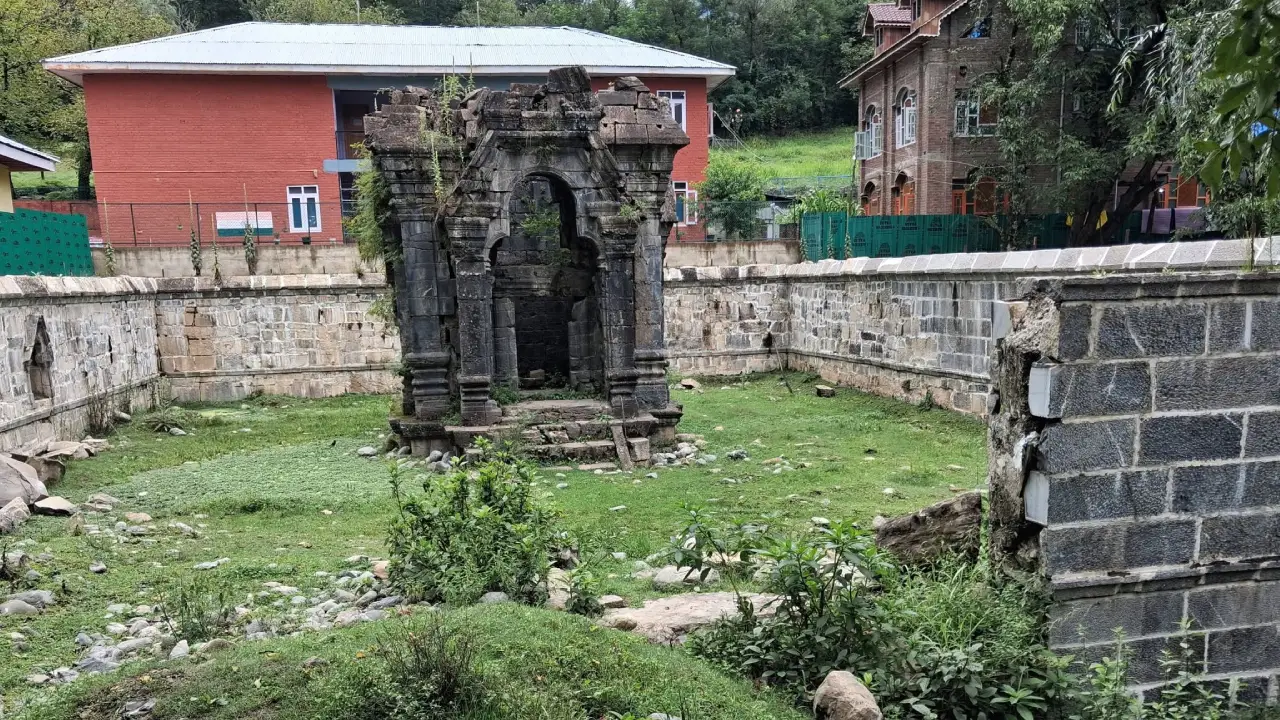
Among the remarkable archaeological remains of Kashmir, the ancient temple remains of Narasthan, in the picturesque Tral area of Pulwama district, occupy a distinctive place. Situated amidst a beautiful rural landscape, this impressive stone structure stands as a silent testimony to Kashmir’s rich architectural traditions and its glorious cultural past. Despite its massive stone construction and considerable archaeological significance, the monument has yet to receive the recognition and attention it deserves as a heritage destination.
The remains of the ancient temple reflect the remarkable craftsmanship and architectural skills of the traditional stone builders of Kashmir. Its massive stone blocks, carefully dressed masonry and impressive structural composition reveal an advanced understanding of stone construction. Such monuments are not merely remnants of religious structures; they are important archaeological documents that help us understand the artistic sensibilities, building techniques, religious traditions and cultural environment of the period in which they were constructed.
Distinctive Architecture
Basically, this marvellous architectural heritage, characterised by a uniform plan, material and architectural style, distinctive in character, is encountered at several places in Kashmir but not beyond its borders.
Although natural calamities and human vandalism have continuously affected these magnificent man-made structures over centuries, almost reducing these marvels to ruins, the pristine glory of this heritage is still very much evident through its grand remains.
Pandava Legends
In local folklore, these remains are usually known as Pandave Lari, the buildings of the Pandavas. Generally, common people have attributed these monuments to the Pandavas, and in the local dialect, they are known as Pandav Lari, meaning the buildings of the Pandavas.
This curious legend is based on the perception that, since these are huge structures formed of heavy and massive limestone blocks, they must be the handiwork of the Pandavas, who are believed to have belonged to a tall, strong race.
Pandavas are locally referred to as belonging to a tall and physically strong race, and since these structures are formed of massive limestone blocks, they are attributed to this race. However, this is not a historically proven fact. It is only on the basis of the massiveness of the materials used that people have developed this belief.
Otherwise, most people know that these are the remains of historical buildings, identified by some as ancient temples and monasteries, while a few are considered palaces. These are dated to the medieval and early medieval periods. Most of these remains are believed to have been built during the Karkota and Utpala periods, which roughly correspond to the 7th to 10th centuries AD, while some are earlier.
Ancient Engineering
In fact, I could also find something interesting about these ruins. I felt these architectural structures were highly advanced and doubted that they could have been the work of any local architect.
Arranging for the extraction of such massive limestone blocks from quarries and then transporting them to designated places according to the plan required not only advanced technology but also a strong workforce. I keenly observed their plan, architectural styles and the finesse adopted in these ancient constructions. I was very much puzzled. Although I could understand the architectural design to some extent, I could not understand the technology and techniques followed in raising these wonderful structures.
Lifting massive cuboid, rectangular, square and other geometrically designed stones and placing them one over another to form large and heavy walls, that too in a neat and clean manner, is quite surprising.
Martand Connection
The Narasthan temple ruins, which correspond architecturally to the Sun Temple ruins of Martand, also deserve particular attention. The use of massive stone elements, their careful placement and the overall composition of the surviving structure reflect a distinctive tradition of early Kashmiri temple architecture.
Kashmir developed a remarkable temple-building tradition in which stone was employed not only as a construction material but also as a medium of artistic expression. The surviving remains at Narasthan provide an opportunity to study this tradition and compare it with other historic temple structures across the Kashmir Valley.
Unfortunately, the monument has remained largely outside the mainstream heritage tourism circuit. While several historical and religious destinations in Kashmir have received considerable attention, Narasthan has not yet been developed as a properly documented and interpreted archaeological site. Its historical identity, architectural features and cultural associations need systematic investigation by archaeologists, historians and conservation experts.
Tourism Potential
The location itself offers considerable potential for heritage tourism. The picturesque surroundings of Tral, combined with the archaeological importance of the monument, could make Narasthan an attractive destination for visitors interested in history, architecture, culture and nature. Its inclusion in a heritage tourism circuit connecting other historical and natural attractions of south Kashmir could also encourage local tourism and create opportunities for the surrounding communities.
Indeed, the Cultural Department has prepared a comprehensive conservation plan worth Rs 1.73 crore for the renovation and preservation of the monument, and the executing agency has already taken up its conservation and maintenance work. The renovation of the site’s wall has been almost completed and restored. It has, to a large extent, retained the pristine glory of the site.
However, the conservation of its main chamber is yet to be taken up. In fact, experts believe that the development of the site should go hand in hand with scientific conservation.
The monument also requires an archaeological survey, architectural documentation, condition assessment and appropriate protective measures. Informative signboards, visitor facilities, a clearly marked approach and a small interpretation centre could subsequently help visitors appreciate its historical and architectural value.
Heritage Recognition
Narasthan is more than an old stone structure standing in a village landscape. It is a valuable fragment of Kashmir’s architectural memory, deserving recognition, protection and scholarly attention. Its preservation would not only safeguard an important archaeological legacy but also restore a forgotten chapter of the region’s cultural history.
It is time that the concerned heritage and tourism authorities recognised the potential of Narasthan and took meaningful steps towards its heritage promotion.

Now that this site is being conserved, proper attention to this neglected archaeological treasure could help it emerge as an important destination on Kashmir’s heritage tourism map.
The District Administration Pulwama, under the leadership of Shri K.K. Sidha, the Deputy Commissioner Pulwama, in collaboration with the Departments of Culture and Tourism, has been reviewing heritage-site tourism plans for the district’s heritage sites and monuments.
It is hoped that this historically significant archaeological site of Narasthan, Tral, will also find a place in this proposed heritage-site initiative and revive the intellectual tourism potential of this wonderful archaeological site, which is no less a wonder than Martand Temple.
(The writer is a senior archaeologist and author. The ideas are personal.)