by Syed Shadab Ali Gillani
SRINAGAR: Chief Minister Omar Abdullah, on Monday addressed the rift, differentiating the MP Aga Syed Ruhullah Mehdi’s actions from those of other senior MP Mian Altaf. The confrontation is no longer over policy. It is a war for political direction. The National Conference (NC) political structure is facing a severe internal challenge. The Member of Parliament from Srinagar refused to join the party campaign for the crucial Budgam Assembly by-poll. This refusal marks the public culmination of a political conflict that now defines the ruling party’s first year in government.
The Chief Minister’s Distinction
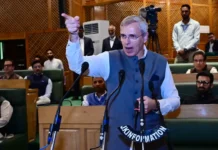
National Conference (NC) Vice President and Chief Minister Omar Abdullah spoke to reporters after the assembly session, commenting on the campaign participation. He stated the party possessed sufficient leaders for the election campaign. He sought to minimise the impact of Ruhullah’s absence. Abdullah said he had never forced a leader to join or withdraw from a campaign. “The National Conference has plenty of leaders who are actively participating in the campaign and continuing outreach across constituencies,” he confirmed. “The party has enough people for the campaign. No one is being forced,” the Chief Minister said.
The leadership’s response to internal criticism, however, was bifurcated. Abdullah addressed a recent statement made by another Member of Parliament, Mian Altaf. He said he had spoken to Altaf over the phone. “He is like a fatherly figure to me,” Abdullah said of Altaf. “He has said nothing wrong and advised me just as my father would.”
When reporters questioned him about the similar statements and abstention by Ruhullah, Abdullah drew a sharp distinction. He confirmed a “vast difference” existed between Mian Altaf and Aga Ruhullah. This public statement positioned Altaf’s critique as permissible familial guidance, while framing Ruhullah’s dissent as unacceptable insubordination.
Ruhullah has consistently expressed dissatisfaction with the party leadership. His discontent centres on the government’s performance and the handling of the political mandate received in the 2024 elections. His latest criticism targeted Abdullah, accusing him of ridiculing the people who voted the party into power. Ruhullah had demanded the Chief Minister reserve such language for the opposition, specifically the BJP, whom he defined as the “real oppressors” of the constituents.
The Institutional Response: A Challenge to Mandate
The NC leadership immediately activated its defence system. Party leader and MLA Anantnag West, Abdul Majeed Larmi, directly challenged the dissenting MP. Larmi responded to Ruhullah’s criticism of Chief Minister Abdullah’s governance and delivery.
“The Chief Minister has done nothing, he says,” Larmi stated at a media interaction in Srinagar. “If that is true, then resign from your MP seat won on the National Conference ticket.” The challenge was clear and uncompromising: “Resign and then fight a new election. Then see and tell people.”
Larmi acknowledged the right of elected representatives to voice constituency concerns but questioned the wisdom of public criticism. “If he talks about our people on our ticket, can’t we do the same?” Larmi asked. “We made a promise for five years, not for one year.”
Larmi defended the government’s governance record by deflecting blame for administrative setbacks. He cited the smart meter installation as an example. Larmi stressed these decisions were made under the Lieutenant Governor’s administration, not the elected government. “The smart meter was in the LG government, not ours. The LG government issued the order,” he explained. He then made a defiant political promise: “If our government comes, we will throw the smart meters in jail. Let the state return, and you will see.”
He contextualised the current administration’s constraints. Major political or economic decisions, he argued, remain impossible without the restoration of statehood. “Before the state returns, it is not possible,” he confirmed. “When there is no money here, when there is no flour, who will make the bread?” Larmi pointed out that economic and administrative powers once held by the state now rest with the central government. “Earlier, the Lakhanpur tax and other revenues came to the state government. Today, GST and income tax go directly to the Government of India.”
Larmi insisted that Abdullah understood the challenges. “We are CM’s soldiers. When the time comes, he will understand our situation,” he claimed. The MLA concluded that Ruhullah should have raised his concerns privately. “If Ruhullah had any grievance, he should have come to the CM’s office.” He demanded that the party be judged only at the end of its term.”
The Rebel’s Principle: Beyond Personal Ego
Aga Syed Ruhullah Mehdi delivered a sharp rebuttal on CM Omar’s statement. He criticised his party’s leadership, demanding Jammu and Kashmir politics move past “personal egos” to address the suffering and aspirations of the people. He called the counterattacks personal. “They are making it personal. If they want to fight based on ego, I am ready for that too,” Ruhullah stated. “But Kashmir’s issues are bigger than personal ego.”
The party, he argues, has failed to uphold its commitment to its voters. His dissent is a reflection of his earlier criticisms from the first year of the NC government, where he had demanded the party make its position clear on the reservation policy report, arguing it was unjust. He consistently pointed to the government’s political inaction, saying the intent expected from a newly elected government was missing.
Ruhullah raised the issue of political prisoners. “Thousands of our men are languishing in jails,” he lamented. “Do they even know their addresses? Where are the jobs? Our religion and culture are under attack. Do we fight against that?”
He defined his actions not as rebellion but as a demand for accountability. “I am nothing. I have no identity except the mandate that people have given me,” he clarified. “They deserve answers. Did we do anything in a year for the incarcerated youth?”
Ruhullah stated his loyalty rests with the people, not party ranks. “Let it be clear, people did not vote for me; they voted for their identity. Whoever remains loyal to the people will succeed, and those who betray their trust will be shown the door,” he affirmed. He urged the government and party members to accept his criticism as constructive. “Instead of targeting me, the government should address the reservation issue that directly affects our youth. That is where their focus should be,” he concluded.