SRINAGAR: Coinciding with Prime Minister’s high-profile visit to Jammu and Kashmir for the inauguration of the iconic Chenab railway bridge and the launch of Vande Bharat trains between Katra and Srinagar, the Congress has launched a pointed critique of Narendra Modi’s public narrative, accusing him of deliberately ignoring the long history of continuity behind flagship infrastructure projects.
In a detailed statement released on Thursday, Congress general secretary in charge of communications and party MP Jairam Ramesh said the 272-kilometre Udhampur-Srinagar-Baramulla Railway Line (USBRL) project — hailed as a marvel of modern engineering — is not a feat of any single government, but a product of sustained effort across three decades and multiple political regimes.
“Governance involves great continuity, a fact consistently denied by Prime Minister Narendra Modi in his perennial desire for self-glory,” Ramesh said, calling the USBRL a textbook example of “collective achievement” by successive Prime Ministers. He likened it to the BrahMos missile programme — also carried forward over multiple governments — which, he said, the PM never acknowledges in his speeches.
Tracing the origins of the USBRL, Ramesh pointed out that the railway line was first sanctioned in March 1995 under the P V Narasimha Rao government, declared a national project in 2002 by Atal Bihari Vajpayee, and saw significant milestones under the UPA regime led by Manmohan Singh.
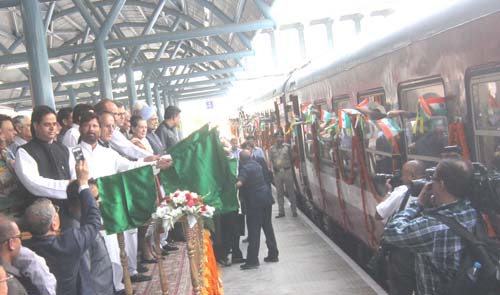
“In April 2005, Dr Manmohan Singh inaugurated the Jammu-Udhampur section. Then came the Anantnag-Mazhom link in 2008, the Mazhom-Baramulla stretch in 2009, Anantnag-Qazigund later that year, and finally, the Qazigund-Banihal link in 2013,” the statement noted. “By June 2013, the 135-km Baramulla-Qazigund corridor was already operational.”
The Congress leader added that the inauguration of the Udhampur-Katra section was delayed in 2014 only due to the general election code of conduct, and that the current government took over a project whose core civil contracts — including those for the iconic Chenab Bridge — had already been awarded as far back as 2005.
“Contracts for the Chenab Bridge had been given to Konkan Railway Corporation, Afcons, VSK India and Ultra Construction and Engineering Ltd of South Korea well before Modi became Prime Minister,” Ramesh said.
As Modi prepares to flag off Vande Bharat trains from Katra to Srinagar and inaugurate the Chenab Bridge today — part of development projects worth over Rs 46,000 crore in the Union Territory — Ramesh said the Congress congratulates the people of Jammu and Kashmir and lauds the engineers and companies involved in executing one of India’s most difficult infrastructure challenges. But he warned that attempts to present these accomplishments as the achievement of one individual “misrepresent the very idea of democratic governance”.
Separately, Ramesh also reminded the Prime Minister that pressing security concerns remain unresolved. In a post on X (formerly Twitter) on Wednesday night, he said: “Surely he is aware that the terrorists directly responsible for the brutal terrorist attacks at Pahalgam on April 22nd have still not been brought to justice.”
The Congress has previously raised the issue that the same group of militants is suspected to have been behind earlier attacks in Poonch in December 2023, and Gagangir and Gulmarg in October 2024. Ramesh said there has been no public denial of these reports nor any clarification from the government.
“While the Prime Minister is right to celebrate progress, he must also speak honestly about the continuing threats and unfinished responsibilities in Jammu and Kashmir,” Ramesh said, accusing Modi of prioritising “publicity over accountability”.
The Chenab Bridge, part of the USBRL, is the world’s highest railway arch bridge and stands as a powerful symbol of connectivity, linking remote mountainous districts with India’s rail network. Its completion caps nearly three decades of engineering effort across successive governments — a fact the Congress says must not be whitewashed by political branding.