by Prof Hameed Naseem Rafiabadi
Mansur al-Hallaj’s reported journey to Kashmir remains a contested historical question, examined through medieval Persian accounts, Massignon’s reconstruction, modern scholarly critiques, and his enduring influence on Kashmiri Sufi thought, poetry, and mystical traditions.
The historical and spiritual legacy of Abu al-Mughith al-Husayn ibn Mansur al-Hallaj (c. 858-922 CE) occupies a central position in Islamic mystical thought and comparative philosophy. While al-Hallaj’s trial, execution, and ecstatic declaration, Ana al-Haqq (“I am the Creative Truth”), are well documented in medieval historiography, his reported journey to Kashmir in 283 AH (c. 895-896 CE) remains a subject of intense scholarship, debate, and literary reception.
This paper examines the historiographical foundations of al-Hallaj’s travels to northern India and Kashmir, analysing primary source material from Farid al-Din ‘Attar’s Tadhkirat al-Awliya, Louis Massignon’s monumental reconstruction La Passion d’al-Hosayn-ibn-Mansour al-Hallaj, Herbert Mason’s English translation, and critical modern counter-assessments.
Besides, it explores the deep theological and literary impact of Hallajian thought on Kashmir’s indigenous mystical tradition, focusing on the poetry and hermeneutics of Shaikh Nur-ud-din Wali (Nund Rishi) and subsequent 19th- and 20th-century Kashmiri Sufi verse.
Mystical Theology
Husayn ibn Mansur al-Hallaj was born in Tur (Persia) and spent his formative years under the tutelage of prominent Sufi masters, including Sahl al-Tustari, ‘Amr al-Makki, and Junayd al-Baghdadi. Although traditionally understood to mean “wool carder” (panba-zan), mystical commentators often interpreted his epithet as Hallaj al-Asrar (“revealer of secrets”), highlighting his role as an unveiler of divine mysteries.
Al-Hallaj reinterpreted Tawhid (the oneness of God) not merely as a formal assertion of Shariah, but as an absolute, lived experience of divine absorption (fana). He maintained that God alone possesses the absolute right to proclaim “I” (Ana), treating human existence as an instrument through which the Divine speaks.
Opposing pantheistic interpretations (Hulul), scholars like RA Nicholson emphasised that Ana al-Haqq was not an outburst of visionary enthusiasm, but an intuitive formula summarising a profound system of mystical theology. Al-Hallaj distinguished between the divine nature (Lahut) and human nature (Nasut), viewing the deified man as a personal witness to the Creative Truth.
Textual Origins
The hypothesis of al-Hallaj’s personal presence in Kashmir rests upon a complex interplay of hagiographical texts, orientalist reconstructions, and critical textual analyses. The primary literary source for the Kashmir connection is found in Farid al-Din ‘Attar’s 13th-century biographical compendium, Tadhkirat al-Awliya (Memoirs of the Saints), composed in early 13th-century Persia.
In the critical edition prepared by Reynold A Nicholson (Tadhkiratu ‘l-Awliyá, Part II, 1907), as well as Dr Mohammad Est’elami’s authoritative Tehran edition (1987), the entry dedicated to Shaykh ‘Abdallah al-Turughbadhi of Toos narrates that, while the Shaykh was breaking bread with his disciples, Mansur al-Hallaj arrived from the city of Kashmir (az shahr-i Kashmir dar-amad), dressed in a black robe (qaba-yi siyah) and holding two black dogs on a leash (du sag-i siyah).
In medieval Persian geographical vocabulary, shahr-i Kashmir designated the main urban centre and administrative seat of the Kashmir Valley (historically Srinagari/Pravarapura). Abel Pavet de Courteille’s publication of the 15th-century Uighur manuscript (Tezkereh-i-Evliâ, 1890) confirms that this Turkic recension preserved the narrative intact, demonstrating that the Kashmir reference was embedded in Central Asian textual lineages long before the late Ottoman period.
While philologists have examined whether Kashmir could be a graphical corruption (tashif) of Kish or Kabul, manuscript collation demonstrates that Kashmir appears consistently with proper diacritics, rendering a simple scribal typo unlikely. Textual scholars view this passage not as an empirical court chronicle, but as an allegorical apologue: the black robe symbolises outer condemnation or spiritual concealment, while the two leashed black dogs represent al-Hallaj’s control over his outer nafs (carnal soul/passions). By placing his return from the non-Muslim borderlands of Kashmir, ‘Attar uses the geographical distance to emphasise al-Hallaj’s willingness to cross physical and spiritual frontiers to confront egoic attachment.
Historical Reconstruction
In La Passion d’al-Hosayn-ibn-Mansour al-Hallaj, French scholar Louis Massignon proposed that Kashmir was a central landmark of al-Hallaj’s journey through India around 283 AH (895-896 CE). Massignon’s reconstruction remains one of the most sophisticated examples of 20th-century Orientalist historiography. Rather than relying on a single entry, Massignon deployed a cumulative methodology integrating philology, trade-route geography, and cross-cultural intellectual history.
First, he cross-referenced Persian hagiographical apologues with early Arabic primary sources (such as Ibn al-Nadim’s Kitab al-Fihrist and al-Sulami’s Tabaqat al-Sufiyya) and Uighur manuscripts, arguing that al-Hallaj’s eastern mission was deeply embedded in medieval Islamic historical memory.
Second, Massignon mapped al-Hallaj’s itinerary along established 9th-century trade corridors: setting sail from the Persian Gulf, disembarking at Daybul (near Karachi) or Gujarat (balad al-shirk), travelling north up the Indus Valley through Mansura and Multan, advancing towards the north-western frontier (Wayhind/Qandahar under the Hindu Shahi dynasty), and returning in a circular overland circuit via Kabul and Balkh to Khurasan (Toos).
Third, Massignon rejected the idea that the trip was a search for magic (karamat). Situated within Kashmir’s Utpala dynasty (under King Avantivarman and Shankaravarman), the region was a vibrant centre of philosophy and multi-religious debate, where scholars discussed scriptural texts, including the Torah, Gospels, and Psalms.
Translation Shift
However, Massignon maintained an explicit epistemological distinction between degrees of historical probability, a nuance that was significantly altered in later English translations. Herbert Mason’s four-volume English translation (Princeton University Press, 1982) subtly shifted the posture of Massignon’s original 1922/1975 French text. Where Massignon wrote with academic hedging (“Il est probable qu’al-Hallāj passa…”, which means “It is probable that al-Hallaj passed…”), Mason rendered the sentence with active certainty (“He went directly up the valley of the Indus…”).
Besides, in Massignon’s framework, the phrase le seul point sûr (“the only sure point”) designated Kashmir as the sole explicitly named target in ‘Attar’s narrative, in contrast to the unmentioned intermediate river routes. Mason’s translation, however, made “only sure point” sound as though al-Hallaj’s arrival in Kashmir itself were an established empirical fact.
By stripping away French subjunctive qualifiers and smoothing over the methodological tension between ‘Attar’s parable and al-Biruni’s later accounts of closed mountain passes, Mason transformed Massignon’s tentative hypothesis into an assertive geographical narrative. This translational shift led modern South Asian scholars, including Prof Mohammad Ishaq Khan in Kashmir’s Transition to Islam (1994), to cite Massignon as having proved the visit beyond doubt, rather than as having presented a plausible historical reconstruction.
Modern Criticism
Contemporary Islamic studies scholars, such as Carl W Ernst, Alexander Knysh, Ahmet T Karamustafa, Michael Sells, and Nile Green, evaluate Massignon’s work as both a monumental historiographical milestone and a product of a specific 20th-century Orientalist paradigm. Critics point out that Massignon’s personal Catholic spirituality profoundly influenced his interpretation of al-Hallaj, leading him to frame al-Hallaj’s execution through a Christological lens of vicarious suffering, redemptive sacrifice, and divine incarnation (Hulul).
Besides, scholars critique Massignon’s tendency to treat late medieval hagiographical compendiums (tabaqat) as historically reliable blueprints for 9th-century travel itineraries, blending symbolic parables with empirical trade routes. The contemporary consensus regards Massignon’s recovered archive as essential, but insists that his geographical reconstructions and theological claims must be evaluated through rigorous textual, codicological, and historical-critical frameworks.
Kashmir’s Legacy
Regardless of whether al-Hallaj set physical foot inside the valley, his spiritual archetype and theological legacy deeply permeated Kashmir’s mystical landscape, primarily through Mir Sayyid Ali Hamadani, the indigenous Rishi movement led by Shaikh Nur-ud-din Wali (Nund Rishi), and subsequent classical poets.
Mir Sayyid Ali Hamadani played a pivotal role in embedding classical Sufi treatises into Kashmir’s scholarly life. In his writings, Sayyid Ali Hamadani contextualised ecstatic utterances (shathiyat) by masters like Bayazid Bistami (Subhani) and Mansur al-Hallaj (Ana al-Haqq), explaining that when a gnostic is completely absorbed in the contemplation of the Absolute Real Being (Wujud-i-Haqiqi Mutlaq), individual identity is submerged in divine grandeur.
Rishi Interpretation
Shaikh Nur-ud-din Wali (1377-1438 CE) made frequent and profound references to Mansur al-Hallaj in his poetic verses (shruks). Unlike critics who viewed al-Hallaj’s claims as heterodox, Shaikh Nur-ud-din interpreted Ana al-Haqq through the lens of Quranic absorption. He noted that al-Hallaj was so deeply lost in the contemplation of divine revelation that he sacrificed his bodily existence. He wrote that the reading of the Quran should have broken the fleshy talisman of life and that, in reading the Quran, Mansur annihilated himself.
The Shaikh provided a balanced interpretation aligned with Wahdat al-Shuhud (Unity of Witnessing). He argued that al-Hallaj, overwhelmed by the flash of Divine Grace, revealed a royal secret (barmala ghuft). By willingly accepting his sentence on the scaffold, al-Hallaj paid the ultimate sacrifice to uphold and safeguard the outer boundaries of Shariah.
Literary Afterlife
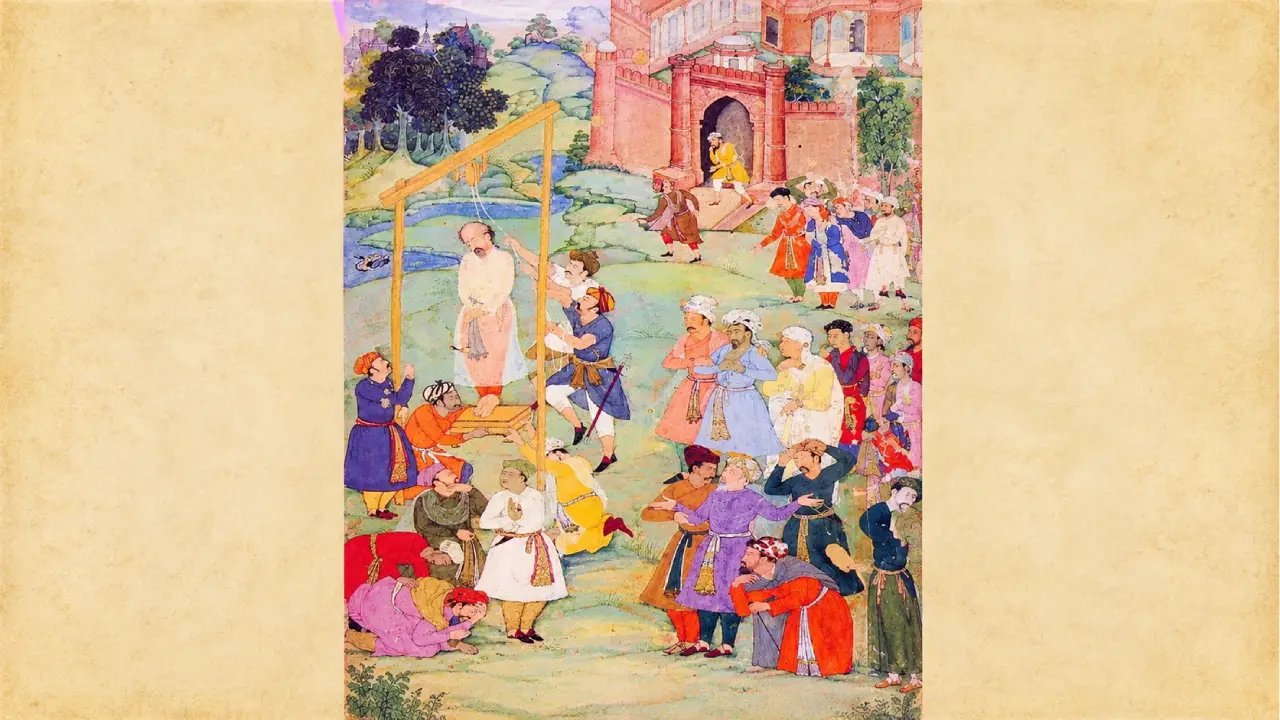
In later Kashmiri literature, 19th-century poets like Mahmud Gami (1765-1855), Soch Kral (1774-1854), and Samad Mir (1893-1959) integrated Hallajian imagery into the Ghazzal and Vatchun forms. Al-Hallaj evolved into a source of key metaphorical tropes: the scaffold (Dar) as the ultimate test of truth, where verbal claims of love must be authenticated by bodily sacrifice; burning and ashes (Suur), representing absolute Fana; and the unveiling of the secret (Raz-i-Fash), functioning as a cautionary motif regarding spiritual discretion (Kitman) versus ecstatic intoxication (Sukr).
In the 20th century, progressive Kashmiri poets repurposed al-Hallaj as a symbol of moral courage and resistance against political tyranny, summarising the regional sentiment with the adage that Mansur hangs because the pen is in the hand of the tyrant.
Historical Assessment
In conclusion, the account of Mansur al-Hallaj’s tour to Kashmir represents a compelling junction of historical reconstruction, Orientalist scholarship, codicological tradition, and sacred geography. While historical analysis confirms that a direct, verified itinerary to 10th-century Kashmir remains a plausible hypothesis rather than an established empirical fact, the spiritual presence of al-Hallaj in Kashmiri literature is indisputable. Through the hermeneutic synthesis of Kashmiri Rishis and Sufi scholars, al-Hallaj was transformed into a central symbol of divine love, self-sacrifice, and unyielding devotion within Eastern mystical thought.
(Author served the University of Kashmir, IUST, Awantipora as Dean Islamic Studies and also served some off shore university as well. Ideas are personal.)