by Nisar Farhad
How do scientific principles quietly echo Qur’anic wisdom and the emotional architecture of human connection?

Human relationships are often portrayed as unpredictable, emotional, and difficult to understand. Yet, when one examines them through the lens of science, particularly chemical bonding, patterns begin to surface. What appears chaotic suddenly reflects balance, purpose, and structure. Chemistry, usually confined to equations, reactions, and laboratories, quietly mirrors the way we grow, connect, detach, and seek belonging.
Life, in many ways, behaves like atoms navigating a universe of possibilities, sometimes content alone, sometimes seeking bonds, and sometimes breaking old ones to form new ones, leading to more stable relationships. These invisible scientific laws guide not only matter but also echo deeply in the way human hearts interact. During my MSc in Chemistry, one of our teachers, Prof Khaliquz Zaman, would often remind us with a smile, “The atoms and molecules in this universe think exactly like us, the only difference is, unlike human beings, they never engage in wrong dealings.”
His words were simple yet profound. They carried a message that chemistry is not just a subject of reactions and formulas but a silent moral system where balance, honesty, and purpose govern every interaction.
Living Like Noble Gases
There are phases in life when one chooses distance, becoming emotionally reserved and self-contained, like the noble gases in chemistry. These gases do not bond easily because they already possess a complete electron configuration. In similar moments, humans may feel complete alone, guarded, cautious, or healing from past experiences.
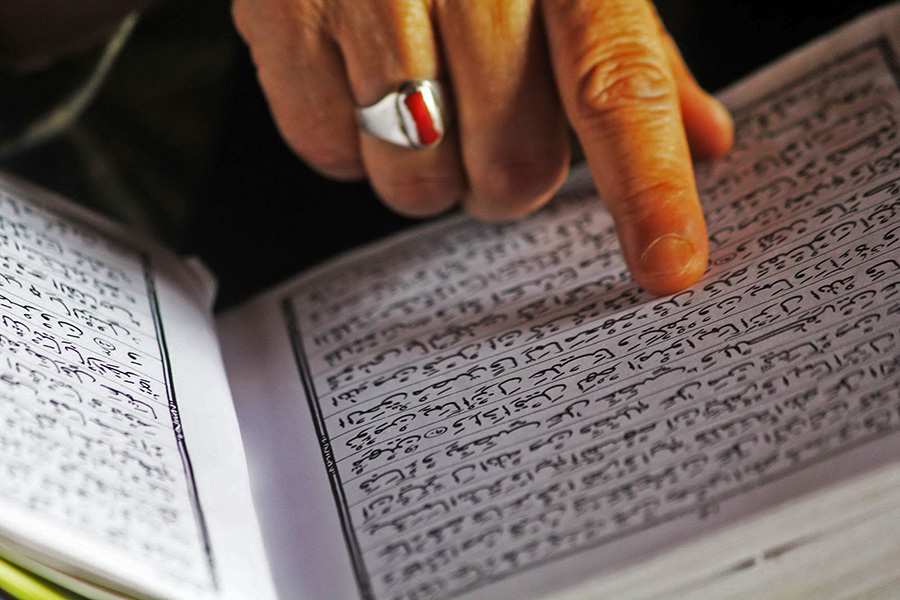
But faith reminds us that this state, while comfortable, is not natural for humanity. The Holy Qur’an beautifully reminds:
“O mankind, We created you from a single male and female and made you into nations and tribes so that you may know one another.”
(Surah Al-Hujurat 49:13)
To “know one another” is not merely a social act but a divine purpose.
Ionic Bonds
In some relationships, people behave like ions; one gives too much while the other takes without offering balance. These are emotionally charged connections: intense, fascinating, and strong at first glance, yet fragile beneath the surface. What initially appears stable can slowly become exhausting, because one heart keeps losing energy while the other keeps absorbing it.
This imbalance mirrors the formation of sodium chloride (NaCl). Sodium (Na) willingly loses an electron, becoming positively charged, while chlorine (Cl) takes that electron, becoming negatively charged. The attraction is immediate and strong, but the bond is entirely dependent on this unequal exchange. If external forces like heat, stress, or pressure appear, the bond breaks and the structure dissolves easily in water.
Similarly, in human relationships, when one person continually sacrifices peace, dignity, or emotional well-being just to keep the connection alive, the bond becomes weak at its core, no matter how strong it appears from the outside.
Prophet Muhammad teaches fairness, emotional intelligence, and responsibility when forming bonds. He beautifully reminds us:
“A Muslim is the one from whose tongue and hands others are safe.” (Sahih Bukhari)
Any emotional bond, be it friendship, marriage, family, or community, that causes harm, drains one side, or grows from control rather than compassion, is ultimately unsustainable.
Healthy relationships are not about giving or taking. They are about sharing, balancing, and protecting each other’s emotional integrity.

Covalent Bonds
As life matures, individuals seek relationships that resemble covalent bonding—where energy, trust, and emotional responsibility are shared fairly. These bonds are built through communication, respect, and mutual benefit. They require patience but provide stability.
The Qur’an describes marriage, the highest form of this shared emotional structure, with depth and tenderness:
“And He placed between you love and mercy so that you may find tranquillity in one another.”
(Surah Ar-Rum 30:21)
A successful marriage, much like a covalent bond in chemistry, thrives when energy, trust, and responsibility are shared rather than taken. Stability emerges through balance, communication, and mutual respect, not dominance. Just as catalysts accelerate reactions, honest and compassionate communication deepens connection. Flexibility, forgiveness, and emotional investment prevent cracks when life applies pressure, just as flexible molecules resist breaking.
Marriage is not a one-time event but a continuous bonding process strengthened by patience, kindness, and shared purpose. Here, tranquillity is not accidental; it is engineered through balance.

Polar Covalent Bonds
Not all bonds are perfectly equal. In many relationships, parent-child, teacher-student, or friendships, one side gives slightly more. Yet these relationships endure because sincerity exists and compassion fills the gaps where perfection does not.
The Prophet Muhammad emphasised the virtue of service and kindness:
“The most beloved to Allah are those who are most beneficial to others.” (Al-Mu‘jam Al-Awsat)
In this wisdom lies a reminder: sometimes our extra effort becomes someone else’s stability.
Metallic Bonding
Beyond individual relationships lie society, families, schools, villages, and nations, connected through shared values, identity, culture, and responsibility. This resembles metallic bonding, where many atoms share a pool of electrons, creating flexibility and collective strength.
The Prophet described this unity powerfully:
“The believers, in their love, mercy, and compassion for one another, are like one body.” (Sahih Muslim)
Strong communities, like metals, shine, endure hardship, and hold together under pressure.

Breaking and Reforming Bonds
In chemistry, bonds are not always permanent. Some break, reform, strengthen, or evolve. Human relationships are similar. Friendships fade, new ones emerge; some bonds evolve into lifelong companionships, while others serve as lessons.
This cycle does not signal failure; it signals transformation, growth, and the natural evolution of life.
Between Science and Faith
Both chemistry and spiritual teachings point to the same universal truth: “we are designed for connection.”
Atoms seek stability through bonds, just as hearts seek meaning through relationships rooted in kindness, trust, faith, and balance.
In the architecture of life, the strongest structure is built through intentional, respectful, compassionate bonds, not isolation.
Conclusion

When we observe life with both scientific insight and spiritual understanding, we realise that our relationships are not random; they follow patterns woven into the very design of creation. Just as matter forms the universe through meaningful bonding, we build our emotional and spiritual world through relationships grounded in balance and guided by faith.
To live fully is not to walk alone but to form bonds that uplift, protect, and reflect the values Allah has placed within the human heart.
(The author teaches Chemistry. Ideas are personal.)