by Dr Farooq A. Lone
Government jobs remain highly preferred due to security, benefits, prestige, and stability, though excessive dependence on them limits broader career aspirations among youth

Like in any other part of the country, government employment remains exceptionally attractive in Jammu and Kashmir because it offers a combination of economic security, social prestige, and structural advantages that the private sector often cannot match. It is not simply a matter of preference; it reflects deeper features of India’s economy, labour market, and social fabric.
First, job security is the single biggest factor. A government position is widely perceived as stable, with a very low risk of layoffs. In a country where economic uncertainty, market fluctuations, and informal employment are common, this stability carries enormous value. For many families, a government job is seen as lifelong financial insurance. Once a person gets a government job in India, it is very difficult to show him or her the door, no matter how poorly he or she performs. Perhaps this is the reason that, in a lighter vein, the Government in India is considered one of the largest charitable organisations in the world.
Second, the compensation package is often more robust than it appears at first glance. In addition to salary, government employees typically receive benefits such as pensions or retirement schemes, health insurance, paid leave, and other perks. When these are factored in, the total value can be highly competitive, especially outside major metropolitan private-sector markets.
Third, social status plays a major role. In many parts of India, a government employee commands considerable respect. Such positions are associated with authority, reliability, and achievement. This prestige often extends to family standing, marriage prospects, and social influence. A government officer, teacher, or civil servant is often viewed as having “made it” in life.
Fourth, complaints of nepotism, corruption, and favouritism notwithstanding, government jobs are merit-based in principle and accessed through standardized examinations. For many aspirants, especially those from rural or modest backgrounds, this creates a pathway for upward mobility that is perceived as fairer than private-sector hiring, which may depend more on networks, language skills, or urban exposure.
Fifth, work-life balance is often seen as better in many government roles. While some services such as the civil services, police, or healthcare can be demanding, many government positions offer predictable working hours, holidays, and less pressure than high-intensity private-sector jobs. This is particularly appealing for those seeking long-term stability and family life.
There is also a historical dimension. Since independence, the Indian state has been one of the largest and most trusted employers. For generations, government service has symbolized security, integrity, and upward mobility. That cultural legacy remains powerful.
At the same time, the intense competition for these jobs also reflects challenges in the broader labour market. Private-sector employment can be uneven in quality, with concerns about job insecurity, wage disparities, limited benefits, and variable working conditions. In that context, government employment becomes even more desirable.
In short, the appeal of government jobs in our country rests on five pillars: security, benefits, prestige, fairness of access, and stability. When a single career path offers all five, it is no surprise that millions compete for relatively few positions. Given the level of unemployment in the country, these jobs are witnessing cut-throat competition. Having made government jobs too glamorous, with societal prestige and respect guaranteed, our youth lose many years of productive life in their search for them, even though such jobs are available only to a small fraction.
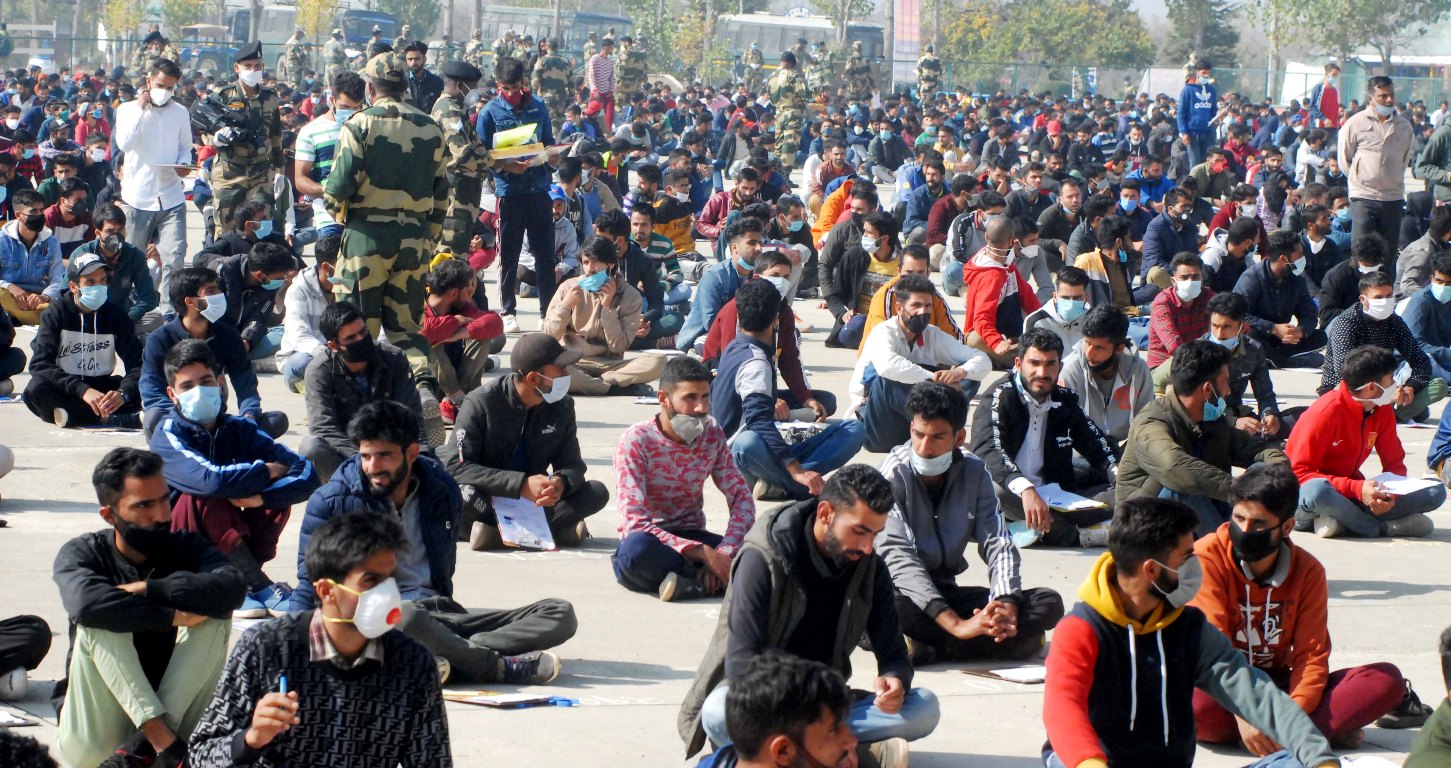
The long-term challenge in Jammu and Kashmir is as much about mindset as it is about available jobs. As long as work continues to be hierarchized into categories of “respectable” and “menial,” and as long as government employment remains the sole legitimate measure of success, the imbalance will persist.
The way forward lies in broadening what we mean by meaningful employment. Society must recognise the value of all forms of work. Education must align with market needs. An ecosystem must be fostered where private enterprise and skilled labour are both viable and respected.

Without such a shift, the region risks not only economic stagnation but a deeper erosion of its work culture. The challenge before us is not merely to create jobs in the government sector, which is already oversaturated, but to redefine how society perceives work itself. Until a carpenter commands the same respect as a clerk, until the farmer walks with the same dignity as a gazetted government officer, the unemployment enigma will remain unsolved.
Times have changed, and we have arrived at a stage where the rules of the game have to change, work must be treated as work, and the dignity of labour must be established so that our youngsters feel pride in any job. Admittedly, the careers of the majority of our youngsters lie outside the government sector.
The question is whether we have the collective will to change the rules of a game that has already cost our youth too many years of productive life in search of an elusive government job.
(An IAS officer, the author retired as Chairman Jammu and Kashmir Public Service Commission. Ideas are personal.