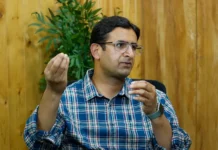
Jammu and Kashmir Bank is more than just a financial institution. As the economic backbone of the erstwhile state, it has served as its largest and most trusted banking platform for decades. In an extensive conversation with Kashmir Life, the bank’s Managing Director and CEO Amitava Chatterjee spoke candidly about the challenges that shaped the past year, the strategies that drove this landmark performance, and the bold plans the bank has charted for the current fiscal. Asrar Syed captured the essence of this conversation
KASHMIR LIFE (KL): Jammu & Kashmir is currently witnessing a difficult economic time. How did you make a profit of Rs 2,363 crores in such testing times?
AMITAVE CHATTERJEE (AC): It is the hard work of Jammu and Kashmir Bank’s 12,500 employees; they have tried to conduct business at every stage which they thought was suitable. We have given them directions from the headquarters, but a huge credit goes to them.
As you know, last year was very difficult for the Jammu and Kashmir. Despite that, we have been able to record almost 13% improvement. Two strategies played a key role, we changed the mid-term strategy. We had also introduced an Agri-product during the initial part of the year, which was not affected by last year’s tragic incidents. Since Jammu and Kashmiris an agriculturally driven territory, it gave better-than-expected results.
Last year, the first tragedy happened in April, followed by floods afterwards, which shut down communication and impacted retail business by a huge margin. Two-thirds of our retail business depends on Jammu and Kashmir government employees.
Another strategy we followed was paying close attention to our outside branches, both retail and corporate, although corporate played a bigger role. The bulk volumes remained high, through which we recorded a 17% increase in advances and 11% in deposits, these margins are higher than the industry average.
KL: At the face of it, it looks interesting that your per-employee business improved from Rs 17 crore to Rs 23 crore on YoY basis. On the flip side, it suggests you have not adequate work force. Why do not you hire more employees?
AC: There is a perception that we are understaffed, but as I said earlier, across our branches we have an average of 12 employees per branch, while the normal industry standard is only 10 employees per branch. We are not understaffed, but unfortunately the composition is such that we cannot derive actual business from all these employees.
However, this time we are also going to change this strategy, and after acquiring board approval, we are going to carry out a large-scale recruitment drive based on two patterns, clerical and direct officer recruitment, and along with that, we will also recruit specialists.
The revenue stream we currently earn is from interest income, and we don’t earn from other revenue streams the way other banks do. To tap into those, we will need to recruit these specialists.
KL: If we look at your core income or net interest income, is is not that impressive?
AC: If you look at this year’s interest income, it won’t seem so impressive due to the many disturbances we witnessed as the core retail business in the territory was significantly affected this year. For example, we have a very strong government employees’ consumption segment, which amounts to almost Rs 1,000 crore per year, and this year it was only Rs 30 crore. Despite that, we maintained a good volume of interest income, better than last year.
Secondly, since last year, the RBI has cut the repo rate by almost 125 basis points, and it had a direct effect on our 52% loan portfolio which is repo-linked. Both new and existing loans witnessed a decrease in interest rates. Due to this, we changed our strategy and focused on volumes. As you said, a bank is like a commercial shop, just as shopkeepers earn through per-unit profit and profit in volumes. This will change next year as things return to normal and business normalises. I recently went to Gulmarg and things are clearly changing.
KL: We were looking at the results and an interesting pattern was observed — a clear difference in the growth of advances between Jammu and Kashmirand rest of India. While Jammu and Kashmirhas recorded only 9–10% growth in advances, the same figure for outside states stands at 24%. Has Jammu and Kashmirlost its capacity for credit absorption?
AC: As I mentioned, last year Jammu and Kashmir witnessed large-scale disturbances, which is why the figures are so low for Jammu and Kashmir. This 9–10% growth was recorded in just the recent quarter.
Take the example of transport operators, which are linked to the tourism sector — we did not earn a single rupee from that sector, which is a very important segment for our bank. Had we not changed our strategy by focusing on outside Jammu and Kashmir branches, the numbers would have been far lower, and our profit figure too would have been lower than the previous year. But since normalcy has returned to the business sector here, next year these figures will change, and Jammu and Kashmir will witness growth larger than that of outside states.
KL: Talking about absolute numbers for Jammu and Kashmir, which is your core territory, you haven’t advanced more than Rs 7,000 crore, of which around Rs 1,200 crore were advanced to the Yuva Mission, and the remaining amount on other state sponsored schemes?
AC: We advanced only Rs 1,000 crore on Yuva, not Rs 1,200 crore. The major advances recorded in Jammu and Kashmir were in Agri term loans, the major chunk of Rs 3,000 crore was spent on the hassle-free Agri term loans we introduced last year, and Rs 3,000 crore in advances was recorded in a single year.
KL: Was there any priority sector lending shortfall? Did you need to fulfil a deficit quickly?
AC: No, there was no such crisis. We have a 51% priority sector lending ratio today, while the normal government requirement stands at just 40%. There was no deficit, we did this to support the economy of Jammu and Kashmir. Our bank’s priority is to support the economy of Jammu & Kashmir. If we have to absorb some losses because of it, we don’t mind that.
KL: As Bank’s MD, you monitor the entire Jammu and Kashmir territory, every sector and how the trends are moving. Talking about the figure of Rs 7,000 crore last year, where do you see the tourism and agriculture sectors?
AC: Last year was undoubtedly a bad year. Agriculture remained at the top during the last year, while in tourism, there were virtually no tourists until September, which kept tourism at the second position. But this year, tourism is returning to normalcy. I spoke to several hotel owners and they explained how they are planning new projects, and they only plan such things when they are confident that tourists are returning to the valley.
This year, I expect agriculture to continue at number one, but I believe the figure of Rs 7,000 crore will increase to somewhere around Rs 15,000 crore. There is a reason for saying so, our direct exposure to tourism is relatively low, except for transport operators. Hoteliers in Jammu and Kashmir have, over the past decade or more, built a good financial buffer for themselves and are not as dependent on the bank as before. Our bank mainly caters to small-time transport operators, and we will focus on that more.
Another sector we will focus on this year is homestays, for which we have planned a very attractive scheme. We are expecting good growth in that sector. Apart from that, I see more opportunities in loan against property, home loans, and one particular sector where we are doing very well, the automobile loan sector. We have the largest market share in Jammu and Kashmir in that segment, nearly 70%. In government loans, the numbers are big but profits remain low, and they demand the same effort as other loans.
KL: We saw that your Net NPA has improved despite challenging ground conditions, but only by 0.5 percentage points. Looking at your overall loan book, where are you bleeding the most?
AC: We are no longer bleeding. If you notice, our slippage ratio is around Rs 800 crore, of which we recovered Rs 80 to 85 crore in cash and upgraded almost Rs 450 crore. Essentially, we have a 0.82% slippage ratio, which is recorded by very few banks. On Special Mention Accounts, till last year’s March, we had 22% SMA, and today the same figure stands at 12%. We barely have any accounts in NPA, and even the SMA-2 figure is so low it doesn’t even run into crores.
This year alone, we have recovered Rs 500 crore in cash. Both our gross NPA, which has come down from 10% in the past to just 2.5% today, and our net NPA, currently at 0.6%, will slip below 0.5% in the near future. The provision coverage ratio has also improved, which has contributed to better profits.
Take the example of Kisan Credit Cards, there is no other bank in the country that can claim an NPA of only 8 to 10% in this scheme. Jammu and Kashmir is the only state with a KCC NPA lower than 4%, which is exemplary, and this figure has been consistent traditionally. In Jammu and Kashmir, people don’t default on bank loans, the propensity to repay in Jammu and Kashmir is very high and has remained so for decades.
KL: But considering all these positives, Jammu and Kashmir Bank’s market share is slipping. With all these positive parameters, you have no reason not to be bringing in more business. Have you done something about that?
AC: Wait for the RBI data to come out, you will be pleasantly surprised. We have reclaimed many accounts, and even if the increment is by a few basis points, it will reflect an upward graph.
However, these private sector banks are not practising fair banking in Jammu and Kashmir. They lure customers with one offer or another, but when the same customer faces difficult times, they don’t support them, they are the first to move out. But Jammu and Kashmir Bank has never done that. We always support our customers regardless of the circumstances.
I have personally met many customers and tried to make them understand the value of staying with us, and through that many accounts have been added back to the bank’s portfolio. If you look at deposits, we grew by almost 11–11.5% in Jammu and Kashmir, and I hope we improve far more than this.
During Operation Sindoor, every private bank stood apart from Jammu and Kashmir Bank. We did not allow the ATMs to run dry; our people, despite all odds, kept the bank branches running, even refusing my orders for closure, saying, “What will people do if we close the bank?”
KL: Talking about the banking sector, it has changed a lot over the last few decades with the arrival of mobile phones, fintech, and much more. Has Jammu and Kashmir Bank also evolved with the times?
AC: Activation and usage haven’t yet reached a stage I would call satisfactory, but our app, JK Bank mPay Delight, which I use myself, is not inferior to any other banking app. That said, there have been complaints about the app’s uptime, and over the last year we have worked extensively on that, from infrastructure upgrades to software improvements. In the last 3–4 months, our uptime has improved significantly and has remained close to 100%. It takes time to earn people’s trust, and we are confident it will only grow with time. In fact, our digital transactions currently stand at 94%. Once we improve our fundamentals, we will be adding more features to our banking app.
KL: If we talk about the new generation, compared to other competitors in your peer group, have you thought about them?
AC: My own thinking tells me that the most loyal customers of Jammu and Kashmir Bank are senior citizens, and we can never neglect this group. Surely, we must also target Gen Z, and we will need to shape our products in a way that they appear trendier, more colourful, and more attractive, which is something we are currently working on. But we have always prioritised the senior citizen customer base. The deposit rates we offer them are unmatched by any other bank here, and that will continue. Coming back to Gen Z, you can engage them through technology, which is beneficial for any organization. In the upcoming year, we have doubled our budget for technology infrastructure.
KL: Talking about Jammu and Kashmir Bank’s financial services utility, it’s a separate entity but owned by the bank. At the time of its formation, there was a sense that many financial products were difficult for people to navigate. In Kashmir, there has always been an investment awareness gap, people have money but don’t always know where to invest it. Nowadays there are many options like gold, the stock market, and more. How is Jammu and Kashmir Bank Financial Services performing in that space?
AC: As MD of Jammu and Kashmir Bank and Chairman of BFSL, I am not yet satisfied with the performance. For example, JK BFSL sells mutual funds as a third party, Jammu and Kashmir has a mutual fund market of Rs 13,000 crore, and JK BFSL only has a market share of Rs 500 crore. Our market share in overall banking deposits is around 60% today, and with our branch network supporting BFSL, that share should logically be higher.
To address this, we have done some revamping, and within the next few years, JK BFSL’s share will also increase. Sufficient attention wasn’t given to JK BFSL in the past, and that has changed over the last year, you will soon see a distinct difference. Its app has been upgraded, though there are a few limitations, such as not having a dedicated research team. They have now been given directions by the board, and they have applied to SEBI to establish a research team as well. Despite all this, JK Bank BFSL made a profit of Rs 4 crore this year, and we will perform even better in the times ahead.
KL: Today, there is almost a sponsored scheme for every need, though with a very small ticket size and considerable effort behind each. As MD of Jammu and Kashmir Bank, which drives so much of the economic activity in Jammu and Kashmir and holds the highest number of sponsored schemes, are you absorbing losses on these?
AC: Definitely not. If we talk about these low-ticket-size loans, take the nano scheme under Yuva, for instance, the investment we made brought about a transformation within our bank. When executed properly, you generate profits from it.
This year, the most popular scheme in Jammu and Kashmir was PMEGP, whose portal remained shut for the entire year, so nothing materialised under that scheme. In the MSME sector, we had negative growth for nine months, but with the introduction of the Yuva Scheme, we turned that around into positive territory. That’s one advantage. Another is that the Yuva scheme covers all 862 of our branches, and even if nothing else, it has normalised the habit of credit-giving. Staff are now actively working on other schemes as well; the apprehension around borrowing is fading, and people across age groups are embracing it. Attitude transformation plays a big role in any organisation.
We never launched the Yuva scheme for business purposes alone — it has a clear aim: to engage the youth. And we are doing that in a structured, scientific manner so that losses are minimized. In most government schemes, losses surface at the end — but in this one, we have designed our processes so that any losses will be minimal. In which other government scheme do you hear of employees conducting field visits to verify whether units have actually been set up, filming footage as evidence, and then reporting back? In the long run, this will only benefit the bank.
KL: We are not seeing any meaningful improvement in the industrial sector. There should have been a more strongly driven industrial sector by now. What’s the update on that?
AC: There is a need for a proper industrial policy. You will be pleased to know that there is a three-member committee on this, and I am one of its members. Given my position on that committee, I think like a banker, and that is why our perspective has been incorporated. We have identified where banks are comfortable funding units, and we have advocated that the policy be shaped accordingly.
A common mistake governments often make is that every policy element becomes about freebies, subsidies, waivers, discounts, and more. With that approach, you can never build a successful business. A business thrives when you invest your own stake and sweat into it. If everything is offered free, there’s no skin in the game and no real interest in making it work.
The new industrial policy we are designing reflects these conditions, there will certainly be government support, but the majority of the stake will lie with the businessman. We have already had several meetings on this, and within the next few months, we will have a new industrial policy that meets all the above conditions.
KL: Economic activity doesn’t happen because people sit in ivory towers and decide. It demands people who work, have ideas, innovate, and take action. Last year this remained sluggish for one reason or another. What are the remedies and suggestions for growing our credit appetite, and what are you going to do about it?
AC: Entrepreneurship comes from within, education is critical, and I believe in both education and skill development. Having been part of meetings on such policies, I can assure you that the authorities are working as hard as they can. The Yuva scheme was introduced specifically to help people start their own businesses. Under it, the target is for 1.35 lakh people to start their units and provide employment to 4.50 lakh people. Even if we achieve 10 to 15% of these targets, you will have around 10,000 entrepreneurs in Jammu & Kashmir, which is a significant number. They will create businesses, supply chains will develop, vendors will come in, and economic activity will spread across the region.
Compare two pairs of states — Maharashtra and Gujarat versus Bihar and Odisha. In Maharashtra and Gujarat, you have entrepreneurs who invest thousands of crores, creating supply chains and drawing in vendors, which spreads business across the entire region. In our Jammu and Kashmir, there is still much work to be done. How many businessmen do we have in Jammu and Kashmir who can invest more than Rs 1,000–1,500 crore on their own? So we need to build and improve the supply chain, and we are trying our best on that front.
Businessmen in Jammu and Kashmir will now need to explore partnerships or collaborations with larger business houses, which will create supply chains covering the entire economy of the region, and it is achievable. We always think there’s a shortage of minerals, raw materials, or skilled labour, but we have something others don’t, food processing, for instance. That sector still needs significant development, and it holds tremendous potential.
However, I have noticed a common pattern among our businessmen, they are always looking for what they can get for free. With that mindset, neither the business grows nor can any expansion happen. We have also improved our CASA rates, and they will improve further going forward.
KL: Is your education loan portfolio performing better today?
AC: No, it’s not performing that well. There’s no fundamental problem with it, but the pace at which it should have been growing, it simply isn’t.
KL: Why is your CASA ratio is going down?
AC: We have actually improved the CASA percentage. In December it dipped to a very low level, but over time we recovered and recorded an improvement of almost 1.5 percentage points. In absolute terms, an 8% improvement has been recorded in CASA. But in today’s environment, people want higher returns, so fixed deposit growth is stronger, which is why CASA appears low in percentage terms, though in absolute terms, it is not low. This trend will continue, but even so, we remain the best in the industry.