In fiscal 2025-26, JK Bank rewrote its own record books with a historic high profit of Rs 2363 crore and won back investor confidence as well as clientele trust. Bank leader Amitava Chatterjee tells Masood Hussain that the real story is just beginning
There is a particular kind of pressure that comes with success. Amitava Chatterjee knows it well. Sixteen months into his tenure as the Managing Director and Chief Executive Officer of Jammu Kashmir Bank, the man who presided over the institution’s most profitable year in its entire history is not resting easy. He is, by his own admission, already tense, not about what has been achieved, but about what must come next.
“The composition of gains needs to change,” he said in a free-wheeling conversation, in that measured, deliberate way of his, the kind of phrasing that bankers use when they mean something far more urgent than the words suggest.
Chatterjee came to JK Bank as an outsider, a professional banker parachuted into one of India’s most complex and consequential regional lenders. The institution he took charge of is not just a bank in the conventional sense. It is the financial backbone of Jammu and Kashmir that has seen more turbulence than most, political, economic, climactic, and human.
To lead it requires more than banking acumen. It requires an understanding of how Kashmiris and Dogras save, spend, borrow, and invest; how government employees think about credit; why a transport operator in the valley is as important a customer as a corporate borrower in Mumbai; and why agriculture, tourism, and informal enterprise are not peripheral concerns but the very engine of the local economy.
After 16 months, Chatterjee has clearly absorbed the lessons. “Just give him a prick,” goes the informal saying among those who have watched him work, “and he will tell you the whole story.”
The story he is currently telling the market is a good one.
Historic Numbers
For the fiscal year 2025-26, JK Bank posted a net profit of Rs 2,363 crore, the highest annual earnings in the bank’s history. To put this in context: this is an institution that has battled years of elevated bad loans, the economic fallout of the 2019 reorganisation of the state, a devastating pandemic, and more recently, a difficult year marked by severe disruption to tourism and business activity. Against that backdrop, recording a 13 per cent increase in profit is not merely impressive. It is, in the language of the markets, a statement.
Investors responded accordingly. Shares of JK Bank touched fresh highs in recent trading sessions following the results announcement.
For value-focused investors, those who hunt for strong companies trading below their intrinsic worth, JK Bank has become increasingly attractive. Its relatively low valuation compared to several private-sector peers, combined with record profitability and a declining bad loan portfolio, has made it a stock worth watching. And then came the news that added institutional weight to the emerging narrative: regulatory approval allowing Kotak Mahindra Bank to acquire up to a 9.99 per cent stake in JK Bank. The stock, in short, is bullish. Chatterjee is happy about that. But he is already busy thinking about the next quarter.
The Profit Architecture
When pressed on how the bank managed a historic profit in what was, by any measure, a difficult year for Jammu and Kashmir’s economy, Chatterjee is careful to share the credit widely.
“It is the hard work of JK Bank’s 12,500 employees,” he asserted. “They have tried to do business at every stage which they thought was suitable. A huge credit goes to them.”
But credit alone does not explain a 13 per cent profit increase in a year when the valley’s core retail business was significantly disrupted. Strategy does. And Chatterjee is methodical about explaining the two pivots that made the difference.
The first was a mid-term strategy revision. When it became clear that business conditions within Jammu and Kashmir were going to remain challenging through much of the fiscal year, the bank leaned harder on its branches outside the territory. “We paid close attention to outside branches, both retail and corporate,” Chatterjee explained, “although corporate played the bigger role.” The result: a 17 per cent increase in advances and 11 per cent growth in deposits.
The second pivot was agricultural. The bank introduced a new agricultural lending product, a hassle-free Agri Term Loan that proved transformative in scale and speed. “We recorded Rs 3,000 crore in advances in this single product in one year,” Chatterjee said, a note of quiet satisfaction in his voice. Agriculture, as it turns out, was the one sector that held firm when tourism collapsed, transport dried up, and government-employee consumption, usually a reliable Rs 1,000 crore annually, fell to a paltry Rs 30 crore.
The Interest Income Puzzle
One of the more counterintuitive aspects of JK Bank’s FY26 performance is the story of its interest income, the money the bank earns from loans. At first glance, it looks underwhelming relative to the profit numbers. Chatterjee explained why, and in doing so offers a master class in how macro-economic forces translate to a regional bank’s bottom line.
“The RBI has cut the repo rate by almost 125 basis points since last year,” he said. The repo rate is the rate at which the RBI lends money to commercial banks, and when it falls, the interest rates on loans linked to it fall too. JK Bank has approximately 52 per cent of its loan portfolio directly linked to the repo rate. That means when the RBI cuts rates, more than half the bank’s loan book automatically generates less interest income, whether those are new loans or old ones. “Both new loans and old loans witnessed a decrease in interest rates,” Chatterjee said.
In plain terms: JK Bank was lending more money, but earning less per rupee lent, because the RBI had made credit cheaper. The response was to focus on volume, to grow the loan book fast enough that even lower margins would translate into respectable total income. It worked. And as rate cuts plateau and business normalises in Jammu and Kashmir, the combination of higher volume and stabilising margins should make interest income a stronger story in FY27.
Over Performing Staff
One of the more striking data points in JK Bank’s FY26 performance is the jump in per-employee business, from Rs 17 crore last year to Rs 23 crore this year. It is a 35 per cent leap in productivity, and it raises an obvious question: if your employees are generating so much more business, why not hire more of them?
Chatterjee pushes back on the premise of understaffing. “We have an average of 12 employees per branch, while the normal standard of the industry is only 10 employees per branch.” The bank is not short of people. What it has, he argues, is a composition problem, the staff it has cannot always be deployed to their highest-value use. That is a legacy issues dictated by region’s politics.
But change is coming. The bank plans a large recruitment drive across two tracks: clerical staff and direct officer recruitment, plus specialists. That last category matters most. “The revenue streams we currently earn are from interest income, and we do not earn from other revenue streams which other banks earn,” Chatterjee said.
Hiring specialists is how the bank plans to diversify its income and reduce its dependence on the interest margin.

Where the Loans Went?
A close reading of JK Bank’s loan book reveals an interesting asymmetry. Advances grew by nine per cent within Jammu and Kashmir. But the advance update outside Jammu and Kashmir was 24 per cent. Why the gap?
“Last year, Jammu and Kashmir witnessed large disturbances,” Chatterjee explained. “The figures are so low for Jammu and Kashmir because of that. Take the example of transport operators linked to the tourism sector; we did not earn a penny in that sector, which is a very important product of our bank.”
This is the local context many national analysts miss. JK Bank’s transport loan portfolio is tied directly to taxi operators, vehicle owners, houseboat managers, and logistics providers dependent on tourism. When tourism collapsed, borrowers stopped seeking fresh loans and shifted from expansion to survival.
The single digit growth in Jammu and Kashmir, seen in this light, is actually a testament to how the bank repositioned, leaning on agricultural credit and various government sponsored schemes to compensate for the vacuum. And now, with tourism returning and hotel owners, as Chatterjee said, “planning new projects,” the expectation is that Jammu and Kashmir’s advance growth will significantly outpace outside branches in the coming year. “This figure of Rs 7,000 crore will increase to somewhere around Rs 15,000 crore this year,” he said.
Cleaning Up the Book
No conversation about JK Bank’s turnaround is complete without addressing its Non-Performing Assets, loans that have gone bad and are no longer generating interest or principal repayment. For years, high NPAs were the cloud that hung over the bank, suppressing investor confidence and limiting its ability to grow.
The numbers have been moving in the right direction. Chatterjee is almost enthusiastic when he talks about them. “We are no longer bleeding,” he said flatly.
The bank’s slippage ratio, the rate at which good loans turn bad, stood at around 0.82 per cent in FY26. That is a number, Chatterjee noted, recorded by very few banks in India. On Special Mention Accounts (SMA), loans that are showing early signs of stress but have not yet turned into NPAs, the improvement is dramatic. “Till last year’s March we had 22 per cent SMA, and today the same figure stands at 12.” In a single year, the early-warning stress portfolio has nearly halved.
Cash recoveries, money actually collected from borrowers who had defaulted, stood at Rs 500 crore for the year. The bank also upgraded approximately Rs 450 crore worth of accounts, meaning borrowers who had fallen behind resumed regular payments and were reclassified as performing.
There is one metric Chatterjee is particularly proud of: the Kisan Credit Card NPA. The Kisan Credit Card (KCC) is a government scheme that provides short-term credit to farmers for agricultural expenses. Across the country, KCC portfolios often carry NPAs of 8 to 10 per cent, loans extended to farmers who could not repay. “This is the only state which has KCC NPA lower than 4 per cent,” Chatterjee asserted. That is a remarkable number for a farming-heavy economy, and it speaks to the quality of both the bank’s underwriting and its customer relationships on the ground.
There is one perception about Jammu and Kashmir that Chatterjee is particularly keen to correct, and it concerns the character of the borrower. In many parts of India, regional lenders struggle with wilful defaulters: borrowers who take credit and make a calculated decision never to repay it. Jammu and Kashmir, he said, is different in a way that often surprises outsiders. “Jammu and Kashmir’s propensity to repay is very high and has remained so for decades. People do not run away here.” It is a cultural fact that does not always make headlines but shapes everything about how JK Bank underwrites credit.
Market Share
Not everything in the FY26 report is cause for celebration, and Chatterjee is candid about the gaps. JK Bank’s market share, its slice of the total banking business conducted in the territory, has been under pressure as private sector banks have expanded their presence.
“These private sector banks are not doing fair banking in Jammu and Kashmir,” he said, a flash of controlled irritation in his tone. “They lure customers by this or that reason, but when the same customer faces a difficult time, they would not support them. They are the first people to move out.”
Chatterjee said he has met many such customers personally, walked them back to JK Bank, and rebuilt those relationships. “If you look at deposits, we grew by almost 11 to 11.5 per cent in Jammu and Kashmir.” He expects further improvement.
And then there was Operation Sindoor. During that tense period, Chatterjee makes a point of noting, “Every private bank stood apart from JK Bank. We did not allow the ATMs to dry out.” It is the kind of institutional loyalty that does not show up in quarterly earnings but shapes decades of customer relationships. In a territory where access to cash can mean the difference between stability and panic, keeping ATMs running is not a small thing.
The Yuva Scheme
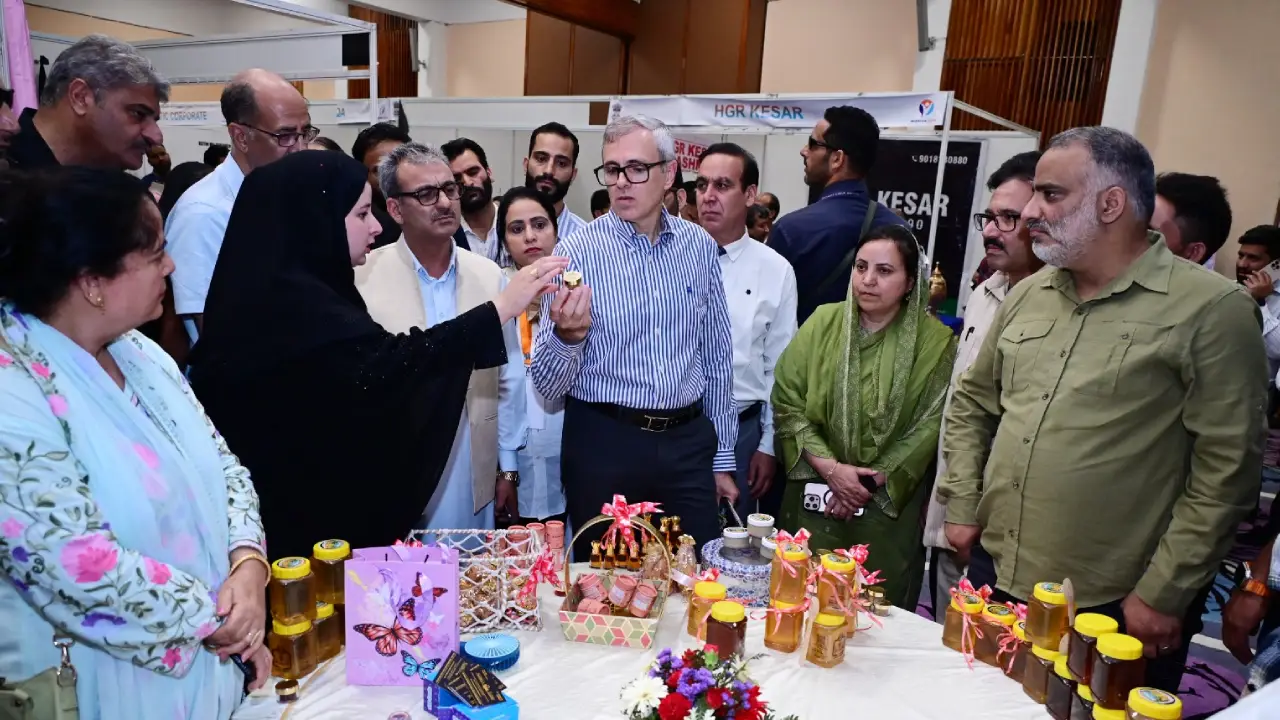
One of the more unusual elements of JK Bank’s recent strategy is its involvement in the Yuva scheme, a government initiative designed to extend small-ticket loans to young entrepreneurs. The scheme aims to support 1.35 lakh units and create employment for 4.50 lakh people.
For a bank accustomed to thinking in crores, nano-loans, tiny amounts extended to first-time borrowers with limited credit history, might seem like a distraction. Chatterjee forcefully disagrees.
“I saw a transformation in our bank,” he said. “When it is done properly, you get profits out of it.”
The Yuva scheme covered bank’s all 862 branches. In a year when the MSME sector recorded negative growth for nine straight months, the Yuva scheme helped push the bank back into positive territory in that segment. But for Chatterjee, the deeper value is cultural. “The apprehension which was there of taking loans is over, and every age group is supporting this.” In a territory where borrowing has sometimes been viewed with suspicion, where the cultural instinct is to save rather than leverage, getting young people comfortable with credit is a foundational change.
And the bank has built in safeguards. “In which government scheme have you heard the bankers going for a check-up whether the unit has been set up or not, making its footage, and then reporting it?” Chatterjee asked. The answer, of course, is almost none. The verification-first approach is designed to minimise the moral hazard that has plagued many government lending schemes, the risk that loans are taken and never deployed into real business activity.
“Even if we achieve 10 to 15 per cent of the targets,” he says, “you will have 10,000 entrepreneurs in Jammu & Kashmir. That is a large number.” The scheme has seen an uptake of Rs 1000 crore so far.
Generation Gap
JK Bank’s digital infrastructure has historically been a weak point, the kind of thing that customers and analysts mention with a sigh. The bank’s mobile application, JK Bank MPay Delight, has faced criticism for unreliability, slow loading times, and patchy service.
Chatterjee does not deflect. “There have been complaints about the app’s uptime,” he acknowledged. But he also said the last year has seen significant investment, in infrastructure upgrades, software improvements, and stability enhancements. “In the last three to four months, our uptime has improved a lot.”
The digital transaction rate now stands at 94 per cent. That is a striking number; it means the overwhelming majority of JK Bank’s transactions happen without a human teller, processed through digital channels. The challenge is not getting transactions online; it is keeping the system reliably available when customers need it.
The generational dimension of this challenge is one Chatterjee thinks about carefully. JK Bank’s most loyal customers are senior citizens, people who have kept their money in the bank through decades of change, who trust it with the kind of institutional loyalty that is hard to earn and easy to lose. “We can never neglect this group,” he asserted. “The amount of interest rates we offer them here, no other bank does that, and it will continue.”
But Gen Z cannot be ignored either. “We will have to shape our products in such a way that they look trendier, colourful, and attractive, which we are doing currently.” In the coming year, the bank has doubled its technology infrastructure budget. It is a significant commitment, and one that signals an understanding that the next generation of JK Bank customers will be won or lost on a phone screen.
An Unfinished Business
JK Bank Financial Services Limited ( BFSL) is the bank’s wholly owned subsidiary, designed to offer wealth management, insurance, and investment products. In Jammu and Kashmir where Rs 13,000 crore in mutual fund investments are made annually, BFSL’s current market share of just Rs 500 crore represents both a failure and an opportunity.
“I am not satisfied with the performance as of yet,” Chatterjee said, in a rare moment of direct criticism. The subsidiary, he said, has not received the attention it deserves. That is changing. The app has been upgraded. BFSL has applied to SEBI to establish a research team, a prerequisite for serious investment advisory services. And the bank’s branch network, which reaches into every corner of JK, will be more actively leveraged to push BFSL products.
The investment opportunity in JK is real. Kashmiris save at high rates; what they lack is access to well-structured investment products and the advisory support to use them. BFSL, properly resourced, could fill that gap. “Within the next few years, the share of JK BFSL will also increase,” Chatterjee said. “You will soon see a distinct difference.”
Supply Chain Gap
Perhaps the most forward-looking part of Chatterjee’s vision for JK’s economy concerns industrial policy. He sits on a three-member committee designing a new industrial framework for the territory, and his presence there, he says, ensures that the banker’s perspective is built into the foundation.
The critique he offers of previous industrial policy is pointed: “A common mistake made by governments is that in a policy, everything should be made free, subsidies, waivers, discounts. By this logic, we can never make a business successful. Business can be made successful when you invest your own stake and sweat. If everything is offered free, it would nott work.”
It is a view that cuts against the grain of how JK’s economic development has often been framed, as a problem solvable by government subsidy. Chatterjee is not opposed to government support. But he wants it structured so that entrepreneurs have skin in the game. “For sure there will be support from the government, but most of the stake will be of the businessman.”
His supply-chain argument is central. Unlike Maharashtra or Gujarat, where large entrepreneurs sustain networks of vendors and suppliers, Jammu and Kashmir lacks that anchor base. “How many businessmen do we have in Jammu and Kashmir who can invest more than Rs 1,000 to Rs 1,500 crore on their own?” Very few, he says, arguing that local firms must partner with larger mainland companies to build wider supply chains and spread economic activity.
And he sees natural advantages that remain unexploited. Food processing is one. “We still need to develop that sector a lot, which can achieve a lot of positive results.” The raw material, fruit, vegetables, dairy, is there. The processing infrastructure largely is not. Getting it built would create jobs, generate exports, and give the agricultural sector a value-added layer that currently does not exist.
What Next
As Chatterjee shuttles between the Civil Secretariat and his twin offices in Jammu and Srinagar, the heat of the plains following him even under the blast of air conditioning, the picture that emerges is of a banker who has internalised the complexity of his assignment.
The record profit is real, and the improved NPAs are real, and the bullish stock is real. But Chatterjee is already calibrating for FY27, and the ambition is visible in every number he quotes.
Advances in Jammu and Kashmir: from Rs 7,000 crore to Rs 15,000 crore. BFSL market share: from 500 crore toward something more proportionate to the Rs 13,000 crore market it operates in. Digital uptime: from improved to genuinely reliable. Staff productivity: augmented by specialist recruitment. Market share: on an upward graph when the RBI data comes through.
The story of JK Bank under Chatterjee is, at its core, a story about an institution reclaiming its place. Not just as the largest bank in the territory, but as the most trusted, the most innovative, and the most consequential one. It is a bank in which people have emotional equity and the CEO is aware of that.
(With Asrar Syeed’s inputs)