Prominent geologist Prof GM Bhat tells Masood Hussain that Kashmir’s rocks hold the world’s most complete record of Earth’s greatest extinction, that humans walked this valley half a million years ago, and that we are quietly destroying the evidence of both.
KASHMIR LIFE (KL): You have spent nearly 45 years studying the geology of Jammu and Kashmir. Where does one even begin?
PROF G M BHAT (GMB): Jammu and Kashmir is the Museum of Natural History. In this small area, the 4.6 billion-year history of the Earth is hidden. We have Proterozoic rocks here that are billions of years old, and then, in unbroken continuity, every geological period right up to the present. Sediments are still forming in our rivers today. It is an extraordinary endowment.
KL: When did serious geological study of the region begin?
GMB: With the British, and specifically with men who served multiple functions simultaneously, soldiers, surveyors, geographers, and, not incidentally, spies, given the Russian and American interest in these borderlands. Frederic Drew, for instance, served in Maharaja Gulab Singh’s government for 20 years. He wrote about geography, geology, culture, and heritage. The first proper geological account was by Falconer, who came in 1837 and identified Permo-Carboniferous rocks here.
Then from 1864 to 1866, a geologist and surveyor named Godwin-Austen went to a place called Guryul Ravine, near Khunmoh. That visit set in motion something whose consequences are still unfolding today.
KL: What makes Guryul Ravine so significant?
GMB: To answer that, I need to go back 260 million years. At that time, this part of what is now Kashmir was near the South Pole, part of a single great landmass we call Gondwana. The Tethys Ocean covered much of what is now the northern hemisphere. Then, around 252 million years ago, something catastrophic happened. Ninety per cent of marine species and seventy per cent of terrestrial species, plants and animals, were wiped out. This event is called the Great Dying, or the end-Permian mass extinction. It is the largest extinction in the history of life on Earth. Five mass extinctions have happened in 4.6 billion years; this was the biggest.
The organisms that died sank to the ocean floor and became sediment, layer upon layer. Gondwana broke apart. The Indian plate drifted north, collided with the Eurasian plate, and those sediments, that record of the Great Dying, came with it. A portion of it ended up here, at Guryul Ravine.
KL: And the record preserved there is exceptional?
GMB: It is the most complete in the world. The Permian-Triassic boundary section at Guryul is 2.68 metres thick. The equivalent section in China is 27 centimetres. In Iran, Alaska, Siberia, and Wales, all of them are thinner. A thicker record means more history, more evidence, like a complete book versus a pamphlet.
This is why, from the 1960s onwards, European and American geologists kept coming here specifically to study and compare. From 1971 to 1980, the Geological Survey of India ran a decade-long joint project with Japan. Fifteen to twenty major papers were published. A memoir appeared from Tokyo University in 1975. The section was, in effect, the unofficial global standard.
KL: Yet we lost the formal designation. What happened?
GMB: In 1990, a competition began to designate what is called a Global Stratotype Section and Point (GSSP) for the Permian-Triassic boundary. This is the official geological standard against which sections everywhere else in the world are measured. China put forward three candidate sections. India put forward Guryul Ravine.
The competition ran from 1990 to 2004. Three international conferences could not resolve the issue. Then, in 2004, the decision went to China’s Meishan section. The chairman of the Triassic Commission at the time, Tim Tozer, had himself visited Guryul in 1988. He knew it was the better section scientifically, and he said so. But in the intervening years, China had done exhaustive work on Meishan, isotopes, sedimentology, fossil extraction, and dozens of published papers. We had HM Kapoor’s work from the 1970s, and then, after 1989, nothing. The political situation in Kashmir made fieldwork impossible. Foreigners stopped coming. There was an advisory against travel here.
I can illustrate exactly how this happened. In 1989, Michael Brookfield, the Canadian geologist who had last visited Kashmir in 1987, wrote to me saying he wanted to return. He was enthusiastic. Then, a few weeks later, another letter arrived. He said he would not be coming that year after all; he preferred, he wrote, to visit the Soviet Union “before it breaks away.” That letter, written in 1989, sits in my files. He went to the USSR. The following year, 1990, Kashmir erupted. Nobody came here for almost two decades. The science stopped. China did not stop.
Tozer reluctantly accepted the majority decision in 2004. It was not unanimous, but a majority vote. We lost the GSSP through our own incompetence. Not because the science was against us.
KL: You continued working through those years?
GMB: In 1991, with my students at Jammu University, we began sedimentological work on the Permian-Triassic boundary. We worked on Guryul Ravine and on four other sections, Barsoo, Mandakpal, Narastan, and Pastuna (both in Tral). PhDs were completed in the nineties. Conditions were difficult, but we kept going.
In 2007, I organised an international conference to mark the centenary of the Geology Department at Jammu University, which Wadia had established in 1907. Brookfield came, the same man who had written me that letter in 1989, who had wanted to return and could not. We went back to Guryul Ravine together.
It was completely untouched. Not a mark on it. Middlemiss, in his 1910 report, had used a large Chinar tree there as his benchmark: “the section so many metres north-east of the Chinar.” That tree was still standing.
KL: And when you returned later in 2012?
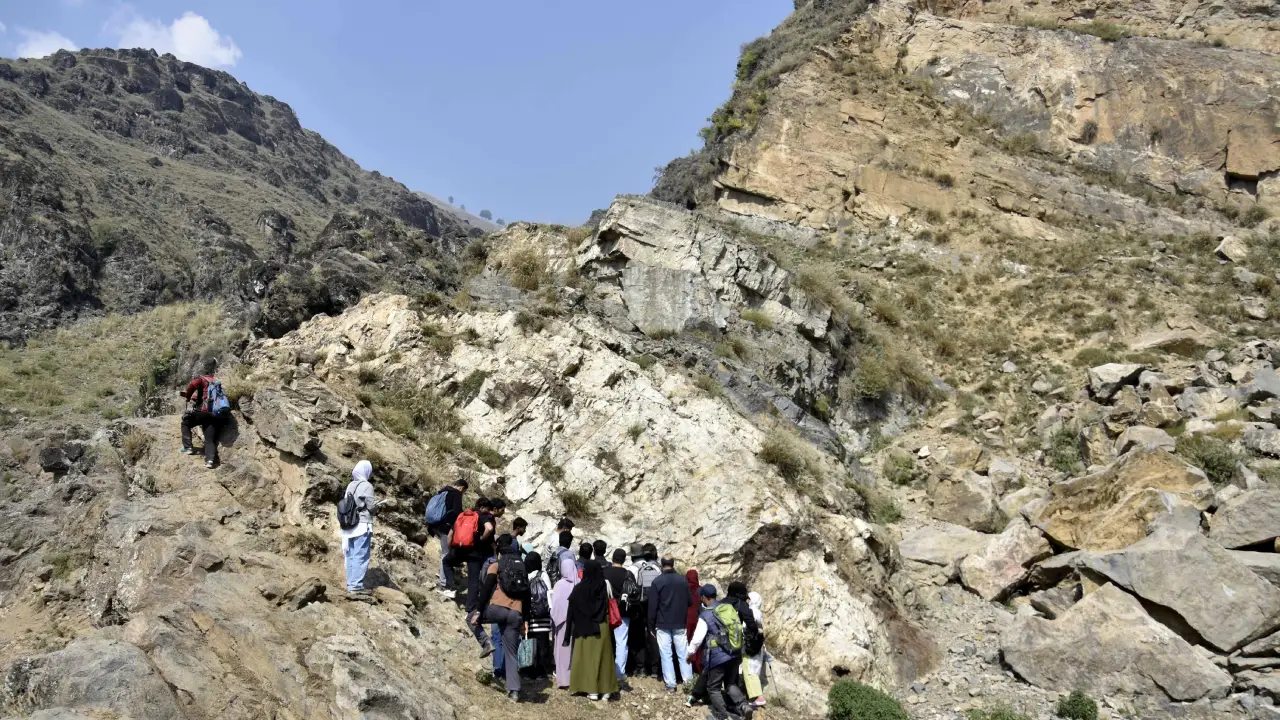
GMB: Half of it was gone. Four or five quarries were operating. They had cut into the mountain. The Chinar was gone. Everything Middlemiss had described was gone.
I called a journalist. He sent cameramen. I had Brookfield give a statement on the importance of the site. It went online, into the newspapers. I had him write a letter to the Prime Minister of India. The letter travelled from the Prime Minister’s Office to the Geological Survey of India to the Government of Jammu and Kashmir, where Omar Abdullah was Chief Minister. It took until 2017 for a formal notification to be issued declaring it a protected area. Five years of struggle. Mining eventually stopped.
In 2014, following the floods, a Chinese team came as part of an IGCP project, an International Geoscience Programme, in which China was the lead, and I was co-leader. They came with Japanese, European, and American colleagues. We ran a seven-day workshop and took them to Guryul and the satellite sections. The Chinese team spent a week examining the rock face. Their conclusion, stated openly, was that Guryul is the better section. They have the official GSSP status; they cannot deny what the rocks show. That is what scientific integrity looks like.
Today, there are 38 scientists from institutions in America, Canada, China, Japan, and Europe working on this section. We have published 26 papers since 2007.
KL: What else has the recent work revealed?
GMB: In a 2014 paper, Brookfield and I established that Guryul Ravine contains the world’s oldest evidence of a tsunami. It is a unique discovery with no parallel anywhere else on earth. The replica signature is also present in the Barus section. The record of what caused the Great Dying, ocean chemistry changes, volcanic eruptions, and possible meteorite impact, those questions are still being worked through. But the section holds evidence that we are only beginning to read.
There is also something above the Permian-Triassic boundary, a later extinction event called the Smithian-Spathian boundary, which falls roughly 2.7 million years higher in the section. The record of that transition is also preserved here, continuously, which has not been established anywhere else in the world. We are working toward a GSSP for that boundary. We may yet get what we lost. In science, nothing is final. New evidence continuously emerges. It is not impossible that even the Permian-Triassic GSSP could one day be revisited if we do the work properly.
KL: In 2025, the site was finally declared a National Geo-Heritage Monument.
GMB: In October 2025, yes. And Guryul was not alone. Mandakpal, Pastuna, Barus, and Narastan were included as supplementary sites in the same declaration. Guryul is the mother section; the others are parallel or satellite exposures of the same geological record.
The recognition was long overdue. India has 79 sites on UNESCO’s tentative list, and not one geological site has received formal UNESCO recognition. The officers of the Geological Survey of India are confident: if Guryul is properly projected, it will be the first. It deserves to be the first.
But even as we pursue that, there is a problem. The area demarcated as protected, almost four square kilometres, has already partly been allocated to SIDCO for industrial development. Construction has begun. The approach path to the site is disappearing. The Geological Survey of India and the Government of India are trying to push the section toward UNESCO recognition, and simultaneously, we are masking the very face of it. The plan was always to develop this as a Geo-Park, the way China developed Meishan. Instead, we are burying it under concrete.
I appeal to the Lt Governor: do not let this happen. This is a world heritage. The whole of humanity has a claim on it. There are limestone deposits throughout this region, do the industry somewhere else. Why here? Why this?
KL: Did you discover the Galandar fossil in 2000?
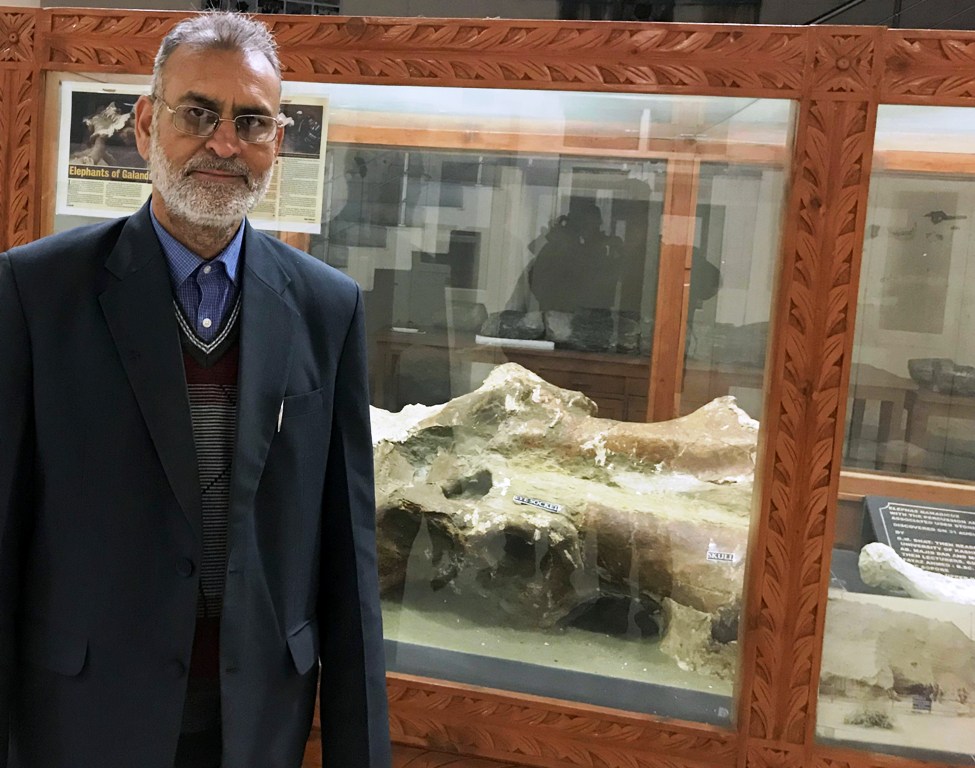
GMB: Chance, as with most things in science. Students from Degree College Sopore were on a geology field trip. A trial railway line was being laid through the area, and Karewa deposits were being excavated for fill. The digging had left a vertical cliff face near the sericulture centre at Galandar, with beautiful sedimentary layering, exactly the kind of section that makes a geologist stop the bus.
One of the students, a boy named Fayaz, noticed something circular embedded in the cliff face, a slightly different colour, not protruding, flush with the rock wall. The teachers dug around it, saw that it continued into the rock, and wisely left it. They instructed the workers not to touch it. Then they called me that evening from a landline in Pahalgam. When I drove out and looked, I recognised it immediately: an elephant’s tusk.
We began excavation the next morning. By September 6, we had uncovered a complete skull, both tusks intact, one about three feet long, both upper and lower jaws preserved. That day, the story went around the world.
KL: What happened to the fossil after that?
GMB: It lay there for seven years. That is the honest answer. There was a government order, from the Additional Chief Secretary, MS Pandit, that a huge patch of government land be transferred to the University of Kashmir, to develop the site as a park with the fossil preserved in place. The order was never implemented.
A police picket was deployed for two and a half years, then withdrawn. Encroachment began. We had found an additional tusk at a lower level, 8.5 feet long and fully intact with the complete tip. That is gone. A five-storey building stands on top of it. On the side where the skull itself lies, another building stands four feet above it.
I wrote repeated letters to Kashmir University. No response. I have that correspondence on record. Eventually, Amitabh Mattoo, as Vice Chancellor, authorised a team to transport what remained to Jammu University, where it could be properly preserved. That is where it sits today.
After the transfer came the predictable uproar: Kashmir versus Jammu, accusations that it had been sold in the international market for crores. That is our attitude toward our own heritage.

KL: Once it was in Jammu, did scientists come to study it?
GMB: This is one of the most troubling parts of the story. I contacted four of India’s leading vertebrate palaeontologists: Ashok Sahni of Chandigarh University, GL Badam of Pune University, himself a Kashmiri, an expert who had worked in Kashmir, and AC Nanda from the Wadia Institute of Himalayan Geology. Official letters went from Jammu University. Three of the four refused. When I asked them why, they said they had been forbidden to come. Forbidden from where, by whom, they did not say precisely. But the instruction had come from Kashmir. They did not come.
So what alternative did I have? I turned to the outside world. It took another 13 years to assemble an international team. That team was sponsored by the British Museum. They came to Jammu in 2019.
KL: And the scientific findings? The fossil was initially called a mammoth.
GMB: That early identification, 50,000 years old, possibly mammoth, was provisional. No specialist had examined it in person. I sent photographs to experts in the United States and the United Kingdom. They made tentative identifications from images.
The 2019 team was different. Four specialists came in person: a taxonomist, a stone-tool and archaeology expert, an amino acid dating specialist from Europe, and a butchery-mark expert from the Natural History Museum in London. They spent a week with the fossil.
The paper was published in 2025. The animal is not a mammoth. It is Palaeoloxodon, a species that represents a missing link in the evolutionary radiation of this genus between its primitive African forms, Palaeoloxodon recki, and the later Asian lineage, Palaeoloxodon antiquus. A similar fossil had been found in Turkmenistan in 1955 and named Palaeoloxodon turkmenicus, but its preservation was poor enough that debate about its identity never settled. The Galandar skull, exquisitely preserved, authenticates that Turkmenistan’s find and establishes the evolutionary position definitively. It is a genuine discovery.
KL: And the stone tools found with it?
GMB: Sixty-eight artefacts in total. A hammer core made from Panjal Trap, the local volcanic rock, sourced from nearby outcrops. Flakes, at least one of which functions as a cutting or piercing tool. Crucially, several flakes were found in two matching pieces, both halves together in the same spot. If these had been washed in by sediment from elsewhere, the matching pieces would not be side by side. They were made, used, and broken right there. The core itself shows evidence of percussive use; it was used to crack the bones for marrow extraction. Bone fragments carry the corresponding percussion marks.
Someone hunted or scavenged this animal, butchered it on site using tools they had made from local rock, and extracted the marrow. The adult animal was approximately 50 years old, a bull. There was also a juvenile with it; we believed for 25 years that there was only one animal; the taxonomist separated the bones into two individuals.
KL: How old is the site?
GMB: The stone tool dating suggests a minimum of 300,000 years. The amino acid dating, with the caveat of limited samples, points toward 500,000 years. The taxonomist’s morphological assessment also supports 500,000 years. The sediment layer itself dates to around 780,000 years, meaning the fossil was deposited sometime within that broad span. We have settled on at least 500,000 years as the conservative agreed figure.
This means human presence in Kashmir, not Homo sapiens, who appear at around 300,000 years globally, but pre-sapiens hominins, likely Homo erectus or a transitional form, is established half a million years ago. With the cognitive sophistication to identify appropriate stone, manufacture tools, and systematically process a large animal. That is a significant thing to establish.
There is another dimension to this site that was never fully excavated.
This is what stays with me. During our excavation in 2000, a resident we had hired, a daily worker, came to me one evening and said, quietly, that about 500 metres away, workers laying the railway track had encountered something. Twelve feet long skeleton, buried 12 feet down in the Karewa. A large structure. He believed it might be a skeleton of some kind.
By the time I mobilised the following morning, it was gone. Destroyed in the course of the railway work. I visited a place where the soil was dropped. I dug it and recovered a piece of the skull.
But consider what that site represents: the prey is there, the stone tools are there, and perhaps the hunter himself was there too. If we had recovered that, it would have been one of the most significant paleoanthropological finds in Asia. Instead, it was fed into a railway embankment. This is not incompetence in the abstract; it is incompetence with consequences that cannot be undone.
KL: You have not only worked on these sites but watched Kashmir’s geological specimens scatter across the world’s museums. How far does that dispersal go?
GMB: Very far, and it began early. A Yale University expedition came to Sempora in 1931, during Maharaja Hari Singh’s reign, looking for evidence of Pleistocene glacial cycles. They excavated elephant limb bones. The Maharaja’s government refused to allow them to be exported, a genuine act of heritage consciousness. The bones were deposited in the SP Museum in Srinagar.
When I went looking for them years later, nobody on the museum staff knew where they were. An elderly man, a former watchman, took me up over a tin roof to a space under a higher roof. There were four long bundles wrapped in rotting cloth, lying in the dust. I opened one: elephant bones, identical in character to the Galandar fossil, porous, fragile. The Maharaja had fought to keep them, and we had stored them in the rafters and forgotten them.
Then there is the matter of Ramnagar, in Udhampur district. In the Siwalik formations, fossils of Ramapithecus and Sivapithecus were discovered, primate ancestors of humans, dating to approximately eight million years ago. I have seen those specimens myself, in the Natural History Museum in London, where they now reside. Eight-million-year-old fossils of our human ancestry, found in Jammu, are preserved in Britain.
And there are my own specimens. Near Ashmuqam in Anantnag district, in a section near the village of Seer, I found something in a two-centimetre slab of rock that has never been satisfactorily resolved. On one face of the slab, a palynologist at the Birbal Sahni Institute identified what he called Ductoidia, a unicellular marine plant, possibly the earliest of its kind recorded anywhere in the geological record. On the other face of the same slab sit Carboniferous fossils. Between those two things lies a gap of hundreds of millions of years. How are they juxtaposed in that slab, and what geological story connects them? I cannot fully explain.
I also found what appear to be graptolites in sections near Anantnag. An American specialist, W BN Berry, studied photographs and specimens for six months and wrote me a letter. He said: “It is very unfortunate to have such material about which one cannot be sure”, meaning the evidence was tantalising but not conclusive. Specimens went to the Birbal Sahni Institute, to Berry in the United States, and to the Natural History Museum in London.
When I visited London in 2006, Robin Cocks, then President of the Geological Society, took me deep into the museum’s storage. He opened a rack labelled Ordovician. My letters were in it. My samples were in it. He asked if I wanted them back.
I thought for a moment. I said: Leave them. He told me that if they stayed there, he could guarantee their preservation for three hundred years. If I brought them back to Kashmir, I could not guarantee three years. So they remain there, waiting for someone in the future with the instruments and the patience to understand what they mean.
KL: That is a melancholy arithmetic.
GMB: It is the condition we are in. We are literate. We have doctorates, we have universities, and we have 14 institutions of higher learning in Jammu and Kashmir. Whether we are educated, in the sense of understanding the value of what we hold, is a different question.
(The interview is based on the inaugural episode of History Talks, a long conversation series surrounding the history of Jammu and Kashmir.)