A Kashmiri scholar trained the men who built India’s most influential seminary, shaped its 1857 uprising, and defined its Islamic intellectual tradition, but history barely remembers his name, writes Lilac Ali
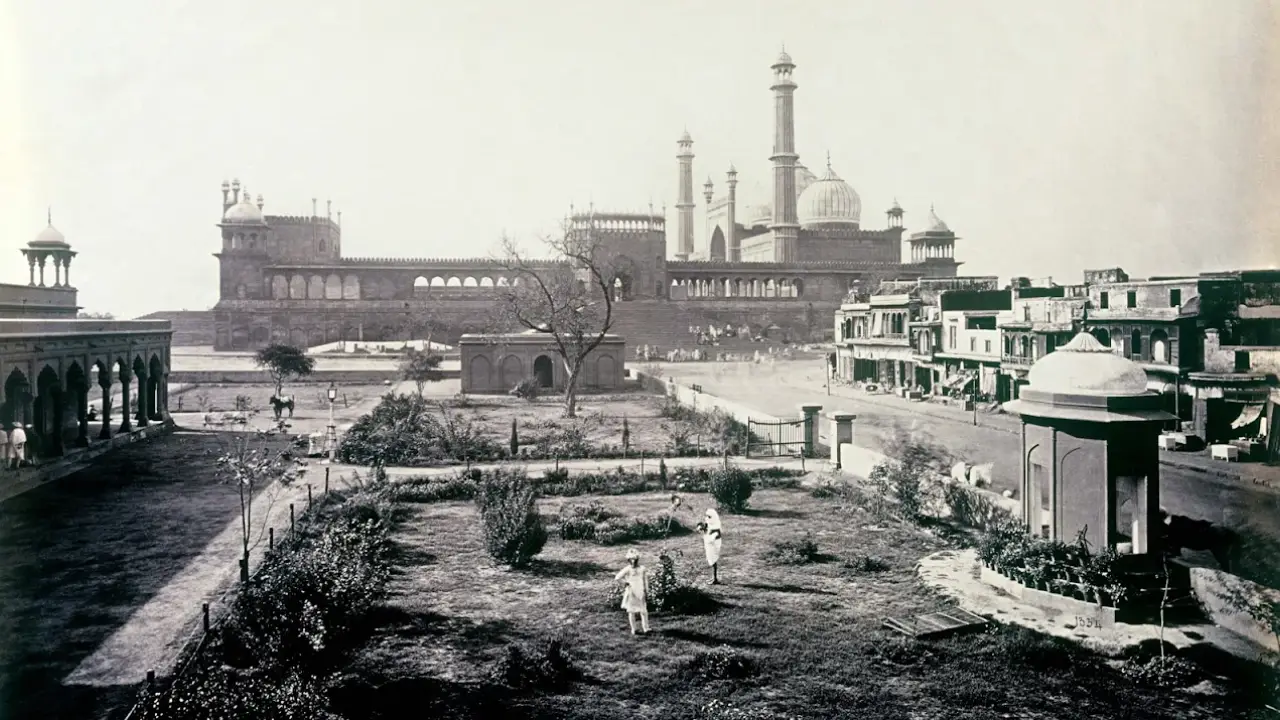
Towards the end of the Chitli Qabar market, just off the road that runs in front of the Jama Masjid in Old Delhi, there is a narrow lane that leads into an area now famous for envelope making. Walk through the cramped shops, loose electric wires, the smell of paper and ink and ordinary commerce. Near the arched gateway at the lane’s entrance, one finds an Arabic inscription of the word Allah still embedded in the old stone facade, half-hidden behind decades of accumulated electrical wire. That inscription is almost all that remains of what was once the most consequential intellectual address in nineteenth-century India.
This was Haveli Sadaruddin Khan. The man who built it and would preside over its gardens, canals, waterfall, fountains, and its daily gatherings of poets, judges and scholars, was originally from Kashmir.
A City in Twilight
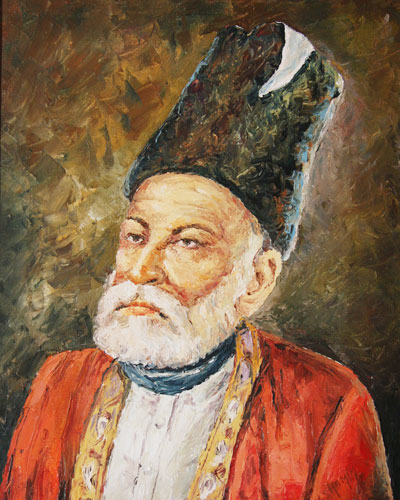
Mufti Sadruddin Khan Aazurda was born in 1789, into a Delhi that was simultaneously dying and burning with a concentrated final brilliance. The Mughal Empire had contracted. The political authority had been hollowed out, but the erudition had not. Scholars would still gather and debate. Poets competed in mushairahs that drew the finest minds of the age. The tradition of Indo-Muslim learning, far from retreating, seemed to gather itself into one last, brilliant expression. Into this world, Aazurda was born.
His ancestor, Khwaja Bahauddin Khwarizmi Faruqi, had migrated to Delhi during the reign of Akbar. For generations, the family remained traders. It was not until the era of Aurangzeb that their orientation shifted decisively toward the madrasa and the mosque rather than the market. By the time Aazurda arrived, the family, in almost 200 years, had completed its transformation from a mercantile family into a scholarly one. His father, Maulana Lutfullah Kashmiri, gave him his first instruction in the Quran, Arabic grammar, jurisprudence, and exegesis.
The Making of a Scholar
Aazurda studied under Hazrat Shah Abdul Aziz Dehlavi, the foremost Islamic authority of the age, completing his formation at the Madrasa Rahimiya. He studied alongside Maulana Fazl-ul-Haq Khairabadi, the period’s most formidable scholar-theologian, and the two men built a scholarly friendship that would last decades and eventually converge at one of history’s most charged moments.
Aazurda mastered both manqoolaat, the traditional Islamic sciences of hadith, fiqh, and tafseer, and maqoolaat, the rational sciences of logic, philosophy, and mathematics.
The testimonies are a witness. Sir Syed Ahmad Khan, in his landmark Asaar-us-Sanadid, called him “the wisest of the wise.” Nawab Siddiq Hasan Khan wrote that in whatever gathering Aazurda sat, whether at the courts of kings or among scholars in their discussions, his stature was always the same: authoritative, impossible to reduce.
The Judge
In 1827, the British appointed Aazurda to the position of Sadr-ul-Sudoor, the highest Islamic judicial office in British India, responsible for administering Muslim personal and civil law across Delhi’s population. He would hold it for nearly three decades.
Over thirty years, the record largely bore him out. His reputation as an arbitrator extended well beyond Delhi; he was called upon to mediate in the estate disputes of the Raja of Jaipur’s family, cases of sufficient political sensitivity that others had declined to touch. The English residents of Delhi held him, according to Abdur Rahman Parwaz Islahi, whose biography Mufti Sadruddin Aazurdah: Hayat, Shakhsiyat, Ilmi Aur Adabi Karname is a major work on the scholar, in genuine intellectual awe, even as they found his independence difficult to accommodate.
It was in this capacity that Ghalib’s chronic debts eventually brought him before Aazurda’s court. By the 1840s, Ghalib’s financial precarity was public notoriety. When his creditors finally dragged him into the courtroom, the atmosphere was thick with tension, until Ghalib, completely unfazed, looked at his friend on the judicial bench and recited a freshly composed couplet:
Qarz ki peete thay mai aur samajhte thay ke haan
Rang layegi hamari faqa-masti ek din
(On borrowed money we drank our wine, and told ourselves: yes,
Our reckless hunger will bear fruit someday)
The wit of the verse broke the solemnity of the court entirely. Aazurda stepped down from the bench and personally paid off the entire debt, sending the poet home a free man.
Ghalib’s Critic
Altaf Husain Hali, whose biographical account of Ghalib remains the most indispensable record of the poet’s life, notes that if there was anyone towards whom Ghalib maintained genuine deference, it was Aazurda. The observation is worth pausing on. Ghalib’s literary relationships were rarely simple, and his deference was rarely unconditional.
Born to a Kashmiri mother, Ghalib was a regular visitor at Haveli Sadaruddin Khan, arriving by carriage at the junction of Matia Mahal and Chitli Qabar and remaining for hours. The mehfils held there drew the most significant literary figures of the age: Momin Khan Momin, Imam Bakhsh Sahbai, Nawab Mustafa Khan Shefta. It was within those gatherings, Hali records, that Ghalib’s engagement with Urdu deepened and intensified.
Aazurda’s recommendation of Ghalib for the Persian teaching position at Delhi College was an act of literary advocacy that placed him in the most distinguished company available. That Ghalib ultimately declined the position did not diminish the nomination; in the literary culture of that world, whose name was spoken in which room, and by whom, carried its own weight.
The Teacher
Alongside his judicial career and literary life, Aazurda maintained a commitment to teaching that he regarded, by every account, as the most essential of his obligations. He taught students at his own home without fees, bearing the costs of their food, clothing, and stipends himself.
On Fridays, he would take them out of the city and into its gardens, continuing instruction under the trees. When a student fell ill and could not attend, Aazurda went to the student, walking to his house, sitting beside the sickbed, resuming the lesson there, with the rest of the class following behind.
His madrasa, Dar-ul-Baqa, originally established near the south gate of the Jama Masjid during the reign of Shah Jahan and fallen into ruin, was rebuilt entirely under his direction. The curriculum encompassed both manqoolaat and maqoolaat, the traditional and rational sciences, reflecting his conviction that genuine scholarship required command of both traditions.
The reach of his teaching circle, measured by the careers of those who passed through it, was extraordinary, and it is here that the full weight of what Aazurda built becomes visible.
Maulana Muhammad Qasim Nanautawi, who studied under Aazurda and later taught at Dar-ul-Baqa, went on to found Dar-ul-Uloom Deoband in 1867, one year before Aazurda’s death. Nanautawi, a key figure in Deoband’s founding, taught at Dar-ul-Baqa directly.
Maulana Rashid Ahmad Gangohi, the other foundational pillar of the Deobandi tradition, emerged from the same scholarly environment. Maulana Rahmatullah Kairanawi, who would later write Izhar-ul-Haq, the landmark refutation of Christian missionary arguments, was shaped by his association with Aazurda’s circle. Like Ghalib, Azurdah enjoyed a lot of influence on Sir Syed Ahmad Khan, who later founded the Aligarh Muslim University.
A single Kashmiri scholar’s classroom produced, directly or through immediate intellectual descent, the founders of the most consequential Islamic educational institution on the subcontinent.
Perhaps his most consequential act of mentorship, however, was his relationship with Maulana Ahmadullah Shah Madrasi. Aazurda trained him, supported his development, and then in 1846, more than a decade before 1857, advised him to relocate his organisational activities from Delhi to Agra, away from the surveillance that attended every prominent scholar in the capital. Aazurda used his own network of official connections to ease that transition, leveraging thirty years of judicial authority and scholarly relationships to smooth a passage that might otherwise have been obstructed. Ahmadullah Shah established a council of scholars in Agra tasked with building the intellectual infrastructure for resistance against colonial rule, and rose to become one of the most significant figures of the 1857 uprising.
1857: The Reckoning
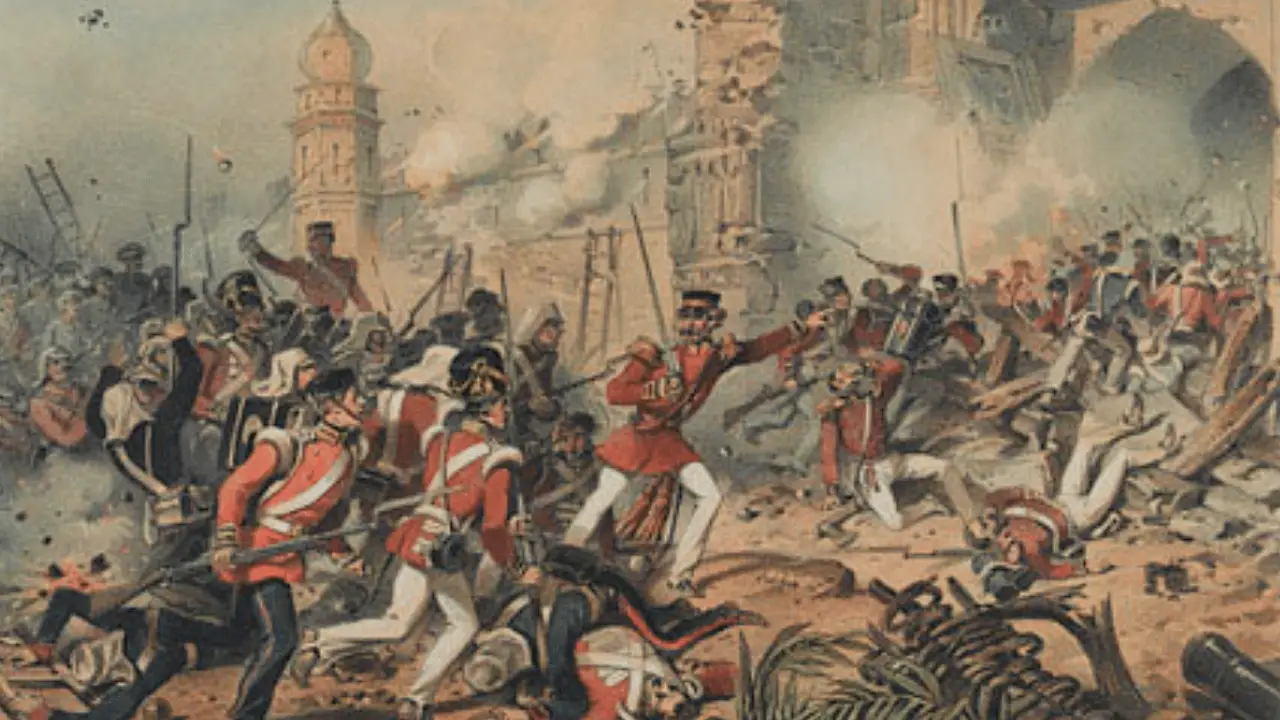
The uprising reached Delhi in May 1857 with a speed that allowed little time for careful deliberation. The rebel sepoys entered the city; Bahadur Shah Zafar was proclaimed, reluctantly by most accounts, the restored emperor of Hindustan. With this, the arrangements that had sustained Aazurda’s position within the colonial structure collapsed within days.
The conditions had been accumulating for years. The East India Company’s increasingly aggressive support for Christian missionary activity had eroded among Delhi’s Muslim scholarly community. By 1857, that premise was no longer defensible.
Aazurda had already begun, quietly, to instruct his students at Delhi College to disregard the Christian propaganda circulating through its corridors.
He arrived, as he had arrived at every major question of his career, through precise legal reasoning. The conditions now prevailing rendered armed resistance not merely permissible but farz al-ayn, an individual religious duty incumbent upon every Muslim. When the ulema of Delhi gathered, and the fatwa was placed before them for signature, his name went on it. The document was published on July 26, 1857, in the Akhbaar-uz-Zafar, a copy of which is preserved today in Delhi’s National Archives.
The paradox was not lost. The man whom the British had appointed as their chief Islamic judicial officer had now declared in writing, for the public record, that fighting that same colonial power was a religious duty.
William Dalrymple, drawing on both British and Indian sources in The Last Mughal, records that some of the ulema later claimed they had been coerced into signing. The British records document these claims. What the same records also document is Aazurda’s presence at Bahadur Shah Zafar’s court on August 2, 1857, presenting Rs 126 rupees as personal nazrana.
When the British, after the revolt’s suppression, pressed him to confirm his signature had been obtained involuntarily, he declined. He maintained that he had signed with full conviction and would not retract it.
His most consequential intervention of the entire period was also, characteristically, the one conducted through persuasion. On August 1, 1857, a crisis erupted between Muslim and Hindu rebel forces over cow slaughter on the occasion of Eid, a dispute with the potential to fracture the uprising. Dalrymple describes Aazurda as “a clever choice of emissary, and not just because Azurda was the most respected Muslim intellectual in Delhi.” He was also the former teacher of Maulvi Sarfaraz Ali, the leader of the jihadis, a relationship that carried a claim of personal authority that institutional position alone could not have generated. What passed between them is unrecorded. What is recorded is the outcome: Maulvi Sarfaraz Ali agreed to restrain his forces, and a potential civil war within the revolt was averted.
The Ruins
The British retook Delhi in September 1857, and what followed for Aazurda was methodical and comprehensive. He was dismissed from his judicial post, tried for rebellion, and had his property confiscated. The destruction of his private library, approximately three lakh volumes accumulated across a lifetime, was recorded by Parwaz Islahi as a blow of a different order from the material losses.
He was eventually exiled from Delhi and spent his final years in Rampur, the Muslim princely state in Uttar Pradesh, where Nawab Qalb Ali Khan, whose own father had once studied in Aazurda’s circle, provided financial support.
The Last Pages
In Rampur, old, partially paralysed, and in failing health, Aazurda wrote a long Persian memoir in which he attempted to account for what remained of his life. He was almost 80. The paralysis had affected his movement; his speech had become difficult. And yet students continued to find him, and he continued to receive them. In a letter to Nawab Qalb Ali Khan requesting financial assistance, he was careful to frame the need in terms of his students’ requirements rather than his own. At eighty, in exile, partially paralysed, he was still worrying about their stipends.
He died in 1868.