Abd al-Karīm ibn Khwāja ʿĀqibat Maḥmūd al-Kashmīrī was waiting in Delhi for a visa to Makkah when Nadir Shah’s invasion of 1739 swept him into one of the most extraordinary careers of the 18th century. He became Persia’s roving ambassador across the Ottoman world and, ultimately, a pilgrim who reached the Kaaba via one of the longest routes in Hajj history. His Persian account, Bayan-e-Vaqi, was published in Calcutta in 1788. The piece is excerpted from his book that details the Damascus caravan, the desert crossing to Medina, the arrival at Makkah, and the sea voyage home from Jeddah to Bengal.
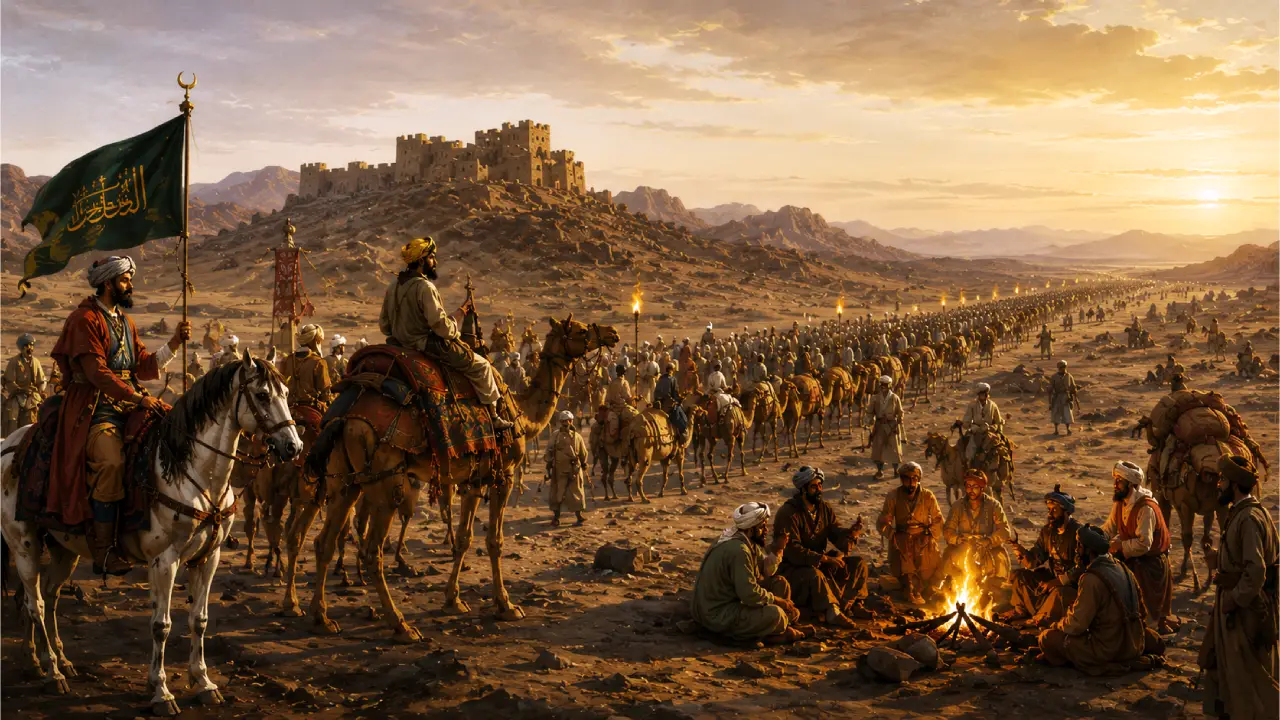
In the month of Shawal the pilgrims assemble in the city of Damascus, and the Pasha of Damascus is always appointed by the edict of the Emperor of Turkey, Meer Haaj, or conductor of the caravan of Makkah. Without a considerable escort, it would be impossible to pass the desert; and even when the caravan is strongly guarded, and the pilgrims are very numerous, the wild Arabs hang in such a manner upon their march, that if any straggle from the caravan, they are sure to be plundered. Another advantage from the appointment of the Meer Haaj is that by obliging everyone to pay implicit obedience to the regulations for marching and halting, the confusion is prevented, which would otherwise be unavoidable amongst so large a body without a head.
The following are some of the regulations for the caravan. Everyone has his station assigned him in the line of march, which he must preserve during the whole journey. The people of Iran, and their camels, always form the rear. When the caravan halts, a particular spot is assigned for every string of camels, and where the master of them is allowed to pitch his tent. No one is suffered to infringe any of these regulations. When the stages are very long the caravan travels day and night; stopping an hour at each of the five stated times of prayer, when the camels are allowed to lie down with their burthens upon their backs: and at midnight they halt in like manner another hour. In order that those in the rear may know at night when the caravan is going to halt, the Meer Haaj lets off a rocket. This nightly halt is called Awafee.
The troops of the Meer Haaj guard the caravan on all sides; and the reason why he acts with such vigilance is, that if he conducts the caravan in safety, to and from Makkah for seven years successively, the Emperor promotes him to the office of Grand Vizier: and therefore particular care is observed in appointing to the government of Sham, a person duly qualified to fill the Vizarut, the highest office in the Turkish empire.
When the caravan arrives at Musseeret, the third stage from Damascus, they purchase necessaries for passing the desert, which the wild Arabs bring to that place for sale: after having bought what they want, they pursue their march. The stages of this journey are longer than what are travelled in any other country, insomuch that the camels of Syria, which are larger and more powerful than those of any other place, are fatigued almost to death. At the same time, the zeal of the pilgrims who go all the way on foot, keeps up their spirits, and they perform the journey with surprising ease and alacrity.
In Prophet Soleh’s Tribe
We travelled as mentioned in the route, till we came to the pass in the mountains where the tribe of Thimud hamstringed the camel of the Prophet Salah. Here the caravan discharge fire-arms, beat their drums, and shouting and clapping their hands make a most astonishing noise; and the camel-drivers pretend that if they did not do this, their beasts would expire from hearing the lamentations of Salah’s camel.
In the neighbourhood of this city are seen the ruins of a great city, said to have been turned upside down, at the command of God, in punishment of the disobedience of this tribe to the word of his prophet. And here are also said to be the caves which they made in the mountains, to shelter themselves from the divine vengeance.
The castle of Ala is situated in these mountains. In its vicinity is the castle of Khyber, which was conquered by Ali. Here are still many Jews and Christians, who believe that nothing can be more pleasing to God than the death of the pilgrims of Makkah, and for the attainment of any particular object, they make vows to murder them.
Notwithstanding the Meer Haaj took every precaution in his power to protect the caravan, these assassins of Khyber robbed three of our pilgrims, and shot them with pistols. The Meer Haaj wanted to assault the place, and revenge the death of our unfortunate companions; but was dissuaded from the enterprise, by the interposition of the principal people of the caravan, who represented to him, that in case of delay, the season for the performance of the pilgrimage would elapse before we could reach Makkah.
The Desert Travel
The journey across the desert is exceedingly fatiguing, on account of the great length of the stages; and the travelling charges run very high: yet this part of the way is not without its delights, for the number of links which are along with the caravan, every camel having one, form a beautiful illumination; and the songs of the camel-drivers, called Hooddee, enliven the pilgrims and enchant the camels. After all, the fatigue would be supportable, were it not for the continual dread of the wild Arabs.
If I was to relate all the stories that I have heard of these fellows, I should swell my narrative to a large volume, and those who have never had an opportunity of seeing their tricks, would suppose me to be deceiving them with fictitious tales. I shall therefore content myself with mentioning only two or three of their feats, that are most commonly practised.
During the night, when from the fatigues of the day the greatest part of the caravan are asleep upon their camels, half a dozen wild Arabs will get on each side of a beast that is richly laden. It is necessary to observe, that in loading the camels, all the merchandise is packed on one side, and the provisions for the journey on the other. Whilst some of these thieves are ripping open the bottom of the merchandise pack and taking out the goods, others support the opposite side with the provisions, to prevent its slipping off, and waking the rider, who would alarm the caravan; but the instant they have taken out all the goods, they run off, when the camel, frightened at the sudden fall of his rider, and the remainder of the load, runs about in a rage, pulling the string to get loose from his companions; and frequently in the scuffle the poor man is trodden to death.
The swiftness of these Arabs is astonishing, of which I shall give two instances. In the plain of Arafat, at noon, Hajee Mohammed Cazviny had pulled off his clothes to bathe, and whilst he was desiring Aka Aly to take charge of his Kezlebash girdle, in which were 300 gold mohurs, an Arab snatched it out of his hand, and although the rogue was instantly pursued by horsemen, he made his escape. Another day Mehdy Beg Shirazy was performing his ablutions, when an Arab came behind him, and seizing the ewer, flew away with it like an arrow.
In the desert of Khyber, Mirza Mohammed Yacoub died of a consumption; and we buried him in the sand.
From Ala we proceeded as mentioned in the route, till we reached Medina, where we paid our devotions at the shrine of the holy prophet, and other sacred tombs in that neighbourhood.
When we had performed all the usual ceremonies at Medina, the caravan proceeded; and on the 6th of Zulhejeh we arrived at Makkah.
Visiting Makkah
When I had completed my pilgrimage, I visited the most remarkable places in and about Makkah. At present the pavement round the mosque, as well as the place where the Prophet was born, and the Mejed ul Gin, are considerably below the level of the city: probably this is the original level, and the city may have been raised by the accumulation of rubbish from dilapidated buildings: I have made this observation in several other places of antiquity.
The women of Makkah wear green apples about their necks, and think them very ornamental. Masoud, the present Shereef or governor of Makkah, is a man highly respected and beloved by all ranks of people; and the pilgrims in particular, have every reason to be satisfied with his conduct.
Sailing Home
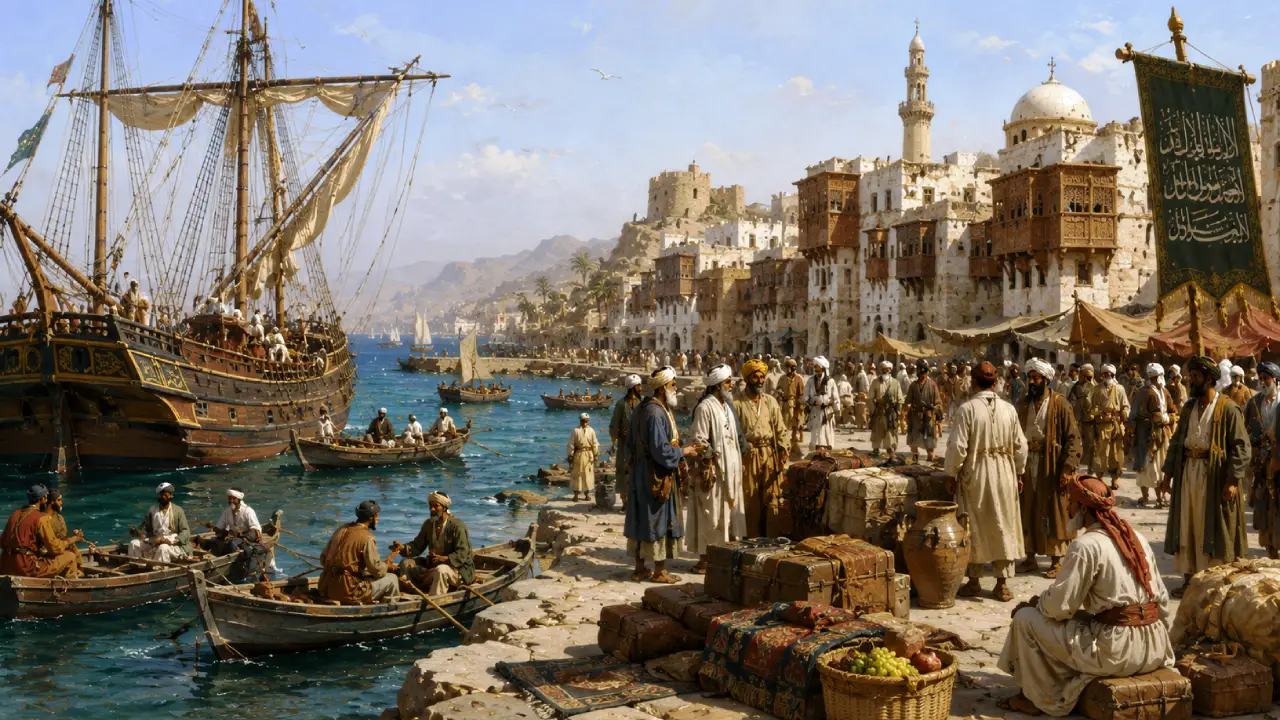
On the first of Rebby ul Awwel, AH. 1155 (or the 24th of April 1742), after staying three months at Makkah, I departed from that place to the port of Jeddeh, which is two days journey.
At a short distance from the town of Jeddeh, is the place where Eve is said to be interred. The grave, which resembles a flower-bed, measures 197 of my paces. On the middle of the grave, a small dome is erected, and the ends are enclosed with wooden pales.

The governor of Jeddeh is appointed by the Emperor of Constantinople; who also nominates the Shereef of Makkah, but he is always a descendant of the ancient Shereefs, who have been for the most part of the tribe of Beni Hassan. If a man quarrels with another, and calls him a bastard, he is cited before the Shereef and punished; because many of the principal persons of Makkah are born of concubines. The Europeans have a factory at Jeddeh; but the Shereef will not permit any one of them to go to Makkah.
After remaining a month at Jeddeh, I embarked on board a ship commanded by an European captain, that was bound to Bengal.
We staid fifteen days at the port of Mokha, to take in water and provisions, as well as to traffick. Mokha is dependant upon Yemen, the Prince of which territory is called the Imam of Yemen, and Sanaa is his capital. The people of Yemen are chiefly of the sect of Zyed. Here are the tombs of Sheikh Osman Shadely, and Sheikh Abul Hassan Shadely.
The author of the Nefehat ul Uns asserts that all the wells in this country were brackish before these holy men were interred there, since when the water is perfectly sweet. It was now the month of June, when grapes, mangoes, and peaches, are common in the markets. Some of the houses are three, and others four stories high; and the house of the governor, whom they style Dowlah, consists of six stories.
Near Ceylon
When the captain had transacted his business at Mokha, we embarked and set sail; and passing the island of Secotorah, famous for its aloes, came into the main ocean. It is said to be unfathomable, and which is the reason that no fish are to be found there. After twenty days sailing, when we had crossed the ocean, we saw a snake, at which the captain and his officers thanked God, it being a sign of our near approach to land.
Three days after this we discovered on our left side, Ceylon, famous for cinnamon. This is a very large island, and its mountains abound with springs of fresh water. It is now in the possession of the Europeans. We saw Ceylon four days, and on the fifth it disappeared.
Four days after losing sight of Ceylon, we arrived at Pondichery, a French settlement on the coast, near Arcot. They obtained the Emperor’s permission to erect a factory and warehouses, merely to carry on trade, instead of which they have built a large city on the sea-shore. We remained here twenty days to refresh our crew and carry on some trade.
We then set sail for Cheenaputten (or Madras), in its neighbourhood, and where ships touch, on account of its being a very flourishing place. Through the negligence of the officers of the ship, and the night being dark, we got about four cose beyond it before morning, and the wind proving unfavourable, the ship, which with a fair wind will sail one hundred and fifty cose in twenty-four hours, was above eight days in gaining the port, which we had missed by so inconsiderable a distance. On the ninth day after leaving Pondichery, the wind coming fair, we arrived at Madras in an instant.
The English have long possessed this settlement on the coast of Arcot. Here they live entirely after their own manners and customs. The women of all ranks appear in public, and go about wherever they please, the same as the men.
After finishing our business at Madras, we weighed anchor and set sail for Hoogly.
God having hitherto granted us fair weather, I was not aware of the danger of a sea voyage. But when we approached Balasore, which is at all times considered as a perilous navigation, we had such a violent storm, that it called to my remembrance the old saying, “That no wise man will make two voyages to sea; for in the first, he will experience sufficient danger to deter him from exposing himself to a second adventure.”
A Stormy Return
From the violence of the storm, the waves dashed against the ship with such force, that she sprang a leak, and the captain and his officers had resolved to abandon their property, and escape in the boat at night, without informing the crew of their intention. But the Almighty, for the sake of the few righteous persons who were on board, spared the lives of the rest. The storm ceased, and the wind proved favourable, as it is promised in the divine book, “After difficulty cometh ease: and whosoever placeth his confidence on the Lord, he will deliver him from out of his distress.”
After escaping the perils above described, we arrived at a channel, where if the ship’s course inclines too much to the left, she will strike upon a hard sand, and most probably perish. The officers are particularly careful when they come to this part of the river; and on account of the many losses that have here been sustained by European and native merchants, marks are placed on the water, to direct the vessel what course to follow, by pointing out the places to be avoided; the mark is a wooden float, resembling a wine vessel, which the Europeans call a pipe.
Upon enquiry, I was informed that it is fastened by a rope to an anchor sunk in the bottom of the river, and the rope being covered with tar, the same preparation that is spread over the bottoms of ships, is not easily injured by the water.
From Balasore to Hooghly you see about twenty of these floats. Providentially, we had now a fair wind; and through God’s mercy, arrived safe at the port of Hooghly in Bengal.