From Mughal terraces to tulip fields, Srinagar’s ten gardens offer tourists centuries of beauty, history, and calm, writes Asrar Syeed

Kashmir has long been called paradise on earth. Its gardens are proof of that title. Tourists arriving in growing numbers each year come for these very spaces. Some gardens are Mughal creations, built for emperors centuries ago. Others are modern additions, built to serve today’s visitors. Together, they tell Kashmir’s layered story through flowers, chinar trees, and mountain views.
The Tulip Garden
Spread across almost 30 hectares, Tulip Garden was opened to the public in 2008 and is the outcome of efforts that Ghulam Nabi Azad made as Chief Minister of Jammu and Kashmir state. It is said to be South Asia’s largest tulip garden.
The philosophy behind its setting-up is to attract tourists slightly early and prolong the tourist season. This has helped as now tourists plan their visits early so that they get the chance to visit the colourful garden in time. It is the new selfie point for young tourists in India now.
Each spring, the garden displays close to 1.5 million tulips. Over 60 varieties bloom here. These include classic cup-shaped tulips, fringed tulips, and double tulips. Triumph tulips and Darwin hybrids grow here too, along with several rare ornamental varieties. Most of the tulips are flown from Europe, even though the SKUAST-K is gradually trying to create an alternative supply line to substitute for the imports.
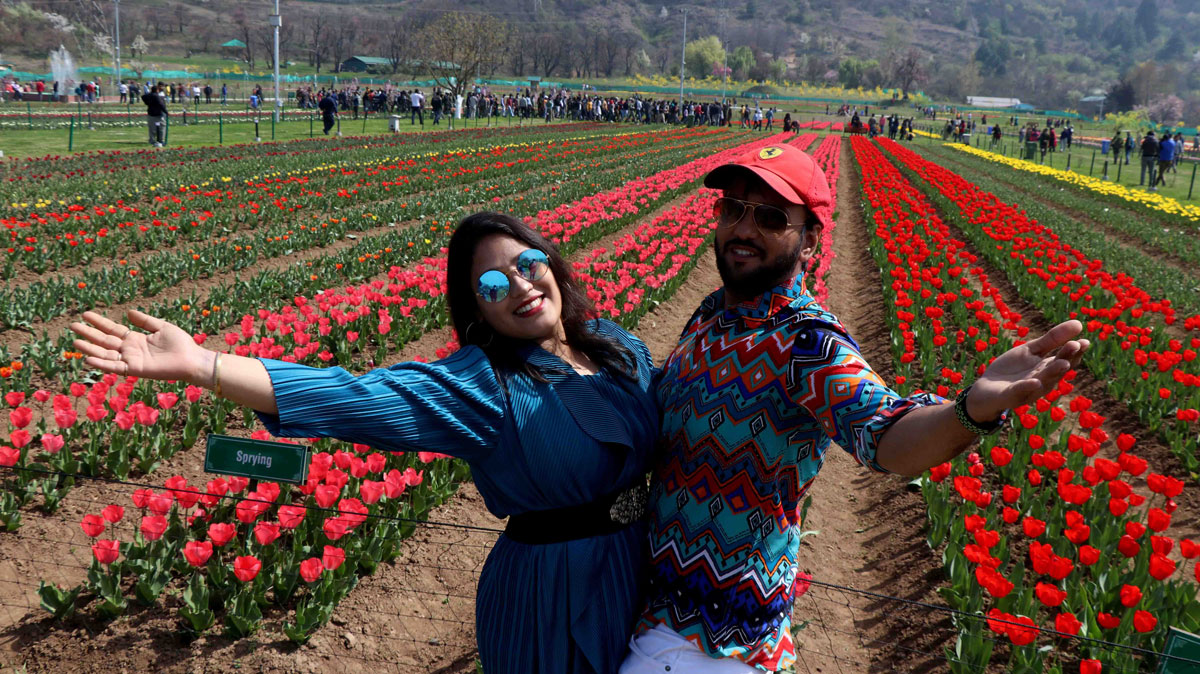
The blooms are arranged in careful patterns. Contrasting colours are placed side by side for effect. Walking through the garden at peak bloom offers an ever-changing view of colour and fragrance. Tulips are the main draw, but other flowers grow here too. Visitors can see hyacinths, daffodils, and narcissus. Ranunculus, muscari, and cyclamens also bloom across the grounds. Over the years, new varieties have been added each season. Landscaping, irrigation, and visitor facilities have all been upgraded.
Badamwari
One of Srinagar’s oldest public gardens, the Badamwai (The Almond Garden) is located on the foothills of the Fort that the Mughals initiated and the Afghans completed. The garden spans nearly 300 kanals of land and was part of the ruins of the Mughal governance city, Naagar Nagar. Barring the Faseel (wall), nothing remains of that city now.
Hundreds of almond trees grow inside it. They bloom in April, and that is when the tourists flock to this space. For more than 20 years, it was abandoned till the then Jammu and Kashmir Bank Chairman, Haseeb Drabu, invested CSR funds and revived it. Till recently, the bank was managing it.
Long pathways run through the grounds. They let visitors walk amid blooming almond trees. The fragrance of the blossoms fills the air. Panoramic views stretch across Downtown Srinagar. A part of Nigeen Lake, once part of the Mughal governance city, is also visible from here. As the trees bloom, the garden turns into a floral landscape. Wooden rest houses offer a place to relax. Flower beds hold different flower species.
It is an amphitheatre and a famous spring, Chah-e-Wari Khan, that was used as an interrogation spot by the Afghans.
The Emporium Garden
Emporium Garden sits in central Lal Chowk, Kashmir’s main business district. Located on the famous Jhelum Bund, it is a calm spot where Chinars offer an impressive umbrella to the great greens that Srinagar has. Flowers are planted in sequence, in different shades. Large flower beds are shaped in distinct patterns. Benches are placed across the garden for visitors to rest. Birds chirp in the trees, adding to the quiet. The garden is home to the main Government Arts Emporium. This name comes from a handicraft centre located outside its gates.
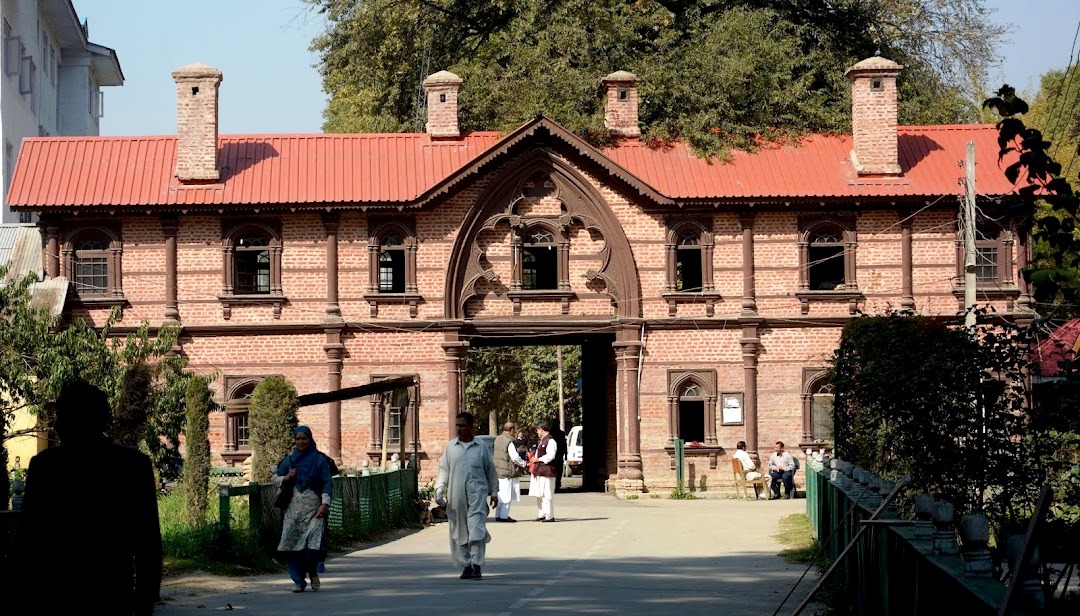
Of late, it was reconstructed after a fire incident, and many facilities were added to it. Now, the artisans can display their talents and products in a separate hall, and people can have meetings around.
This is basically a colonial-era space in Srinagar, and it was from this garden that the British Resident operated. The top British-India officer who had a huge say in the misgovernance of Kashmir would operate from this building from the late nineteenth century to 1947, when the exploitative Maharaja regime ended, and he fled from Kashmir.
Post partition, when the Emporium building was destroyed in a fire, it was reconstructed on the same pattern and with the same architecture that it originally had. It is retained to date.
The garden is known for its untouched simplicity. It has not been burdened with heavy architecture. Long lawns invite visitors to walk at length. The garden changes with each season. In winter, snowfall turns it into a white landscape, right in the middle of Srinagar’s busiest area. In spring, flowers bloom, and fresh leaves appear on the chinars. In summer, the trees and flowers are both in full bloom, filling the garden with green shade. In autumn, the chinars turn gold. Fallen leaves cover the lawns like a golden carpet. It has some rare plants that perhaps do not exist outside this garden.
The Shalimar Garden
Ordered to be built for Empress Nur Jehan, Shalimar Garden was built in 1619 CE by Subaidar Zafar Khan. It was a pleasure garden for the Mughal king, but, unlike Nishat, it had access to people, at least to part of it. It spans 31 acres and is laid out across three grand terraces.
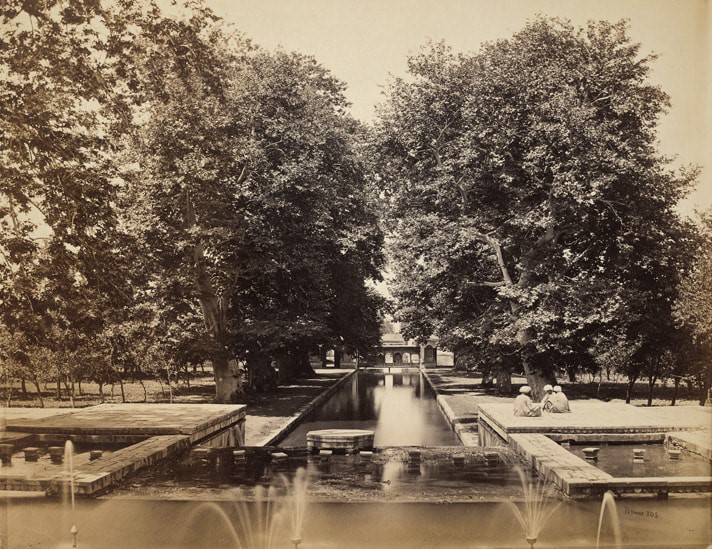
The first terrace is the Public Garden, or Diwan-i-Aaam. Here, the ruler once received nobles and officials. The second terrace is the Diwan-i-Khas, reserved for the royal court and honoured guests. At its centre stands the Black Marble Throne, where Jahangir is believed to have held court.
The third and highest terrace is the Zenana Garden. It was kept exclusively for the emperor, his family, and the women of the royal household, offering them privacy amid quiet surroundings.
A central water channel known as the Shah Nahar, supplied from Harwan through an engineered canal, flows through the length of the garden, feeding numerous fountains, cascades and pools. This garden, for most of Jehangir’s reign, was the capital of Mughal India. All the were flowing from this garden.
The Nishat Garden
Nishat Garden was built in 1633 CE under the orders of Mughal emperor Shah Jahan. It sits on the eastern bank of Dal Lake. The Zabarwan Range rises behind it. For centuries, the garden has drawn tourists from across the world in hordes. Mughal emperors were fascinated by Kashmir’s beauty. Their admiration shows in the gardens they built here. Nishat covers 46 acres. It has 12 terraced levels descending towards the lake. This makes it one of the largest gardens in the valley.
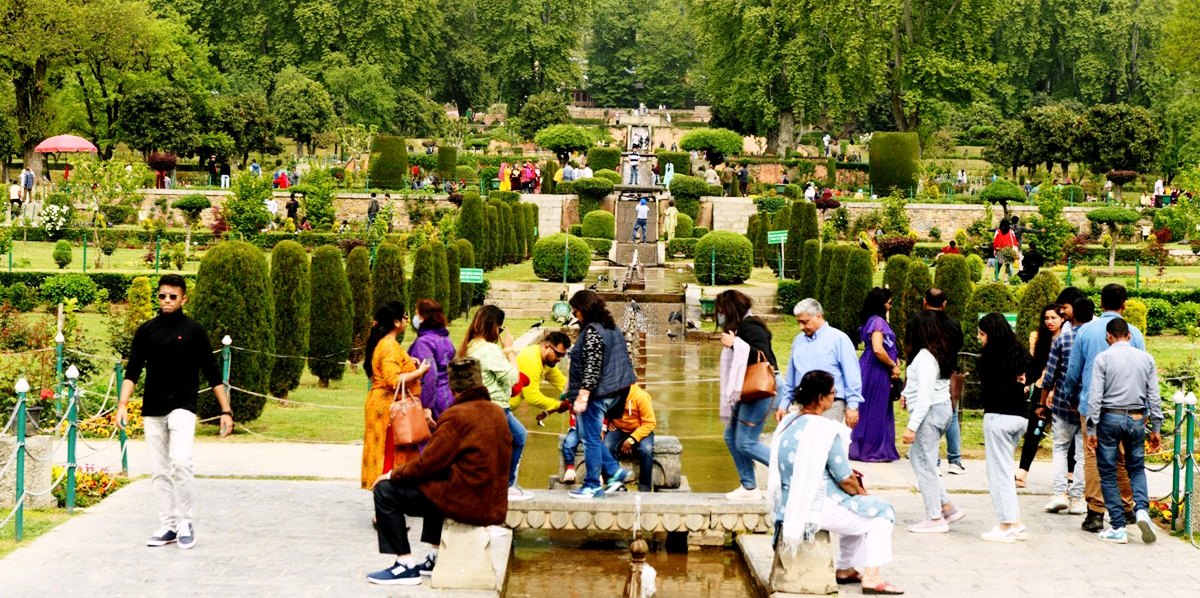
Rows of chinar trees, planted hundreds of years ago, have grown into natural canopies. They offer visitors a place to rest, away from the city’s noise. Different flower varieties add colour throughout the garden. It has a central axial water channel with cascading fountains in all the terraces.
In summer, they offer a soothing experience. A large pool sits at the garden’s far end. Children often swim there as the mercury reaches its peak. Nishat symbolises Kashmir’s Mughal heritage. Laid out by Asif Khan, the elder brother of Empress Nur Jahan, the garden was a private space for the Mughal rulers. Jehangir was fascinated by this garden throughout.
Chashma Shahi
Located at a stone’s throw from Srinagar Lok Bhawan in the Zabarwan Range, Chashma Shahi, the Royal Spring, is also a Mughal-era masterpiece. It was also laid on the order of Jehangir and was set up by Mardan Ali Khan, one of the impressive engineers of Mughal Kashmir. It was ready by 1632 CE.
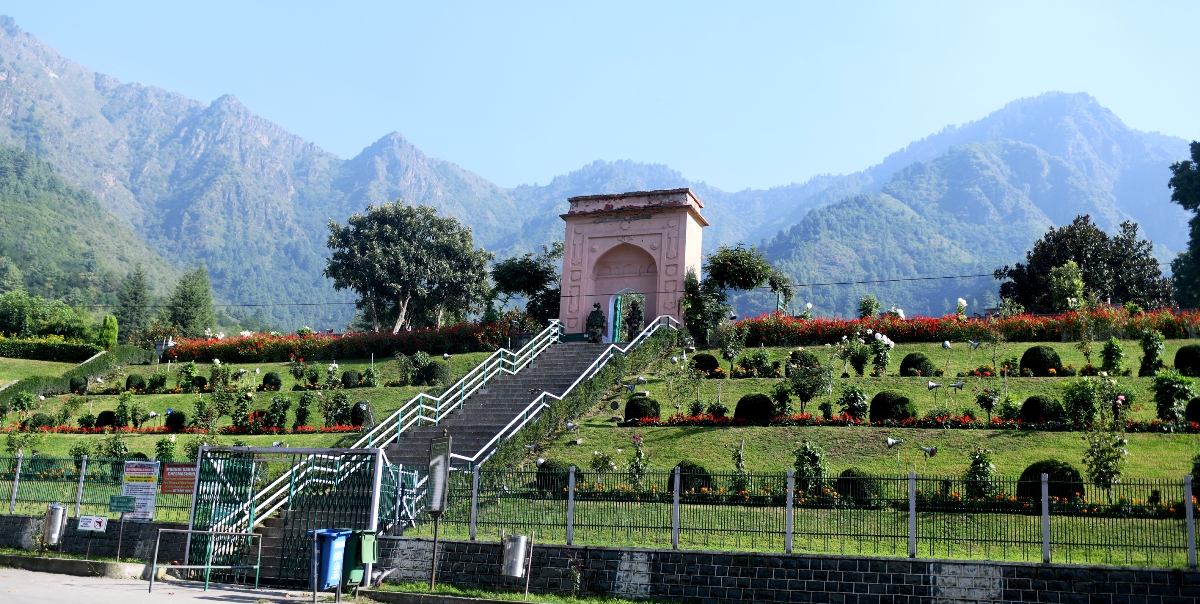
It is smaller than Kashmir’s other Mughal gardens, but its location is bewitching. Water streams run through the grounds, and for generations, people in Kashmir have believed that this water has medicinal properties. This was precisely the reason why a garden was laid around the spring on the order of the Mughal king. Several families in Srinagar still go and get water for drinking purposes from this spring.
Concrete pathways and small fountains complete the layout. Large chinar trees follow the pattern. In summer, locals, schoolchildren, and tourists sit beneath them to take in the valley’s beauty.
Pari Mahal Garden
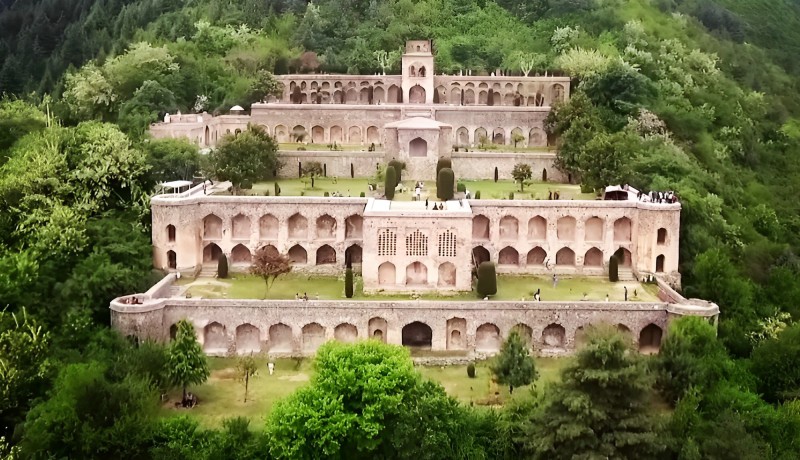
Pari Mahal Garden was built in 1650 CE. Prince Dara Shikoh, the eldest son of Shah Jahan, built it. The garden lies inside the Pari Mahal complex. The Pari is being seen as having two different meanings, one Fairies and another Pir, the teacher. The palace’s peculiar construction seemingly was aimed at the prince exploring astronomy under the guidance f his teacher.
The palace is visible from Boulevard Road. It stands as another example of Mughal admiration for Kashmir’s beauty. The palace is considered the finest example of hillside architecture in the region.
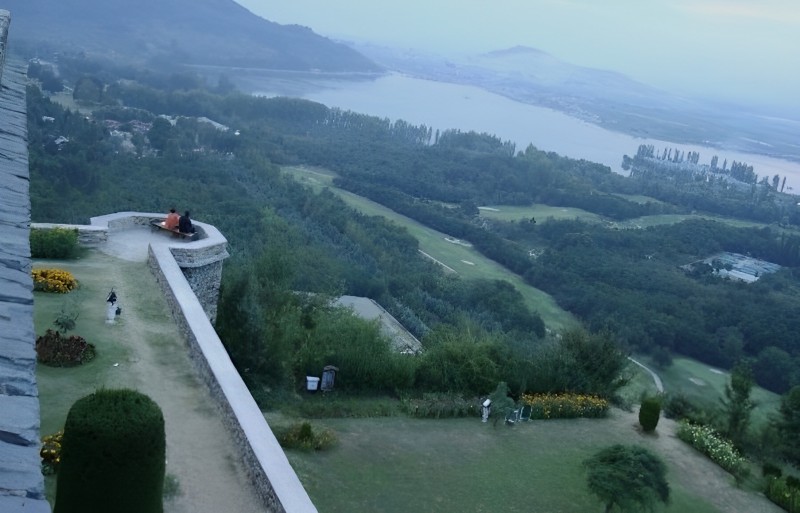
The palace garden has seven terraces, each connected by stone staircases that rise toward the top.
Each terrace is maintained along the green slopes of the Zabarwan range. The garden inside holds well-kept lawns, ornamental flower beds, flowering shrubs, and mature trees. A few old chinar trees stand among the terraces, too. Benches sit beneath them, offering visitors a calm place to rest. From here, visitors can see Dal Lake and the Royal Springs Golf Course, framed by the surrounding mountains.
Harwan Garden
Despite its proximity to Kashmir’s celebrated Mughal gardens, Harwan Garden is a modern public park. Developed around the Harwan Reservoir and one of Kashmir’s most significant archaeological sites, its importance lies not in Mughal architecture but in the region’s far older cultural and religious heritage.
Located about 15 kilometres northeast of central Srinagar at the foothills of the Zabarwan Range, near Dachigam National Park, Harwan occupies a landscape that has witnessed centuries of Kashmir’s history. The adjoining Harwan archaeological site dates to the Kushan period (3rd–4th century CE) and preserves the remains of an ancient Buddhist monastery, famed for its exquisitely decorated terracotta tile pavements. Archaeological evidence suggests that the site flourished during the early spread of Buddhism in Kashmir and may have played an important role in the transmission of Buddhist thought beyond the Valley.
Harwan also finds mention in Pandit Kalhana’s Rajatarangini, which refers to the Bodhisattva Nagarjuna residing at a place called Sadarhadvana. The noted historian Sir Aurel Stein identified Sadarhadvana with the Harwan Monastery, lending literary support to the site’s archaeological significance.
The present-day garden, developed by the Jammu and Kashmir government, offers expansive lawns, walking paths and mature chinar trees that provide welcome shade during the summer months. Although modern in appearance, it stands amid one of Kashmir’s richest historical landscapes, where archaeology, nature and history converge.
Today, Harwan Garden, laid out late last century, is a popular destination for families, birdwatchers, photographers and nature enthusiasts. In autumn, the towering chinars shed their golden-brown leaves, transforming the garden into a vibrant seasonal landscape while quietly reminding visitors of the centuries of history buried beneath its tranquil surroundings.
Botanical Garden
Established in 1969 by the Jammu and Kashmir Government, the Botanical Garden is one of Srinagar’s most important green spaces and a centre for plant conservation and environmental education. Nestled on the lower slopes of the Zabarwan Range, adjacent to the Indira Gandhi Memorial Tulip Garden, the garden is owned and maintained by the Department of Floriculture. It was created to conserve rare and indigenous plant species, promote botanical research, and foster public awareness about biodiversity and the environment.
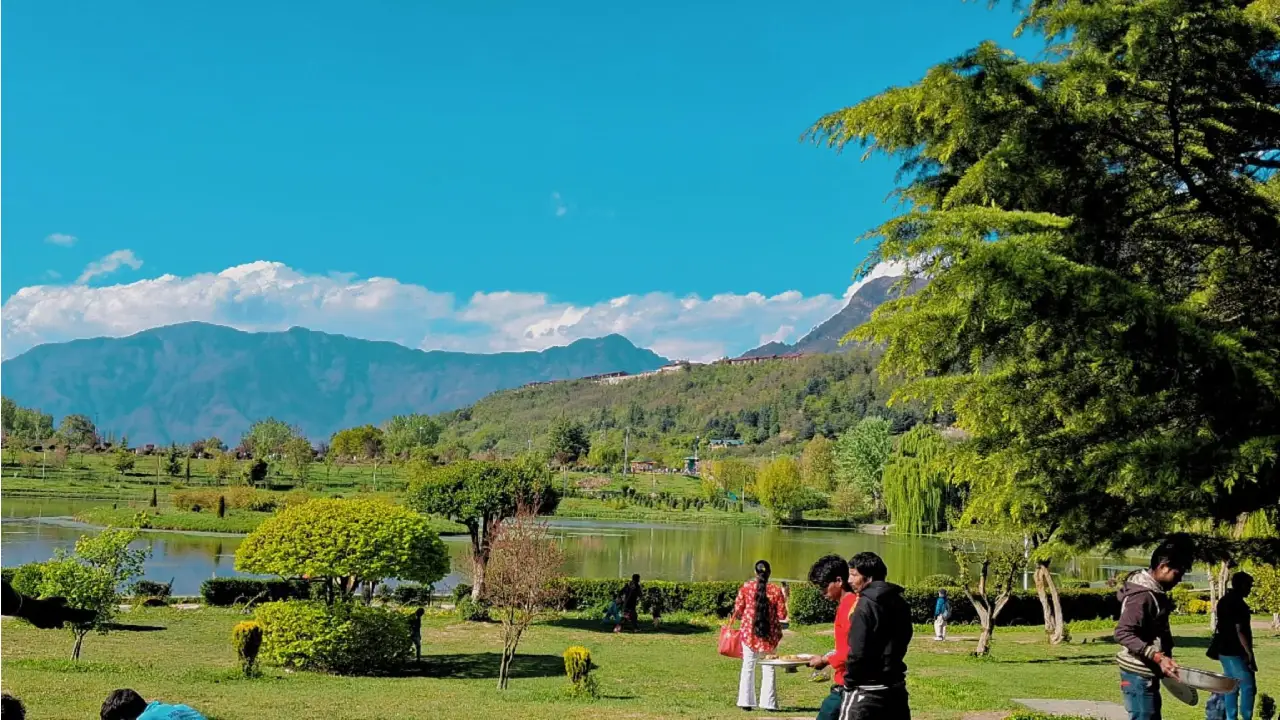
Over the decades, the Botanical Garden has expanded to cover nearly 80 hectares, making it one of the largest botanical gardens in northern India. Its gently landscaped terrain, interspersed with walking trails, water features and wooded sections, provides a tranquil retreat against the backdrop of the Zabarwan hills.
The garden houses an extensive collection of native Himalayan and exotic plant species, including thousands of varieties of trees, shrubs, flowering plants, medicinal herbs, ornamental grasses and seasonal blooms. It plays an important role in preserving the region’s botanical diversity, particularly rare and threatened Himalayan flora. Educational signboards throughout the garden identify many of the species, providing their scientific names, geographic origins and ecological significance, making the garden a valuable resource for students, researchers and nature enthusiasts.
Beyond its scientific and educational role, the Botanical Garden is one of Srinagar’s most popular recreational spaces. Its tree-lined avenues, secluded corners and colourful flower beds attract families, morning walkers, photographers and birdwatchers throughout the year. The garden is also especially popular among young couples, who are drawn to its peaceful surroundings and scenic setting overlooking Dal Lake and the Zabarwan hills.
Duck Park
Perched along the western edge of Dal Lake, Duck Park is a small yet picturesque lakeside garden overlooking both Boulevard Road and Foreshore Road. Backed by the towering chinar trees of the University of Kashmir campus and facing the waters of Dal Lake, it offers one of the city’s finest vantage points for enjoying the Valley’s natural beauty.
Developed by the Srinagar Municipal Corporation in the early 2000s, the park was created as part of a broader initiative to beautify the Foreshore Road and provide residents and tourists with an accessible public space along the lakefront. Though modest in size, its strategic location has made it a popular stop for visitors seeking uninterrupted views of Dal Lake and the surrounding landscape.
The park derives its name from the ducks and other waterfowl that frequent the adjoining waters. In the early morning and late evening, visitors can often watch flocks gliding along the shoreline, adding to the park’s tranquil atmosphere.
What Duck Park lacks in scale, it more than compensates for in scenery. From its lawns, visitors enjoy sweeping views across Dal Lake to the Zabarwan Range, while the stately chinars in the background frame the landscape beautifully. During the summer months, the still waters mirror the mountains and sky, creating one of Srinagar’s most photogenic settings. At sunrise and sunset, the changing light transforms the lake into a canvas of shimmering colours, making Duck Park a favourite destination for photographers, walkers and those simply seeking a quiet moment by the water.
Bagh-e-Gul-e-Dawood
This is the latest garden that the government set up in the fascinating Zabarwan range. As Tulip Garden was aimed at advancing the tourist season, this garden was established to extend it.
At the foothills of the Zabarwan mountain range overlooking Dal Lake, Bagh-e-Gul-e-Dawood has emerged as Asia’s largest chrysanthemum-themed garden, ushering in a new chapter in Kashmir’s floral tourism. Spread across 100 kanals and home to more than 30 lakh chrysanthemums in vibrant shades of red, yellow, purple and white, the garden was developed by the Floriculture Department for Rs 1.869 crore. Conceived as an autumn attraction, it fills the traditional gap between the summer and winter tourist seasons, extending Kashmir’s floral calendar beyond the celebrated Tulip Garden.
More than just a horticultural attraction, the Chrysanthemum Garden represents a strategic initiative to sustain tourism and strengthen local livelihoods during the Valley’s lean season. Since chrysanthemums remain in bloom until the end of November, the garden draws visitors well into late autumn, creating new economic opportunities for vendors, artisans and tourism stakeholders. The initiative also reflects the government’s broader vision of developing season-specific theme gardens, giving each season in Kashmir its own unique floral identity while reinforcing the Valley’s reputation as a year-round tourism destination.
(This is a web-only feature)