Nishat is one of the fascinating Mughal-era gardens that has never lost its magnetic attraction, nearly 400 years after it was laid cuddled between the lake and a hill, writes Mujtaba Hussain
Nestled in the Zabarwan foothills of Srinagar, the Nishat Bagh is a poignant reminder of the bygone Mughal era. Translated from Urdu, Nishat Bagh is synonymous with the Garden of Delight, Garden of Bliss, or Garden of Gladness. Situated 11km from the city centre of Lal Chowk, the Bagh is huddled between the eastern shore of the Dal Lake, Kashmir’s main tourist hub, and the Zabarwan foothills.
The 21-km road from the Srinagar Airport to the garden presents a holistic view of the city. The journey through the famed Boulevard and the Fore Shore Road towards the garden offers an impressive peripheral view of the Dal Lake. Alternatively, a Shikara ride provides a magnificent view of the lake from within, an ecosystem
As one of the six heritage Mughal gardens, Nishat Bagh is a unique marvel of architectural landscapes. Almost a stone’s throw from Shalimar, Nishat is the second-largest Mughal garden in Kashmir. The two gardens share the same water supply, originating from Zabarwan hill. Other notable Mughal gardens in Kashmir include Naseem Bagh, Chashmi-Shahi, Pari-Mahal, Verinag, and Achabal. Nishat, however, stands out as a symphony of the garden, the lake, and the mountains, which makes it more exquisite than its counterparts.
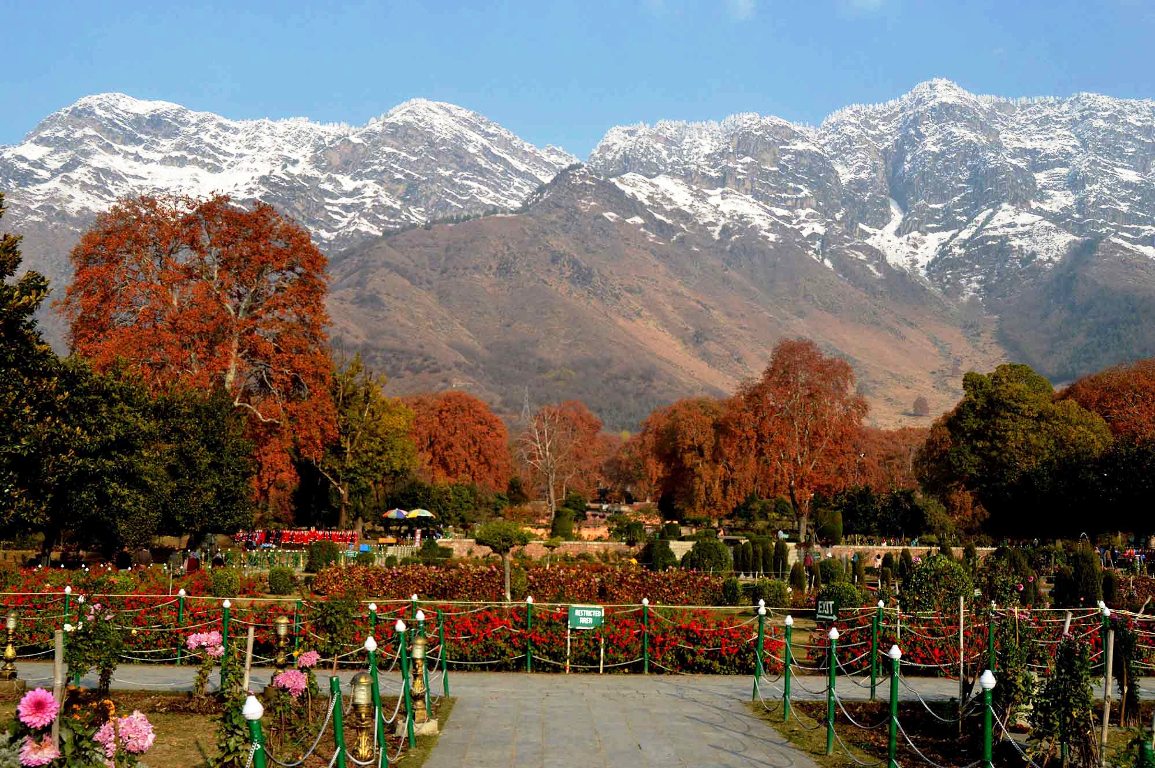
The garden’s vantage point offers a splendid view of the Dal Lake, the Khi Sulaiman (Shankar Acharya Hill), and the Hari Parbat Fort. The grand look of the snow-capped Pir Panjal mountain range on the far side of the Lake is a sight to behold.
Distinct Architecture
The picturesque Nishat Bagh is one of the most celebrated tourist attractions in Srinagar, renowned for its distinctive architectural style. The garden’s upkeep is a collaborative effort between the Department of Floriculture and the Department of Tourism.
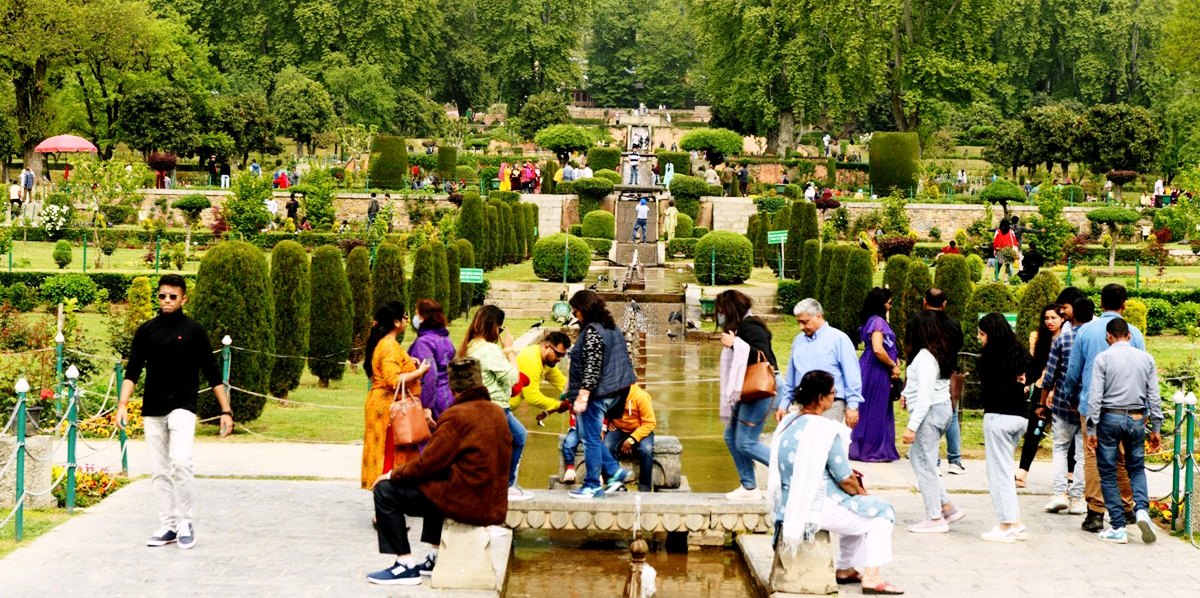
A notable feature within the garden is the flower nursery, meticulously maintained. It is a testament to the garden’s commitment to preserving its natural beauty. Unlike the Shalimar Bagh, which Emperor Jahangir founded as a royal retreat, Nishat Bagh was originally owned by Asaf Khan, a nobleman and a prominent figure in Jahangir’s court.
As visitors approach the garden, they are greeted by steel frames affixed to the walls, inscribed with the chronicles of Nishat Bagh. Within the garden, makeshift stalls offer visitors the opportunity to don traditional Kashmiri attire and have their photographs taken, providing a memorable experience amidst the garden’s breathtaking beauty.
An Impressive Garden
Nishat Bagh, an exemplary model of Mughal architecture, stretches from the shoreline of the Lake to the base of the Zabarwan hill. The garden’s rectangular layout, measuring 548 metres in length and 338 metres in width, spans an impressive 20 hectares in an east-west direction. This carefully designed layout is based on the concept of Chaharbagh, a Persian-style quadrilateral garden featuring four sections separated by waterways, commonly found in countries across West Asia, South Asia, and North Africa.

The garden’s original design comprises twelve majestic terraces, each representing a Zodiac sign. The twelfth and final terrace was intended as a private enclosure for women, known as the Zanana section. This secluded area is protected by a high retaining wall, with a single arch opening providing access. Two octagonal watchtowers, positioned on either side of the twelfth terrace, offer a panoramic view of the lower terraces. These watchtowers served as a means of surveillance, restricting access to the female section while allowing women to observe the surroundings.
The twelve terraces are interconnected by stairways and ramps on either side of the water chutes. Each terrace boasts an array of features, including gushing cascades, serene pools, picturesque Chinar vistas, shady cypress trees, and vibrant flowerbeds.
The second and third terraces of Nishat Bagh are particularly striking, lined as they are with Persian lilacs, pansies, and an abundance of sparkling cascading water tubes that flow over the central basal chute. The water source originates at the hill end of Zabarwan Mountain, invigorating the garden through an axial stream that descends into the Lake. As the water flows from one terrace to another, it transcends through polished stone chutes, adding exuberance to the flow. The head of almost every waterfall is capped with a stone or marble throne, inviting visitors to pause and contemplate this architectural marvel.
Nishat’s history dates back to the Mughal era, modelled as it is on peculiar Persian architecture. Designed and built in 1634 AD by Mirza Abul Hassan, alias Asaf Khan, the elder brother of Nur Jahan, wife of Emperor Jahangir, the garden is a testament to the era’s grandeur. Asaf Khan was also the father-in-law of the great Mughal monarch Shah Jahan.
A Shah Jahan Tale
A remarkable anecdote from the garden’s past recounts the jealousy of Shah Jahan upon its completion. He reportedly considered the garden a momentous and grandeur tribute to Asaf Khan, far surpassing his accomplishments. Shah Jahan had hoped that Asaf Khan would bestow the garden upon him, but when no such offer was made, the emperor became provoked. In a fit of pique, Shah Jahan decreed that the water supply to the garden be cut off, leaving it to wither and die. The garden remained closed and deserted for some time, much to the devastation of Asaf Khan.
The garden’s abandonment eventually came to an end when one of Asaf Khan’s servants, disobeying the court order, reinvigorated the garden by turning on the water supply once more. Rather than being annoyed by this transgression, Shah Jahan was reportedly impressed by the servant’s loyal service to his master.
A lesser-known aspect of the garden’s history is the presence of the tomb of Princess Zuhra Begum, the daughter of Mughal emperor Alamgir-II and the granddaughter of emperor Jahandar Shah. This poignant reminder of the garden’s rich heritage is a testament to its enduring significance.
Suffering Garden
The Bagh has endured a tumultuous history, having suffered vandalism during the governorship of Afghan Subedar Amir Khan Jawan Sher from 1770 to 1776. However, Subedar Azeem Khan undertook repairs in 1830. Further interventions and restorations were carried out during the Dogra reign. Post-1947, several alterations and demolitions were undertaken, including the demolition of two pavilions in the garden in the 1970s. Additionally, the bottommost terrace, which once linked the garden to the lake, was paved into a road in the early 20th century.
A stroll through the Nishat Bagh is a sensory delight. The ornate lawns, adorned with flowers of distinctive varieties, bushes, and eccentric Chinar vistas, are set against the majestic backdrop of cypress trees and polished water chutes. As the sun begins to set, the garden’s picturesque setting is bathed in a warm, golden light, as the sun sinks slowly into the far end of the Dal Lake. Visitors can experience this splendour firsthand, as the garden remains open from 9 am to 7 pm throughout the year. While the garden attracts tourists in all seasons, it is usually thronged during the summer and autumn months.
The Autumn
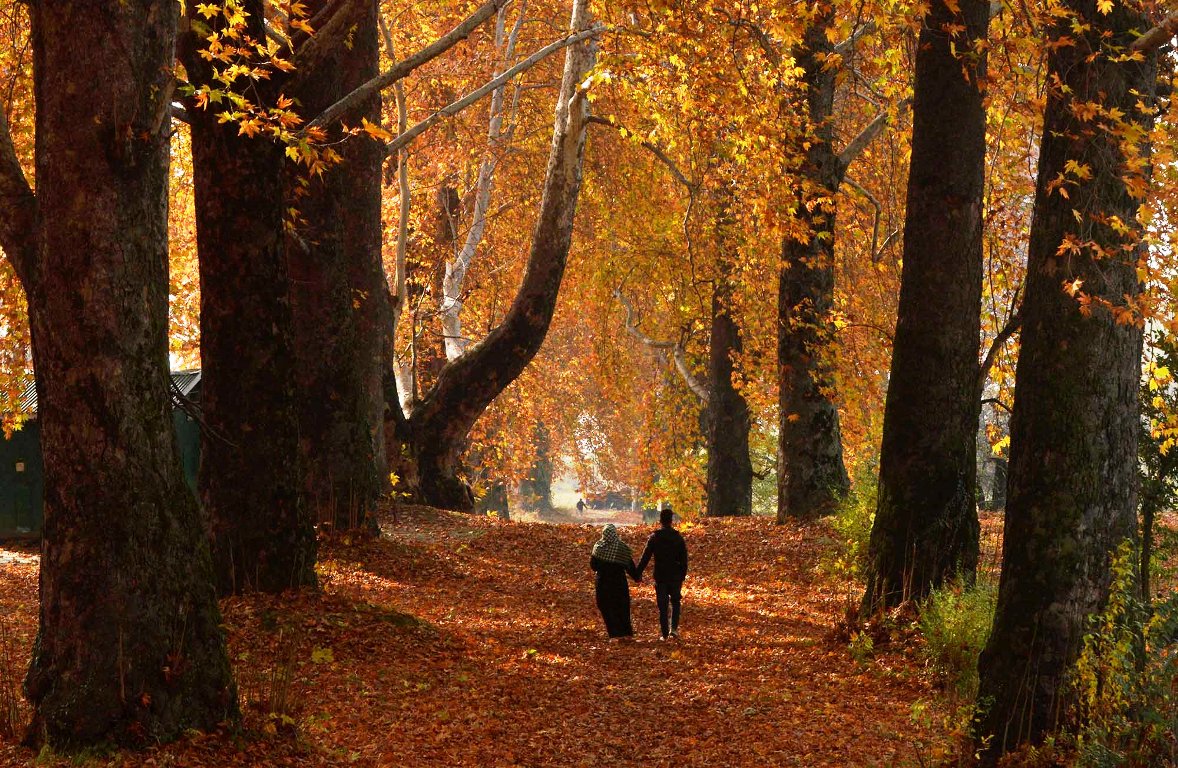
Autumn brings a new dimension of beauty to Nishat Bagh, as the golden Chinar leaves to create a vibrant and eye-catching spectacle, attracting locals and tourists alike to witness the fall season, locally known as Harud. The garden’s strategic location also makes it an ideal starting point for exploring other nearby tourist attractions along the famed Boulevard Road and Fore Shore Road. A short stroll or a leisurely Shikara ride from the Nishat front can take visitors to other notable destinations within the Dal Lake, including the Lotus Lake, Lilly Garden, Meena Bazar, Kabutar Khana, Mughal Gate, Golden Lake, Vegetable Market, Nehru Park, Char Chinar, and Floating Garden.
Located at the rear end of the garden is the mausoleum of Hazrat Syed Baba Ibraheem Balki, which is meticulously maintained and cared for by the Intizamiya Committee Astan Alliya Nishat. Facing the Nishat Bagh is the camel-hump-shaped bridge, known as Oont Kadal, which dates back to the 1670s and is an integral part of the Mughal landscape, strategically located in the middle of the lake on the north-south axis.