A year after the Baisaran massacre, authorities readied a 57-day Yatra with tighter security, upgraded infrastructure and record pilgrim registrations, reports Babra Wani
A year from the horrifying Baisaran massacre that claimed 26 lives, both authorities and civilians are preparing for Kashmir’s largest annual yatra with unprecedented security, expanded infrastructure and digital surveillance. The 57-day pilgrimage is set to commence on July 3, third and will conclude in the last week of August.
Future Vision
Speaking at an International Conference on the Yatra, organised by Government Degree College for Women, Anantnag, LG Manoj Sinha said the pilgrimage is poised to emerge as a major centre of global spiritual tourism in the coming years, revealing that extensive infrastructure upgrades, digital transformation and improved pilgrim facilities introduced over the past five years have laid the foundation for taking the annual pilgrimage to an international level.
He highlighted online registration, RFID and GPS-based monitoring systems, camera surveillance across the route, digital information systems and modern communication technologies used in improving safety and transparency.
Sinha revealed that major infrastructure improvements were carried out in last three years. The Baltal and Chandanwari tracks have been widened to 12 feet, illuminated for night movement, and are inspected and repaired every night during the Yatra period. Ambulances have also been stationed at designated locations along the route to strengthen emergency response mechanisms.
He said the Yatra is an important economic driver for the region. He also stressed the need for balancing development with environmental conservation, asserting a zero-waste Yatra remains a key objective, with initiatives such as organised waste collection systems, 100 per cent waste recycling campaigns and the Bring Plastic, Take a Bag programme being implemented to minimise environmental impact.
Security Exercise
Yatra is a security intensive exercise. In wake of the 2025 massacre, the security grid has taken extraordinary steps to ensure the yatra is incident free.
Reports appearing in the media suggest that around one lakh security personnel from the Army, CRPF, BSF, ITBP, SSB, Jammu and Kashmir Police and other security agencies have been deployed under a multi-layered security grid. The security architecture has been reinforced with the induction of the Special Frontier Force (SFF), 22 sniper teams positioned at strategic locations, elevated observation posts (Machan Morchas), bomb detection and disposal squads, canine units, and 45 Joint Mountain Rescue Teams deployed at 21 locations along the Baltal and Pahalgam routes. A comprehensive traffic management plan, convoy regulation system and a no-flying zone over the entire Yatra area are also part of the security framework.
Technology forms a key component of this year’s security strategy. Under Project Hawk Eye, more than 400 CCTV cameras, surveillance drones and Facial Recognition Systems (FRS) have been integrated into a central monitoring network for real-time surveillance of the pilgrimage routes and base camps. QR code-enabled pilgrim identification and RFID-based monitoring systems have been introduced to streamline movement and enhance security, while continuous weather monitoring and regular advisories will help regulate pilgrim movement in response to changing conditions.
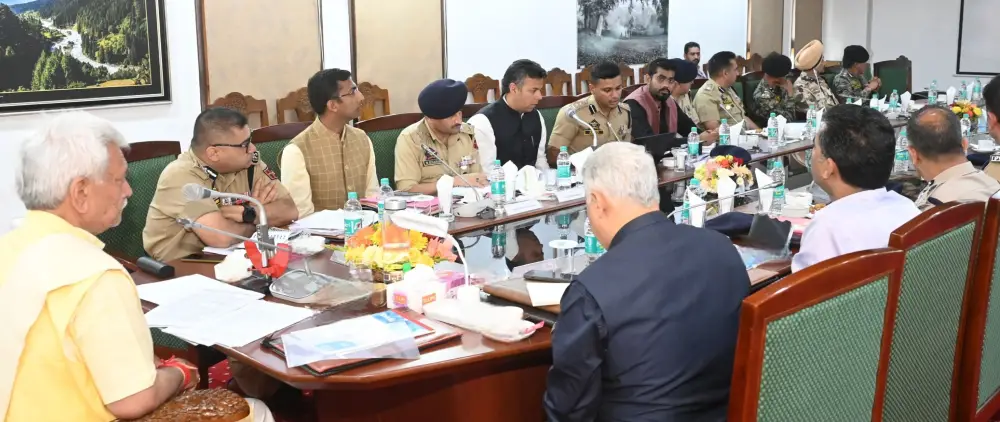
Manoj Sinha, while chairing a high-level review meeting at Pahalgam to assess preparations for the annual Yatra, directed all departments to ensure seamless arrangements, fool-proof security and a safe pilgrimage experience for devotees. “Management of the Yatra requires a comprehensive, hybrid planning approach with an absolute zero-tolerance policy for operational lapses. Operations must aggressively mitigate the risks associated with high altitudes, harsh weather and extreme crowd density,” he said.
Stakeholder Registrations
Kashmir Divisional Commissioner Ansal Garg said the pilgrim numbers look set to increase this year. “The advance online registrations are approaching four lakh, although the exact figures are maintained by the Board,” he said. “Another contributing factor is that this year’s pilgrimage will continue for 57 days, whereas last year’s Yatra lasted 37 days. Naturally, the longer duration is expected to result in a higher number of pilgrims.”
Authorities said they have registered 29,073 service providers across Jammu and Kashmir and neighbouring districts by the third week of June. These include 14,985 pony handlers, 9,043 palki carriers, 3,837 pithu operators, and 1,208 hawkers, all of whom play a crucial role in facilitating the annual pilgrimage.
Anantnag accounted for the highest number of registrations, with 8,635 service providers, including 6,391 pony handlers, 1,157 pithu operators, 618 palki carriers, and 469 hawkers. The district serves as the principal gateway to the traditional Pahalgam route of the pilgrimage.
Besides, Reasi registered 4,917 service providers, followed by Rajouri with 3,598, Ganderbal with 3,015, and Ramban with 1,886. Kupwara also recorded a significant 1,551 registrations, while Budgam accounted for 956. In contrast, districts such as Kargil and Samba recorded only a handful of registrations, reflecting their comparatively limited involvement in the pilgrimage.
Ground Arrangements
“Every year, we make incremental improvements to the arrangements for the Shri Amarnath Ji Yatra. This year is no exception, with several key facilities being significantly enhanced compared to previous years,” Divisional Commissioner Anshul Garg said.
He said the expansion of registration infrastructure is a major improvement. The number of on-the-spot registration counters as well as e-KYC counters has been increased substantially. “In fact, the capacity has almost doubled in comparison to last year.” More than 100 registration and e-KYC counters are operational across four districts, and for the first time, registration counters will also be established at the Nowgam Railway Station, to make the process more convenient for pilgrims arriving by train.
On healthcare, he said medical facilities along the twin routes have been strengthened. “The Health Department is procuring dedicated four-wheel-drive ambulances for critical care,” he said. “These specialised ambulances will be deployed on the Yatra routes to ensure rapid medical response in difficult terrain and improve emergency care for the pilgrims.”
In Srinagar, an Integrated Command and Control Centre has been established to monitor the entire exercise in real time. CCTV cameras installed along both routes have been integrated with this centre, and nodal officers have already been appointed to oversee its functioning.
Garg said the Yatra tracks are tiled at various stretches and hand railings were raised at vulnerable locations. “We have also deployed specialised mountain rescue teams along both routes for disaster management, emergency response, and evacuation operations should the need arise.”
More than 7000 toilets have been installed along the twin routes. Besides, 100-bedded hospitals at both base camps have been set up with doctors, nursing staff and gynaecological teams assigned duty rosters. “Pilgrims will also receive regular weather advisories through display boards at the base camps. Updates will be issued daily and, whenever required, every three hours depending on changing weather conditions,” he added.
Garg revealed that while many of these arrangements are undertaken every year, the scale has increased considerably this time. “For instance, we will have more display boards than before, the number of toilet facilities has been increased by approximately 15 per cent, and the number of registration counters has more than doubled.” Another improvement is the availability of filtered RO drinking water, earlier available roughly every four kilometres along the track, now accessible at intervals of nearly half a kilometre.
Bridge Restoration
Ahead of the commencement of the pilgrimage, the Road Transport and Highways ministry announced the successful restoration of two flood-damaged bridges over the Ravi River and Sehar Khad near Kalibari on NH44. It restores a key transport link between Punjab and Jammu.
“The reopening of these bridges will ensure seamless connectivity, facilitate the smooth movement of passengers and freight, and provide substantial relief to devotees undertaking the annual Amarnath Yatra, while strengthening regional mobility and economic activity,” Nitin Gadkari said on X.
The administration in Jammu and Kashmir is already on maximum alert. Tension free movement is a top priority.
The police have issued a detailed public advisory urging yatris, tourists and the general public to strictly adhere to traffic regulations and security guidelines. Restrictions have been imposed on the movement of general traffic through the Navyug Tunnel during designated hours throughout the Yatra period. General vehicular traffic travelling from Kashmir towards Jammu shall not be allowed to cross the Navyug Tunnel before 11:30 am every day, while vehicles travelling from Jammu towards Kashmir shall not be permitted to cross the tunnel after 3:00 pm.
Specific cut-off timings have also been announced at various locations in the Kashmir Valley. Vehicles moving towards Srinagar and Anantnag from Mir Bazar have a cut-off time of 4:00 pm, while those proceeding towards the Navyug Tunnel must cross before 5:00 pm. Vehicles from Panthachowk, Srinagar, heading towards Ganderbal and Baramulla must cross before 3:00 pm, as must those travelling towards Anantnag.
At Shadipora in Sumbal, vehicles heading towards Manigam and North Kashmir must cross before 3:30 pm, while traffic moving towards Srinagar from Manigam has a cut-off time of 1:00 pm. Vehicles travelling from Manigam towards Baltal will be permitted up to 5:00 pm, while traffic towards Srinagar and North Kashmir must cross before 12:00 noon.
Police advised tourists and pilgrims to plan their travel schedules well in advance, commence journeys towards Kashmir before the stipulated cut-off timings, and keep adequate time margins for security checks, weather-related delays and traffic regulation measures. Commuters were further urged to follow instructions issued by the Traffic Police, Civil Administration and security personnel deployed along the route, to keep their vehicles adequately fuelled, and to avoid unscheduled halts during the journey.
Police said any tourist or traveller reaching designated cut-off locations after the prescribed timings shall be accommodated at the nearest designated Yatra camp for safety and security reasons. The department has appealed to the public to remain updated with advisories issued by Jammu and Kashmir Traffic Police through official websites, social media platforms and news outlets during the Yatra period. “Your cooperation ensures a safe and hassle-free Yatra,” the advisory stated, reaffirming J&K Police’s commitment to ensuring the safety and security of pilgrims and the general public throughout the pilgrimage season.