At a candid interaction, Kashmiri civil society members pressed Omar Abdullah’s government on governance failures and demanded full statehood restoration, reports Masood Hussain
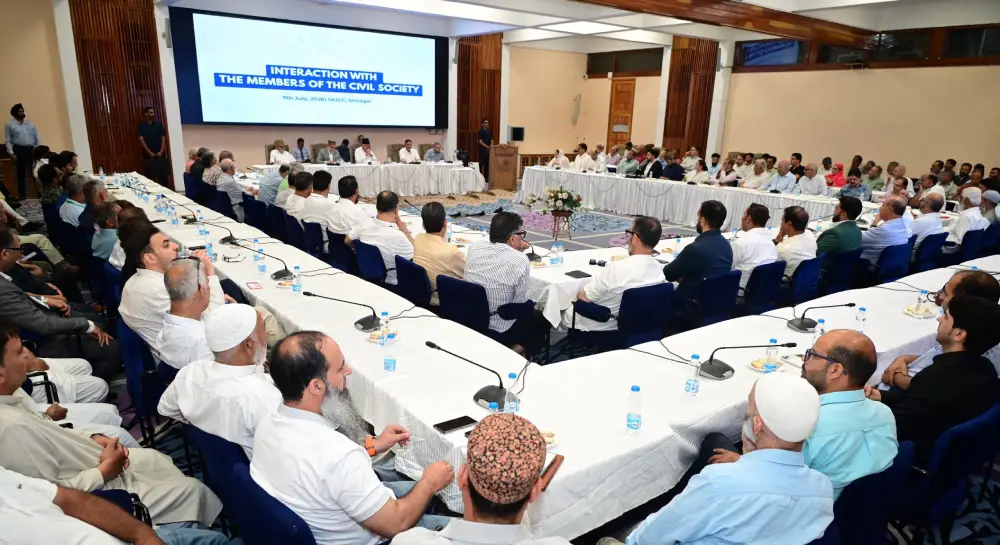
“Seemingly, you have grown politically weak, and that is precisely why you have called us,” industrialist Ashraf Mir bluntly told Dr Farooq Abdullah, a remark that may well weigh on his mind as he leads party workers and like-minded groups in demanding restoration of statehood in Delhi on July 20. The event in Delhi, an outcome of the party’s Dachigam meeting, is the first of its kind and is expected to be attended by all the like-minded from across the country.
Recalling the plight of aspiring entrepreneurs, he said many young people had begged, borrowed and pooled their savings to pay for industrial plots on which they hoped to build their futures. Yet, four years later, they are still waiting for allotment.
“For four years, they have been pleading for allotment, while your Industries Minister keeps moving around in a noisy cavalcade,” he said in an emotional outburst. “People gave you a sweeping mandate. They even voted for candidates they did not know because they trusted your leadership. And yet, this is the condition of our youth.”
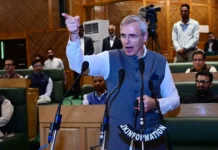
The assertions by the industry leader came minutes after the ruling Jammu and Kashmir National Conference leadership talked about the challenging situation in which the elected government is operating. Dr Farooq, Jammu and Kashmir’s five-time Chief Minister, his son Omar, and other party leaders had invited the Kashmir civil society to pass a resolution for the restoration of statehood. It was part of the party’s outreach amid criticism that inertia is the only constant of Kashmir’s grand old party.
The occasion, the second of such nature after Omar took over as the Chief Minister almost 19 months ago, emerged as the first one in which some of the invitees could freely express themselves. Omar ensured the television cameras were switched off so participants could speak candidly. Many invitees offered frank advice to a party that enjoys a commanding electoral mandate but is grappling with a growing governance and delivery crisis.
“We understand the challenging situation that Omar Sahab is in,” industry lobbyist Shakeel Qalandar said. “That is precisely why we do not disturb him much.”
Good Bargain
Despite the governance and political issues that various invitees highlighted, party insiders said it was not a bad bargain. The interaction gave the party a rare opportunity to gauge how sections of Kashmiri society perceive the political and social changes that have unfolded since August 5, 2019. It also served as an informal report card on Omar Abdullah’s 19 months in office. Many participants broke with the long-established culture of telling those in power only what they wanted to hear. Instead, they spoke candidly, drawing largely on their own first-hand experiences and observations.
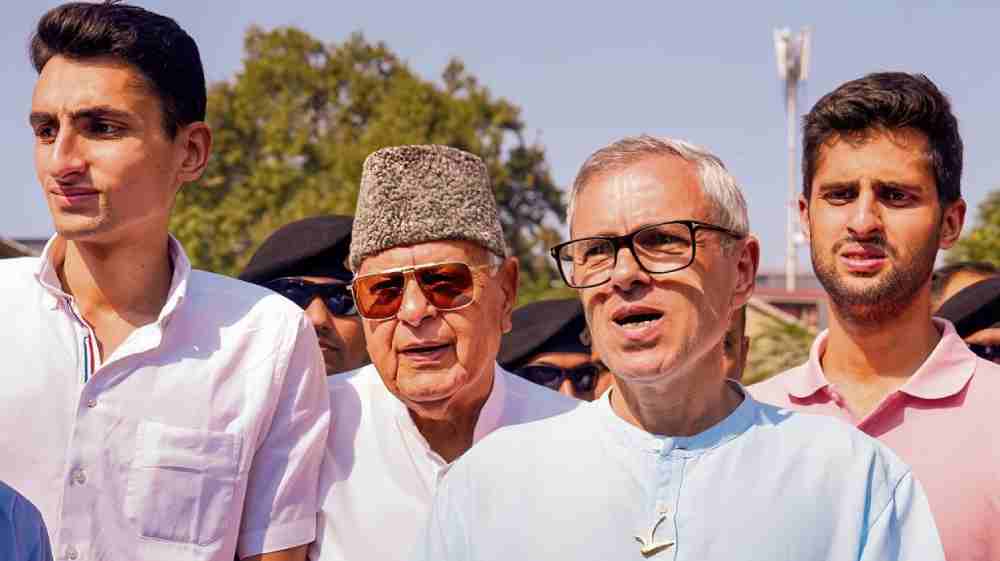
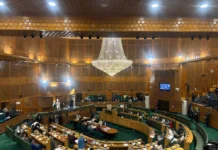
While many invitees chose not to participate in the discussion, some did speak. Those who spoke were former civil servants who reflected on the changes they had witnessed in governance. Others came from the trade and manufacturing sectors and described the difficulties they said they were facing because of what they viewed as the government’s restrained approach. What united nearly all the interventions was the view that the story of Kashmir being debated within the SKICC hall and beyond did not begin with the events of 2019. Rather, the developments after August 5, 2019, were seen as part of a much longer political and historical continuum.
‘Counter the Narrative’
Statehood issue apart, several participants insisted that the Omar government, with a massive mandate, has not done anything to counter the prevailing narrative.
Qalandar said an impression has been generated that Kashmir was won in 2019, which is incorrect. “The fact is that Jammu and Kashmir rejected the two-nation theory and acceded to a secular India voluntarily,” he said. He insisted that two individuals who must rise to the occasion and tell the truth are Dr Karan Singh and Dr Farooq Abdullah. “It was Dr Singh’s father who signed the accession documents, and it was Dr Abdullah’s father who supported it as a mass leader, and they must get in and tell the countrymen the real facts. Both of them have personally been part of the story.”
Former civil servant Naseem Lanker offered an interesting perspective, recalling how her generation absorbed Kashmir’s political history through the stories of veterans such as Sheikh Abdullah. “He was part of our lives,” she said. “Our parents would often use him as a reference point, telling us that when you were born, Sheikh Sahib had been dismissed, or that when you achieved a particular milestone, it was when Sheikh Sahib had done something significant.”
With both Sheikh Abdullah’s son, Dr Farooq Abdullah, and his grandson, Omar Abdullah, on the dais, the former Kashmir Commissioner drew a pointed comparison. “If Sheikh Sahib had been in the situation you are in today,” she said, “he would not have spoken about these issues here. He would have taken them to Gole Bagh (where the High Court was set up) or Lal Chowk.”
Qalandar pointed out that the narrative comprises the dignity of the people living in Kashmir. “We are being projected as terrorists, pro-Pakistan people and the ones who chased the Kashmiri Pandits away,” he said. “What stops the Omar government from locating the file in which a senior civil servant had suggested creating safe zones within Kashmir rather than permitting them to migrate? At least his government can reveal the names of people who rejected that idea.” He said the government has not been able to tell in as many words that the migration was not Pandit-specific, as tens of thousands of Muslims and Sikhs also fled. “Those who lived behind were in an unspeakable crisis.”
Issues of Identity
The narrative, some of the participants pointed out, was a factor behind the systematic disempowerment. “Go to the secretariat or the law-and-order machinery,” one of them said. “You do not find Kashmiris anywhere.”
“We do not have our rights even on our sand and bajri as the contracts were given to non-natives and now, they are not being renewed,” Qalandar pointed out. “This has led the stone crushing units to lack raw material, as a result of which your development story is at the slowest pace.”
Educationists and former president of the Private Schools Association GN Var said the curriculum has been ‘purged’ a lot in recent years. “We do not have Sheikh ul Aalam, Lal Ded, Sheikh Mohammad Abdullah and Agha Shahid Ali in our books now,” Var pointed out. “You have been told by the central government that statehood will be restored at an appropriate time, and we teachers face a crisis in classrooms explaining what ‘appropriate’ means. Now students ask us what democracy is all about, and we find it difficult to tell them that it is a government by the people and for the people.”
Var told the gathering that the younger generation is hugely impacted, and some of them are depressed.
Yes Minister
Some participants were blunt in conveying in too many words that successive governments in Jammu and Kashmir have hardly used the mandate to seek the rights for their people. “They thrust things upon us, and you go on legitimising them,” broadcaster Nayeema Ahmad Mehjoor said. “Ideally, government formation should have followed the restoration of statehood.”
Mehjoor said that under the Constitution of India, people in Jammu and Kashmir are the citizens of India and they have rights. “These rights need to be sought and negotiated, ankhoon main ankhain daal kar,” she said. “The civil society will support you as it always has, but you will have to gather the courage and give up the appeasement politics.” She suggested the JKNC leadership must share the problems they are facing in governance with the people, rather than ignoring them.
Industrialist Mir said the abrogation of Article 370 should not have surprised the political class in Jammu and Kashmir because they have been supportive of gradual erosion throughout. The erosion, he said, started in 1948 and the Indira Abdullah accord was ‘the last nail in its coffin’.

On Statehood
Former commissioner Lanker said that the issue of statehood is vital as it not impact the people who are living, but also those who are in wombs or in cemeteries. She said the people’s support is essential and will come, but the leadership should be in a position to articulate it better.
While tackling the legal aspect of the issue, former Chief Justice of the Jammu and Kashmir High Court Ali Mohammad Magrey suggested to the ruling party that they should go to the Supreme Court with a review petition. This, he said, while highlighting some of the issues that the bench had skipped to consider. His review was focused on the delay in the restoration of statehood, a promise made by the government and endorsed by the highest court in the country.
Khursheed Ahmad Ganai, senior IAS officer, who heads the Group of Concerned Citizens in Kashmir post-retirement, made two important points to Dr Farooq and Omar, whom he has served in different capacities. First, it impacts the reputation of the political class when they resort to mudslinging and slugfests against each other on social media. This, he said, is not in good taste. “There should be consensus in the political spectrum on the issue of statehood, and you must be united on it,” he suggested. “You said you would write to them and invite them to the Delhi event, but I would suggest inviting them and talking with them.”
Ganai’s second suggestion was about the members of the Parliament. “They have stature and the mandate, and they must start planned visits across the country and educate the people,” he said. “They must tell people how the reorganisation of Jammu and Kashmir has disabled the government the people elected.”
A Happy Ending
After discussing things for many hours, the gathering eventually passed a resolution that was read out to the gathering.
“The gathering unanimously adopted a resolution calling upon the Union government to restore full statehood to Jammu and Kashmir without any further delay,” a ruling party statement said. “The resolution reflects the collective and unanimous voice of the civil society representatives present at the meeting, reaffirming the broad-based demand for the immediate restoration of full statehood to Jammu and Kashmir.”
Later that evening, Omar’s tweet acknowledged the outcome of the day. “The meeting was extremely productive & Dr Sahib was able to get a lot of useful feedback and good suggestions,” he wrote. “The meeting passed a unanimous resolution calling on the Union Government to fulfil its promise & restore FULL statehood to J&K without further delay.”