While Srinagar’s conclave debated dignified return, government data now shows most transit flats built for Kashmir’s Pandit employees are still empty, reports Babra Wani
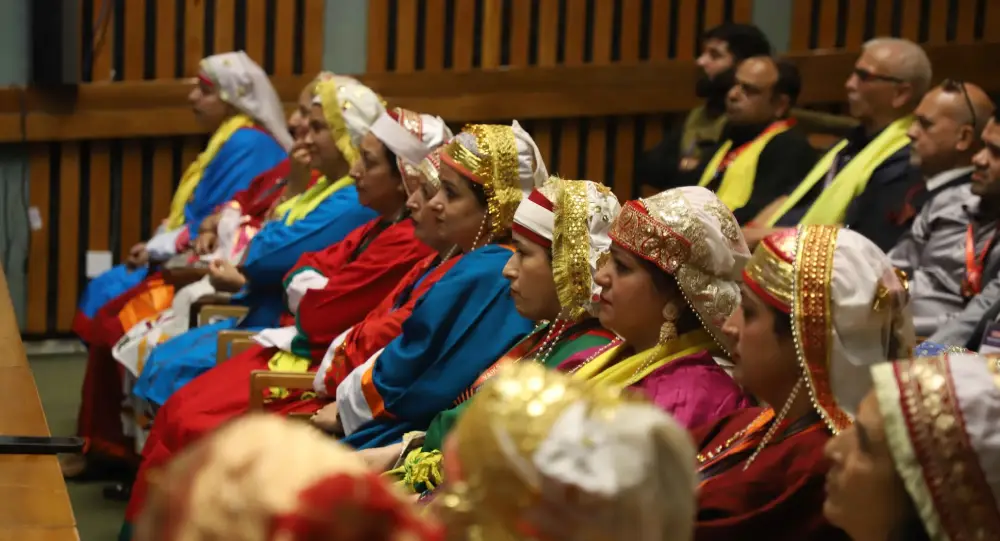
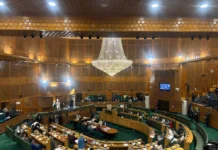
Thirty-six years after the migration that transformed Kashmir’s social fabric, scores of Kashmiri Pandits from India and abroad gathered on the banks of the Dal Lake for what organisers described as a historic exercise in reconnecting with their homeland.
The two-day SKICC Global Kashmiri Pandit Conclave brought together members of the community, policymakers, entrepreneurs, scholars and cultural figures. More than a commemorative event, it became a forum for one of Kashmir’s most enduring questions: whether conditions are finally emerging for the dignified return of displaced Pandits.
The gathering followed a week-long heritage tour in which nearly 100 members of the community travelled across the Valley, visiting Martand Sun Temple, Kheer Bhawani and other cultural landmarks. For many, it was their first visit since leaving in the early 1990s.
LG’s Speech
Addressing the conclave, Lt Governor Manoj Sinha described the event as a “moment of transformation” and called the return of displaced Pandits “the truest victory.” “Those once uprooted from their homeland return, and this homecoming is the truest victory,” he said, urging successful members of the community to invest in Jammu and Kashmir by establishing industries, educational institutions and cultural centres.
“The journey of the Kashmiri Pandit community has been scarred by genocide, exile and struggle. The community chose a different path. They refused to be defined by wounds and struggle. Instead, they transformed that pain into strength,” Sinha said, pointing to the community’s accomplishments in technology, medicine, finance, academia and entrepreneurship as evidence of resilience despite decades of displacement.
Beyond the official speeches, the conference revealed a more complex conversation within the community itself. Among the most discussed voices was that of Dr Surinder Koul, head of the Global Kashmiri Pandit Diaspora, who had taken part in the heritage tour. “Terrorism is no longer a fear factor in Kashmir. We drove from Kupwara to Srinagar in the middle of the night. We want to be part of the change,” Koul said. He went further, framing the return in terms of shared inheritance: “Kashmiri hospitality is world famous. We have no complaint against the people here. The Kashmiri Pandit is not the enemy of anybody here. We are one people.”
Koul, however, did not leave the community’s grievances unspoken. Referring to the 1990 exodus, he said: “There is one grievance with the people. When it was happening in 1989 and 1990, they saw nothing, heard nothing and said nothing. But we are not against them.”
The theme of reconciliation also surfaced in remarks by Nasir Aslam Wani, Advisor to Chief Minister Omar Abdullah, who announced that the government would move to revive the Apex Committee originally constituted during Omar Abdullah’s first tenure as Chief Minister to facilitate the return and rehabilitation of displaced Pandits.
“This conclave is fine, but beyond it, we have to sit together and talk. Some representatives from your side and some from our side will have to talk to each other and find a way,” Wani said, calling Kashmir incomplete without the return of its Pandit community. “The storm of 1990 impacted all. It affected both the communities and the resolution will also come together,” he said, adding that the government would approach both the Chief Minister and the Lt Governor to push for the committee’s reconstitution.
For many participants, the emotional weight of return outweighed the policy discussion. Sunil Kaul, who left Kashmir as a teenager and now lives in Punjab, said his visit had left him cautiously hopeful: “I must have been around 16 when we left Kashmir. The atmosphere and conditions here have certainly changed. The residents of this place want us to come back because our hearts still live here. The government has to see how our return can be sustained. We genuinely want to come back.”
Neerja Sadhu, who returned to her native Srinagar after more than three decades, described the visit in starker, personal terms: “I was from Rainawari. We have decided to come back and become part of Kashmir. Our ultimate dream is to settle here and die here.”
| State and Status of 6000 Flats for Migrant Employees | |||||||
| District | Location | Flats sanctioned | Approved cost (cr) | Funds Utilised (Rs Cr) | Completed | Alloted | Occupied |
| Bandipora | Odina | 480 | 104.18 | 63.38 | 432 | 327 | 267 |
| Barramullah | Fatehpora I&II. |
408 | 70.05 | 45.62 | 320 | 320 | 320 |
| Kupwara | Kulangambagh, Natnoosa sheikpora |
480 | 98.45 | 75.22 | 448 | 236 | 0 |
| Budgam | Kakanmaran, sheikhpora |
288 | 73.5 | 60.35 | 256 | 266 | 96 |
| Ganderbal | Babadaryadin, Wandhama |
384 | 352 | 75.59 | 352 | 116 | 102 |
| Srinagar | Zewan | 936 | 197.37 | 176.6 | 792 | 703 | 0 |
| Anantnag | Machbawan Ranbirpora, shangus |
896 | 203.15 | 139.07 | 579 | 579 | 0 |
| Kulgam | Chowgam Mirhama, vessu |
592 | 148.2 | 100.79 | 448 | 422 | 96 |
| Pulwama | Lethpora I& II. | 1104 | 243.7 | 148.42 | 480 | 155 | 0 |
| Shopian | Allowpora I& II. | 432 | 96.69 | 62.2 | 384 | 133 | 0 |
| Total | 6,000 | 1,325.84 | 947.24 | 4,648 | 3,257 | 881 | |
| Source: Jammu and Kashmir Government | |||||||
The Return Debate
The conclave also exposed continuing divisions within the wider diaspora over the pace and nature of return. Some organisations welcomed the gathering as a confidence-building measure; others argued that unresolved questions of security, justice, rehabilitation and recognition of past suffering remain central concerns that cannot simply be set aside in the language of homecoming.
The conclave itself was timed days ahead of another, far larger annual marker of engagement with Kashmir: the Kheer Bhawani festival on June 22, one of the most significant occasions on the Kashmiri Pandit calendar. For years it has been the practice to facilitate willing members of the migrant community in travelling to Kashmir for the festival, touring the Valley and meeting residents, and this year is no exception. Now, organisers anticipate more than 15,000 participants.
Set beside the conclave, the contrast is instructive: tens of thousands will make the festival journey this month, a temporary, devotional visit repeated annually with state facilitation, against the far smaller, far slower movement of families actually settling into the homes the government has built for permanent return. The conclave’s debate was about the latter.
Those unresolved questions have also begun to surface in legal and institutional forums, in ways that bear directly on the infrastructure story beneath the conclave’s speeches. Recently, the High Court of Jammu and Kashmir sought a government response to a petition seeking land in Srinagar for a dedicated housing colony for displaced Kashmiri Pandits, a plea for exactly the kind of general-purpose return housing that the existing transit accommodation scheme was never designed to provide.
Empty Enclaves
The two narratives of return are quite different. The debate at SKICC focused mainly on the global Pandit diaspora, while government rehabilitation efforts are aimed largely at displaced families seeking to resettle in Kashmir.
The transit accommodation scheme dates to November 2008, when the Centre announced the Prime Minister’s Rehabilitation Package for the return of Kashmiri Migrants. Unlike the open-ended return being discussed at SKICC, the Package was built around employment: 3,000 government jobs were sanctioned in 2009 for eligible Kashmiri migrants, with a further 3,000 approved in 2015, taking the total to 6,000 posts across 20 departments. Transit accommodation, broadly one flat per appointee, was conceived as housing tied to these jobs, not as general housing for any Pandit family choosing to come back on its own. Of the 6,000 sanctioned posts, appointment letters have gone out against 5,780; the remaining vacancies are still being reconciled.
The petition now before the High Court, in other words, is asking for something the PM Package scheme structurally cannot offer: land for families returning outside the government-employment channel. Whatever the court’s response, the gap that has surfaced between a housing scheme keyed to a payroll and a return debate that is really about the whole community runs underneath everything said at the conclave.
Against a sanctioned target of 6,000 flats across the Valley, 4,648 have been constructed, and 1,352 remain under construction, as of May 31, 2026. Of those completed, 3,257 have been formally allotted to employees. Just 881 are actually occupied.
That is the gap the conclave’s return debate runs into: even within the one channel where infrastructure is largely built, paid for, and allotted on paper, fewer than one in five completed flats have anyone actually living in them.
Read district by district, the pattern sharpens. Baramulla’s Fatehpora-I is at full occupancy; every allotted flat is occupied. Bandipora’s Odina is close behind, at 82 per cent of its allotments. But Srinagar’s Zewan, the single largest site in the programme at Rs 197.37 crore and 936 flats, has 703 flats allotted and not one occupied. Pulwama, the costliest district overall at Rs 243.70 crore approved, shows zero occupancy despite 155 allotments at Lethpora-I. Anantnag and Shopian show the same pattern: flats built, funds spent, allotment letters issued, and still empty.
Roughly Rs 947 crore of the Rs 1,326 crore approved across the programme has already been spent, about 71 per cent of the total committed cost, against an occupancy rate of under 15 per cent of all sanctioned flats.
Issues Involved
When asked, official sources pointed to some of the friction points behind the gap. About 1,600 PM Package employees could not be allotted flats in their actual district of posting, even where flats sit vacant elsewhere. This mismatch DMRRR has since tried to fix this through a revised allotment order in March 2026, after which over 1,000 fresh applications came in.
Allied infrastructure, water, power, internal roads, security dormitories, remains incomplete at several sites; at Natnoosa in Kupwara and Kakanmaran in Budgam. Some flats earmarked for return remain in the possession of security forces, a matter still pending with the Home Department.
The Yatra
The same official machinery handling these issues is, in these very weeks, also absorbed in a much larger seasonal mobilisation. With the Amarnath Yatra set to begin on July 3 for a 57-day run, DGP Nalin Prabhat has flagged off 45 specialised Mountain Rescue Teams deployed across roughly 21 to 25 critical points on the Baltal and Pahalgam routes. Besides, Northern Army Commander Lt Gen Pratik Sharma personally reviewed security arrangements along the Southern Route.
It is a useful reminder that the administrative and security bandwidth devoted to Kashmir’s pilgrimage and return calendar each summer is considerable, and that the Pandit return debate is only one of several claims on it.
As devotional chants once again echoed in the temples and ashrams visited during the heritage tour, many participants at the conclave spoke of the gathering not as a conclusion, but as the beginning of a renewed conversation about Kashmir’s shared future. “Our civilisation and heritage belong to everybody,” Dr Koul said. “We are coming as strangers to our own home after 36 years.”
Within a few days, thousands more will make the familiar pilgrimage to Kheer Bhawani, reaffirming a bond with Kashmir that has never entirely been severed. But if visits are no longer the problem, settlement remains one.
District records suggest that for a significant category of returnees, the state has already built much of the required housing. Yet years later, many of those homes remain empty, raising a more fundamental question: not whether Kashmir can accommodate return, but whether it has created the conditions for people to stay. It is this unresolved question that hangs over the far larger vision of return discussed at the conclave.