For young Kashmiris who inject drugs and live with HIV, two stigmas collide, and the shame decides whether they ever reach a hospital, reports Syed Samreen
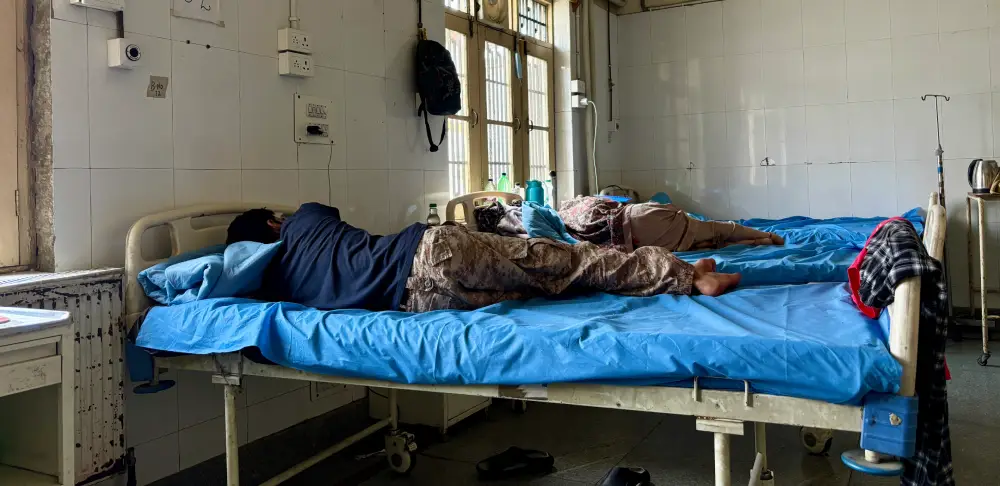
In a dim hospital room with four beds, 18-year-old Faizan lies on his side, staring at the wall. His brother sits at the edge of the bed, legs crossed, watching him closely. Faizan is being treated for substance dependence at a government hospital in Jammu and Kashmir.
Faizan is one of thousands of young Kashmiris who use substances. A 2016–17 Institute of Mental Health and Neurosciences (IMHANS) study on inhalant use found that adolescents made up nearly two-thirds of those studied. About 99 per cent were male and from middle-income households, and a quarter showed accompanying psychiatric conditions.
Substance use is deeply stigmatised in Kashmir, and living with HIV carries its own heavy judgment. For people who use drugs and test positive, the compounded shame dictates whether they seek medical care at all.
The ones who reach the hospital are treated as no less than deviants. Faizan said hospital staff told him to keep his utensils and belongings separate because “he has HIV.”
“I was hurt when I was told this,” he said. “I thought at least here they would not treat me like that.”
The othering of people living with HIV often amounts to a form of social exclusion, one that mirrors the old logic of untouchability. “Why are we treated as aliens?” Faizan said. “I started using substances when I was very young. I did not know what kind of repercussions it would have.”
Surging Numbers
A Right to Information query in 2025 revealed that Jammu and Kashmir recorded 2,071 new HIV cases and 66 deaths between 2019 and June 2025. The documents show new cases moving unevenly year to year: 361 in 2019-20, 206 in 2020-21, 272 in 2021-22, 374 in 2022-23, 338 in 2023-24, 403 in 2024-25, and 117 more between April and June 2025.
Jammu and Kashmir recorded 604 deaths related to HIV and AIDS between 2020 and 2024, according to figures the Ministry of Health and Family Welfare placed before the Rajya Sabha. Over the same period, the number of people living with HIV in the Union Territory grew from 3,806 in 2020-21 to 4,577 in 2024-25, with new diagnoses each year ranging between 174 and 284.
The First Time
Faizan said that when he was in tenth grade, he went to Punjab for a few days. There, someone offered him a joint (marijuana). He felt euphoria and a sense of disconnection from reality, soon escalating from one drag to five joints a day.
“Then heroin came to Kashmir and swept us all away with it,” Faizan said. “I started using it and depended heavily on it. I even exchanged syringes with other people. The kind of power it has over you, you do not care whether a syringe is new or used.” He said he had no awareness that injecting drugs with non-sterile equipment could expose him to HIV. “The people who introduced heroin to Kashmiri youth did not care about us injecting safely,” he said. “They just needed money, and we needed peace.”
According to the Centres for Disease Control and Prevention, HIV can be transmitted by sharing needles, syringes, or other drug injection equipment because used equipment may carry someone else’s blood. It can also spread through intercourse. In other words, injecting drugs with a shared needle is itself a direct route of transmission, no sexual contact required.
Aamir, who was standing in a clinic line to receive medication for substances dependence, bristled at the mention of HIV transmission. “What are you asking?” he said. “Do you mean I have been intimate with a girl? How can you say that? I might have HIV, but I have not done that. I do not want to tell anyone about it, please.” His reaction reflected a common misconception that HIV is contracted only through sexual activity.
Suffering Silently
In Kashmir, this belief adds a moral layer to the judgment faced by people living with HIV, said social worker Aasif Ahmad.
Ahmad runs a nongovernmental organisation in South Kashmir, counselling people who use drugs. He said he knew of a woman living with HIV and using substances who was kept locked inside her home. Her family prevented her from seeking rehabilitation, fearing that acknowledging her need for treatment would bring profound public shame. “Most women do not show up to rehabs because of the intense shame around substances and HIV,” Ahmad said. “It is almost impossible to find one you can even talk to about her situation.”
Mona Balani, a programme manager at the India HIV and AIDS Alliance, said that the prevalence of young people injecting drugs is increasing in northern India. “If you see the NACO data, you can see how young people are engaging in drug use, and STI screening and notification are also showing some increase. These are the evident factors where you can see the progressing prevalence among youth,” she said.
Balani said HIV prevalence is concentrated in specific geographic areas and demographics, but a lack of family awareness remains a universal hurdle.
“In the Northeast, the prevalence is among people who use drugs and live with HIV and female sex workers,” she said. “In the south, it is among female sex workers and men who have sex with men (MSM). In the north and northwest, there is mixed prevalence. There is not much awareness among the families. They don’t treat it as a condition.”
Because many families believe HIV is solely transmitted through physical relationships, they relate the virus directly to a person’s character. “If people living with HIV go to a public platform, they need to disclose their status,” Balani said. “They will never come out because they are afraid that an opportunity may be grabbed away due to the HIV status disclosure. They always hide it.”
In closely knit valley communities, the fear of disclosure makes people prone to hiding their status, she said.
Alternative Opinion
Some medical professionals offer a different perspective. Local doctors, speaking on the condition of anonymity, insist that HIV prevalence in Kashmir remains low compared to Hepatitis C, which is spreading fast among people who inject drugs.
But that leaves the harder question unanswered: how many reach a rehab or a clinic to be counted at all? How many are kept at home, told by their families to “heal” quietly, so the neighbourhood never learns and the shame never lands?
A low case count may not accurately reflect the true extent of HIV in Kashmir. It may only reflect how few of those living with it were ever allowed to be seen.
Language matters when we talk about people living with HIV. Words can either restore a person’s dignity or deepen the shame that already keeps them from care. The terms below reflect how those living with HIV ask to be addressed, and the ones that quietly wound.
The Terminology
According to the UNAIDS terminology guidance 2024, stigma is defined as a process of devaluation that discredits a person in others’ eyes, and notes that women and gender-diverse people living with HIV often face compounded stigma. When stigma is acted upon, it becomes discrimination. “Internalised stigma” or “self-stigma” is when a person absorbs those negative attitudes and applies them to themselves.
Say “person who uses drugs” or “person who injects drugs,” not “addict,” “drug abuser,” “drug addict,” “injecting drug user,” or “intravenous drug user.” The person comes before the behaviour. “Person with drug use disorder” is also acceptable in clinical contexts.
Say “person living with HIV,” not “AIDS patient,” “AIDS victim,” “AIDS sufferer,” “AIDS carrier,” “HIV-infected,” or “transmitter.” Many people feel these terms reduce them to a virus or a source of contagion.
Say “acquired HIV” or “living with HIV,” not “infected with HIV.” “Patient” applies only in a clinical setting where the person is actually receiving care.
Distinguish HIV from AIDS. Write “HIV and AIDS,” not “HIV/AIDS.” HIV is the virus; AIDS is the most advanced stage of the disease, which may never develop. Because of treatment, it is usually more accurate to say HIV than AIDS.
Say “human immunodeficiency virus” or “HIV,” not “AIDS virus” or “HIV virus” (the V already stands for virus).
Say “use of non-sterile injecting equipment” or “multi-person use of injecting equipment,” not “needle sharing” or “needle/syringe sharing.” Use “contaminated injecting equipment” when indicating actual transmission occurred, and “non-sterile” when indicating risk of exposure.
Say “sterile” and “non-sterile” injecting equipment, never “clean” and “dirty.” Calling equipment “dirty” carries the same moral charge that calling a person “dirty” does, which is exactly the stigma your story documents.
Say “modes of transmission,” meaning how a person most likely acquired HIV, rather than any language implying fault or blame.
Say “key populations” or name the specific group, not “high-risk groups,” “most-at-risk populations,” or “risk groups.” People are not risky by identity; certain practices carry risk.
Avoid “groups at risk” and “risk groups” entirely. Describe the practice that creates risk, not a category of person.
(Some names have been changed to protect the identity and safety of those interviewed. This story was produced as part of the Thomson Reuters Foundation’s Breaking Down Barriers to Healthcare programme, which focuses on the barriers key populations face in accessing healthcare for HIV, tuberculosis, and malaria across South Asia.)