In Kashmir, transgender people with HIV face compounding stigma, discrimination, and isolation that silences them and blocks access to Health care, reports Bisma Farooq Bhat
On a sunny morning in Srinagar, Sobiya (name changed) agreed to meet at Lal Chowk. The meeting was scheduled for noon at a local café. Shortly before the appointed time, she called to say she would be delayed by another 30 minutes.
As the wait stretched on, her Instagram profile offered a glimpse into her world: one video showed her in a home kitchen garden, absorbed in the quiet rhythm of nurturing plants. Like her social media presence, Sobiya’s life reveals many layers: moments of joy, fragments of struggle, and traces of a journey shaped by her identity as a transgender woman in Kashmir. Sobiya uses she/her pronouns.
After 30 minutes, she arrived. While sipping a cup of Kehwa, a spiced Kashmiri green tea, she explained that the delay was due to a morning shopping trip during which she had bought a floral dress.
She twirled in her dress, then let the smile fade as she began to talk about living with HIV. Diagnosed four years ago, she has spent every day since fighting for access to the health care she needs.
Her story reflects a broader crisis. In Kashmir, transgender people living with HIV navigate a compounding stigma, from their gender identity and their diagnosis, that health workers and researchers say drives underreporting, discourages treatment-seeking, and leaves a vulnerable population outside the reach of public health systems.
A study on the quality of life of transgender people in Kashmir documented those challenges. Researchers Sana Majid and Dr Yasir Hamid Bhat found that discrimination and violence significantly affect the quality of life of transgender people in the region, citing reports of harassment, emotional abuse, sexual violence, and exclusion from both public and private spaces. The result, the researchers noted, is an environment of fear and insecurity shaping nearly every aspect of their lives.
A Different Childhood
“My brother never helped with household chores, but he was always the one everyone adored,” Sobiya said. “And I was the one who got beaten,” she paused briefly before continuing. “I must have been around four when I started playing with dolls and wearing my sister’s clothes. That’s when it began; my family started treating me differently.”
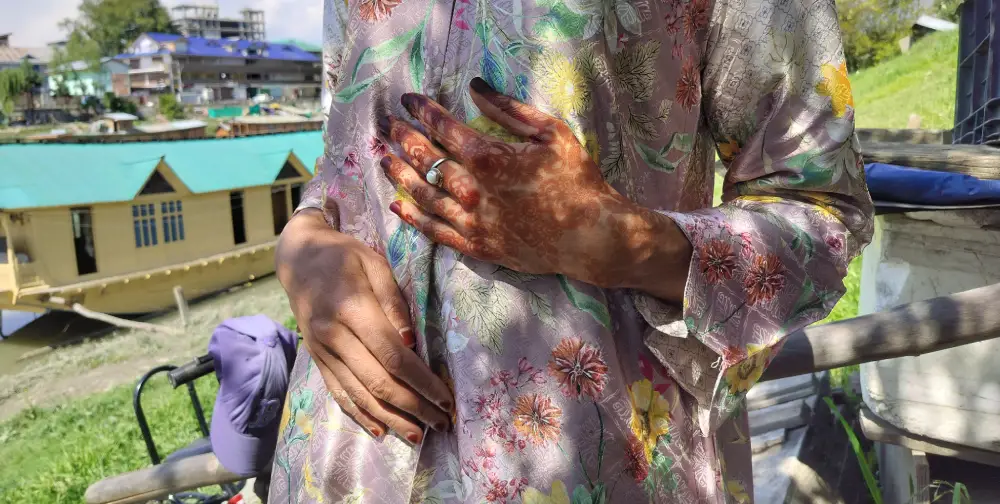
Looking down at her hands, tracing the henna patterns absentmindedly, she added: “He didn’t even do well in school, and I was always the one who studied hard. But it didn’t matter. I was still the one who faced the anger of my family.”
Speaking with quiet detachment, Sobiya said love was never something she received at home, and over time she stopped expecting it. From the age of four to 15, she said, she was subjected to repeated sexual abuse. Despite this, she held on to her education as a source of strength. Passing her 10th-class examination became a turning point, giving her the confidence to resist. At 15, she chose to live life on her own terms in Kashmir, apart from her family.
A Meeting in Bangalore
In 2019, Sobiya travelled to Bangalore for training in hotel management. It was there, she said, that she met a man who identified himself as a doctor and began pursuing her. He repeatedly asked to meet in person; at first she refused, but over time his persistence and her own growing curiosity drew her in.
“He would say he was deeply in love with me,” she said. After several months, she agreed to meet him.
What followed, she said, was deeply disturbing. During their first meeting, the man offered her a drug injection for what he called a “transcendental experience”. Trusting him, she agreed. The next thing she remembered was waking up three days later.
“When I came to my senses, I had no energy. My body felt numb,” she said. Alarmed, she asked him to take her to a hospital. He agreed, but only on the condition that she would not tell anyone what had happened. “He gave me Rs 5,000 after a few days, and I returned to my rented room,” she said. “Soon after, I wanted to get high again. I used the money to buy drugs and quickly became addicted.”
Diagnosis
In 2022, she went on a date with a man. “We were sexually active and used drugs together,” she said. “After physical intimacy, he went to the washroom to get a drug injection.” Sobiya said she believes she contracted HIV through a needle her date had used before her. “I didn’t meet anyone else before or after this meet-up,” she said. “Within a few days, I fell ill and developed a high fever. My doctor recommended body tests, and the HIV results were positive.” She had the test confirmed at three other facilities.
“That was the time my world came crumbling down,” she said. “After a few minutes, I gathered myself and murmured to myself – it’s just an infectious disease, the world has not ended.”
As her drug use deepened, her health deteriorated. After two months she returned home and sought treatment at the Sheri Kashmir Institute of Medical Sciences (SKIMS), where doctors placed her on antiretroviral therapy (ART) and prescribed three months of medication. Sobiya asked for a six-month supply instead, she said, because visiting the hospital was difficult, she faced stares and noticeably different treatment each time, particularly in the HIV ward.
Ali Mohammad, an outreach worker under the Vihan Project, a care and support programme approved by the National AIDS Control Organisation and supervised by J&K AIDS Control Society, said: “I have almost 15 to 20 transgender people registered in my database who are getting treatment for HIV.”
Hiding in Plain Sight
Back home, Sobiya sought treatment while hiding her diagnosis from her family, friends, and the wider community, visiting the hospital alone and moving through the wards as if nothing were wrong.
“If anyone comes to know that I’m HIV positive, I won’t be allowed to enter the mosque,” she said. “I go to the mosque and behave like a male, wearing a cap and doing my hair.” At home, she locks the door before taking her medicine, fearing how her parents would treat her if they discovered her status.
“They face discrimination everywhere,” Ali said. “When a transgender person living with HIV goes to the hospital for treatment, it is written on their card that they are HIV positive. They are unfortunately being highlighted, which creates a problem. Healthcare providers, while taking samples, see them with difference. I sometimes accompany them, and I’m being seen as the same. I’m also being treated differently, seen as a carrier of infection. People stay away from them as if they stink badly. This is the kind of discrimination they face.”
Threats and Resilience
Despite the challenges, Sobiya continued to build a life for herself, including a presence on social media. One day she uploaded a video, her voice firm and resolute, saying she wanted to return to her world. Behind that declaration, however, was fear.
“I was being threatened with death,” she said. “Someone even sent me a photo of a gun, telling me to quit what they called my ‘fake life.’ They accused me of being an agent trying to spread homosexuality in Kashmir. They told me, ‘you want to spread this virus in Kashmir.'”
“My family then asked me to upload a video on social media saying that I am actually a man, and to change my voice,” she said, briefly thickening her tone to mimic what was expected of her. “I did it. But after some time, I realised nothing would change. So I returned to my original self.”
Ali said that in Kashmir, many people believe a transgender person has no religion, and discriminate against them on that basis. Sobiya said dedicated care at ART centres would help. “There should be doctors available at ART centres so we don’t need to go among other patients,” she said. “They see us differently.”
A System Under Strain
Dr Rouf H Tak, a consultant in internal medicine and rheumatology in Srinagar, said managing HIV among transgender patients in Kashmir presents challenges distinct from those in better-resourced health systems. “The most significant impediment to effectively managing transgender individuals is not lack of viable treatment modalities, but a deep-rooted social bias that inevitably excludes transgender people from the main stratum of society,” he said.
Hamidullah Marazi, former Head of the Department of Religious Studies at the Central University of Kashmir and Head of the Department of Islamic Studies at the University of Kashmir, now Visiting Professor of Theology at Aliah University, said religious leaders in Kashmir hold significant influence over public attitudes but rarely address transgender issues in their Friday sermons.
“They shape the thinking of people, but they lack engagement with the most important issues, such as transgender issues,” he said. “Trans people should talk openly about their issues, and people should come forward and listen to them. Family should support them because they are also the creation of God, and we have to accept them. The family should give them love and care so that they won’t be deprived of what is their basic right in Islam. They have to treat all their kids equally, whether they are trans or not.”
During a recent visit to the doctor for an intestinal infection, Sobiya said she was sent from counter to counter, with doctors barely speaking to her. “I ended up treating myself,” she said, a decision that led to an allergic reaction, illustrating, she said, the cost of discrimination within the healthcare system.
The Government of India has allotted funds for HIV patients, payable at Rs 1,000 rupees ($11) per month per individual. Sobiya said the payments had not been disbursed this year. “We have already submitted the complete list of eligible HIV patients to GMC Srinagar. The Government of India releases the funds to GMC Srinagar for disbursement. Our role is to provide the list of beneficiaries. Once the funds reach GMC, they decide how the disbursement is carried out and who receives the assistance,” said Dr Tabassum, Deputy Director of JKACS.
What Remains
HIV took away Sobiya’s dream of becoming a flight attendant. She now wants to open a poultry farm, though the thought of relapsing shadows that ambition too. Whenever she falls sick, she goes to the doctor alone; she never lets any family member accompany her, fearing they will learn she is HIV positive and that her life will change irrevocably.
“I want to have a partner but let’s see who accepts me as I am,” she said.
Looking over the Jhelum River, she stood and walked back into the city.
“This content received support from the Thomson Reuters Foundation as part of its global programme aiming to strengthen free, fair and informed societies. Any financial assistance or support provided to the journalist has no editorial influence. The content of this article belongs solely to the author and is not endorsed by Kashmir Life or associated with the Thomson Reuters Foundation, Thomson Reuters, Reuters, nor any other affiliates”.