In an investigative portrait of Qazigund’s hollow slaughterhouse, Insha Yousuf reveals how backyard butchery, administrative failure, and blood-soaked drains are quietly devastating Kashmir’s public health and ecological safety
The air in Qazigund usually carries the scent of woodsmoke and damp earth, but inside the kitchen of Mohammad Yousuf Khan, it is thick with the deep scent of slow-simmering mutton. Khan is a Waza, a master chef who knows the intricate art of preparing Wazwan, Kashmir’s seven-course mutton feast. For twenty years, his life has been measured in the rhythmic thud of a wooden mallet against fresh mutton. It is a sound that signifies the heartbeat of a celebration.
But now, as Khan prepares for a local wedding, his hand movements lack the exuberant energy of his youth. There was a clinical, almost sombre precision to how he handled the meat. Something is seemingly amiss.
“I have been doing this for twenty years,” Khan said, leaning against a soot-stained wall. “But between the old days and today, there is a difference like the earth and the sky.”
Khan is not just mourning the passage of time; he is lamenting the loss of trust. In old Kashmir, a wedding feast would begin months in advance in the backyard of the host. The animal was a domestic companion, raised under the watchful eye of the family, fed on clean grass, and known to be free of disease. Today, that intimacy has been replaced by a cold, anonymous supply chain.
“Today, we don’t know the animal. We don’t know what it ate or how it was treated,” Khan lamented. “No matter how many spices I add, I cannot cook away the loss of trust. The maza (taste) isn’t just in the salt; it’s in the soul of the meat. And that soul is being stolen from us.”
Shell of a Space
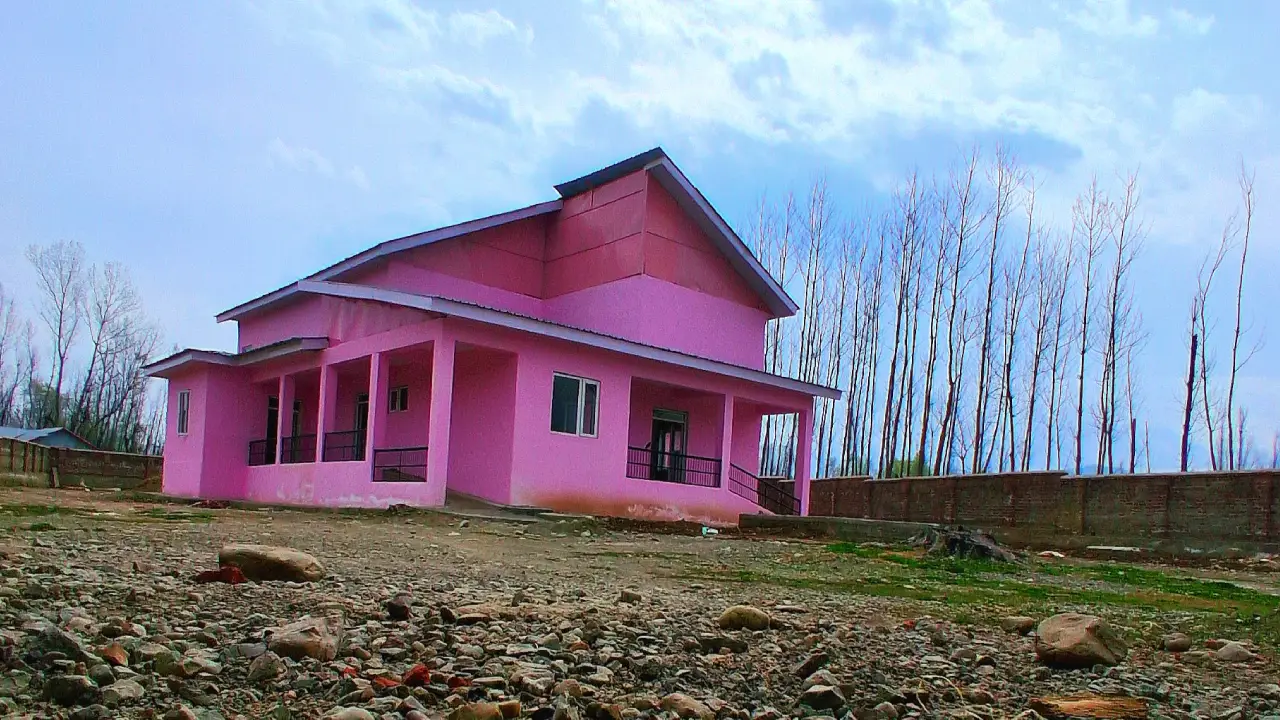
To understand the Waza’s crisis, one must drive to Qazigund’s Gagadanji area, where a building stands as a monument to administrative irony. It is a recent, modern structure, painted a bright, hopeful pink, situated not far from the road.
On paper, this is supposed to be the solution. It is the promised mechanised slaughterhouse meant to revolutionise meat safety for the region. Get close, and one finds the gates are rusted, and the silence is deafening. There is no hum of machinery, no sterile white-coated inspectors, no refrigerated trucks.
Mohammad Iqbal, the Executive Officer of the Municipal Committee (MC) Qazigund, sits in the uncomfortable seat of explaining why this “solution” is currently a hollow shell.
“The roadmap began in 2024 through Finance Commission (FC) grants,” Iqbal explained, his tone shifting into the defensive cadence of a bureaucrat. “The civil work is almost done. The shell is there. But we have hit a bottleneck.”
The “bottleneck” is a classic Kashmiri administrative deadlock. While the Revenue Department identified the land and the MC built the walls, the Mechanical Department has failed to provide the “heart” of the building. “Unfortunately, we didn’t get a tender response for the machinery and the Effluent Treatment Plant (ETP),” Iqbal admitted.
While the government waits for a “tender response,” the health of the public hangs in the balance. Iqbal notes that apart from the Srinagar Municipal Corporation (SMC), none of the other 40 municipalities in Kashmir has a functional slaughterhouse. It is a vacuum of safety that covers Kashmir entirely.
The most damning admission from the EO, however, is environmental. “We can manage the solid waste, the offal,” he said. “But the blood? We can do nothing with the blood. It goes directly into our local water bodies.”
Massive Costs
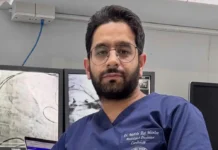
Five kilometres away from the empty pink building, the consequences of this “direct discharge” arrive on the examination table of Dr Aarif, a Medical Officer. To him, the slaughterhouse delay is not a matter of “tenders” or “finance”; it is a matter of life and death.
“In the scenic valleys of Kashmir, we have a dangerous ‘backyard butchery’ culture,” Dr Aarif warned, his face hardening as he discussed the clinical data. “When meat isn’t processed in a controlled, hygienic environment, the distance between the farm and the dinner table becomes a breeding ground for pathogens.”
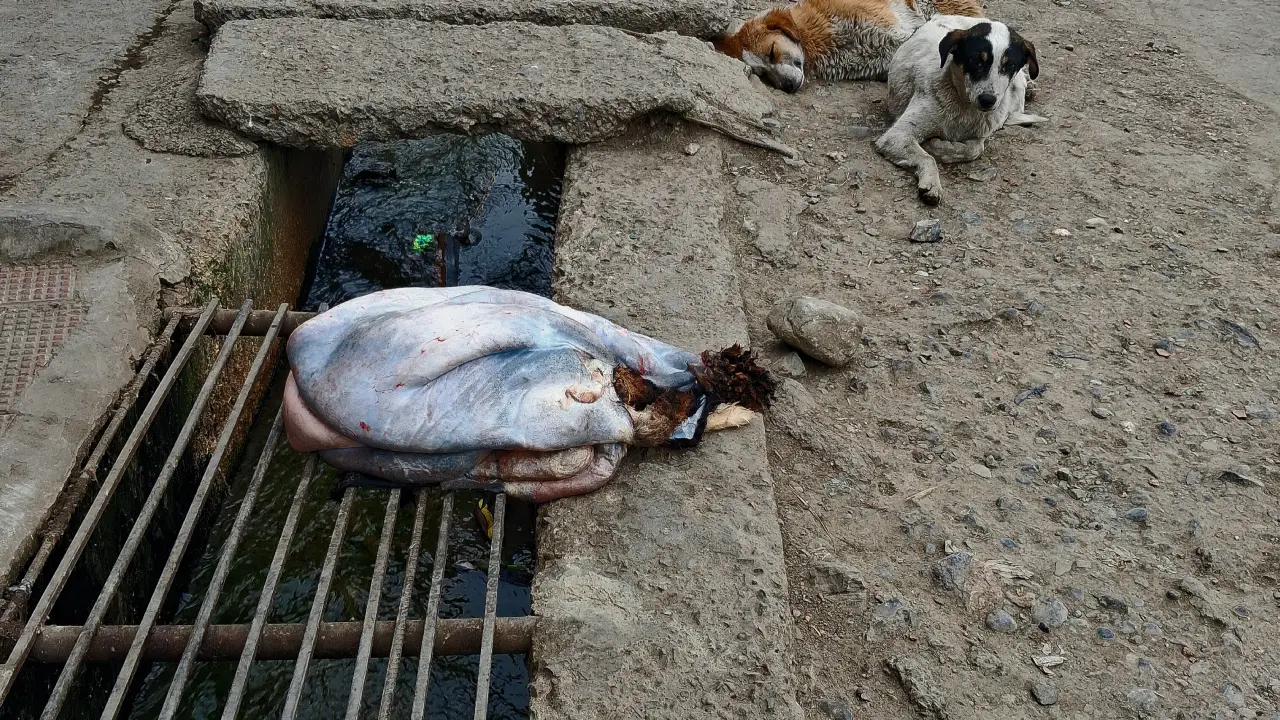
Aarif points to a rising epidemic of Hydatid Cyst (Echinococcosis). It is a parasitic cycle that reads like a horror story. Livestock are slaughtered in open alleys; stray dogs consume the infected offal; the dogs pass parasite eggs in their faeces; these eggs contaminate the water and the vegetables that Kashmiris eat every day.
“I see the fallout in our clinics daily,” Aarif asserted. “Humans ingest these eggs, and suddenly, we are performing complex, high-risk surgeries to remove massive cysts from the livers and lungs of young children. We are a meat-heavy society, but we are eating in the dark.”
Then there are the “Big Three” bacterial killers: Salmonella, Campylobacter, and E. coli. Without a refrigerated “cold chain” and sterilised tools, raw meat becomes a petri dish. “Carrier animals, those that look healthy but are infected, are being slaughtered daily without veterinary oversight,” he noted. “In extreme cases, we see kidney failure and severe bloody diarrhoea. All of this is preventable with a single functional building.”
His warning is seconded by Dr Sajad Hussain Wani, a Veterinary Surgeon who sees the crisis from the perspective of animal health. He said 60 per cent of all human diseases are zoonotic, transferred from animals to humans.
“We are talking about Tuberculosis, Rabies, and parasitic infections that can devastate a family,” Dr Wani said. “A slaughterhouse is a filter. Right now, that filter is missing. We are drinking the blood of our livestock through our groundwater, and we are wondering why our hospitals are full.”
The Red Drains
The environmental cost is articulated by Bisma Waseem, an Environmental Science student whose home in Qazigund overlooks the very streams being poisoned. She doesn’t see “meat”; she sees “pathogenic loading.”
“This is a systemic ecological failure,” Bisma said, standing near a local khul (stream). “By introducing high-protein effluent directly into our hydrological corridors, we are triggering anthropogenic eutrophication. We are literally suffocating our water.”
Bisma explained that animal blood is rich in nutrients that cause algae to bloom uncontrollably, stripping the water of oxygen and killing aquatic life. These streams, once the pride of Kashmir, are becoming “anaerobic sinks”, dead zones where nothing but bacteria can thrive.
But the damage goes deeper. In peripheral Kashmir, groundwater tables are shallow. The blood and waste leaching into the soil are contaminating the wells. “We are prioritising short-term convenience over long-term bio safety,” she warned.
Besides, this waste fuels the “Scavenger Surge.” Dr Wani noted that “roadside offal” is a high-protein buffet for stray dogs. This isn’t just a nuisance; it’s a biological explosion. The dogs are not just scavengers; they are carriers of the very parasites Dr Aarif removes in the operating theatre. The cycle of the “red drains” is a circle of disease that begins at the butcher’s knife and ends in the human body.
A Butcher’s Dilemma
To truly understand why the “Pink Mirage” stands empty, one must talk to the men who hold the knives. Ghulam Mohammad, a butcher for 35 years, and Farooq Ahmed, a second-generation tradesman, are not villains; they are men caught in an economic trap.
“I want a slaughterhouse,” Ghulam said, wiping his hands on a blood-stained apron. “I want clean water. I want a place to dispose of waste. But look at where they built it!”
He gestured toward the Gagadanji site, kilometres away from the local market. “We don’t earn enough to afford a transportation system. If I have to pay to move my meat back and forth, I cannot feed my family. The government builds buildings, but they don’t think about the butcher’s pocket. If they want us to move, they must compensate us for the logistics.”
Farooq Ahmed spoke of the failure of the dustbin system. “The municipality gave us bins, but they never emptied them,” he alleged with a bitter laugh. “The waste would rot in front of my shop for three days. The smell became unbearable. The dogs would tear the bags open and spread the waste across the market. Eventually, I had no choice, I had to dump it in the stream just to keep my premises clean.”
This is the “administrative gap” that Sheikh Zameer, the Assistant Commissioner of Food Safety, Anantnag, finds impossible to close.
“Slaughterhouses should have been in place decades ago,” Zameer admitted. “We are policing an unorganised sector. We raise the issue with the Chief Secretary, we issue fines, we conduct raids. But until there is a centralised, mechanised facility in every district, we are just chasing shadows. We can punish a butcher, but we cannot fix a broken system with a fine.”
The Consumer’s Grief
Finally, the story returns to the kitchen of Maroofa Akhter. Her testimony is the most heartbreaking because it represents the emotional toll of the crisis.
“When I was a child, my mother’s kitchen was a place of joy,” Maroofa recalls, her eyes clouding with sudden sadness. “But today, when I cook meat, there is no excitement. I look at the plate, and I think about the scandals. I think about the 12,000 tons of seized meat. I think about the diseases the doctors talk about.”
For Maroofa, the lack of a slaughterhouse has stolen her peace of mind. “I want to know that what I am feeding my children is saaf-o-shifaaq (pure and clean). I want a system that assures me that the food on my table isn’t a threat to my family’s life. Is that too much to ask for in a modern society?”
The Gateway’s Choice
Qazigund is the Gateway of Kashmir. It is the first impression a traveller receives of the Valley. If that gateway is defined by blood-slicked drains, scavenger dogs, and a hollow pink building that serves only as a mirage of progress, then the entire Valley is at risk.
The “meat paradox” is a mirror of Kashmir’s larger struggle: the clash between a beautiful tradition and failing infrastructure. Kashmir has the culture of the Wazwan, but it lacks the science of the slaughterhouse. It has the “pink shells”, but not the “mechanical hearts” these shells ideally should have.
As the Waza waits for quality, the doctor waits for his patients, and the butcher waits for compensation, consumers continue to eat in the shadow of a preventable crisis. The Gateway needs more than a coat of pink paint; it needs the political will to turn on the machines.
Kashmir’s world-famous cuisine cannot survive on 19th-century hygiene in a 21st-century world. The feast is ready, but the costs have never been higher.