Asia’s largest freshwater lake is shrinking, and so is the world of the thousands who depend on it, reports Asrar Syeed
Seven hours on the water and 1500 grams of fish.
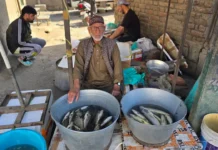
Adil Yusuf paddled back to the shore at Lankreshipora, Bandipora, with little to show for a full day’s labour. He was quiet for a moment, looking out at the lake that had sustained his family for as long as he could remember. “If you spent seven hours just ten to fifteen years ago,” he recalled, “a fisherman would return with at least 20 to 25 kilograms of fish.”
Adil came to this profession not by choice but by necessity. When his father died while Adil was in Class 11, he stepped into the fishing boats to keep the household afloat. Now he wonders whether he made the right call. The fish have been disappearing, slowly, then all at once, and with them, the livelihoods of tens of thousands of families spread across more than 20 villages on the banks of the Wullar Lake.
Wullar Lake, located roughly 30 km north-west of Srinagar in the foothills of the Pir Panjal Mountains, is one of Asia’s largest freshwater lakes. On its banks are located parts of Sopore and Bandipore.
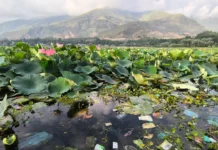
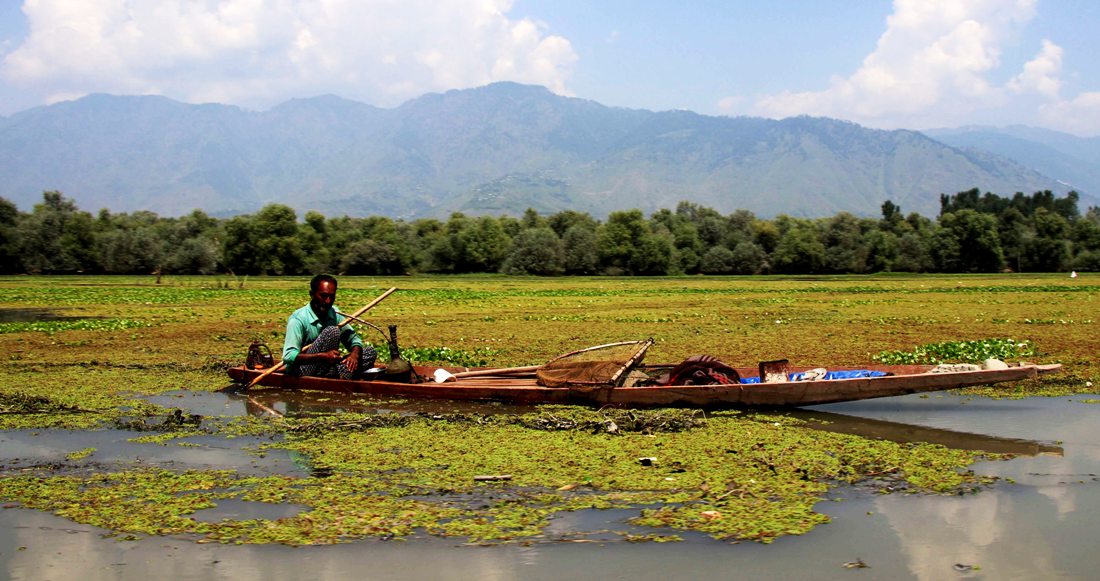
In 1911, it spread across 217 square kilometres. By 2007, it had contracted to 86 square kilometres, with the rest swallowed by agriculture and plantations. A 2022 study using data from India’s ISRO found that even the open water area that remained had shrunk by around one-quarter between 2008 and 2019. What was once so vast that people could not see its far shore is today, in the words of Abdul Ganie, a fisherman from Watlab, “a large green meadow.”
A Mother Lake
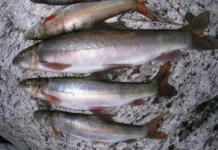
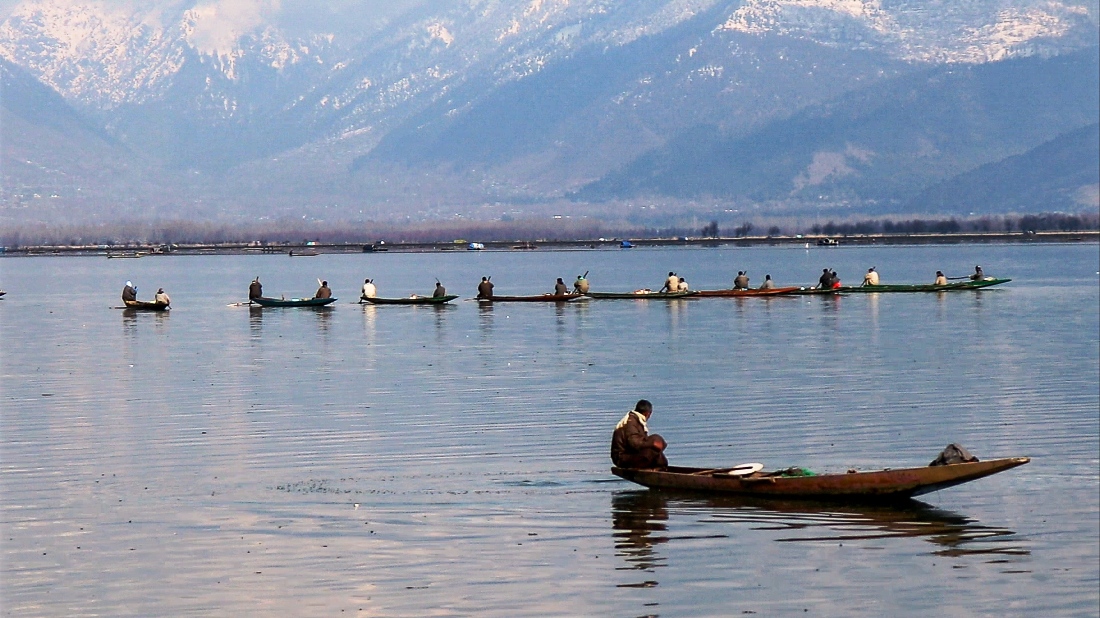
For Abdul Ganie, the Wullar is not merely a body of water; it is an inheritance. His grandfather fished it. His father fished it. He has fished it for thirty to forty years. In those earlier decades, a single tour of the lake would reliably yield twenty-five to thirty kilograms of fresh fish. The lake was teeming with native species: Schizothorax, commonly known as Snow Trout, along with Schizothorax curvifrons and Schizothorax niger. These were not just food; they were the most prized catch, commanding the best prices and the deepest respect from the fishing community.
“Wullar once used to be clean and rich with different species of fish,” said Dr Masood Ul Hassan Balkhi, former Dean and Founder of the Faculty of Fisheries at SKUAST-Kashmir, who has published more than 200 papers in national and international journals. When he entered the fisheries sector in the 1980s, production was dominated by local species. Today, non-native species, Crossocheilus diplocheilus and Nemacheilus loaches, have proliferated in the lake, edging out the indigenous fish that once made the Wullar famous.
A comprehensive study by Wetlands International put numbers to what fishermen already knew in their bones: overall fish production in the lake had fallen from 10,544 tonnes to just 1,476 tonnes a year, a collapse of nearly eighty-six per cent.
What Killed the Fish
The causes are multiple, interlocking, and decades in the making.
Pollution has transformed the Wullar from a source of drinking water into something people fear to touch. According to a 2022 report by the Central Pollution Control Board, Biochemical Oxygen Demand levels in parts of the lake exceed the safe threshold of 3 mg/L, reaching concentrations as high as 10 to 15 mg/L near urban discharge points. Faecal coliform counts indicate widespread contamination from human and animal waste.
A 2021 study by researchers from Bhagwant University documented the dumping of non-biodegradable plastics and polythene directly into the lake, describing settlements around the Wullar as “epicentres of organic waste.”
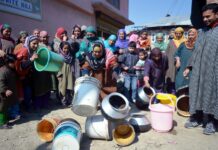
Ganie, who once performed ritual ablutions with the lake’s water before prayers, confident in its purity, now asserts that accidentally drinking from it could be fatal. “Today, if you even accidentally drink water from this lake,” he lamented, “it will prove fatal due to the impure chemicals and garbage that flows in this lake nowadays.”
Then there is the water itself, which is receding. Bashir Ahmed, another veteran fisherman from Bandipora, pointed to a road near the lake’s viewpoint that was entirely submerged in water when he began his career. Now it sits dry. “If this continues for a few more years,” he foresees, “fishermen might find it difficult to even get one to two kilograms of fish.”
The shrinkage has been driven in part by changing weather. A study published on Research Gate, examining temperature and precipitation trends in Kashmir, found a consistent decrease in annual precipitation at the alarming rate of approximately 7.9 millimetres per year. The long dry spells that now characterise the region reduce inflows into the lake and accelerate the drop in water levels.
Dr Balkhi points to a wider web of harm: “Indiscriminate fish catching using illegal gear and methods, release of domestic and agricultural waste, including pesticides and fertilisers into open waters, and filling up of river and lake banks by encroachers, all these interferences impact the health of a waterbody and disrupt fish migration for breeding and feeding.”
Sand Mining: The Invisible Drain
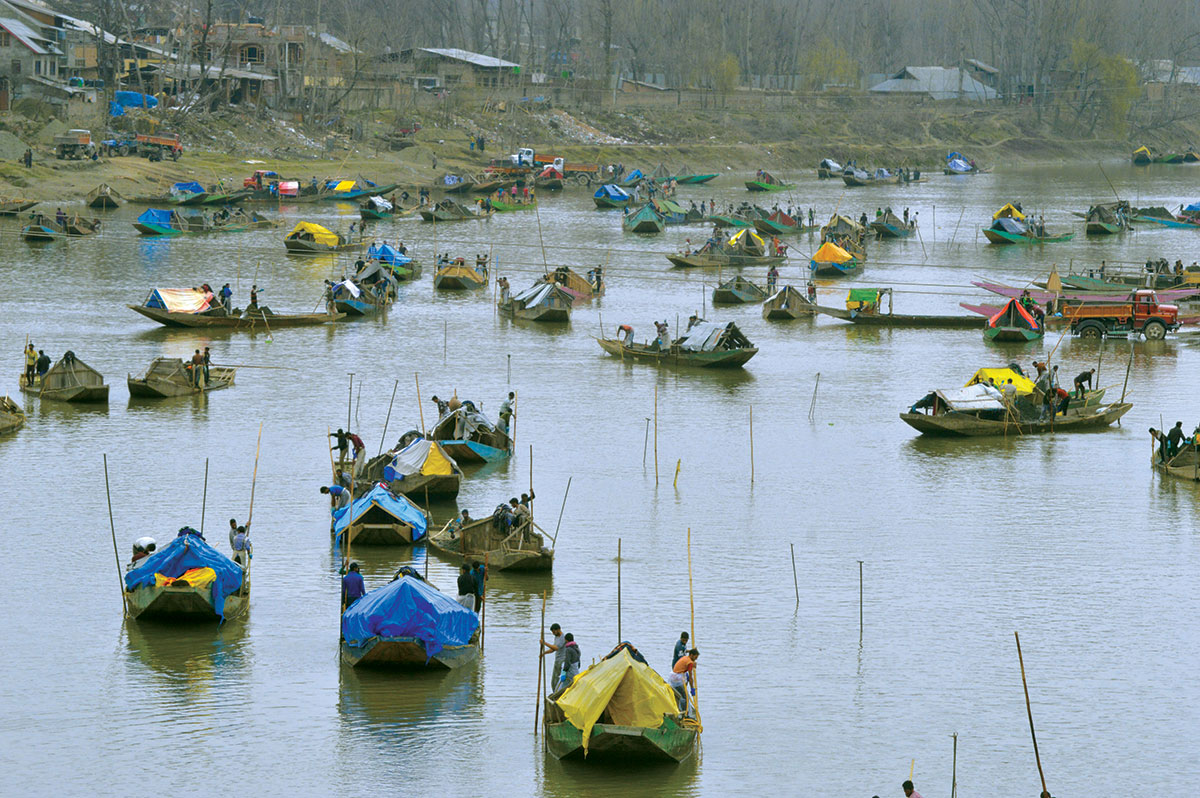
Among the pressures on the Wullar, sand mining may be the least visible to outsiders, yet its damage is extensive and immediate.
Research has established that uncontrolled and illegal extraction of sand and gravel can seriously disrupt the hydraulic connection between surface water and groundwater, destabilising the entire water regime. The mining activity around the Wullar has continued despite government efforts to curb it, efforts that local fishermen insist have fallen far short.
“Sand mining continues to happen around this lake,” said Adil. “I acknowledge that those people must provide for their families. But due to some people’s livelihood, Kashmir could lose a major lake which has, over the years, helped thousands of fishermen earn their living.”
Dr Balkhi is more direct in his assessment. “Encroachment of river and lake banks by the sand mafia has been a huge reason for the lake’s shrinkage over the past few years. The government and field staff haven’t been paying serious attention.”
The financial scale of the mining industry offers some context for why it has been difficult to control. Data from the Jammu and Kashmir Mining and Geology Department shows that between 2022-23 and September 2025, the department collected over Rs 462 crore in revenue. In 2022-23, it stood at Rs 101 crore; by 2023-24, it had risen to Rs 175 crore. The numbers suggest an industry with significant economic momentum, one that makes regulation politically and practically difficult.
Lives on the Edge
The collapse of fish productivity has not remained an environmental statistic. It has entered homes, disrupted schooling, and pushed families into debt.
In Kulhama village, seventeen-year-old Yawar Wani has not been in school for years. His father, once a fisherman, abandoned the profession as catches dwindled and switched to daily wage labour. The family could no longer manage.
“I went to school for two to three years, then after my father faced extreme financial difficulties, I had to drop out,” Yawar said. He is not alone. In Kulhama, most young people have not completed schooling and work odd jobs, with a large number now employed in the very sand mining industry that is damaging the lake.
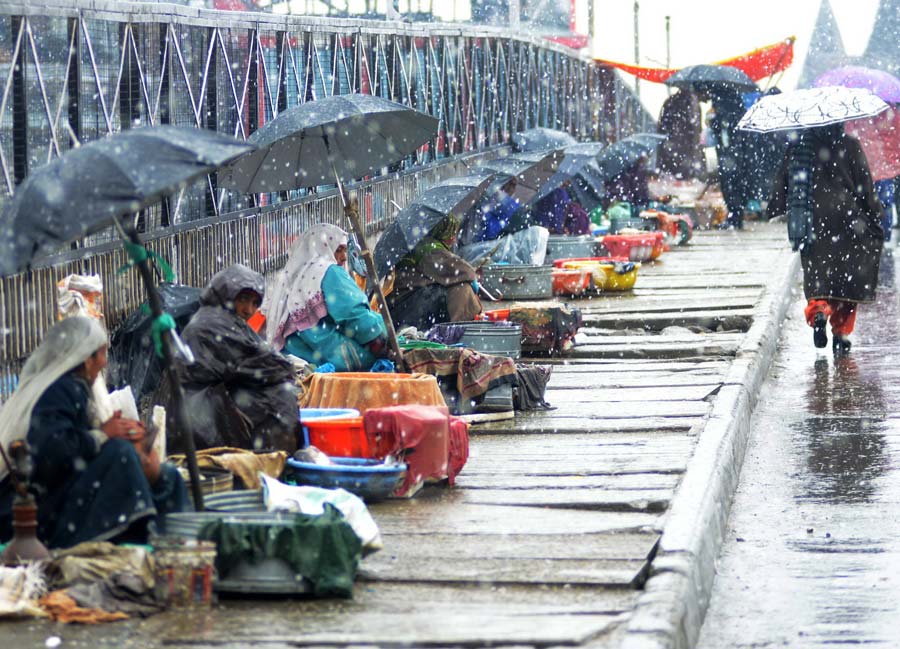
At Ningli Ghat, eighty-year-old Azzi remembers the old days with an ache in her voice. Her husband used to bring home reliable earnings from the lake. “A fisherman returned with an average of twenty-five to thirty kilograms of fish in just one tour,” she said. “But times have changed. Our lives have become miserable.” Her son now works as a labourer. The family has had to borrow money to meet basic household expenses.
Basharat Khan, who has stopped fishing entirely after years of diminishing returns, has pivoted to running a Shikara at a ghat near the lake. But tourism has not filled the gap. “Most of us spend the day sitting idle. On the other hand, we must meet rising expenses, we have children who are studying, and it is not easy to provide education in current times,” he said, his worry focused on whether he can keep his children in school through rising inflation.
The scale of the crisis is staggering. An estimated 32,000 families and around 2,300 fishing households depend on Wullar Lake for their livelihood. Across more than twenty to twenty-six villages in Bandipora, the lake has historically been the spine of the local economy, from fishing to boat services. As that spine weakens, entire communities are bending under the weight.

Way Out
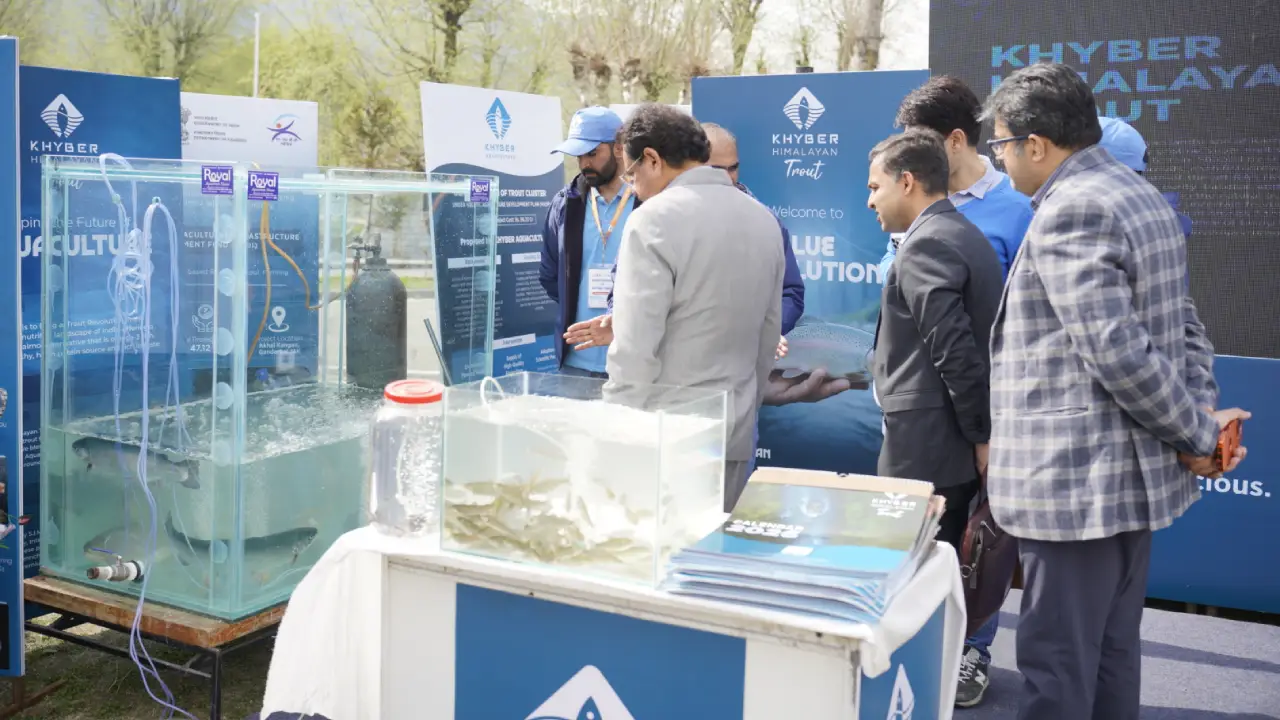
Dr Balkhi, who serves on national committees including the Research Advisory Committee of ICAR-NBFGR and the Quality Review Team of ICAR’s Central Institute of Coldwater Fisheries, believes the situation is serious but not irreversible, provided the will exists.
“The government and the fisheries department need to work closely to produce adequate quality seed material of all troubled fish species and restock the depleted water resources across Jammu and Kashmir,” he suggested. He also called for sustained awareness programmes on the importance of water resources, and strict enforcement of existing legal provisions under the Fisheries Act and the Environmental Protection Act.
The 2021 study from Bhagwant University echoed similar recommendations: increase forest cover in the lake’s catchment area, remove excess weeds regularly, and work to restore the lake’s water storage capacity.
For now, those prescriptions remain largely unimplemented. Adil Yusuf will go out again tomorrow. Ganie will row his boat across the green, shrinking water. Yawar will wait for work. And Wullar, once so immense that people could not find its edge, will continue its quiet retreat, carrying with it the memories and the futures of all who have lived beside it.