A distant conflict in the Strait of Hormuz is forcing Kashmir to unlearn a century of energy evolution. The kerosene lamp is coming back. So is the wood fire. And nobody knows for how long, reports Masood Hussain
Somewhere between the Strait of Hormuz and a kitchen hearth in Hipora, the erstwhile gateway village on Mughal Road, history has collapsed into itself. The oil tankers that Iran has been preventing in the Persian Gulf since the war in West Asia escalated, thousands of kilometres away from Kashmir, are now the reason a housewife in this Shopian village is being rationed two litres of kerosene oil. Or a grandmother in Doda is blowing into a wood fire that she thought she had left behind forever.
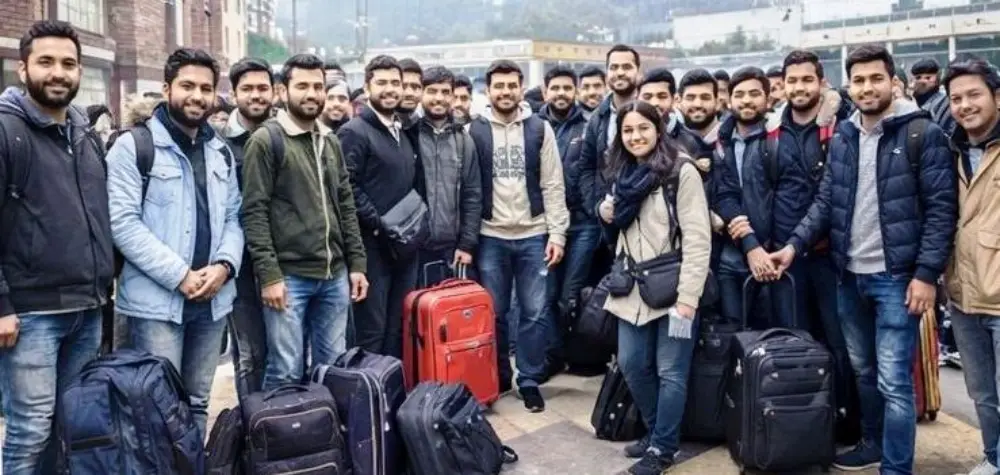
Kashmir is too distant from the war theatre. Yet the geography of global energy, the single thread that connects every modern kitchen from Tokyo to Tangmarg, has made it an unintended casualty. At the initial stage, Kashmir was too preoccupied with the students enrolled in the medical and engineering schools in Iran. Most of them have returned, and some stuck there are making efforts to move out. Now, the scene has shifted to supplies.
This is the story of a globalised world about what happens when a faraway war reaches the cooking fire. It is also a story that is older than it first appears.
The Evolutionary Reversal
For the past three decades, Kashmir’s energy story was a story of progress – linear, incremental, and largely taken for granted. Firewood gave way to kerosene. Kerosene gave way to LPG. The cylinder replaced the stove, the stove replaced the hearth, and the hearth was left to crumble in the corner of the old house, fit only for nostalgia.
Most of the new urban home constructions lacked the Daan, the traditional hearth. Driven by nostalgia, some kept a space and built the Daan just for fun. The traditional hearth would feed charcoal into the Kangri, Kashmir’s traditional fire-pots, and provide a gradual flame that would help the food cook better.
In March 2026, the ladder has not just wobbled. It has been pulled from under the feet of an entire society. Or, at least, there is a lurking danger of that.
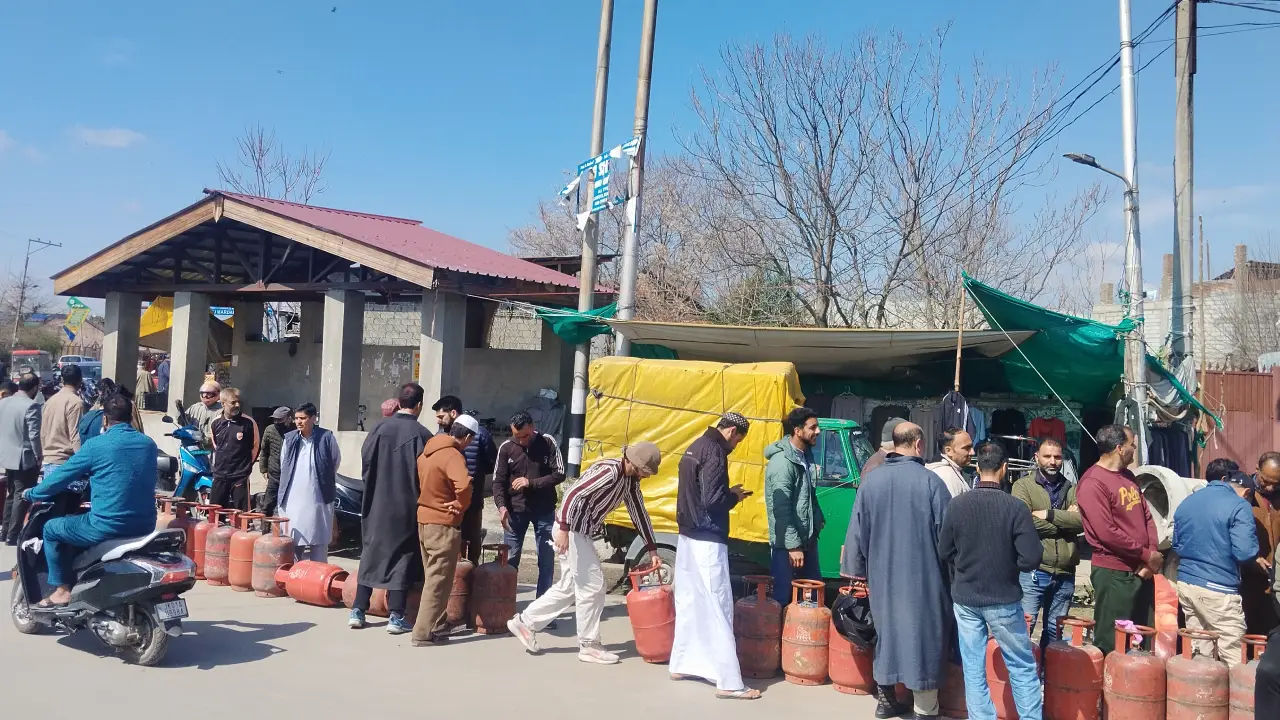
The Government in Jammu and Kashmir is putting on a brave face, but the situation is gradually getting tense. Last week, it allocated 468 kilolitres of PDS kerosene oil, Superior Kerosene Oil, in official language, for distribution across the erstwhile state. The allocation covers 2,21,249 families, all of them from the Antyodaya Anna Yojana category: the poorest of the poor, those who were once the last to get a gas cylinder and who are, once again, the first to be handed a tin of kerosene. Each family gets two litres.
Two litres. That is the measure of where we are.
The Hormuz Connection
The immediate cause of the supply crisis is military, but its mechanism is economic. Since Iran began preventing commercial shipping through the Strait of Hormuz, the narrow channel through which nearly 20 per cent of the world’s oil passes, tanker traffic to South Asia has been choked, rerouted, and repriced. India’s LPG imports, which travel substantially through this corridor, have taken a direct hit.
The Union Ministry of Petroleum and Natural Gas has been responding in stages, issuing a series of letters to Chief Secretaries across the country. On March 16, it allowed states a 20 per cent allocation of commercial LPG. On March 18, another 10 per cent was unlocked, linked to commitments on expanding the Piped Natural Gas network. On March 21, a further 20 per cent was released, bringing the total to 50 per cent of pre-crisis levels.
Fifty per cent. Across all of Jammu and Kashmir, the three Oil Marketing Companies, Indian Oil, BPCL, and HPCL, are now making available approximately 886 commercial cylinders (not for domestic use) per day for priority sectors. Before the crisis, the daily average was 1,773 cylinders. The government has halved a region’s fuel supply and asked it to manage. This essentially means the hospitality sector will take the hit.
“Kashmir is paying for a war it has nothing to do with,” is a phrase being heard in every government corridor and every market in the Valley. It is not an exaggeration.
Panic In Market
“The government fixed a timeline for refills –25 days in urban areas and 45 in the periphery, which is all right,” said Jagmohan Singh Raina, one of the LP distributors in Srinagar. “I usually dispense 400 cylinders a day, and there were days last week when the crowd came to us, and we had to give 800 cylinders, and our systems are not ready for such records. How can you manage a crowd?”
Raina said barring a day or two, he is getting the supplies as per the routine. “But how can you convince the consumers, they are in panic, and once we start managing the panic, the supply disruptions are bound to happen.”
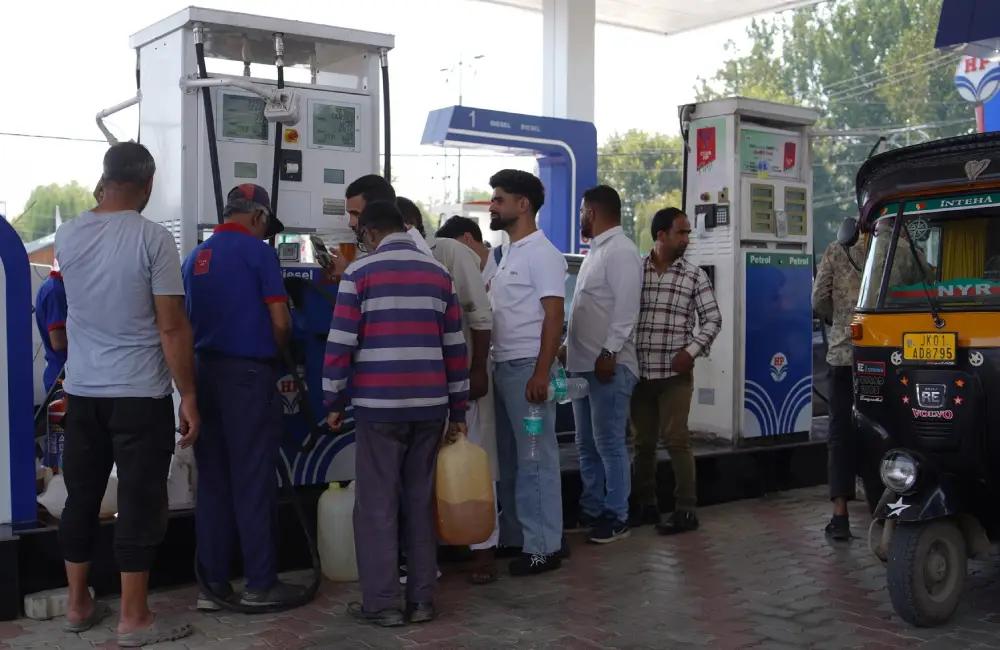
Unlike LPG, there was no such panic on the diesel and petrol refilling stations, so far. But that is about to happen anytime soon.
On March 24, Jammu and Kashmir Chief Secretary was told by the oil companies and consumer affairs managers that, given the stock position, they have enough petrol to last for nine days, diesel for 16 days, LPG for 12 days and kerosene for 37 days. Supplies from the companies will add to the stocks, they said.
Daily, Jammu and Kashmir consumes, on average, 1753 kilo litres of petrol, 2866 KL of diesel, 773 metric tons of LPG and 343 KL of kerosene oil.
Jammu and Kashmir is a huge consumer market. It requires petrol and diesel worth Rs 17000 crore a year, and the LPG bill is upward of Rs 2000 crore.
As the West Asian crisis is gradually showing its impact in places like Kashmir, too far away from the Strait of Hormuz, people are rediscovering a life they had bid goodbye to.
The New Market
For ages, the market has its own arithmetic. When one source of energy becomes unavailable or expensive, the alternatives, however forgotten, become precious overnight.
Traders across Srinagar, Jammu, and smaller peripheral towns are reporting a surge unlike anything seen in recent memory. Induction cooktops, electric kettles, and electric pressure cookers, items that sat in the back of shops for months, have sold out in days. EV two-wheelers, which until last month were a curiosity for the environmentally minded and the early adopter, are now being bought by people who simply cannot afford to run a petrol scooter. Dealers say waiting lists are stretching into weeks.
The logic is simple and brutal: anything that does not run on petrol or diesel has suddenly become an asset. The energy crisis has, in one stroke, done what years of climate policy and subsidy schemes could not: it has made green alternatives economically rational for ordinary people.
But the transition is neither smooth nor equitable. An induction cooktop requires a stable power supply. In many parts of water-abundant but energy-deficient Kashmir and Jammu, electricity is still subject to hours-long cuts. Running a family’s meals on induction power under an eight-hour load-shedding schedule is not a solution; it is an aspiration.
The Stove Comeback
For the families who cannot afford the transition to electric cooking and who live in areas where the power supply is unreliable, the government’s answer is kerosene. It is a practical answer. It is also, in the most literal sense, a step back in time.
The kerosene stove was the appliance that bridged firewood and gas in Kashmir’s energy history. A generation of Kashmiris grew up with the pungent smell of kerosene in the morning, the faint blue flame, the soot on the bottom of the pot, the careful rationing of fuel. That generation thought it had left all of this behind.
Udhampur district, for example, has 4,650 AAY ration card families. They will receive 9,300 litres of kerosene in this first allocation, two litres per family, 36 kilolitres in a cluster. Rajouri, with 13,703 families, gets 27,406 litres. Baramulla, with 25,851 families, gets the largest single district allocation in Kashmir at 51,702 litres.
The distribution mechanism is elaborate and monitored: only families with e-KYC verification on the SMART-PDS portal are eligible. Dealers must maintain registers. Tehsil Supply Officers will verify. Inspections will happen. The government is aware that kerosene, historically, has been one of the most diverted commodities in public distribution, that ‘blue gold’ flows to the black market as reliably as water finds a crack.
As of March 23, the enforcement machinery had conducted 1,418 inspections in one week across Jammu and Kashmir, penalised 11 hoarders, and addressed over 1,024 grievances. The numbers are significant. They are also a measure of how much pressure is building.
There are, however, two issues which are being discussed in the kitchens and the shop-fronts. “It has been more than a decade since the last stove was seen in the kitchen,” Jawahara Begum, in Srinagar’s Khanyar, said. “It would require an effort to relocate it, and then where are the mechanics that sell those items – the leather pump cups, the pins that would unclog the nipple jet and the burner components?”
Market insiders said the entire ecosystem of the pressure stove has gone to oblivion, and the people working in the sector have upgraded to LPG systems, which are more sophisticated, cleaner, and easier to handle. The rollback of the kerosene from the public distribution system was the key factor in undoing the kerosene stove story.
The Hearth Revives
Below the level of government allocations and market rushes, something quieter is happening in the Kashmir periphery. The home hearth, the traditional Daan or Daunber, the wood-fired kitchen corner that urban and semi-urban families had sealed off, is being reopened.
The movement towards fuel-wood had already begun before this crisis, driven by the strict implementation of the power tariffs. With a flat rate prevailing in power tariff systems, the consumers in the periphery were bearing the brunt of it. Historically, Jammu and Srinagar cities, plus a few peripheral towns, have remained the major power consumers requiring slightly less than half of the total energy that the erstwhile state consumed. This had given the periphery a plethora of choices. They would use the energy in cooking, using the crude heaters, heat up their baths using the boilers and of late had started laying electric Hamams, a new technology that the market lifted from certain Scandinavian societies.
In the last few years, while the power distributors introduced smart meters in the urban areas, they pushed the power tariff flat rate to Rs 3500 a month. This forced a shift in consumer behaviour.
“We plucked out all the heating appliances and restored the traditional system,” Abdul Aziz, a Shopian villager, said, insisting that after he made the amends in his consumption style, he has made an application seeking installation of the meter in his home. “I have already converted one of my best rooms into a Hamam, and we are back to the hearth.”
Aziz said this shift has given him some relief from huge mounds of fuelwood, mostly the outcome of post-harvest pruning of his apple orchards, and other material that would routinely produce. “This all is consumed by the Hamam and the hearth and we are back to the life, I have lived with my parents once upon a time.”
The Hamam has returned to many homes as the hearth is making a huge comeback. Till the Kerosene became fashionable, the forest department would supply fuel wood on ration cards, especially in the city and towns. After the LPG became popular, the system was rolled back. Now, they supply the fuel wood for the mosques to fire the community Hamams only. In 2019, 1350 mosques in Kashmir were registered with the forest department for fuel-wood supplies. In 2025, officials said they supplied 8000 tons of fuel wood to the community centres, mostly mosques.
Fuel wood is a huge winter market in Kashmir, and it is now completely run by the private sector. It relies on the non-forest plantations and fires tens of thousands of private Hamams in the city and peripheral towns. Usually, a single Hamam requires around four tons of fuel wood for the season.
Chances of urban spaces rediscovering the heart are impossible. Daan in the city has already walked into oblivion. The only chance, in case LPG becomes rare, is either the kerosene-fired stoves or cooktops.
The Solar Bet
The government is not only looking backwards. Alongside the kerosene allocation, it has asked the Power Development Department and the Science and Technology Department to actively promote solar cookers and solar appliances as alternatives to LPG.
This is, on paper, the most forward-looking part of the official response. And for parts of Kashmir, it may also be the most realistic. The Valley receives abundant sunshine through spring, summer, and autumn. Remote villages in Kupwara, Bandipora, and the high-altitude areas of Gurez and Lolab, places that are expensive to supply with LPG and unreliable to power through the grid, are, in theory, ideal candidates for solar cooking.
But solar cooktops require an initial investment. A quality solar cooker costs between Rs 3,000 and Rs 15,000. For an AAY family receiving two litres of kerosene as emergency relief, that is not a number within reach without subsidy. The government’s policy signals are encouraging; the delivery mechanisms remain, so far, undefined.
Jammu and Kashmir Energy Development Agency (JAKEDA), tasked to popularise the sustainable use of all forms of renewable energy, provides improved biomass cook stoves and solar home lights to the tribal community, but there is no subsidy scheme that could enable commoners to purchase the solar appliances.
However, the government is working overtime to make rooftop solar systems popular within and outside the government. Of the 8000 government-owned buildings identified for solar panel installation to harvest 175 MW of energy, the government says it is already generating 75 MW, and the rest of the buildings are at various stages of implementation. The solar rooftops are installed on more than 26857 privately-owned homes across Jammu and Kashmir under PM Surya Ghar Mufti Bijli Yojna, which offers more than half of the installation costs as a subsidy. Surplus energy generated by the system is evacuated into the grid through routine power distribution lines. The central government has already released Rs 182.21 crore of subsidy under this scheme, as more than 75000 applicants are still waiting for the solar panel installations on their rooftops.
Besides, the government has received Rs 28 crore as subsidy from the centre for managing water security to irrigation of farming lands under PM-Pradhan Mantri Kisan Urja Suraksha evam Utthaan Mahabhiyan (PM-KUSUM).
The Green Transport
In 2023, the Geological Survey of India discovered 5.9 million Lithium reserves, an alkali metal fundamental to rechargeable batteries. With so many tenders failing, it would take many more years for Jammu and Kashmir to harvest Salal mines.
The efforts, however, are on to get green transport to the erstwhile state. Under the Smart City projects in Srinagar and Jammu, 200 e-buses ply with full capacity, albeit with a loss. The electric cars are far and few. Under some scheme, e-rickshaw numbers are surging. By May 1, 2025, Srinagar alone counted 2,850 e-rickshaws.
There is a good demand for e-scooters. “In the month before the war broke out, I sold 150 e-rickshaws and scooters,” the promoter of TVS King said. “In the three weeks, I sold 185. 100 people are waiting even though the market is down.”
The Elusive Pipeline
Unlike the society, it is in the power corridors that a pipeline is being talked about. The Gurdaspur-Jammu Natural Gas Pipeline, being laid by GAIL, was announced by the government in 2023 and was supposed to be in operation by late 2026.
“It is coming up very soon,” a senior official, who was part of a high-level official meeting on fuels and essential supplies, said. “It has two sections. The 78 kms Gurdaspur-Pathankot section is laid to the tune of 31 km, and it would be ready by July 2026. The second section is 74 km between Kathua and Jammu, and 75 km is laid and will be ready by April 2026.”
When the 3.1 million standard cubic metres per day pipeline is commissioned, it will feed a City Gas Distribution network that the Indian Oil Corporation and BPCL are authorised to build across Jammu and Kashmir’s 20 districts. It will pipe natural gas into homes and CNG stations for vehicles. The end of the cylinder economy, at least in urban and semi-urban areas, will be over.
Even though the line will be ready, it still has problems. Officials said the land for the City Gate Station in Jammu is yet to be identified. The CGD policy for the state has not yet been formalised. VAT on CNG in J&K stands at 21 per cent, the second highest in the country, compared to zero in Delhi and 3 per cent in neighbouring Punjab. These are not minor obstacles; they are the difference between a pipeline being commissioned and a pipeline being used.
The government is moving on all these fronts simultaneously, issuing deemed approvals, waiving road-cutting charges, and pushing for single-window clearances. But the pipeline is not yet gas-bearing, and the real test will be the New Year.
A Major Challenge
For the policymakers in Jammu and Kashmir, the major challenge is how the fuel supply should not impact the tourism sector, a sector that is showing some revival after more than a year. Transport and hospitality are fuel-linked, and the desperation is visible that the sector must endure the crisis.
In the commercial LPG supplies, a senior government official said, a decision has already been taken: 8 per cent will be given to hospitals and educational institutions; two per cent for railways and government canteens and 90 per cent to restaurants, hotels, community kitchens, and food processing units.
The government is also pushing hard in Delhi. It is seeking to raise J&K’s commercial LPG allocation from the current ceiling and to increase the kerosene quota from 468 kilolitres to 4,500 kilolitres, a tenfold expansion, to give the alternate fuel arrangement real teeth.
Whether that request will be met, and how quickly, is the question on which the comfort of the next few months depends for hundreds of thousands of families.
At the top level, the government has asserted that India has enough fuel for the next 74 days. “India is the world’s 4th largest refiner and 5th largest exporter of petroleum products, supplying refined fuel to over 150 countries. Because India is a net exporter to the world, domestic petrol and diesel availability is structurally assured,” a PIB handout quoting the top government functionaries said. “Despite the situation at the Strait of Hormuz, India is today receiving more crude oil from its 41-plus suppliers across the world than what was previously arriving through the Straits. High volumes available in international markets, especially from the western hemisphere, have more than compensated for any disruption.”
The Flip Side
While essential imports have triggered the panic, on the flip side, the halt in exports has started impacting the livelihoods, at least for the time being. The major export to the Middle East is Kashmir handicrafts, and the region almost consumes 60 per cent of the overall craft exports from Kashmir.
“Handicrafts were initially impacted by the Covid-19, and then in the subsequent two years, we managed an export earning of Rs 2500 crore,” Masarat ul Islam, Director, Handicrafts and Handlooms, said. “In 2024-25, the Ukraine-Russia crisis hit hard, and we could manage selling handicrafts worth Rs 733.43 crore.”
The 2025-26, he said, had made a promising start. “In the first half of the fiscal year, we exported handicrafts worth Rs 410 crore, and we hope to rebound as soon as the guns fall silent in the region.”
Traders and exporters assert that the mounting tensions have blocked their inventory and essentially the capital, the calculation of which is difficult to make but could be anywhere between Rs 300 and Rs 500 crore.
The Middle East is one of the major regions where Kashmiris find livelihood. In Dubai alone, there could be more than 15000 Kashmiris working and almost eighty per cent of the Kashmiris working offshore are in the Middle East.
Kashmir has spent decades being a subject of geopolitical calculations it never authored. Now it finds itself a subject of one more. This time, the arena is not strategic or territorial. It is the kitchen. And the fire burning in it is, once again, the wrong kind.
…… With Babra Wani’s inputs