Cloudbursts and flash floods tore through Jammu and Kashmir over three days, killing more than 28 people, sweeping away homes and vehicles, and forcing over 1,500 people into swift emergency evacuation, reports Babra Wani
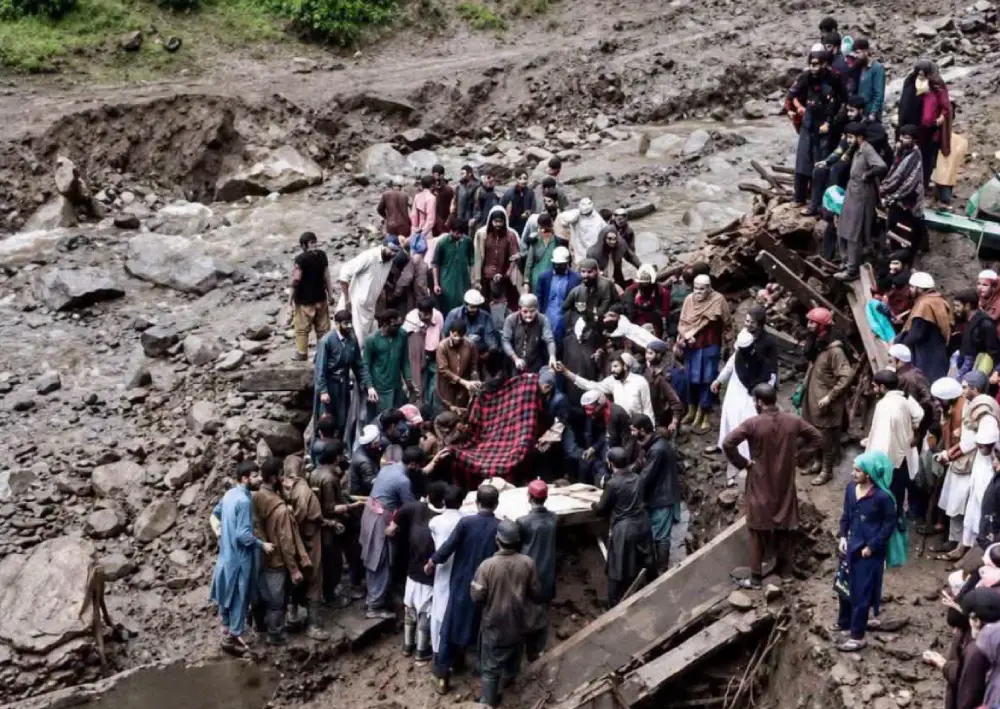
In Poonch’s Loran, on the night of July 19, thunder rolled across the hills as relentless rain pounded the slopes and entire mountainsides began to move. By dawn, dhokes, the traditional mud houses, had vanished beneath landslides, streams had turned into torrents, and families who had gone to sleep believing they were safe lay buried under earth and stone. In a matter of hours, the cloudburst and flash floods had carved a trail of grief through Poonch’s remote mountain settlements.
Recalling the fateful night, resident Zubair Ahmad said the incident unfolded in the wee hours after torrential rain lashed the mountainous region. At around 2 am, as heavy rain, strong winds and lightning intensified, a dhoke collapsed after being struck by a landslide. Seven members of a family, including two adults, women and children, were buried beneath the debris and died on the spot. Since the shelter was isolated, with the nearest dhoke nearly six kilometres away, no one witnessed the incident or could immediately come to their aid.
One family member had travelled to the village below to collect flour and returned only around midday the following day. Finding the mud house reduced to rubble, he realised something terrible had happened and raised the alarm. Personnel from the Army, Jammu and Kashmir Police and the SHO of Loran reached the site, and rescue teams removed mud, timber and debris before recovering the bodies, which were later shifted to District Hospital Poonch and handed over to the family for burial.
The deceased were identified as Zahida Begum, Manan Rafiq, Aleesa, Tanveer Ahmad Bhat, Shamim Akhter, Shabnam Bano and Mohd Irfan. The family had lived in the mud house every year for six months, spending the rest of the year in their permanent homes in the plains.
Zubair said fear is common during periods of intense rainfall in Poonch’s hilly terrain, where residents often stay awake through the night because cloudbursts and landslides can strike without warning. That night, it happened exactly as feared. The family slept and never woke up.
For generations, the dhokes scattered across the Pir Panjal mountains have served as seasonal shelters, with families leaving their permanent homes each summer to climb into the highland meadows with their livestock, trusting mountains that had sustained them for decades. On that rain-lashed night, that trust was shattered.
Murrah’s Devastation
In Murrah village, which falls in Surankote’s Buffliaz block, another cloudburst struck at around 3 am. A family had lived in a kuccha house beside a small stream for nearly 80 years without ever witnessing such an event, having only recently shifted to a newly built pucca house nearby.
Haji Mohd Latief, the head of the family, had stepped outside to move his vehicle to safer ground, fearing falling rocks might damage it. When he returned moments later, he found his house had completely disappeared, swept away by the flash flood. He and another son survived because they were outside the house; the rest of the family were trapped inside. “The other son studies in Jammu, and that is why he was saved. The rest he lost all of his family members,” he said.
The affected were identified as Noor Safia, 59, wife of Mohd Latief; Sajjad Ahmad, 16, son of Mohd Latief; Haq Nawaz Ahmad, 10, son of Mohd Latief; Shehnawaz Ahmad, 10, son of Mohd Latief; Khalida Kausar, 25, wife of Yasar Iqbal; Sufiyan, 2, son of Yasar Iqbal; Bano Begum, also known as Bano Bi, 60, wife of Mohd Hussain; and Mohammad Akram, 7, son of Mohammad Liaqat.
Latief had worked as a labourer in Saudi Arabia for more than two decades, saving every penny to build his dream home, a three-storey pucca house. He now has nothing.
Eight people were initially reported missing. At the time of filing, three bodies had been recovered while five remained missing, with search operations continuing. Residents said teams from the Jammu and Kashmir Police, the SDRF and other rescue agencies were carrying out the operation. Two further bodies were recovered from Sangla, and one body each from Sangalani and Marhote. One person remained missing from Dogrian Buffliaz. In Noona Bandi, Nazia Kouser lost her life, while four injured persons were shifted to District Hospital Poonch for treatment.
A local journalist in Poonch also suffered severe damage to his tin-roofed house during the same spell of extreme weather, underlining the widespread devastation across the district. According to locals, the journalist suffered fractures to both legs, and his wife is still missing.
Officials said Surankote bore the brunt of the disaster after cloudbursts and heavy rainfall triggered flash floods that washed away people and damaged infrastructure. Sub-Divisional Magistrate Surankote, Farooq Khan, said rescue operations were continuing to trace eight missing persons. “Seven bodies have been recovered so far, while eight persons are still missing. Search and rescue operations are underway,” he said.
Rajouri’s Reckoning
A resident who witnessed the tragedy said Rajouri district saw a catastrophe similar to Poonch’s in the early hours of July 19, when a cloudburst struck the Darhal Valley at around 2.30-3.00 am. The intense rainfall triggered a sudden surge in the Darhali Nallah, which overflowed and swept through the recently constructed Bela Bus Stand in Thannamandi.
Rajouri and Poonch districts form Jammu and Kashmir’s Pir Panchal valley. They share the terrain, culture, demography and the climatic conditions. They share the losses in almost every natural calamity.
The resident said the government had recently built the Bela Bus Stand with parking for 300 to 400 vehicles. Since many residents in the hilly town periphery lacked adequate parking at home, they routinely parked overnight. On the night of the disaster, dozens had parked as usual and gone home to sleep, unaware that the overflowing rivulet would engulf the entire area within hours.
The floodwaters completely washed away the bus stand. Between 30 and 35 vehicles were later found badly damaged, while 50 to 60 vehicles remained missing, reportedly swept away by the ferocious water currents. Three heavy trucks were also caught in the flood; one was recovered from the bus stand itself, another was found lodged beneath Abdullah Bridge downstream, and the third remained missing. Locals claimed some truck drivers sleeping inside their vehicles that night were also swept away; their bodies were not yet recovered.
The bodies of Vikas Ahmed, also known as Vikas Choudhary, and Javid Iqbal, who had gone missing after being swept away during the flash floods that hit the Bela Colony and New Bus Stand area during the intervening night of July 18 and 19, were recovered during search operations near the Salani Bridge area on July 20, after an intensive search and rescue effort.
A young man from Darhal was also swept away, his body was eventually recovered in Nowshera, nearly 35 kilometres downstream from where he had gone missing, in a recovery operation that involved a helicopter.
Besides the destruction at the bus stand, a public park in the area was partially washed away, and floodwaters entered a nearby mosque. Three to four houses were inundated, and 15 to 20 shops at the bus stand suffered extensive damage after water destroyed merchandise, causing heavy financial losses to traders. The disaster transformed a busy transport hub into a scene of devastation within hours, leaving residents searching for missing vehicles, missing people and the means to rebuild their livelihoods.
District officials said rescue teams evacuated 11 people, including five children. Nine civilians were rescued from a flooded stream near Churung in Thanamandi, while two youths stranded on a river island in the Tawi near Dhangri in Nowshera were brought to safety.
Officials told the Chief Minister in Srinagar in a high-level meeting that Chenab Valley lost 22 people, 15 of them in Poonch alone, as 73 houses were fully destroyed and 158 severely. Many people are still missing.

The Udhampur Belt
Similar scenes were witnessed in Udhampur and Ramban. In this belt, the Devika River is a resident, but the Tawi and Chenab flow down from Jammu and Chenab Valley. Flash floods, suspected to have been triggered by a cloudburst, struck the Barkuanda area of Bupp during the early hours of July 24, affecting several households and prompting an immediate response from the local administration. No casualties were reported.
Most parts of Jammu witnessed landslides, flash floods, shooting stones and mudslides due to the extreme weather. In Ramban’s Ramsoo area, a shooting stone hit a passenger vehicle, killing two people and injuring four others. Officials said the accident occurred at around 1.20 pm at Gangroo on the Jammu-Srinagar National Highway (NH-44), when a Tempo Traveller (JK06B-9842), driven by Asif Majeed, son of Abdul Majeed, a resident of Kashtigarh, Doda, was hit by a shooting stone.
The incident claimed the lives of Nazir Ahmed, son of Din Mohammad, and his wife, Shakeela Bano, both residents of Dandal, Kashtigarh, Doda. Four other passengers were injured: Dilshad Ahmed, son of Ghulam Rasool, of Zara, Kashtigarh, Doda; Tasleema Bano, daughter of Shamas Din, of Kashtigarh, Doda; Gulzar Ahmed, son of Din Mohammad, of Kashtigarh, Doda; and Akhtar Hussain, son of Mohammad Qasim, of Rajgarh, Ramban.
The weather also caused multiple landslides on the highway. “We suffered a lot,” a local said. “I had to go to Srinagar for urgent work, and it did not materialise because of the weather conditions, and I lost a lot of money.” Eventually, the highway was shut and remained closed as this reportage goes to the press.
Interestingly, Jammu and Kashmir witnessed similar devastation during August and September last year, when floods, flash floods and heavy rainfall claimed 199 lives, killed nearly 11,700 livestock, damaged more than 8,400 houses and affected about 77,915 hectares of agricultural land. Government data shows that the worst-hit districts were Kishtwar, Reasi, Udhampur, Kathua and Jammu in the Jammu division.
In Kashmir
Weather patterns were different during the rainy days. South Kashmir, which is fundamental to the water level in the Jhelum, rained intermittently and slowly, unlike parts of central Kashmir and the north.
Rivulets draining Anantnag, Shopian and Pulwama witnessed improved discharge. Pahalgam had brisk rain, and it pushed the Lidder rivulet to past the flood alert mark. Residents, confused and anxious, sat along the riverbank, fearing the floods could arrive at any moment. In Batakote, people stood vigilant near the riverbank in case water levels crossed critical thresholds.
In many areas, the rains caused waterlogging, leaving farmlands, orchards, roads and grounds inundated, with water even entering residential areas and causing panic. In Overa village, Pahalgam, a cloudburst the previous week had already caused significant damage, and this fresh spell of rainfall caused renewed panic among residents.
Uri’s Ordeal
On July 23, at around 2.30 pm, Munir Ahmad Khan, sarpanch of Mayain (Uri), was at home sipping tea as relentless rain continued for a third consecutive day. Then his phone rang.
The caller, a soldier, delivered a chilling warning: “Save your lives. A cloudburst has struck upstream, and floodwaters are rushing towards the village.” Within moments, calm gave way to chaos as families rushed out of their homes while a torrent of water, mud and debris thundered through the village, washing away bridges, damaging land and leaving residents fearing for their lives. By evening, Mayain had become a disaster zone, with people stranded, reports of missing residents emerging, and an entire community anxiously awaiting help.
Khan said the cloudburst triggered a powerful flash flood that washed away all the village’s bridges and pedestrian crossings, leaving residents stranded and forcing them to help one another cross the stream one person at a time. He described the situation as desperate, with the village cut off and residents struggling to access drinking water, children among those affected.
Floodwaters damaged agricultural land and inundated areas around residential localities, though no major damage to houses was reported. Two people were reportedly missing, though their whereabouts had not been confirmed at the time of the interview.
Mayain comprises nine wards with an estimated population of around 5,000. Officials, including the Tehsildar, visited the area and issued public announcements asking people to remain alert and move to safer places if necessary. Residents, Khan said, were still awaiting a full-scale rescue and relief response.
Khan said a relief centre had been established at the Government Higher Secondary School in Bijhama, but it lay some five to seven kilometres away and was difficult to reach because roads and crossings had been damaged.
Khan noted that the village had witnessed repeated flooding over the years, recalling major flood events in 2008, 2010, 2014, 2017 and 2020.
Budgam’s Blow
Unlike Poonch or Rajouri, it was the Beerwa town that offered the worst visuals of the monsoon 2026 when a complete shopping line crumbled into the Sukhnag rivulet like a pack of cards, all captured on camera. This was a nightmare for people who had taken a huge hit in the September 2014 floods.
Nisar Ahmad, a resident of Gopalpora, Budgam, said the visuals reminded him of the 2014 floods: “It was like reliving the nightmares. I remembered everything that happened in 2014, how I was not able to take my father to the doctor. How I saw filthy rich men sitting on the sides of roads and bridges eating from the langar (community kitchen), how houses fell, how people died. It reminded me of everything.”
Budgam’s Sukhnag saw a ravaging flash flood, affecting parts of Beerwah and damaging buildings, shops and houses.
A massive shopping complex collapsed into the flood-swollen Sukhnag stream in the town. Dramatic videos showed floodwaters eroding the riverbank beneath the concrete structure before the entire building gave way and plunged into the stream. There were, fortunately, no casualties or injuries. The flash floods also washed away a temporary diversion built for an under-construction bridge and damaged the infrastructure of a newly built bridge over the Sukhnag stream, disrupting traffic in the area. Reports suggested the sudden rise in the stream’s water level was likely caused by a cloudburst or extremely heavy rainfall in the upper reaches. “Sukhnag had become scary,” a resident of Beerwah said. “We thought it would devour us.”
A person lost his life in Budgam after being swept away by the raging waters. The newly married man’s body was later recovered from Ashrea Nallah in the Khag area following an extensive overnight search operation. He was identified as Shabir Ahmad Poswal, a resident of Drang, Khag. According to officials, he was swept away after the water level in the nallah rose suddenly following incessant rainfall.
In Bandipora, a 14-year-old boy and his mother drowned after being swept away by a flooded stream. The boy’s body was recovered first from Guzarbal Nallah, while his mother was found dead a few hours later following a search operation. According to media reports, the deceased were identified as Aamir Ahmad Khatana, son of Mehboob Khatana, and his mother, Gudi Begum, residents of the uphill village of Tangath in Bonakoot.
Official Response
Divisional Commissioner Anshul Garg said Kashmir was not facing a flood-like situation, but stressed that authorities were maintaining a high level of vigilance as water levels continued to respond to persistent rainfall. “We are seeing high-intensity rainfall in the upper reaches of south as well as north Kashmir. We expect the water levels to rise, and they are in fact rising in a few areas. Nothing of concern as of now, but we have to be very alert and cautious,” he said.
In Srinagar, the Dachigam Nallah had overflowed earlier in the week but had not affected the population, with the situation being closely monitored. He said the administration had taken precautionary measures by evacuating more than 1,500 people across four districts, primarily nomadic families residing close to river bodies. “They have been shifted to schools or community centres which have been readied by the district administrations,” he said, adding that evacuations had been carried out in Shopian, Kulgam and Anantnag, depending on where vulnerable populations were located. “Nothing of concern, but just to save everybody so that there is no problem. That is why everybody is on alert,” he said, noting that the weather advisory would remain in force until 25 July.
In case of a flood, the Jammu and Kashmir government has already identified 654 villages with a population of 722550, which emerge as vulnerable quickly. They have already identified 744 spots where these populations can be relocated, but these spots have a capacity of not more than 1.9 lakh, official sources said. This time, officials evacuated not more than 1500 people from three spots temporarily.
Srinagar city was on the brink of a crisis, but it was not a flood. It was the waterlogging of the smart city.