More than a century after the British brought trout to Kashmir, one farm on the Sindh River is building an industry. Khyber Aquaculture’s Rs 112 crore venture is already raising close to half of Kashmir’s record trout harvest, and plans to grow six-fold, reports Mudasir Majid Pir
Kashmir has raised trout for more than a hundred years. It has never turned its trout-friendly Himalayan waters into an industry. On the banks of the river Sindh at Chak Akhal, in Kangan, that may finally be changing.
Khyber Aquaculture’s Rs 112 crore farm is what its director, Yunus Trumboo, likes to call Asia’s largest RAS-based (Recirculating Aquaculture System) Himalayan trout venture. It can already grow close to half as much trout as the whole of Jammu and Kashmir harvested in its record year, 2024-25. It plans to grow up to six times bigger.
The company pitches its fish as India’s version of salmon, a home-grown alternative to the imported kind. It now holds a food safety (FSSAI) licence. Branded stores are about to open in Kashmir. It has its sights on hotel kitchens in India’s metro cities and on markets abroad.
If the bet pays off, a bruised and scattered industry could find a new life. Kashmir could find a new way to earn from its rivers, currently vandalised for river bed mining by a reckless system in vogue.
Cold Water
We left Srinagar at half past eight on the cold morning of October 13. A dark, low sky hung over the Ganderbal road. Past Ganderbal town, the river joined us.
The valley narrows there. The road keeps company with the Sindh, slate grey in the cloudy light. It runs fast over rounded stones, carrying the cold of the glaciers above Sonamarg down towards the Jhelum.
That cold is the whole point. Trout cannot tolerate warm or muddy water. The upper Sindh, all fresh hilly terrain, offers neither. By the time we passed Kangan and turned towards Akhal, the river ran so clear along its banks that one could count the pebbles on its bed.
For a century, water like this has fed Kashmir’s small trout ponds. Now it is feeding something far bigger.
Farm Gate
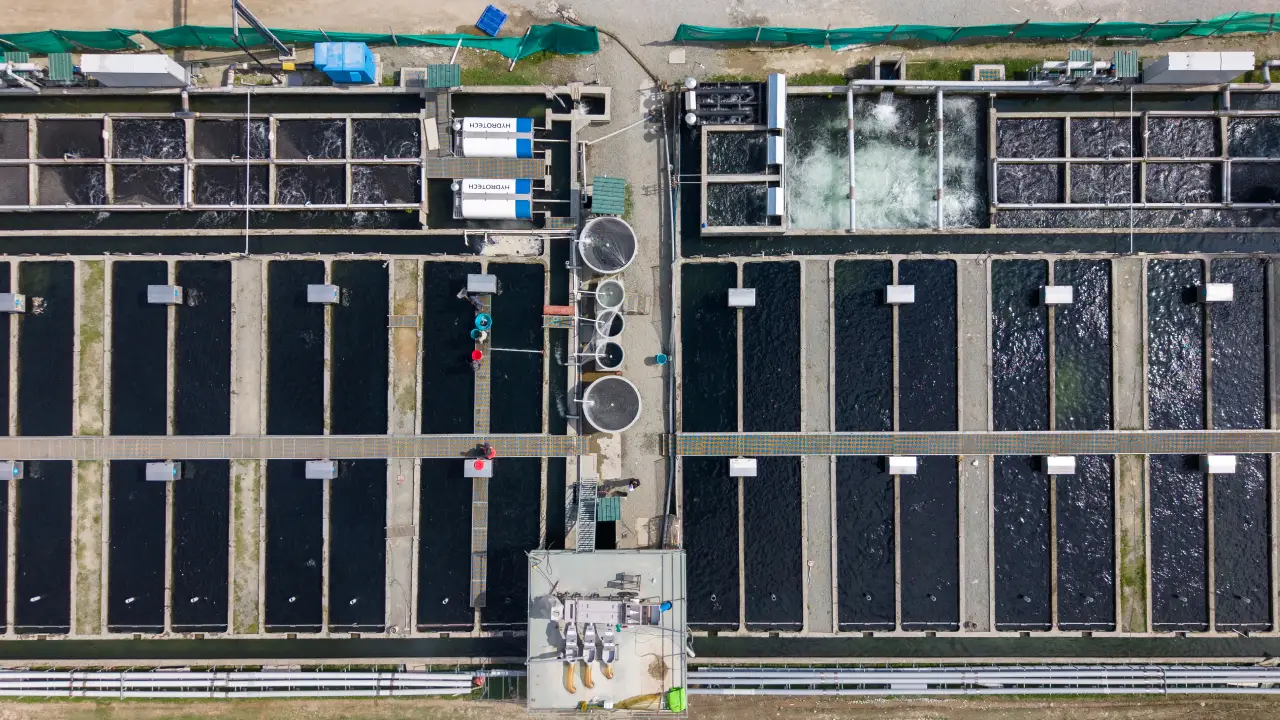
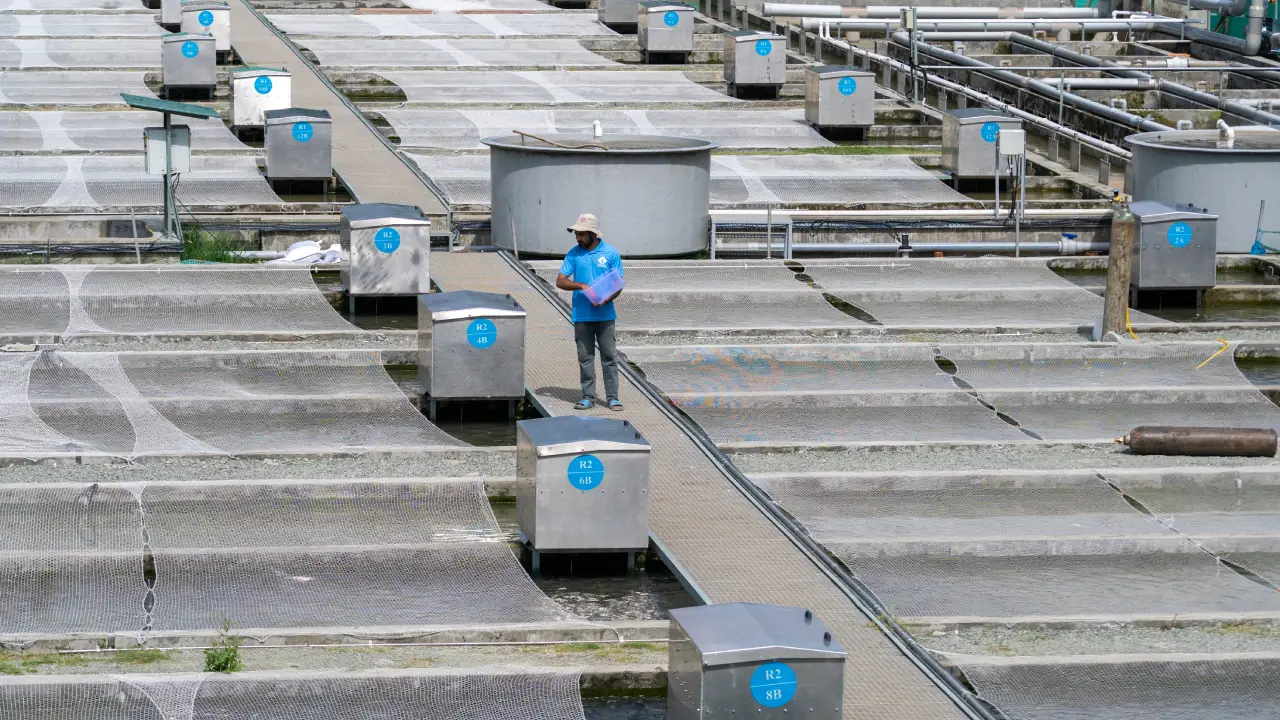
At Chak Akhal, the road passes a fenced compound that looks nothing like a fish farm as Kashmir knows one. Long concrete raceways lie side by side. Steel feeder boxes stamped Andersen Steel stand at the head of each channel. A drum filter marked Hydrotech hums by the fence. A tall blue tank stands over all of it. The machinery is imported, as its make announces. The hillside behind is brown and streaked with pine.
At the water’s edge, a bund of river stones runs out into the Sindh and turns part of the current aside. Three steel cones stand in the rapids, white water foaming around them. This is where the farm begins. A few metres away, inside the fence, the same water moves through pipes, pumps and filters, and through millions of rainbow trout.
The farm does not take the river on trust. Sensors watch the Sindh around the clock. When rain or a flood turns it muddy, they raise an alert in real time, before dirty water can reach the tanks. The river intake is shut. The farm switches to its own groundwater wells until the Sindh runs completely clean again.
Khyber Group
This is Khyber Aquaculture, the fisheries arm of the Srinagar based Khyber Group, best known for its luxury hotel at Gulmarg, its packaged milk and the Cement it has produced for decades. The farm covers eight acres. Trumboo calls it Asia’s largest Himalayan trout venture built on a Recirculating Aquaculture System, or RAS. The company, he says, “will soon be the largest Himalayan trout producer in Asia.”
On October 13, the day we visited, the farm announced that it had received its FSSAI licence to process, pack and sell fish products. Its first branded store opens soon at Karan Nagar in Srinagar. The trout we watched churning in the raceways that morning are about to become a consumer brand.
Patchwork Industry
Kashmir has had trout for over a hundred years. The British brought the fish to the valley’s streams around the turn of the 20th century. It stayed long after they left. The water suited it. Jammu and Kashmir has 27,781 kilometres of rivers and streams and 572 lakes, most of them cold, clear and fed by glaciers, according to the officials who briefed the Parliamentary Standing Committee in May 2026.
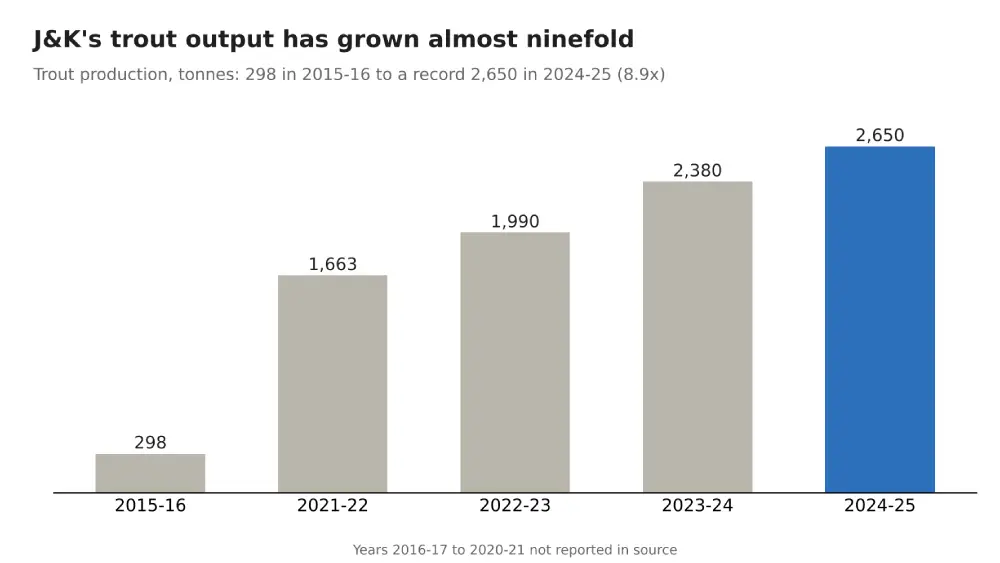
For most of that century, trout was a government hobby and a tourist’s catch. In 2015-16, the whole of Jammu and Kashmir produced only 298 tonnes. Then the private sector arrived. Private trout units grew from 388 to 1,649 by 2024-25. Hatcheries grew from one to nine. Trout feed mills grew from none to six. Output rose almost nine-fold, to a record 2,650 tonnes in 2024-25. Lt Governor Manoj Sinha now says Jammu and Kashmir leads “in trout production across all cold-water states.”
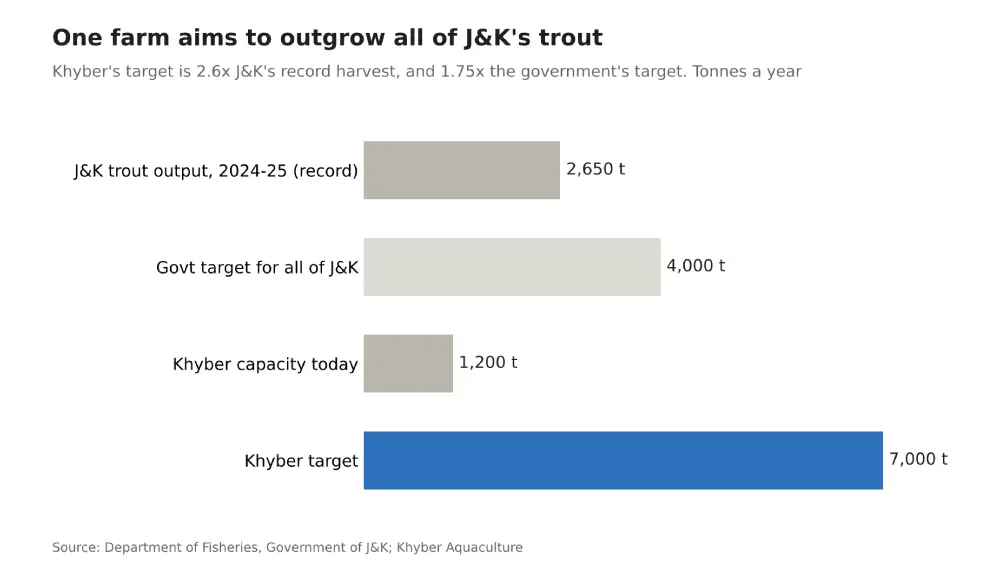
Even so, the industry is a patchwork. The typical private unit is a family run set of concrete raceways producing a tonne or two a year. It is exposed to floods, disease and erratic feed supply. The government’s own target is 4,000 tonnes. Trout is still a small part of Jammu and Kashmir’s fisheries economy, which produced about 31,700 tonnes of fish of all kinds in the latest year, most of it carp, according to official data.
Against that backdrop, Khyber’s numbers look like they belong to another country. The farm at Akhal can already produce about 1,200 tonnes a year. That is close to half of everything the territory’s 1,600 plus trout farms produced in their record year. Its target of 7,000 tonnes would be more than two and a half times Jammu and Kashmir’s entire current output.
One company on eight acres is planning to become bigger than the industry it belongs to.
Controlled Water
A trout is a demanding animal. It needs water between roughly 10 and 14 degrees Celsius, rich in oxygen and free of silt. Traditional Kashmiri farms take what the stream gives them. A flood, a warm spell or a muddy week can wipe out a whole season’s work. This is happened with almost all the small trout farm owners once or twice in their operations, so far. Khyber’s answer is control.
Water enters through the intakes on the Sindh and is managed at every step. In a Recirculating Aquaculture System (RAS), the water is filtered, stripped of waste, re-oxygenated and sent back through the tanks. It is not flushed straight downstream. The company says it holds dissolved oxygen and temperature within the trout’s comfort band all year. The drum filters, pumps and control panels that do this came largely from Denmark, France and Germany. The trout eggs come from the United States and Denmark.
The farm works in three stages.
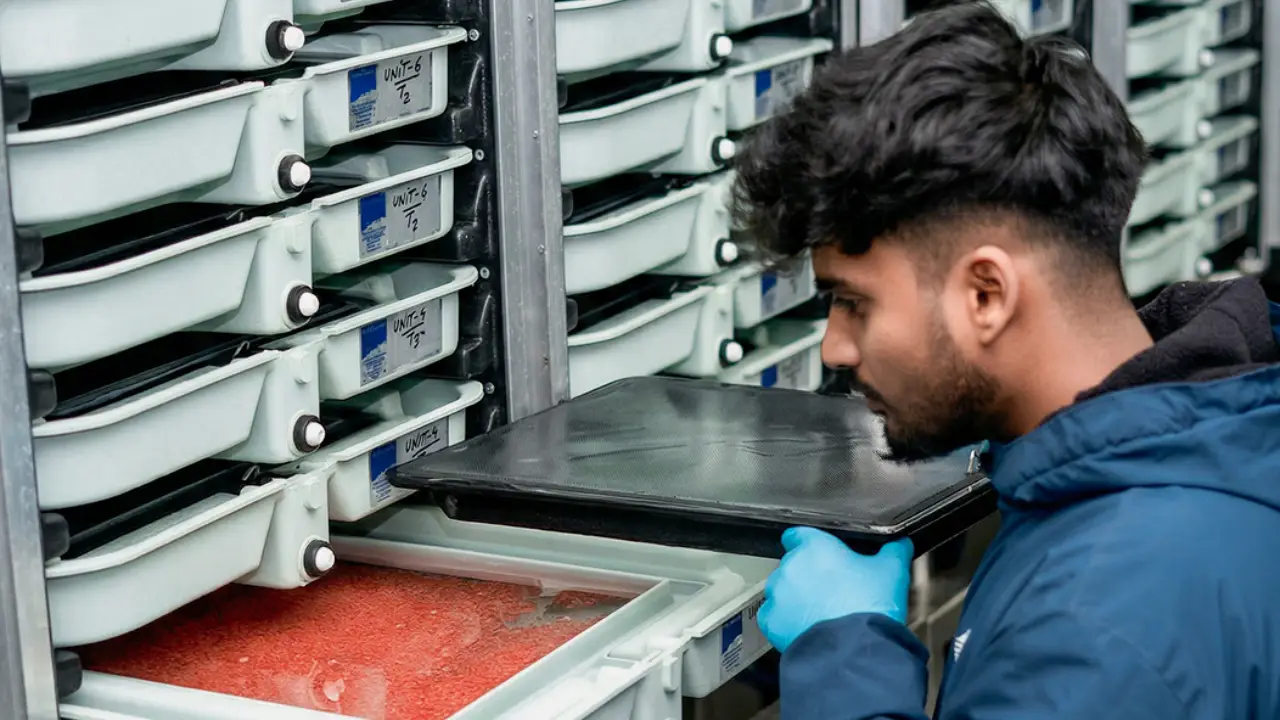
The first is the hatchery. It is an indoor hall of grey fibreglass troughs under white light, with white funnel feeders dripping pellets into water dark with fingerlings. It is built to produce up to two crore fingerlings a year.
The second is grow out, in the long outdoor raceways. Each is tagged with a code like R2 5B on its steel feeder box. Here the fish are fed, graded and moved as they grow. A supervisor in a checked jacket walked us along the grated catwalks, pointing out which channels held which size of fish. When a worker swung a net into one raceway, the water erupted with rainbow trout, their pink stripes flashing.
The third is processing. On the lines, stainless steel machines weigh, cut and pack the fish. The packs go out under Modified Atmosphere Packaging, a controlled mix of carbon dioxide and nitrogen that slows spoilage.
Quality Control
Machines alone do not make a world class farm. Khyber has assembled a team of highly qualified professionals. Many spent years in India’s fish industry outside Kashmir before coming to Akhal. Among them is Dr Hakeem Mudasir, who leads quality control at the farm and earlier worked in the fish industry in Kolkata.
“Fish health and food safety are closely linked to effective farm management,” Dr Mudasir said. “Our biosecurity programme is designed to reduce the risk of pathogens entering the facility and to minimise the risk of pathogens or other biological hazards being transferred from the farm to the surrounding environment.”
He said the incoming water is treated according to the system’s requirements before it is supplied to the fish-rearing units. Water discharged or exchanged from the RAS is managed through the applicable treatment and monitoring procedures before release, with the aim of reducing environmental impacts and the risk of pathogen transfer.
“We use a structured fish-health surveillance programme, with routine observations at defined intervals and escalation when staff identify abnormal behaviour, feeding changes, lesions or unusual mortality,” sad Mudasir. “The objective is to detect problems early, investigate their likely causes and implement appropriate corrective or treatment measures.”
Mudasir has integrated this surveillance process into a digital monitoring system. “I developed a shared workbook for the team, with a separate tab for recording observations. Staff monitor the tanks across three shifts and log relevant observations during their rounds,” he said. Each tank is digitally assigned a colour coded status. “Green indicates routine status, yellow flags a concern requiring follow-up, and red indicates a critical issue requiring prompt escalation. When a tank is flagged yellow or red, the relevant managers are alerted so the issue can be assessed and the response prioritised. The system helps us document observations, track interventions and improve accountability,” he explained.
When a fish health concern is identified, the team follows a staged assessment process. “The initial assessment includes observing feeding response, swimming behaviour, activity, external lesions and other clinical signs. These signs can indicate that a fish is unwell, but they are not sufficient on their own to confirm a diagnosis,” Dr Mudasir said. The team may also assess the vestibulo-ocular response as one part of the clinical examination. “A response can provide useful information, but it must be interpreted alongside the fish’s overall condition and other findings; it is not a stand-alone test for disease.”
“Depending on the clinical findings, we may collect appropriate samples for microscopic examination, such as skin or gill scrapes, and other laboratory tests. If the cause remains unclear or a specific pathogen needs to be confirmed, we can refer suitable samples for molecular testing,” he continued.
The farm’s stated approach is not to use antibiotics routinely as a preventive measure. “Antimicrobials should be used responsibly and only when there is a justified clinical basis, informed by the assessment and diagnostic evidence available. Where treatment is indicated, the choice should consider the likely cause, responsible-use principles, applicable regulations and withdrawal periods,” Dr Mudasir said. “Product testing is also part of our quality-assurance approach. Where required, samples can be tested by competent laboratories, including laboratories accredited by NABL for the relevant test methods, for specified residues or contaminants.”
Even healthy looking fish do not move directly from the raceway to market. “Harvested fish are managed through a defined pre-dispatch and quality-control process. Where purging is used, it is intended primarily to reduce off-flavours associated with the fish’s environment; it is not a substitute for disease diagnosis or food-safety controls. The team also assesses the fish and checks handling and product-quality parameters before dispatch,” Dr Mudasir said.
“The quality and disease-control function works across the production chain, coordinating with teams responsible for feeding, water quality, engineering, fish health and processing. The objective is to support consistent production, animal welfare, food safety and a reliable, high-quality product for the customer,” he said.
He further mentions “At Khyber Aquaculture, quality management extends beyond fish production to processing, packaging and dispatch. Value-added trout products require an integrated approach to food safety, hygienic handling, temperature control, traceability and shelf-life management. From harvesting and primary processing to packaging and distribution, each stage must be managed to preserve product quality, minimise contamination risks and maintain freshness. Modified Atmosphere Packaging (MAP), when supported by validated packaging conditions and an appropriate cold chain, can help extend shelf life. Our objective is to deliver safe, consistent and high-quality trout products that meet regulatory requirements and evolving consumer expectations.”
Funding Growth
Khyber Aquaculture is a bet by one of Kashmir’s largest family businesses. The Khyber Group, founded more than 50 years ago, runs hotels, cement, real estate and healthcare. It has put Rs 112 crore into the trout farm so far. It plans to invest close to Rs 200 crore more to raise capacity to 7,000 MT.
Part of that money came from Kashmir’s own bank. J&K Bank has extended Rs 26 crore of credit to the project. A team of Jammu and Kashmir’s bankers briefed a Parliamentary Standing Committee in May 2026, asserting the sector financed 317 fisheries units across the territory, with Rs 54.5 crore disbursed. Interestingly, almost all of that lending came from JK Bank.
The returns have only begun. Khyber’s trout business earned about Rs 10 crore in 2025-26, its first year of sales. The company is targeting Rs 38 crore in 2026-27, nearly four times as much.
Brand Launch
That growth depends on what happened on October 13. With its FSSAI licence in hand, Khyber can now process, pack and sell fish under its own brand, Khyber Himalayan Trout. “We have invested in building the production and processing infrastructure needed to grow trout at scale,” said Yunus Trumboo, director of Khyber Aquaculture. “Our focus now is to bring our sustainably farmed, clean and biosecure trout closer to consumers.”
The first products are boneless skin on portion cuts, Supreme Fillets and trout steaks, in fresh, chilled and frozen forms. Curry cuts, sushi and sashimi will follow. Hotels and restaurants get a 3.2 kg pack of four Supreme Fillets. Chilled packs keep for five to eight days. Frozen packs keep for up to 12 months.
The first branded store opens at Karan Nagar in Srinagar by this November. “Consumers will also be able to select live trout and have it cleaned, cut and packed at the store,” Trumboo said. After that, the company plans to sell through distributors, modern retail chains, hotels and e-commerce in Jammu and Kashmir, Delhi NCR and the rest of north India.
Wider Impact
The real question is not whether Khyber can grow fish. It is what a farm of this size could do for Kashmir. The answer touches jobs, farmers, diets, health, banks and the valley’s image abroad.
The company expects more than 3,000 indirect livelihoods once the farm reaches full capacity. Those jobs sit up and down the chain: feed supply, hatchery technicians, processing staff, drivers, cold store operators, packers, retail staff and the distributors who will carry the fish to Delhi. Many are skilled jobs of a kind Kashmir rarely offers outside government service. Water quality monitoring, fish health, food safety and cold chain logistics are trades that travel. A young graduate in Ganderbal who learns them at Akhal can use them anywhere.
Jammu and Kashmir’s fisheries sector already supports more than 31,000 fishers and fish farmers. A large, steady buyer and employer changes their prospects too. Khyber says it works with more than 300 local farmers under the Holistic Agriculture Development Programme, the Jammu and Kashmir government scheme that has set aside Rs 233 crore for fisheries. In August 2026, Khyber and the Department of Fisheries trained progressive farmers from Ganderbal, Bandipora and Srinagar in biosecurity, water quality management, early disease detection and RAS.
Trout is a lean, high protein fish rich in omega-3 fatty acids. A steady local supply, processed and sold under a food safety licence, gives Kashmiri households a clean, traceable alternative to fish of uncertain age and origin. The Karan Nagar store, where customers will pick a live trout and have it cleaned and packed in front of them, is built on exactly that promise of freshness. It will help fish make a grand return to the Kashmir kitchen, a space that has been filled by the Punjab poultry and the Gujarat mutton.
India’s luxury hotels and premium supermarkets import salmon by air from Norway, Scotland and Chile. Khyber wants Himalayan trout on those menus instead. Trumboo calls it “a home-grown alternative to imported salmon.” The company is courting chefs through retreats and workshops. Its 3.2 kg fillet pack is built for professional kitchens. Every plate of Kashmiri trout served in a Delhi hotel instead of Norwegian salmon is money that stays in the country and flows back to the valley.
Kashmir’s economy runs on horticulture, tourism, handicrafts and government jobs. It has struggled to attract large private investment. A Rs 112 crore, technology heavy food business, financed partly by the region’s own bank and built by a local group, shows that serious capital can be put to work in the valley’s natural and enviable freshwater resources. If it pays off, it will be easier for the next investors to engage at a major scale with the fish industry.
Way Ahead
Kashmir’s trout has the water and, now, a large operation. Whether it gets the rest will decide whether Akhal becomes a turning point or an exception.
We left at about half past five, just as the rain that had held off all day finally came. We stopped for tea at a dhaba on the banks of the Sindh.
While I filed this story, Khyber would not leave my head. The raceways boiling with trout, the hatchery hall under white light, the half built frame against the hills, the river cones foaming in the current: all of it kept returning, unasked. Kashmir’s trout industry has spent decades small, scattered and bruised. At Akhal, on one cloudy day, we watched it being handed a new life.
Below the farm, the Sindh runs on toward the Jhelum, cold and fast, as it always has. For the first time in a century, Kashmir is learning what that cold water is worth.