Kalhaṇa’s 12th-century Rājataraṅgiṇī, now on UNESCO’s register, has travelled through Persian, French and English translations. It articulated Kashmiri identity, blending history and poetry, but almost nothing is known about its author, a Kashmiri Pandit, writes Haseeb A Drabu
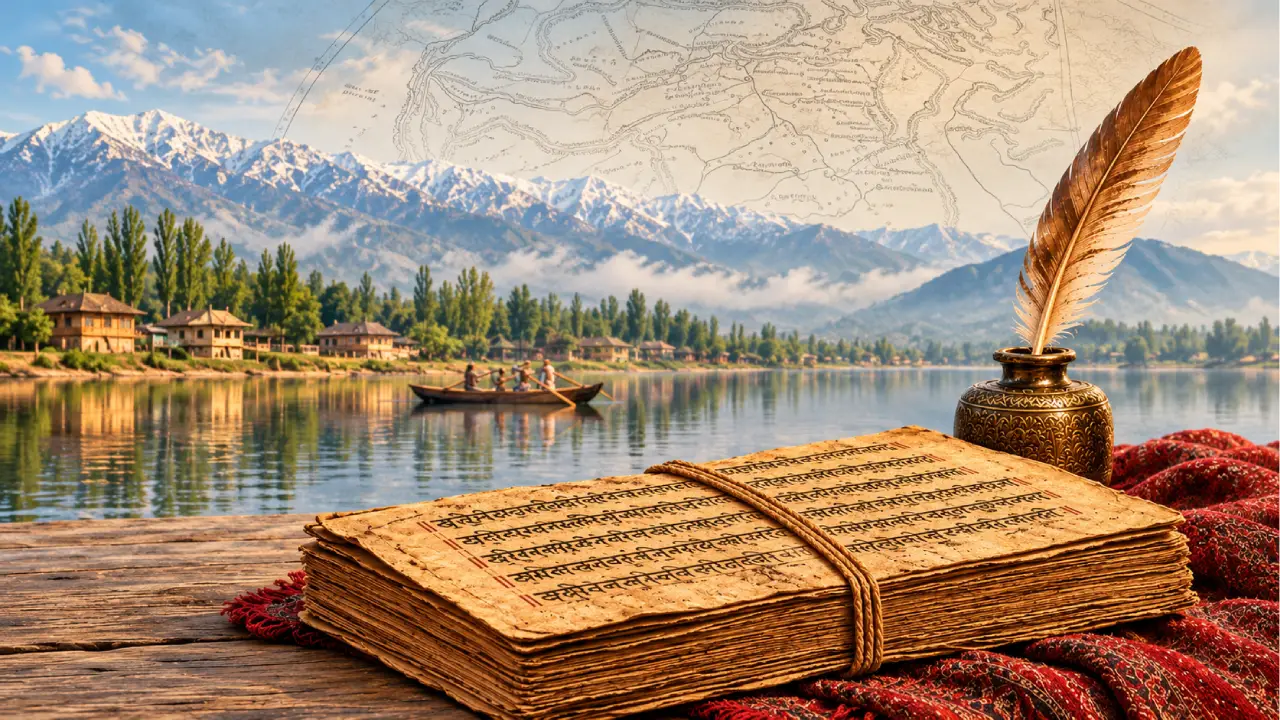
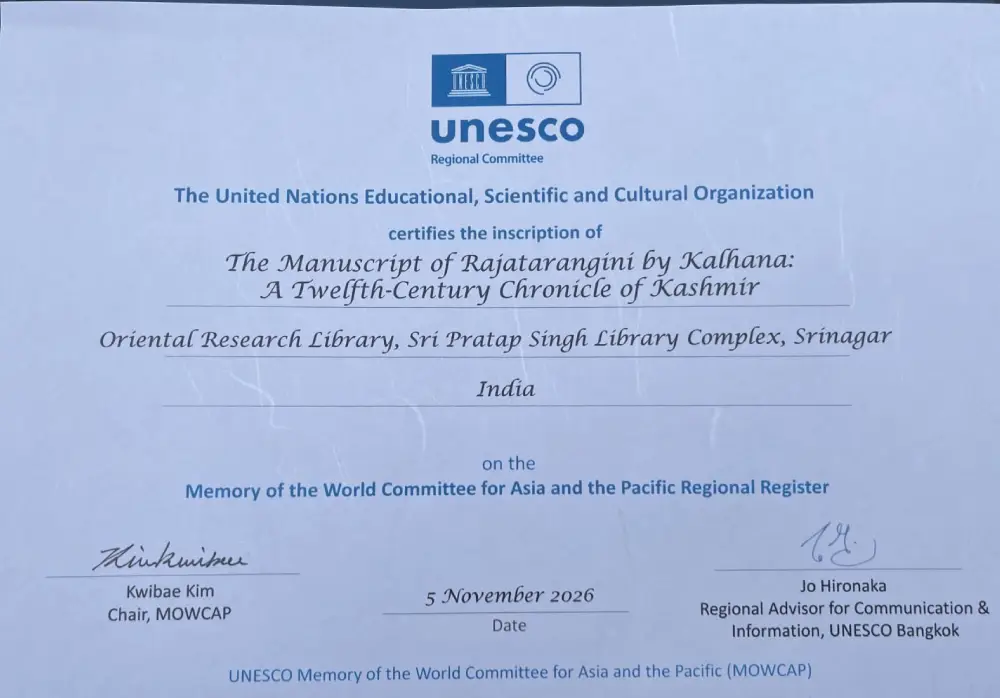
Last week, Kalhaṇa’s manuscript was added to UNESCO’s prestigious list, which recognises important documents that should be preserved for the future. It was a first for Kashmir, which marked yet another significant step in the Rājataraṅgiṇī’s nearly thousand-year journey. The Kashmiri Sanskrit chronicle composed in 1148-49 has crossed languages and latitudes, and courts and continents. It has survived neglect, divided and vanished drafts and partial renderings until it stands today as a recognised part of the world’s documentary heritage.
For centuries after Kalhaṇa laid down his pen in the mid-twelfth century, the Rājataraṅgiṇī remained a closely held Kashmiri treasure. Its Sanskrit verses in the local sharda script were organised in five wave’s cantos circulating mainly among scholars and courtiers within the Valley.
Transcripts’ Trails, Trials and Translations
Its wider journey began under the visionary Sultan Zain-ul-Abidin, Kashmir’s Budshah. In the long twilight of his reign, he got the chronicle translated into Persian as Bahr-ul-Asmār: The Sea of Tales. Suddenly the river of kings had a second channel, and its stories of dynasties, intrigues, and sacred landscapes began to flow beyond the mountains.
A century and a half later, Emperor Akbar found the Persian too archaic and obscure. He directed the court historian Abdul Qadir Badauni in 1594 to produce a fresh version in ordinary, living Persian. Abul Fazl, gathering material for the Ain-i-Akbari, quietly drew on the same source when he sketched Kashmir’s early past for the imperial record.
Then, in 1607, a Kashmiri noble named Haidar Malik Chadura prepared a tighter, more portable abridgement. When the French physician François Bernier reached Srinagar in 1664, he sat with Malik’s text and began translating the histories of the ancient kings of Kachemire into French. The work progressed, yet the manuscript later vanished; Bernier’s translation was never published and is now lost.
In 1775 a Tyrolese missionary Joseph Tieffenthaler included a brief summary of Haidar Malik’s Persian rendering in his Description de l’Inde, offering European readers only a distant echo.
The trail grew faint.
The original Sanskrit itself stayed elusive until the early nineteenth century. In 1823 the restless East India Company veterinary surgeon and explorer William Moorcroft, while in Srinagar, obtained a careful transcript of a local manuscript. Two years later H. H. Wilson used that material for an essay on the Hindu history of Kashmir that gave English readers their first substantial abstract of the opening cantos. The very manuscript Moorcroft had secured became the foundation of the 1835 Calcutta edition published by the Asiatic Society of Bengal.
From that Calcutta text the French scholar A. Troyer, Principal of the Calcutta Sanskrit College, undertook the first complete translation directly from the Sanskrit. He finished the work in 1852, and the Société Asiatique brought it out in Paris.
Momentum now quickened.
In 1875, Georg Bühler toured Kashmir in search of this manuscript. He found that the best Sharada copies descended from one ancestral manuscript. That ancestral manuscript has a story of its own. It was not Kalhana’s original. It was a copy made in the 17th century by the Kashmiri scholar Rajanaka Ratnakantha. Aurel Stein later called it the codex archetypus.
Bühler saw it with Pandit Keshavram, grandson of Pandit Shivaram. By the time Stein arrived in 1888, Keshavram had died, and his three heirs had divided the manuscript among themselves. Stein records that his early efforts failed. After long negotiations, he obtained the portions on loan in 1889. He credits the breakthrough largely to Raja Pandit Suraj Kaul and his son Hari Kishan Kaul.
A later account adds colour. The three brothers each wanted the heirloom for the pride of owning it. Unable to agree, they tore it into three parts and lost some folios. Stein then approached each brother separately, without letting the others know, to have his portion copied. He revealed that the manuscript, originally of 328 folios, lost its last leaf and one from the middle.
There is more drama.
In 1890, the box carrying the manuscript fell into the sea at Ostend. Stein reported that the old Kashmiri paper and ink survived the soaking without visible damage.
Behind the European story stands a Kashmiri scholar. Pandit Govind Kaul of Srinagar, born in 1846, had earned Bühler’s praise in 1875. From 1888, he worked with Stein for nearly 11 years. He collated manuscript readings, prepared Sanskrit indices, traced references to the epics and Puranas, and supplied local knowledge of geography and custom. Stein called him his best Indian friend. Govind Kaul died of typhoid in June 1899, a year before the translation appeared.
In between, drawing on the 1835 edition, Jogesh Chunder Dutt produced an English version issued between 1879 and 1887.
In 1892 M. A. Stein published his critical edition of the original text; around the same time Pandit Durga Prasada’s edition appeared from the Nirnaya Sagar Press in Bombay. Finally, in 1900, Stein completed his full English prose translation, the rendering that placed Kalhaṇa’s river of kings firmly and clearly before the modern world.
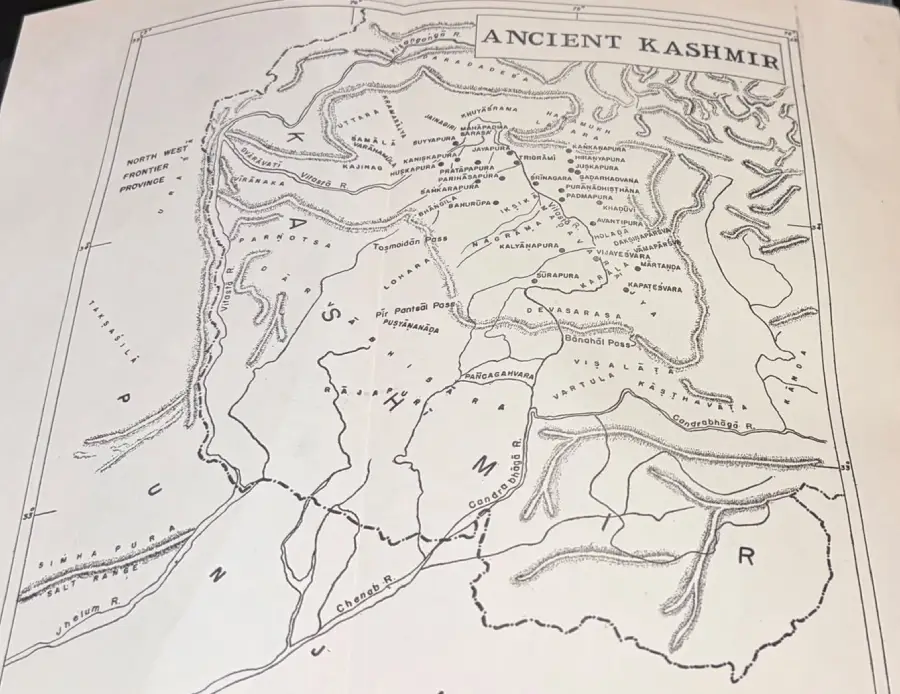
In 2013, Marc Aurel Stein’s Illustrated Rājataraṅgiṇī was edited and published posthumously by Luther Obrock. It features 82 archival photographs of historic locales across the Kashmir Valley taken by Stein during his 1940 tour, paired with two folding maps. Several Mughal-era and later Persian translations of the chronicle were lavishly illustrated with miniature paintings depicting Kashmiri kings, court scenes, and mythical legends. Notable copies are preserved in institutions such as the Oriental Research Library in Srinagar and the National Library of Iran.
The text has passed through an extraordinary range of hands. It has been shaped and transmitted by a Kashmiri noble, a courtier, a French physician, a Jesuit missionary and geographer, a veterinary surgeon, Orientalists and Sanskrit scholars, an educationist and administrator, a translator, an Indologist, and an archaeologist and explorer. Each profession added a new layer, abridgement, translation, critical edition, or scholarly study, until a twelfth-century Kashmiri chronicle became a recognised part of the world’s documentary heritage.
Thesis on Identity
Written over one year in 1148-49, Kalhaṇa’s Rājataraṅgiṇī tells the story of Kashmir’s rulers from legendary beginnings to his own lifetime. It covers dynasties, wars, succession struggles, taxation, floods, famines, temples and the everyday business of power. Before this text, Kashmir existed in scattered inscriptions, older chronicles and local memory. Kalhaṇa gathered those fragments and gave them the shape of a single continuous story. In doing so he wrote the first sustained literary account of the Valley as a distinct place with its own landscape, its own past and its own way of life, the first sustained articulation of Kashmiri identity.
That identity is rooted in place and in the habits of power. The drained lake Satisar, the sage Kaśyapa, the Nāgas and the mountains that enclose the land appear not as mere prologue but as explanations of why the Valley feels set apart. Sacred geography, rivers, springs, temples, monasteries and pilgrimage sites, maps a living landscape.
Religious life is presented as plural and ordinary: Shaiva, Vaishnava and Buddhist kings, shrines and practices share the same pages without any sense that one must erase the others. The chronicle treats this coexistence as ordinary rather than exceptional.
Kings are praised or condemned according to whether they protect the people, maintain justice and avoid oppression. Arrogant or unjust rulers are criticised, and the welfare of the people is presented as the measure of good kingship. Ethics and place are inseparable: to write about Kashmir is to write about how its people should live and be governed. These reflections are not added lessons; they help define what belonging to the Valley meant for Kalhaṇa.
For generations the work has been called India’s first true history. Yet the sharpest scholarly debate is whether the Rājataraṅgiṇī should be read primarily as history or as poetry. Since H. H. Wilson’s partial translation in 1825, many European and later Indian scholars have praised its chronology, causality and apparent impartiality while setting aside its myths, miracles, moralising and elaborate language as imperfections.
Others argue the opposite: the work is first a Sanskrit kāvya, a polished literary composition, and its historical character arises because of, not despite, its poetic and didactic qualities. Ethics, especially the duties of kings and the welfare of the people, is its organising principle. Myths are not lapses but purposeful ways of giving meaning to time and place. Kalhaṇa mixes miracle, prophecy and moral lesson with political narrative, and he judges rulers against ideals of conduct. Judging the text by modern standards of empirical history risks missing what he was actually doing.
That larger purpose was to articulate Kashmir itself. Kalhaṇa does not merely list rulers. He produces a continuous story of the Valley: its sacred geography, its plural religious life, its landscapes, its political habits and the recurring lessons of misrule. In doing so he gave Kashmir a usable past and a sense of itself as a distinct homeland.
Written in cosmopolitan Sanskrit rather than a local dialect, the chronicle still rooted that identity in the particularities of the Valley. Later Kashmiri writers treated it as the foundational indigenous account of their land. Manuscripts continued to be copied and preserved in the Valley itself, and through successive translations the text travelled, yet it remained, above all, a Kashmiri book about Kashmir, the principal source through which Kashmiris understood their own history.
The UNESCO inscription recognises precisely this cultural weight. It describes the manuscript as a repository of the cultural essence of Kashmir and notes Kalhaṇa’s critical method, his use of sources, his chronological framework and his ethical reflections. The listing places the work alongside other major Indic texts of narrative and statecraft. It does not settle the scholarly argument about history versus poetry; heritage recognition is not literary criticism. What it does affirm is that a twelfth-century Kashmiri composition remains important enough to be preserved as part of the world’s documentary memory, and that it still matters as a living source of identity.
Nearly nine hundred years after Kalhaṇa finished writing, the Rājataraṅgiṇī is still the book that first gave sustained literary shape to Kashmiri identity. Kings come and go, empires rise and fall, but the river of kings continues to define the Valley for those who live there. The UNESCO honour simply makes that long continuity visible to a wider world.
Kalhaṇa: A Quiet Life in the Shadow of His Chronicle
Almost everything known about Kalhaṇa comes from the Rājataraṅgiṇī itself. He was a Kashmiri Brahmin of the Valley, a Śaiva by affiliation, and the son of a high official. The colophons that close each of the eight books name him simply as “Kalhaṇa, son of the great Kashmirian minister, the illustrious Lord Caṇpaka.”
He mentions that he began the work in Laukika year 4224 (1148-49 CE) and finished it the following year. Beyond these sparse facts he is silent. No surname, gotra, clan, or kram name is recorded. There is no description of his appearance, no portrait, and no independent contemporary account of his person.
His exact age is unknown because no birth date survives. Working from internal evidence, it has been concluded that he was born around 1100 or shortly thereafter. The detailed and mature way he writes about the troubled years 1112-1121 reads like the observation of an adult who had lived through those events.
It is also fairly certain that he was born at Parihāsapura in North Kashmir.
On this estimate he would have been roughly in his late forties or early fifties when he composed the chronicle. There is no record of when or where he died, nor of his cremation or any memorial. Later Kashmiri chroniclers such as Jonarāja acknowledge him as the author and call him a dvija, yet they add nothing about the end of his life.
Trained in Sanskrit grammar and literary theory, Kalhaṇa knew the classical poems and historical romances, had studied the Mahābhārata and the Rāmāyaṇa, and was familiar with the work of his fellow Kashmiri Bilhaṇa. He also read the Nīlamata Purāṇa and quotes from it. The invocations to Śiva that open the books of the chronicle make his own affiliation clear, yet he wrote with equal respect of Buddhist kings, monasteries, stupas and images.
He belonged to a family close to the centre of power. His father, Caṇpaka, served King Harṣa as dvārapati (Lord of the Gate) responsible for frontier defences. Kalhaṇa notes his father’s role in an expedition against the fortress of Dugdhaghāṭa on the Darad frontier shortly before 1099 and records Caṇpaka’s loyalty during Harṣa’s final struggle.
Caṇpaka was away on a special mission when the king met his catastrophe. Stein observed that the intimate details of these events, including a reported dialogue between king and minister and the account of the king’s flight preserved through a household servant named Mukta, could scarcely have survived except through the family.

Among Kalhaṇa’s contemporaries was the Kashmiri poet and courtier Maṅkha, who served under King Jayasiṃha and composed the Śrīkaṇṭhacarita, a major mahākāvya retelling Śiva’s destruction of the three cities. He moved in the same literary circles as Kalhaṇa in mid-twelfth-century Kashmir. Indeed, in the final canto of the Śrīkaṇṭhacarita, Maṅkha describes a literary assembly of Kashmiri scholars and poets at which he presented his work. Among those present he names a poet called Kalhaṇa.
Despite the iconic status and stature, the Rājataraṅgiṇī has given him, Kalhaṇa never became a common given name among Kashmiri Pandits, either at present or in recent times or even in the earlier recorded tradition. Naming practices settled on a relatively stable set of personal names and a large repertoire of surnames and kram names; Kalhaṇa simply did not enter that repertoire. The reason for this absence remains a quiet mystery. There is no historical difficulty in regarding him as one of their own: he was a Kashmiri Pandit of the Valley and the author of its principal indigenous chronicle. Yet not a single Kalhaṇa appears in the living memory of the community!
(An economist and editor, the author was former Culture Minister of Jammu and Kashmir.)