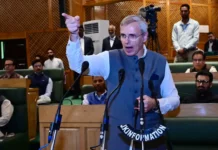
Omar Abdullah expanded his cabinet after two years of divided power. Jammu feels shut out, and even his own party is restless. While tensions are mounting but unlikely to impact the government or party, the tightrope walk is getting tough, writes Masood Hussain
It was very calm but not as cool as was anticipated, one politician who attended the October 27, 2026, oath-taking ceremony at Srinagar Lok Bhawan auditorium said. While the party had asked all the lawmakers to ensure their presence, too many, 11, as per one media report, had not taken it seriously. “Disappointments in politics are so normal, but I could feel that it was indiscipline,” he said, “I saw it as a let-down of the party that ideally has never tolerated it.”
People had rushed to the venue, eager to secure their seats and witness the oath-taking as Omar Abdullah expanded his mini-cabinet, two years after taking office. The strength of the Council of Ministers was set to rise from five ministers, besides the Chief Minister, to eight, besides Omar himself, within the 10 per cent ceiling set for the number of ministers in the Union Territory of Jammu and Kashmir. In the rush to find a place and settle down, however, few had the time to look around for the people they had expected to see there.
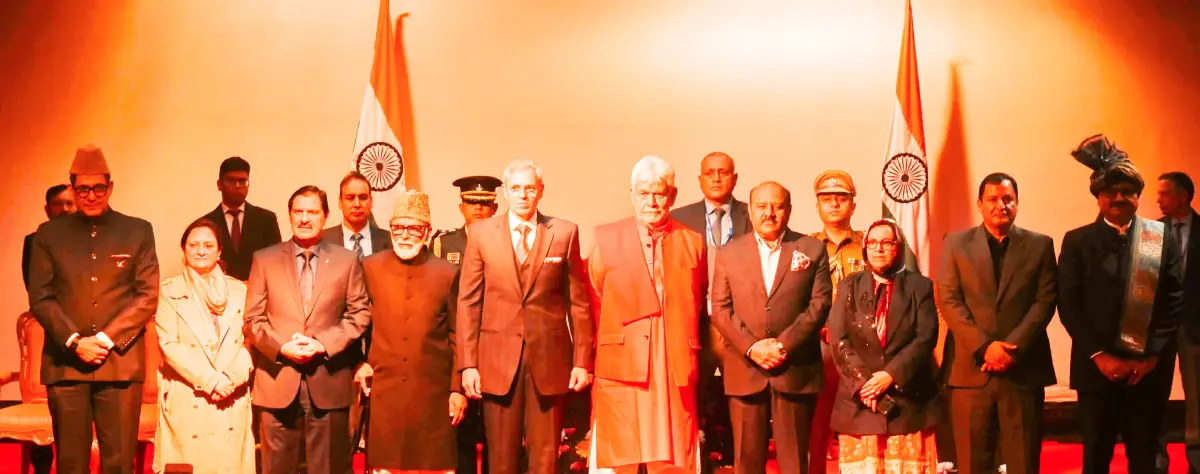
For many in the audience, the first shock came as the four took the oath of office. As the process was going on, the anger was unmistakable on some faces, with expressions that betrayed what words might have left unsaid. Among the new faces in Omar’s team were Ali Mohammad Sagar, Mir Saifullah, Shameema Firdous and Altaf Kaloo. Sagar took the oath of office in Urdu and the other three in English. They took turns to sign the mandatory document, and it happened so orderly, following the script that usually dictates such events.
The next shock came during the customary photo opportunity. Many in the audience scanned the frame, with Omar Abdullah and Manoj Sinha at its centre, but Satish Sharma was conspicuously absent. He had been dropped. People began looking around for him, only to discover that he had stayed away.
The decision had its backstory. Before meeting Sinha on October 24 to seek a time slot for the expansion of his Council of Ministers, Omar had sought resignations from all its members. He accepted Sharma’s resignation but retained the others. Government sources said Sharma had been informed about the decision.
The New Faces
Sagar, 68, is the senior-most of the new entrants in Omar’s council. In addition to being the party’s General Secretary, he is a seven-time MLA from Khanyar (Srinagar). A lawyer by training, Sagar was Rural Development and Panchayati Raj Minister in Omar’s government. His son, Salman, represents the Hazratbal constituency in Srinagar. However, his age and reportedly poor health have raised questions. Many within the party think his closeness to Farooq Abdullah may have worked in his favour. The impression is that his ministry will be run by his son.
A 4-time MLA, Mir Saifullah is a party heavyweight from border Kupwara. He was Omar’s Law Minister in his last term.
In Shamima Firdous, the 58-year-old, 3-time MLA from Habba Kadal, Omar brought the second woman to his council. Apart from heading the party’s women’s wing, the law graduate has also chaired the Jammu and Kashmir State Commission for Women, with the status of Minister of State, earlier.
Two-time MLA from Pahalgam, Altaf Ahmad Wani alias Kaloo is a first-timer and is said to be an engineering graduate and a businessman.
The other day, portfolios were announced. Surinder Choudhary retained Public Works, Skill Development, Industries, and Labour and Employment but gave up Mining
Sagar was given Revenue, Power Development, Law, Justice & Parliamentary Affairs, Disaster Management (DMRRR), and Election.
Sakina Ittoo was given the Health and Medical Education and Social Welfare Departments.
Education Department that Sakina managed for two years was given to Shameema, in addition to Jal Shakti (PHE).
Javed Rana is now minister for Food, Civil Supplies & Consumer Affairs, Tribal Affairs, and Transport.
Javid Ahmad Dar retained Agriculture Production and Cooperatives and was given Finance and Mining. Rural Development and Elections, which he held earlier, have gone to Kaloo and Sagar.
Surprisingly, Mir Saifullah was made in-charge minister for Planning, Development and Monitoring, Culture, Youth Services & Sports, ARI and Trainings.
Greenhorn Altaf Kaloo got Forest, Ecology and Environment, Rural Development and Panchayati Raj.
Departments not allocated to any minister will stay with the Chief Minister.
In effect, Omar Abdullah has let go of Finance, Revenue, Power, Law, Planning and Culture, the departments he had carried for two years.
“I will work hard to serve the people and leave no stone unturned in addressing their concerns,” Kaloo told reporters as his colleagues and friends were congratulating him. “We will listen to the people and do everything possible to meet their expectations.”
In her new role, Shameema saw “a challenge and a responsibility”, and flagged the fact that “a lot of work needs to be done.”
As Omar took his entire council to the Civil Secretariat for a meeting and visited each of their chambers, the angry lawmakers were talking to the media in such a fashion that it created a new precedent in Kashmir politics.
Public Outbursts
The anger and the heartburn did not stay in rooms, perhaps for the first time.
Not far away from the venue, it looked like a mourning space where the media waited for the lawmakers to come and talk to them. Quite a few media organisations had been invited to cover the oath-taking event.
Abdul Majeed Larmi, MLA from Anantnag West, literally broke down. He said he was on the list until Monday evening. “My heart is broken,” he told reporters, wiping his tears. “I was deserving. I say it twice, I was deserving.”
Larmi objected to Wani’s induction. “He came into the party yesterday,” he lamented. Yet he stayed loyal. “I am a soldier of the party,” he said. His supporters protested at Khanabal, demanding the removal of the Chief Minister’s adviser.
By Wednesday, his tone had hardened. His family had been with the National Conference since 1931, he told supporters and regretted that what happened to him and his workers was “intolerable”.
Mubarak Gul, a six-time MLA and former Speaker, was blunter. “I might have been part of 20 oath-taking ceremonies. Every time I watched the oath-taking, I was always dropped, and today as well,” he told reporters.
Nazir Ahmad Khan, known as Gurezi, a four-time MLA, skipped the ceremony. Saifullah and Kaloo later visited his home at Tulsi Bagh. What conversation took place? Nobody knows.
Unlike all others, Mubarak Gul chose to drive to Nawai-Subh, the party headquarters near the Zero Bridge. A gentleman, he had actually been asked to come to the office where Dr Farooq Abdullah and Chief Minister’s Adviser, Nasir Aslam Wani, were waiting for him.
The party had moved fast to calm Gul. It made him general secretary, replacing Sagar, who went into the cabinet. Party insiders said it was initially decided that the post would go to MP Choudhary Ramzan.
“As soon as Gul walked in,” a reporter covering the event said, “the party leaders warmly garlanded him.” Gul was calm but depressed and did not stop or react to anything. He was taken to the Secretary General’s chair, and he sat with the party leader behind and around him for a photo-op.
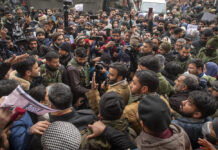
By then, a group of young men, apparently led by Gul’s son, entered the party headquarters and resorted to massive sloganeering. They later entered the hall. Though Dr Farooq Abdullah wanted to talk to the media, the noisy scenes prevented him. One party insider said Gul’s son actually talked to Dr Abdullah “in a very high pitch”, regretting that “our loyalty was betrayed”. Then the leaders started moving out.
Eventually, party spokesperson Imran Nabi Dar told reporters that the workers’ displeasure was “completely natural”. He hoped it would cool soon. People close to Gul said he remains unhappy.
On Wednesday, his supporters were back on the street, wrapped in white shrouds. “Do justice to Eidgah, make Mubarak Gul a cabinet minister”, they chanted, and then, “Gul Sahab, resign”. By Friday night, party president Dr Farooq Abdullah issued an order that Sagar will continue to hold the position of the party’s Secretary General.
Dropped Minister
What was interesting was the exclusion of Satish Sharma from Omar’s cabinet. Son of Congress’s erstwhile MP, Madan Lal Sharma, he won Chhamb in 2024 as an Independent. The Congress had refused him a ticket, and he threw his lot in with the JKNC right at the last moment and emerged as a minister.
With portfolios like Food, Civil Supplies and Consumer Affairs; Transport; Science and Technology; Information Technology; Youth Services and Sports; and ARI and Training, Sharma emerged as a great success story. He became a lawmaker and a minister in one go.
While his success did not last long, he created a gulf that Omar will find very difficult to fill. With Sharma out, Jammu, Samba, Kathua and Udhampur, the entire Hindu heartland, have no one in the cabinet. The Chenab Valley has none either. Deputy Chief Minister Choudhary, from Nowshera, is the only Hindu minister. Choudhary and Rana are from the Pir Panchal belt. Sharma was the only minister from Jammu outside it.
“This is something that will hurt the party,” one party insider from Jammu said. “At the face of it, we have given two-thirds of Jammu on a plate to BJP. And this we did at a time when BJP was facing music. Now they have an issue to talk about.” Besides, the insider said Sharma’s exclusion ignored thousands of people who rejected the BJP and voted for the JKNC in 2024. “They are not too many, but they exist.”
The BJP was quick to get into the ring. “I want to congratulate the new ministers, but it is for the first time that a regional and cultural imbalance has been observed during the Cabinet expansion,” BJP lawmaker Sunil Sharma, who is also Leader of Opposition in the assembly, said, moments after the oath-taking ceremony. “Governments have to maintain religious, cultural and regional balance, but that was not seen today.”
The BJP’s reaction was seen as little more than a formality. “In 2014, didn’t the PDP pay a political price for shaking hands with the BJP?” asked a political commentator who has closely followed Jammu and Kashmir politics for the past 20 years, while defending Omar’s political judgement. “The BJP exploited that opportunity and communalised the state to such an extent that it left nobody from the belt even for a (political) handshake.”
The Kashmiri-speaking Chenab Valley is de facto an extension of Kashmir. Now, even this region went unrepresented. This region is the main belt where BJP is focusing to tilt the balance of power.
This is the first time in history that seven of nine ministers are from Kashmir. Two are from Jammu, and only one of them is a Hindu. Central Kashmir, comprising Srinagar, Ganderbal and Budgam, has three berths in the cabinet: Omar, Sagar and Shameema. South Kashmir has two: Wani and Itoo. North Kashmir has two: Saifullah and Dar. Rajouri-Poonch has two: Choudhary and Rana.
The Jammu Hindu belt has none. The Chenab Valley has none. Only one Hindu sits in the cabinet. Jammu has 43 MLAs. Twenty-nine are from the BJP. The NC has seven there, and two are ministers. Kashmir has 47 MLAs, 35 of them from the NC.
Reluctant Candidate
The tensions created by the Tuesday events are rooted in 2024. Before the elections to the 90-member legislative assembly, Omar had said many times that he might not be the candidate for Chief Minister. Having headed the state twice, he indicated managing a UT with limited powers may not be his cup of tea.
Then the elections came. He won from Ganderbal, the family’s traditional seat. On October 16, 2024, he took the oath of office. The doubt did not vanish. It became the theme of the term.
Omar began with a small team. He had five ministers besides himself, six in all, with Surinder Choudhary as his Deputy.
Choudhary had resigned as a government employee and contested as a Bahujan Samaj Party candidate in 2009. In 2014, he contested the same seat as a PDP candidate and lost. He resigned from the party in 2022 and joined the BJP. In July 2023, he quit the BJP for the National Conference. In 2024, he won, and Omar appointed him as his Deputy.
Sharma won independently and extended support to Omar and became a minister.
The two were seen as representatives of the majority Jammu population. Their presence gave Omar strength, at a front where he had nothing.
Power Maze
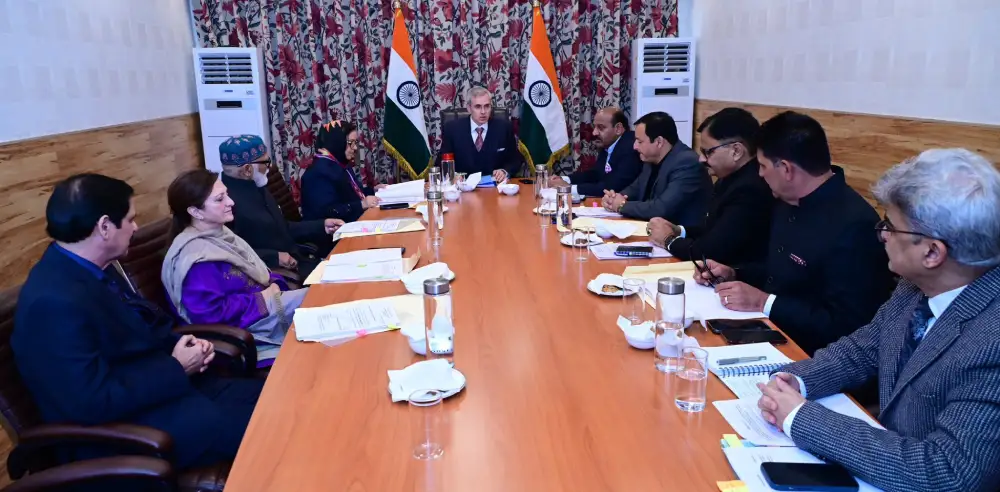
Once in power, Omar started facing a governance structure which lacked the autonomy of a state. Authority remained the core problem even though he had all the legitimacy to exercise it. For two years, Omar has faced a crisis of twin power centres, and it is unchanged.
Omar Abdullah has no control over the Jammu and Kashmir Police, the Union Territory’s largest department and one that exercises extensive executive powers. Its budget is administered by the MHA, while Lt Governor Manoj Sinha retains control over the police. Omar lacks authority over judicial and legal issues, and over the central services.
The Jammu and Kashmir Reorganisation Act leaves little room for interpretation. Section 32(1) keeps “Public Order” and police out of the Assembly’s reach. Section 53(2) gives the LG discretion over these, and over the All India Services, and the Anti-Corruption Bureau.
The centre tightened its grip before the vote was cast. Weeks ahead of the vote, on July 12, 2024, MHA amended the business rules so that proposals on police, public order, the All India Services and the ACB must reach through the Chief Secretary. The appointment for the Advocate General and law officers and sanction for prosecution now must go to the LG first.
The bureaucracy emerged as an owner in itself. It reports to Lok Bhawan for deployment and APR. Yet it is at the disposal of the Chief Minister. In the end, it reported to both and did whatever it wished.
When responsibility is shared, and authority is not, blame travels easily. Two years on, the Business Rules are still not finalised. They would mark a clear demarcation of the responsibilities of the two sides.
Jammu and Kashmir still has no Advocate General. In a series of directions, even the High Court highlighted the gulf. The JKNC says it sent names. They are with Lok Bhawan. No decision has been taken.
Credibility apart, the system is hitting Omar more. His government holds meetings, reviews schemes, inspects works and departments. It does what comes in its way. But the substantial outcome is invisible.
One of the most burning issues is reservations. The stakes are too high. Reserved rules altered by the BJP government, almost a year ahead of the 2024 elections, have created a situation where reserved categories take more than half of the opportunities in government and professional colleges. These categories barely make up one-fourth of the population.
As the youth directly hit by the new rules came out in protest within days after Omar’s takeover, a committee was constituted. It made some recommendations. Then there was no final announcement. “This is the issue on which a major crisis can emerge,” one lawmaker admitted. “That was not understood when one lawmaker broke down in the assembly early this year.”
Some decisions were taken. The academic calendar went back to the traditional system. Women passengers in government-owned buses pay no fare. Resolutions on statehood and special status passed.
Supporters point to limited powers. Critics say the limits became a shield. BJP spokesperson Sunil Sethi wrote that statehood “cannot become an all-purpose explanation for every unfulfilled electoral commitment”. The fact is, Omar is caught in a maze where expectations are limited.
Nasir Aslam is the best instance. A bosom friend, Omar took him as his adviser.
The file about him was tossed from one table to another in the civil secretariat and Lok Bhawan. After more than a year, he formally got his appointment approved and got his first salary.
A routine appointment took over a year. That says something about the system Omar is part of.
Mounting Pressures
Ideally, the UT setup was not alluring as far as power is concerned. But the status matters. So, the pressure to expand had built for a long time.
On October 18, 2025, Omar had said that it was wrong to assume only ministers can serve their areas. “Every minister in my cabinet works for the entire Jammu and Kashmir,” he had said. The expansion, he said, could be considered after the Rajya Sabha polls.
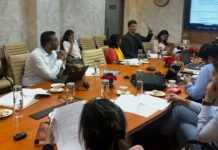
In June 2026, Omar took his lawmakers to Dachigam for lunch. As they sat for a long interaction about how the government was working, the lawmakers fired left, right and centre. They attacked his ministers for their performance and lack of courtesy. He assured them that he would take care of the issues they flagged and hoped the next time they meet the response would be better.
On May 8, 2026, he mentioned statehood. “The cabinet expansion has been delayed because statehood has not been restored, not because there is any fear or instability in the government,” he said. “There is no Eknath Shinde in the National Conference.”
Statehood did not come. It is unlikely to come in his term. So he finally decided to expand.
Before the list came, he said it was finalised after consulting Dr Farooq. He urged legislators to stop lobbying by phone calls and WhatsApp messages. He publicly commented on the “long messages” he was receiving. Various lawmakers told this correspondent that they felt “humiliated” over this. “After all,” one lawmaker said, “if we do not convey our feeling to the head of the family, where shall we go?”
A New Crisis
The tensions in the party are becoming public at a time when Srinagar MP Aga Ruhullah Mehdi plans to resign from the Lok Sabha and quit the party on November 3, the death anniversary of his father, Aga Syed Mehdi.
Soon after the Omar government took over, Aga emerged as a bitter critic of the policies of his own party. Very vocal in the Lok Sabha, Aga wanted the party to change strategy. He alleges his party is retreating from its promise to restore Articles 370 and 35A. He helped draft the 2024 manifesto, which promised both, alongside statehood.
After a series of efforts to mend fences failed, Dr Farooq Abdullah finally challenged him to resign and seek a fresh mandate. Aga reaffirmed his plan. He rejected any wish to bring down the government.
His exit would not change the NC’s strength in the Assembly. It could force a by-election in Srinagar. Nobody knows if Aga will float his own outfit. There has not been any effort from any JKNC MLA to shake hands with Aga. “I once told Aga that rather than making issues public, it is better to discuss them within,” one lawmaker said. “I do not believe in hurting the same party that gives us our identity.” It is too early to say that any disgruntled lawmaker will join Aga once he calls it a day. Even after the expansion controversy, chances are minimal.
In this entire crisis, the Congress is helping its ally, the JKNC. It has decided to stay out of the government even though reports suggest the party was offered a berth. State chief Tariq Hameed Karra said the party had decided “that we will not become part of it”. The condition is statehood.
By this response, the Congress is indirectly paying back for what JKNC did in the 2024 elections to help the party remain in the reckoning in Jammu and Kashmir. Traditionally, Jammu has remained Congress’s base, and it was completely taken away by the BJP. Congress does not exist in Jammu’s Hindu heartland anymore. It still has six seats in the assembly, five of them from Kashmir and one from Rajouri, all Muslim constituencies. Had JKNC contested these seats, Congress might have a much smaller number. Now all six Congressmen support Omar government from outside.
Safe Government
Tensions aside, there is no immediate threat to the government. The NC has 41 MLAs in the 90-member House. Six Congress MLAs, five Independents and one CPM legislator back it from outside. That takes the government to 53. The majority mark is 46.
The BJP has 29 MLAs. The PDP has four. The People’s Conference has one.
There are no chances of the party breaking. But tensions exist.
At a function for the new ministers, Dr Farooq said the NC had faced conspiracies in 1953, 1977, 1984 and 1990. It emerged victorious each time. Those who tried to divide it, he said, had “gradually disappeared from the political landscape”. He vowed the struggle for Articles 370 and 35A would continue.
Dr Farooq is right. Between 2019 and now, there have been serious efforts to weaken the JKNC. It proved to be a rock-solid party. In this era, when parties were broken and new entities emerged, not a single senior leader (excluding the late Devendra Singh Rana) left the party. But that has not stopped the tensions within.
With portfolios allocated, the government is set to resume work from Jammu next week. Omar Abdullah will also have to work with a new Chief Secretary, seniority-wise junior to several officers currently serving in the administration.
The new ministers will move into their chambers with fresh portfolios. Dar holds finance but his budget can’t reach the House without Lok Bhawan’s recommendation. Sagar holds law, but the government still has no Advocate General. Every stalled file will be read by the opposition as a failure and by Omar as proof of the system. Until statehood returns, the Reorganisation Act ensures he can explain his helplessness but not end it.
Omar Abdullah has too many fronts to manage. Few chief ministers in India face so many simultaneously, and fewer still have so little power to resolve them. Yet, this time, he has more hands to work with. The challenge is to turn that support into leverage without losing his balance. For Omar, it remains a tightrope walk.
Post Script
By late evening on Friday, media reports suggested that a number of lawmakers had met in Srinagar. Numbers varied. Reports said they talked about a course correction in the party.