Jammu and Kashmir Bank’s cheap deposit share has fallen from 50.59% to 42.01% in 12 quarters, squeezing margins, as costly term deposits drive growth and management targets are repeatedly missed or cut, reports Mudasir Majid Pir

Jammu and Kashmir Bank historically enjoyed state backing that kept most of the big lenders, both in private and public sector, from competing freely for business in Jammu, Kashmir and Ladakh. Seemingly, that patronage is either missing or is not being used by the bank to retain its status. The trend of the last 12 quarters (3 financial years) of its own numbers shows that the leverage is slowly leaking away.
Provisional Numbers
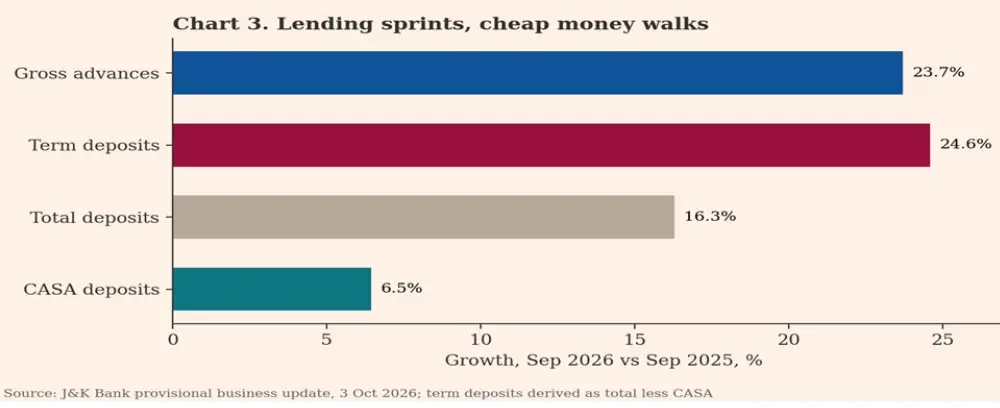
On October 3, JK Bank published its provisional numbers for the second quarter ending September 2026. Gross advances rose 23.7% year on year to Rs 1,33,551 crore. Total deposits rose 16.3% to Rs 1,76,796 crore. Current and savings account (CASA) deposits, the cheap money on which the bank’s franchise rests, rose 6.45% to Rs 74,277 crore. The CASA ratio has fallen to 42.01%, a drop of 388 basis points in a year if provisional numbers hold when the September quarter results are out.
By the end of December 2023, 11 quarters earlier, the CASA ratio was 50.59%. Out of 11 quarters, the ratio has fallen in nine. Over the same period, the bank’s quarterly net interest margin (NIM) has gone from a peak of 4.04% to 3.28%, the lowest in the period and well below the 3.5% management targeted for this year only five months ago. Each step down came with an explanation. Government outflows, industry trends, rate cuts by the RBI, household savings shifting to mutual funds for higher returns, and a deliberate choice to grow were often given as reasons for the slide.
Despite the slide in CASA ratio, the bank continues to top the chart of India’s banking sector on this front, where the average is 39%. The real crisis is that, despite topping the list, the bank, considered the father of the sector in Jammu and Kashmir, is unable to improve its net interest margins (NIM). Banks don’t always operate in normal conditions, and some of these pressures hit the whole industry, so every explanation contains some truth. But a trend this persistent is a concern in itself, and that is what the bank’s own data shows.

Captive Advantage
JK Bank is a good test of something many investors take for granted: that a bank sitting on a captive, government-backed pool of deposits can lend aggressively without having to compete for expensive money. The last three years suggest that belief is shakier.
On its January 2025 earnings call, Amitava Chatterjee’s first as CEO, the bank said Jammu, Kashmir and Ladakh supplied around 90% of its deposits, and that more than 51% of that home money sat in current and savings accounts. A year later, on its January 2026 call, the bank put the industry’s average CASA ratio for the September 2025 quarter at 37.4%, well below its own.
A bank with that kind of deposit base does not have to chase deposits like most banks. It has to keep them. The question is not whether JK Bank still has a cheaper deposit book than the average Indian lender. The question is whether it has used that advantage, or spent it, and whether management’s account of what has happened can be justified by its own disclosures.
Deposit Staircase
The record is laid out in Table 1. Read down the CASA column and a staircase emerges: 50.59% in December 2023; 49.77% by June 2024; 48.17% by December 2024; 47.01% at the March 2025 year-end and 45.71% by June 2025. There were two pauses on the way down, an 18 bps uptick in September 2025 and a recovery to 45.65% in March 2026. Both were celebrated, and both were erased the following quarter. By December 2025, CASA had fallen 179 bps to 44.10%. By June 2026, it had fallen 359 bps to 42.06%.
| Quarter-end | CASA % | NIM % | Deposits ₹ cr | CASA ₹ cr | Gross adv. ₹ cr | NII ₹ cr |
| Dec-23 | 50.59 | 3.83 | 1,28,542 | 65,035 | 93,538 | 1,280 |
| Mar-24 | 50.51 | 3.77 | 1,34,775 | 68,073 | 96,982 | 1,306 |
| Jun-24 | 49.77 | 3.86 | 1,32,573 | 65,981 | 98,580 | 1,369 |
| Sep-24 | 48.6 | 3.9 | 1,37,918 | 67,035 | 99,242 | 1,436 |
| Dec-24 | 48.17 | 4.04 | 1,40,947 | 67,887 | 99,133 | 1,509 |
| Mar-25 | 47.01 | 3.88 | 1,48,569 | 69,843 | 1,06,985 | 1,480 |
| Jun-25 | 45.71 | 3.72 | 1,48,542 | 67,901 | 1,04,040 | 1,465 |
| Sep-25 | 45.89 | 3.56 | 1,52,030 | 69,774 | 1,07,943 | 1,434 |
| Dec-25 | 44.1 | 3.62 | 1,55,861 | 68,736 | 1,16,248 | 1,489 |
| Mar-26 | 45.65 | 3.52 | 1,65,354 | 75,478 | 1,24,981 | 1,487 |
| Jun-26 | 42.06 | 3.28 | 1,73,420 | 72,940 | 1,30,503 | 1,497 |
| Sep 2026* | 42.01 | N.A | 1,76,796 | 74,277 | 1,33,551 | N.A. |
The March 2026 figure deserves more attention, because it is the one management put up as a recovery story. It beat a 45% target, and the bank said so. But the target it beat had been lowered from 48%, and March is the quarter in which, by the bank’s own account, year-end government payments lift its current and savings balances. By June it had fallen to 42.06%, a sequential drop of 359 basis points, the steepest in the series. The September update shows no rebound. CASA balances rose by about Rs 1,300 crore in the quarter; total deposits rose by Rs 3,376 crore. The ratio slipped again, to 42.01%.
Banker’s View
A Kashmir-based banker who has watched JK Bank’s business closely for decades told Kashmir Life that, whether people like to say it loudly or not, the CASA ratio sliding from a peak of 56.8% to 42.01%, a fall of around 15 percentage points in four and a half years, is a cause of big concern.
“CASA brings down the cost of deposits for the bank. Therefore, the better the CASA, the better it is for the profitability of the bank. I believe banks are concentrating more on fixed deposits to show higher deposits,” the banker said. “JK Bank has been focussing on it particularly because the deposits it gets from the rest of India are mostly fixed deposits, and they have a cost. That is one of the reasons for the decline in its CASA.”
The banker said that CASA balances had also fallen in absolute terms in some individual quarters. “The pace of inflows it used to get in its savings and current accounts has also slowed, and that is a more serious issue. It can be attributed to the technological transformation that has reshaped the banking industry,” he said. “The new generation doesn’t even know what a bank branch looks like, because technology has taken banking to people. JK Bank is yet to catch up in that respect, because it is yet to evolve in terms of technology, and people prefer other banks because of that.”
Deposit Inflows
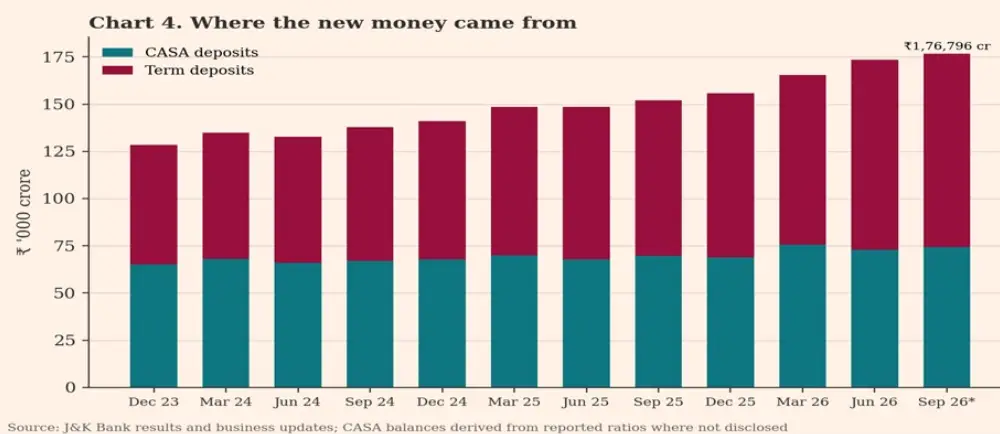
Ratios can conceal as much as they reveal, so it is worth going to the inflows. Between December 2023 and September 2026, JK Bank added Rs 48,254 crore of deposits. Of that, roughly Rs 9,240 crore came in current and savings accounts. The rest, about Rs 39,000 crore, was term deposit money. Put differently, less than one rupee in five of the new deposits raised over the past 11 quarters was cheap. In the latest 12 months, the figure is 18%.
Term deposits have grown by about 61% over the period, from roughly Rs 63,500 crore to Rs 1,02,519 crore. CASA balances have grown by about 14%. In the year to September 2026, term deposits rose 24.6% while CASA grew 6.45%.
In January 2025, JK Bank management told analysts that term deposits had grown 15% year on year against 4.4% for CASA, and that 84% of its term deposits sat in the 7% to 8% interest range. By June 2025 the bank’s own investor brief recorded CASA growth of just 2.9%; reported balances imply term deposits grew about 21% over the same year. By June 2026, term deposits were growing at more than 24% and CASA at 7.5%. In no quarter since has the gap closed.
Chart 3 shows the composition of the deposit book quarter by quarter. The cheap money at the bottom of each bar has barely grown in three years. Almost all the growth has come from the costly term deposits stacked on top.
Margin Squeeze
Management has never claimed that falling CASA alone explains falling margins, and it would be wrong to pin it all there. NIM depends on loan yields, loan mix, re-pricing lags and the investment book as much as on the deposit mix.
In July 2025, after the Reserve Bank of India’s jumbo 50 basis point cut, management told investors that the bank’s cost of deposits seemed to have peaked at 4.83%. Lower deposit costs would follow, the argument went, and margins would steady. The next quarter the cost of deposits rose to 4.86%. In October the bank said again that deposit costs had now peaked. They did then ease, to 4.69% in December and 4.47% in the March 2026 quarter. Then the bank went looking for money to fund its lending, and the reviewed results for June 2026 put the cost of deposits back at 4.74%, after 125 basis points of policy easing in calendar 2025.
The bank’s own explanation for the June quarter was that it had chosen to lend selectively to corporates at competitive rates and to raise higher-cost deposits to fund that growth. In October 2025, the bank had already admitted that the rate on its outstanding term deposits had fallen by only 17 basis points. A deposit book that is increasingly made of term money re-prices slowly and partially. A loan book linked to external benchmarks re-prices at once. That asymmetry to some degree explains how a shrinking CASA ratio turns into a shrinking margin, and it is visible in the bank’s own numbers.
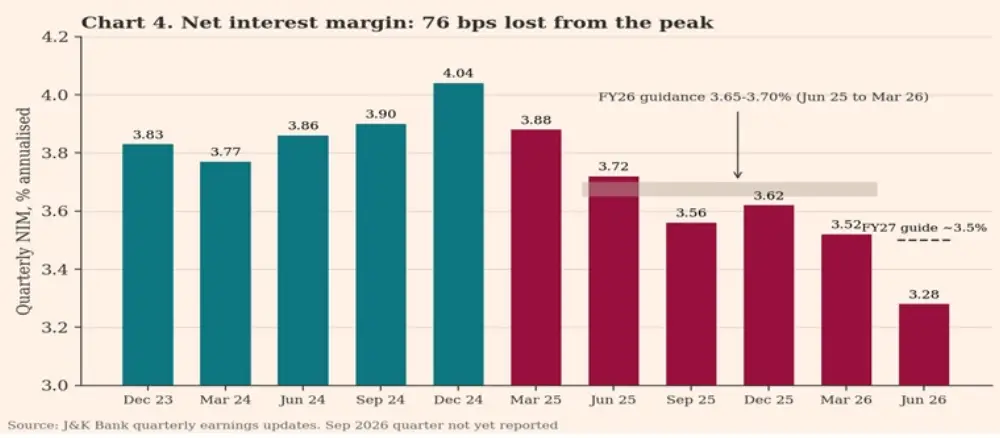
NIM peaked at 4.04% in December 2024, fell to 3.72% by June 2025 and 3.56% by September. In October, management said NIM had bottomed out, unless there was a further repo rate cut. A cut duly came in December, and the December quarter NIM ticked up to 3.62%.
In January 2026, Amitava Chatterjee told analysts his guidance was 3.7%, and that by March “the entire thing will be re-priced”. The March quarter came in at 3.52%. Full-year FY26 NIM was 3.60%, below the 3.65% to 3.70% range the bank had already cut once, in July. At the May 2026 results call the bank conceded it had fallen short on NIM, and set FY27 guidance at around 3.5%. The June quarter printed 3.28%, 76 basis points down from the peak of 4.04%.
Missed Targets
In July 2024, the then chief executive, Baldev Prakash, attributed a dip in CASA to the government outflows that usually hit the first quarter and said the bank was confident of keeping the ratio above 50% annually. In January 2025, with CASA at 48.17%, his successor kept the FY25 target at 50%, while acknowledging that some targets would be hard to reach, and said he expected the CASA ratio to improve in the final quarter. The year closed at 47.01%, however.
In May 2025, the bank set an FY26 CASA target of 48% and guided NIM at 3.70% to 3.80%. The NIM range was cut to 3.65% to 3.70% within three months. The 48% CASA target was reaffirmed in July and again in October, by which time the ratio had spent two quarters below 46%. In January 2026, with CASA at 44.10%, the bank finally revised its CASA guidance to 45%, pointing to a structural shift in household savings.
That explanation is true of the industry. It is also an awkward one for a bank whose pitch is that it is not like the industry. If JK Bank’s deposit franchise is subject to the same forces as everyone else’s, then what is being majority state-owned actually worth?
In May 2026, the bank set FY27 guidance at CASA of 45% and NIM of around 3.5%. In the very next quarter, it reported the two key ratios at 42.06% and 3.28%. In July, rather than revise, it kept the guidance unchanged, said NIM would return to 3.5% by the third quarter, and told analysts that actual credit growth for the year could be 18% to 20%, against a published guidance of 12%.
Fair Picture
None of this describes a bank in distress, and it would be unfair to suggest otherwise. Gross nonperforming assets fell from 4.84% of advances in December 2023 to 2.37% in June 2026, capital adequacy stood at 16.67%, and FY26 profit of Rs 2,363 crore was the bank’s fourth consecutive annual record. Even today, its CASA ratio is above the industry average its own management cites.
JK Bank is not short of business. Credit demand in its home territories is strong, the rest of India offers room to expand, and its asset quality is the best it has been in years. The constraint it faces is subtler and more serious. The cheap money that made its old model unusually profitable is no longer growing fast enough to fund its ambitions, and the bank has chosen to fill the gap with money that costs it close to what everyone else pays.