Kashmir hosted a film festival, drawing global filmmakers to Srinagar, Gulmarg and Jammu, even as some homegrown artists questioned whether the revival included them, reports Afreen Ashraf
For four days, last week, the Sher-i-Kashmir International Convention Centre (SKICC) became a place worth noticing. Visitors turned an otherwise usual gathering into a reminder that something unusual is happening in Kashmir. Srinagar started looking different with buntings and fascinating billboards.
Along the sidelines of Dal Lake, the changed scene was more visible. Shades of pink and purple appeared on billboards, hoardings and banners, announcing an international film festival that promised to bring international cinema back to Kashmir, a place where the Hollywood premiers would take place before 1947.
The Dal, which usually reflects the slow movements of everyday life in shikaras and houseboats, was at the core of the festival. It had a floating screen to showcase a series of movies that celebrated Kashmir’s beauty.
Behind this picturesque sets was a much larger proposition. Jammu and Kashmir projected the 4-day capital intensive festival would bring Kashmir into international cinematic focus, bringing filmmakers, actors, producers, cinematographers and audiences together from across the world.
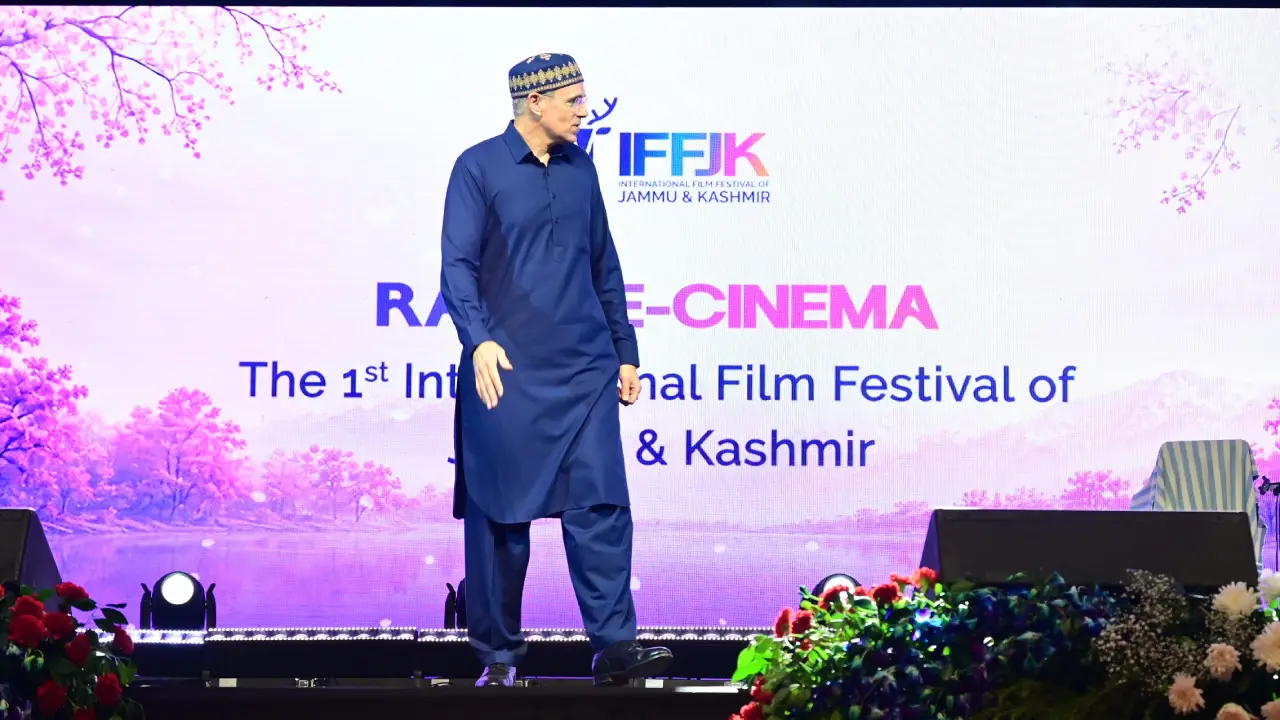
From September 7 to 10, Kashmir hosted Rang e Cinema, its first International Film Festival of Jammu and Kashmir (IFFJK). Organised by the Directorate of Information and Public Relations (DIPR) in collaboration with the National Film Development Corporation (NFDC), it brought a select basket of films to various screens in Srinagar, Gulmarg and Jammu; besides master-classes, panel discussions and cultural performances.
A total of 135 films representing 41 countries were selected for screening with host country having 64 films, followed by France with 13 and Iran with 8.
“The festival is an attempt to revive the legacy of filmmaking and to promote J&K as a premier film destination both in India and across the globe,” said Shreya Singhal, DIPR Director.
Beyond Screenings
The festival was not only focused on screening. A jury comprising prominent personalities from across the world was brought in to evaluate the entries, while filmmakers, actors, cinematographers and other industry professionals travelled to Kashmir to participate. More than 50 experts were associated with master-classes and discussions, interacting with young people and aspiring filmmakers from the region.
“An important part of the festival is master-classes, conversations as well as panel discussions,” Singhal said. “We attempted to bring the best talent of cinema and the film fraternity here so they can interact with youth who see their future in filmmaking.”
The conversations ranged from filmmaking and storytelling to the practical realities of entering the industry. For young people trying to understand how an idea becomes a film, the presence of established professionals created a kind of access that is otherwise difficult to find. For a young aspiring filmmaker who has spent years working in relative isolation, being able to ask a director directly about the craft, the process or the business of filmmaking can be a first step towards seeing the profession as something attainable.
Local Cinema
The festival also reserved a place for local cinema. Five Kashmiri films have were part of the competition, while a separate Jammu and Kashmir category carries prize money of Rs 10 lakh. The overall prize structure amounted to Rs 96 lakh, with Rs 25 lakh for the best film, Rs 15 lakh each for best director and best debut film, and Rs 8 lakh each for best male and female actors.
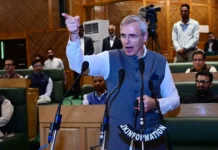
Chief Minister Omar Abdullah said the event should not be viewed merely as a film festival but as a cultural and economic platform for Jammu and Kashmir, one that can create opportunities in tourism, investment, employment and the creative economy. He also said the larger aim of the gathering is to bring the film industry to Kashmir while creating space within it for home-grown artists.
The festival also integrated local filmmakers, writers, directors, actors, cinematographers, technicians, photographers, designers, artisans and craftsmen through exhibition, networking and business engagements.
Historic Roots
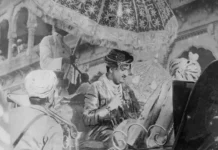
The festival’s arrival in Kashmir was presented as more than a return of cinema to a place that once had a thriving cinema going culture. Kashmir is not new to the world of the camera. Early film records show camera documentation of the valley by 1903.
Ujjwal Nirgudkar, a film technologist, chairman of the Society of Motion Picture and Television Engineers (SMPTE) India Section, technological adviser to India’s National Film Heritage Mission, and a leader associated with the Academy of Motion Picture Arts and Sciences, places Kashmir’s relationship with cinema within a much longer cultural history. He describes Kashmir as a “state of learning” and a “land of poets and saints”, arguing that the region has always had a depth of stories that extends far beyond the landscapes for which it is known.
Pointed to Pamposh, an early Kashmiri film, he recalled its making, and noted how Sheikh Abdullah supported the filmmakers during the shoot, including providing them with a camera and clapboard while they were filming around Dal Lake. For Nirgudkar, such moments show that Kashmir’s association with filmmaking was never simply about outsiders arriving to capture its scenery; there was also an early desire within the region to use cinema to document and express its own society. For a region that has so often been represented from outside, the presence of home-grown filmmakers could therefore mean a shift in perspective.
New Narratives
Since the idea of revival extends beyond reopening cinema halls, the question being asked is that what kind of cinema will emerge within the region. For many jury members and filmmakers who were in Kashmir, the valley is more than beautiful landscapes or cinematic potential. For them, Kashmir has a new scope, one where they could shoot stories that have remained otherwise largely untold.
“The valley has been under reported and with this revival of cinema we are aiming to document Kashmiri heritage and culture,” Kanika Gautam said. She plans to bring Kashmir to animation, where she wishes to document communities like the Hanjis in order to capture a part of Kashmir that has never been explored.
International jury member Kioko Bang, a Singapore based documentary producer and media consultant, and founder of Bang Production, also spoke of documenting other perspectives of the valley. Having herself showcased her work at the festival, she spoke about the opportunity for new filmmakers to present different views of Kashmir to audiences outside the region. Her observation goes to the heart of the festival’s proposition: the world already has an image of Kashmir. What it does not necessarily have is access to the many versions of Kashmir that exist beyond that image.
Mir Arsalaan, a Kashmiri actor, spoke about the significance of an event that brings attention to the region’s own creative community. He urged young filmmakers and actors to believe in their stories, continue creating and work with persistence, while expressing hope that such initiatives would create more opportunities for local actors.
So clearly, the ambition is not simply to bring films to Kashmir, but to bring Kashmir to the world.
Economic Promise
“This initiative will also serve Kashmir in economic prosperity,” Sriram Raghavan, a film director and screenwriter, said. He said the filmmaking is an industry capable of creating employment in Kashmir.
A film set, he said, is a large operation requiring cinematographers, sound professionals, lighting teams, production teams, designers, drivers and a range of other technical staff. He said much of that manpower will be recruited from the place where production is being made.
Music Sidelines
That sentiment was visible beyond the formal film programme as well. At the SKICC, a live session of classical Kashmiri music was organised in the lobby, bringing a different kind of performance into the festival space. Among those involved was a group of local artisans who saw the event not only as a celebration of cinema but as a potential source of employment for people working in the region’s wider cultural economy.
A rabab player expressed his hope in the economic potential of the programme. “If international filmmakers begin coming to Kashmir regularly, they will recruit local artists for their productions.” He also said that events such as this are a great source of income for his team.
Basit Malik, a resident who attended the festival, described the initiative as a positive approach, asserted the panel discussions and other sessions provided a useful platform. Basit believes that if local filmmakers begin producing more stories about their communities, languages and experiences, those stories could travel beyond Kashmir and challenge long held perceptions about the Valley.
Policy Commitments
Omar Abdullah, offered an idea about the government’s expectations. The event, he said, was an attempt to welcome the future of filmmaking and build a world class ecosystem in Jammu and Kashmir. “We must build a world class ecosystem and that is precisely what we are doing,” he said.
Under the government’s comprehensive J&K Film Policy, he said, the aim was to transform the region from merely a beautiful filming location into one of the most filmmaker friendly destinations.
He promised a single window clearance system designed to reduce bureaucratic delays, an online platform through which permissions ranging from locations to security can be processed, and financial support for productions that employ local artists, technicians and crew.
Yet beneath the celebration, there was also a quieter unease among some of Kashmir’s filmmakers. For those who have spent years trying to make films in Kashmir, the festival brought a sense of missed opportunity.
Talking anonymously, a prominent resident filmmaker, said the festival missed an opportunity to connect Kashmir’s existing filmmakers with visiting directors, producers and international guests. If the event aimed to revive Kashmiri cinema, he argued, it should have demonstrated that the region was not starting from zero, but already had filmmakers, actors and storytellers who had continued working despite a limited ecosystem.
“If the idea was to promote Kashmiri cinema, they should have gathered all of us and shown the international guests what this region has already produced,” he said. He also questioned the Rs 10 lakh prize for the J&K category, suggesting the money could have supported several emerging filmmakers rather than one winner. Still, he did not dismiss the festival, saying sustained government commitment could eventually bring existing practitioners into a stronger cinematic ecosystem.
How serious did the participants take the festival was visible at the award ceremony. When the 20 winners were called, there were quite a few to take them.