The contrasting ideas of revival, one exploring silence and the other exhorting slogans, were put forth in the city last week. Kashmir needs more of the former, at least for now, writes Haseeb Drabu
Last week Srinagar held two events that occupied the same city but not the same universe. One arrived with convoys, cameras, and ceremonies. The other opened in a room on the Bund overlooking the Vitasta, cajoling visitors to introspect. One screeched sirens, the other whispered silences.
The two events, a film festival and a crafts exhibition, were not merely different in scale. They were different in scope, in origin, in temperament, and, most significantly, in what they imagined Kashmir to be.
One was a state-sponsored spectacle conceived and designed largely outside the Valley, then lowered onto the lakeside like a travelling fair. The other was completely home-grown: a privately organised, almost unnoticed exhibition shared with the people not as a passing show but as a room opened in one’s ancestral house organically and aesthetically.
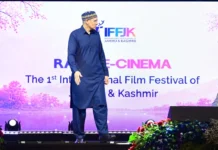
The self-proclaimed “first” International Film Festival of J&K, styled Rang-e-Cinema, was organised by the Department of Information and Public Relations (DIPR). And it was just that; an exercise in PR. To wit, why wasn’t it organised by the Department of Culture?
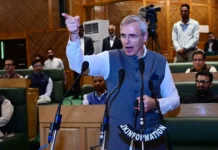
It screened 135 films drawn from more than a thousand submissions and more than forty countries. The chief minister as well as Union ministers attended. Bollywood elders were feted. Masterclasses were announced. A floating screen was moored on Dal Lake so that iconic Bollywood films could return to the landscape that once made them postcards. Awards were distributed.
The Kashmir Frame
The official language was revival: Kashmir as filmmakers’ destination. Kashmir reconnected to the world. But Kashmir was represented as a film set. Yet again! This sub-text is older than this festival. Right from the inception, the cinematic engagement, preferred landscape and ruin to the inhabited house, thereby weeding out Kashmiris out of the frame.
The 1960s “Kashmir films”, Junglee, Kashmir Ki Kali, Aarzoo, Jab Jab Phool Khile, did not merely use the mountains and meadows as scenery but as commodities of pleasure. The shikara and the Dal became signs of romance for audiences who never came here. When this week’s floating cinema returned those same titles to the water, it was not only nostalgia. It was the old contract restaged as inauguration.
Not that this language is empty. Cinema halls were shut down here. Shoots were stop. A multiplex after decades is not a small fact. Young people who want to write and shoot should meet directors. None of this is the problem. The problem is what the event performed while claiming to restore. Mirzapur on a Srinagar screen is not a crime against art. It is a symptom of a mood in which the presence of a national product is treated as proof that the region has re-joined the mainstream. It is the belief that any large, well-lit, well-advertised event is automatically a sign of life. The place becomes a destination. The people become hospitality.
The film festival was conceived as a platform before it was conceived as a conversation with this place. Its architecture was familiar from every capital that wants to look open: international competition, panorama sections, prize purse, celebrity presence, heritage as backdrop. The Valley supplied the chinar and the lake. The script of meaning arrived ready-made. Kashmiris’ most widely shared participation was the inconvenience. Gupkar Road was closed to ordinary traffic for the inauguration. Diversions thickened the evening around SKICC. Shivpora residents weren’t allowed to get home while INOX was screening shows. The city was asked to make way so that an idea of the city could be exhibited.
An Exhibition
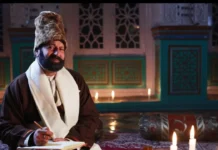
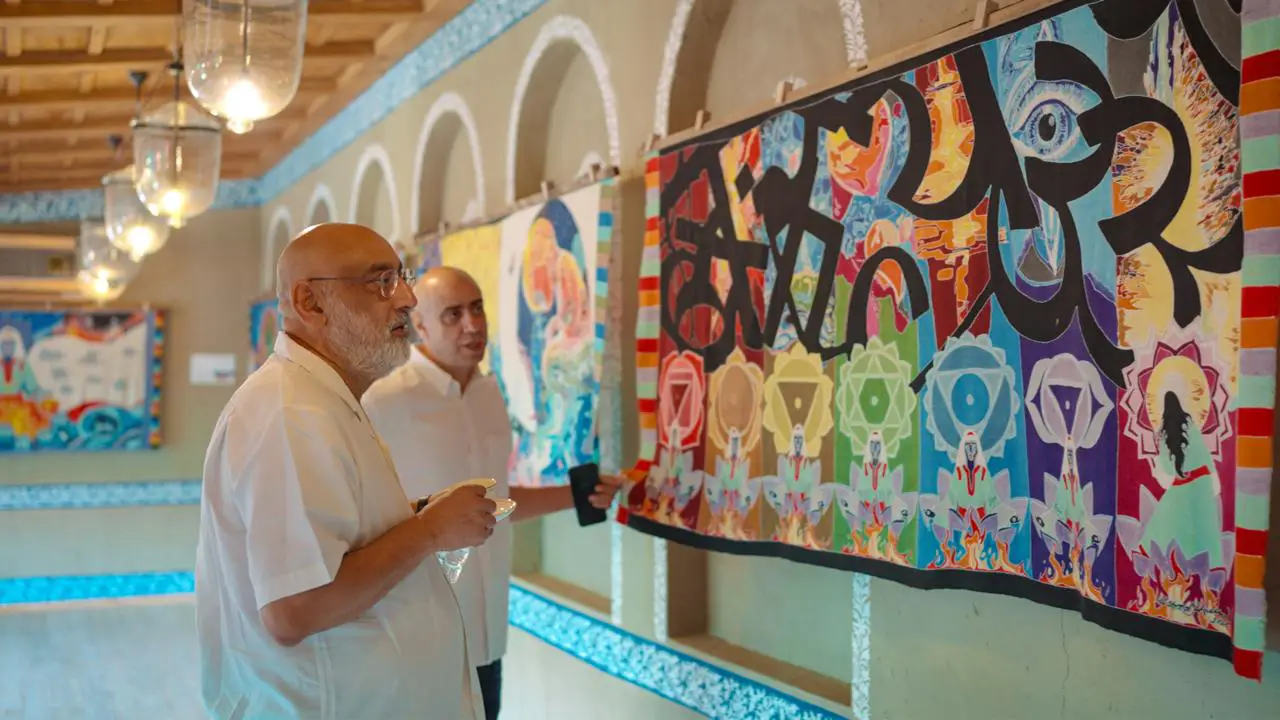
Across the town, almost unadvertised, Maqam opened with another kind of return. The exhibition, Vakhs of Silence, blended the crafts, the poetic and the built heritage of the Valley into one seamless whole. One of Kashmir’s finest artist, Masood Hussain gave visual form to the Vakhs of immortal Lal Ded, curated by the entrepreneur Mujtaba Kadri at a restored space, Maqam, set in the orbit by architect-author, Sameer Hamdani.
The names around the show matter because they complete the ecology the film festival lacked. Hamdani has spent years on the stones and sects of this city, on shrines and the difficult intimacies of Kashmiri Islam and its neighbours. Kadri, opening a space and producing an exhibition, nurtures a private passion without which cities only have programmes. Avtar Mota, poet, author and art critics who over the years has carried the sensibilities of a Kashmiri with conviction made the Vakhs accessible with his translation.
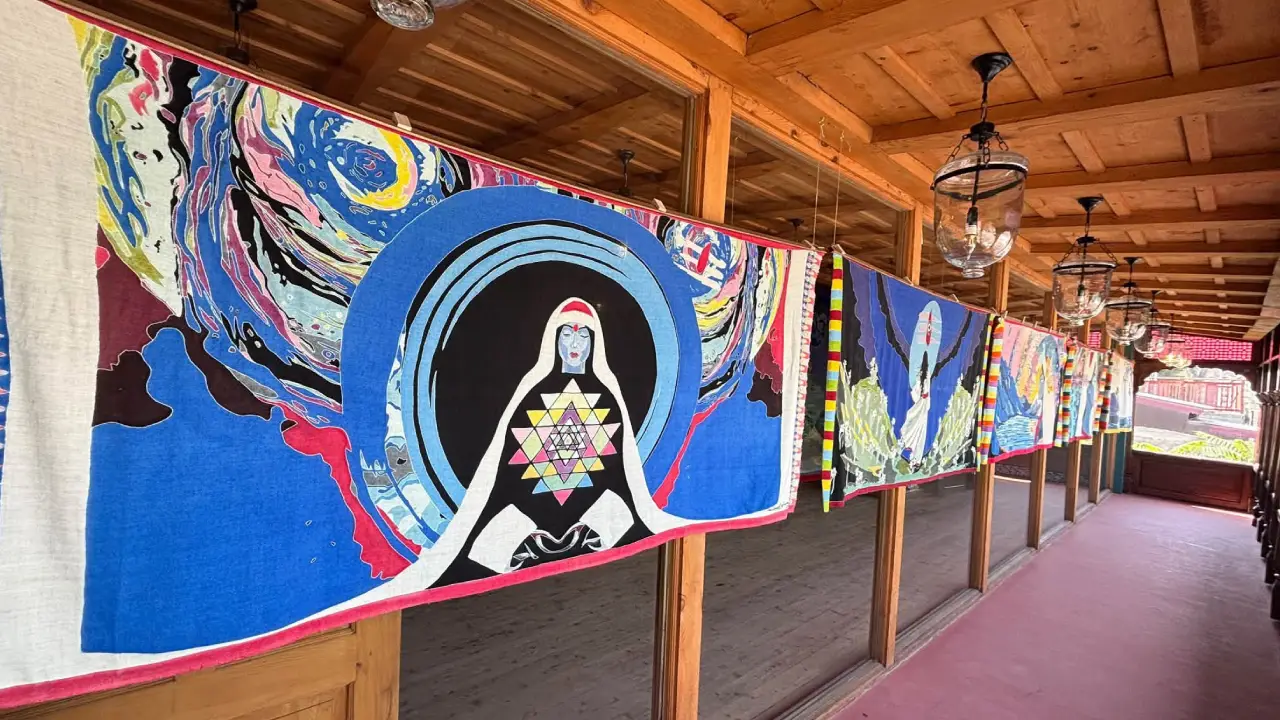
Masood Hussain, who remained a Srinagar artist when remaining was itself a decision, for two years, has been painting Lal Ded’s Vakhs onto pashmina. Twenty shawls. Verses that lived in the mouth for centuries before they lived on the page, now dyed into the wool that is this region’s most eloquent export. One image is a celestial horse, a rider under a sky of constellations. Others turn toward death, passage, the unseen.
The artist, who spent decades making conflict visible in watercolour and relief, has turned toward the older Kashmir that conflict is always accused of having erased: syncretism embodied in Vakhs and Shrukhs. A woman who left a household in the fourteenth century and became grandmother to both the cremation ground and the cemetery or the mosque and the mandir. The city still recites her. That speech was given a new shape by the event.
This is not folklore as decoration. It is cultural work of a precise kind. Lal Ded is not a safe antique. She is one of the few figures through whom Kashmir can still speak of itself. Her language is Kashmiri at its founding. Her thought refuses the later census of identities even as later identities claim her.
To paint her on pashmina is to join the most local of crafts to the most local of metaphysicians and then to offer the result not as souvenir but as argument: that what is unique here is also what can travel. For the enterprising Mujtaba Kadiri the painted shawl is also a commercial activity that might sit beside the weave and weft of the needle as another product possibility for the handicraft economy. That is cultural commerce. It starts from a particular density of place and asks the world to come toward it. It does not flatten the place so that the world will recognise a product it already knows.
None of this was flown in. The theme was local. The labour was local. The risk was local: that few would come, that the week’s noise would drown it, that an exhibition of Vakhs on wool would look small beside 135 films and a floating screen. It did look small. That is part of its truth. Soul in culture is often quiet. It does not need a traffic plan.
Two Events
Set the two events in the terms the week itself supplied. The festival was generalist. It could have been staged, with different hills, in any province seeking investment and photographs. Maqam was specific. It could only have been this artist, this poet, this cloth, this town. The film festival was commercial in the official sense: tourism, shoots, networks, a prize purse of nearly a crore. Maqam was commercial in an older and organic sense: making an object the world might want because no other place can make it.
The film festival spoke the language of integration. Come, shoot, belong to the map of Indian cinema again. Maqam spoke the language of assimilation as the old city understood it: absorb, transmute, and offer. Lal Ded did not impose a system. She walked and said things that later systems had to live with. The exhibition did not instruct the visitor in a correct Kashmir. They share a density and wait.
Even though the exhibition was in uptown, downtown was its metaphor. Downtown Srinagar is lanes, khanqahs, workshops, a memory of mixed neighbourhoods, the stubbornness of a city that was never only a view from a houseboat. Mirzapur is the opposite metaphor: a successful serial about power elsewhere, imported as evidence that Srinagar can consume what the rest of the country consumes. Nothing wrong in the Chief Minister watching it in INOX, but tragic is that he didn’t visit the Maqam, even in his private capacity.
One is a place. The other is a feed. Kashmir has lived for years inside a contest over what it is allowed to be. Identity is argued in courts, textbooks, maps, demography, and the tone of official celebration. In such a climate, the large event that announces revival often announces something else as well: that revival will be recognised only when it looks like the centre’s idea of a festive region.
The small event that returns to Lal Ded does not secede. It does something much more useful. It restores a voice that is already shared, already older than the present squabbles, and it does so without a speech about harmony. The Vakh does not plead. It remarks. It is neither patronising nor pedagogical. That non-intrusive restoration is worth more, just now, than another declaration that the Valley is open for collaboration.
None of this requires contempt for cinema. Kashmiri stories on film, made by people who know the grain of the language and the joke in the kitchen, would belong with Maqam rather than against it. A festival that grew from those stories, that treated SKICC as a tool rather than a throne, that did not need to close Gupkar or Shivpora in order to feel successful, would be a different object.
What should be multiplied is the Maqam pattern: a researcher who knows the archive, an artist who has stayed long enough to change his subject from wound to source, a passionate entrepreneur-producer willing to build a room, a theme that could not be commissioned from a template. Pashmina and Vakh, brick and shrine, santoor and the particular sarcasm of Srinagar speech: these are not branding assets. They are the remaining instruments of a people who have been told, too often, that their uniqueness is a problem to be managed. They are a sentence spoken in one’s own syntax.
The week’s two events will not be remembered equally. One generated official photography and the satisfaction of having hosted. The other may generate a few shawls that outlast the festival’s brochure. That imbalance is the argument. Spectacle is easy to fund because it looks like policy. Soul is harder because it looks like a private singularity until, years later, it is the only thing anyone still wants to stand in front of.
Kashmir, at least for now, should bet on the singularity, collaboratively. The world already knows how to bring itself here. What it does not know, and what only this place can teach it, is how Lal Ded sounds when she has passed through the hands of a painter who learned her city the slow way, thread by thread, Vakh by Vakh.
To revive and resurrect Kashmir, the approach needed is best summed by the following Lal Vakh:
Goran Dopnum akoi Vatschun;
Nabre dopnum andar achun
Suie gov mei lalli vakh te vachun
Tawai hetum nagai nachun.
(Pandit gave me one praxis,
Not outside, seek within;
This gave me the idiom and axis,
Making me whirl in my skin.
(authors translation)
(An economist, the author was Jammu and Kashmir state’s finance minister.)