On the death anniversary of his father, Aga Ruhullah Mehdi walked away from a parliamentary seat won with 356,866 votes and a party he had served for 24 years. He retains his credibility but has surrendered the very institution through which he could give their voice a political expression, writes Mudasir Majeed Pir
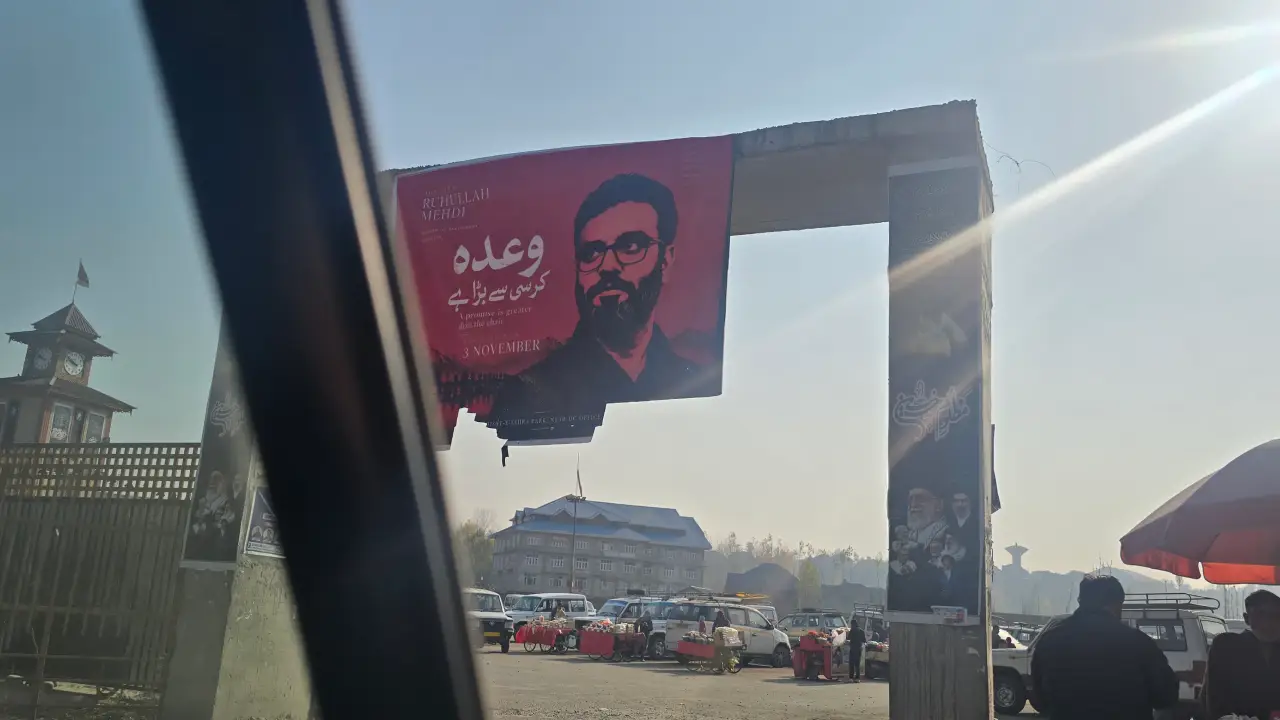
On the morning of November 4, the banner over the entrance to the Budgam bus stand was torn. It hung from a concrete gateway above the taxi rank, where the Sumo taxis fill for Srinagar. A face occupied the left half of it. The Urdu read: Wada kursi se bada hai, and below it, in English, it read: A promise is greater than the chair. Then a date, November 3, and above the date a word: Resignation.
On the pillar beneath it hung black cloth left over from Muharram mourning, printed with the faces of clerics. Politics had been fixed on top of mourning, or underneath it, depending on where you stood. The lower edge of the red banner had gone in the wind.
Later that morning, outside the gate of the house where the interview was to take place, there was a second poster. The face was in profile, lit hard. Beneath the name was a line that would serve as a manifesto if anyone asked for one: Kirdar ki siyasat, usoolon ki qiyadat (The politics of character, the leadership of principles). Lower down, a flag carried the single word Haq over a crowd with its fists raised, and across the bottom, four icons with four words beneath them. Usool. Hausla. Awam. Ehtisab (Principles. Courage. The people. Accountability).
Neither poster carried a scheme, a sanction, a road, a transformer or a job. Nothing a government does. The campaign had been assembled entirely out of nouns that cannot be audited.
November 3, 2.40 pm
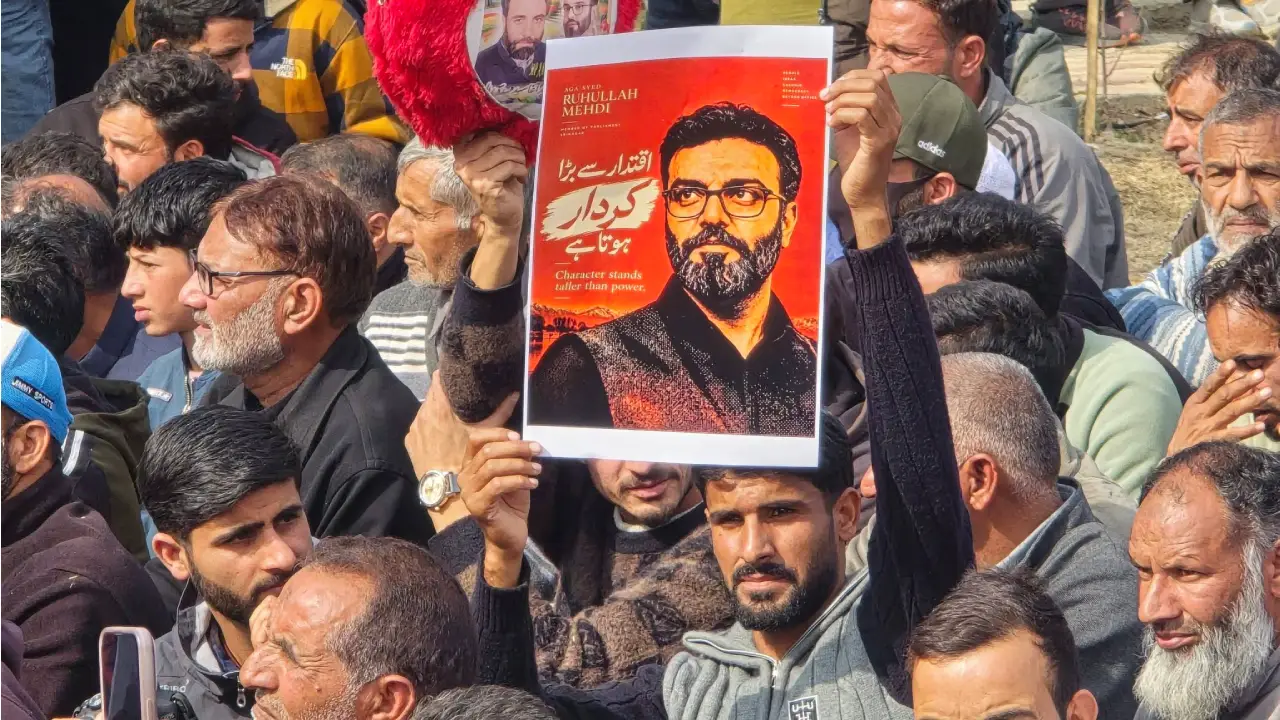
Behind him at Behisht-e-Zehra Park hung a black board edged in gold Urdu carrying Ruhullah’s father’s name, Shaheed Aga Syed Mehdi al-Musawi, and the words chhabbisveen barsi (24th anniversary). Beside it were framed portraits of his father in a dark suit, and beyond that, an older portrait in a devotional manner. In front of it, the crowd stood with their phones up, filming what was about to unfold on the stage.
Ruhullah looked at his watch. “Nov 3, 2026, 2.40 pm. Remember the date and time. I am resigning to give freedom to myself,” he announced in front of a cheering crowd.
There was a handicrafts dealer from Saidakadal on the stage with him, a man named Mohammad Ashraf Mattoo. Tufail, Mattoo’s son, was 17 when a tear gas canister struck him in the head as he walked home from tuition on June 11, 2010, a death that set off a summer in which more than 100 people were killed. In front of the crowd, Ruhullah put the letter ending his 24 years in the National Conference into that man’s hands and asked him to carry it the party he had just announced separation from.
“I am still fighting for justice,” Mattoo told reporters at the park. “He is our voice.”
The parliamentary resignation went to Delhi, to the Speaker, giving up the membership of the 18th Lok Sabha. On November 5, the Lok Sabha Secretariat published Speaker Om Birla’s acceptance of the resignation in the press, effective from November 3. The Srinagar seat is vacant.
The cap
Aga began the speech with Omar Abdullah’s cap.
On September 4, 2024, after filing his nomination at Ganderbal, the man who would become chief minister took the cap off his head, held it in his hands, switched into Kashmiri and said: “Muin dastar, muin izzat, muin topi, are in your hands, ath kariw raetch” (My turban, my honour, my cap are in your hands. Uphold them). He asked, with folded hands, for one opportunity to serve.
In Kashmir, the cap is not a hat. It is a pious symbol of reverence. The Valley read Omar Abdulla’s gesture at the time as a man reduced to asking.
Standing under his father’s portrait, Ruhullah took the same image and turned it the other way, towards God. “I will pray to Allah by pulling down my cap in Allah’s court,” he said. “O Allah, do not ever make us so needy that we are compelled by our desperation for power to pull down our caps in front of people. Protect our dignity and our respect. Bless us with respect, and bless this qaum with respect.”
The National Conference, he said, had been created to fight for the dignity of the people of Jammu and Kashmir irrespective of religion, and they had been told the Constitution would protect it.
“From 1953 onward that dignity was torn to shreds repeatedly, until on August 5, 2019 it was shrouded and buried,” he said while blaming the party he worked with for more than two decades.
Then came the account of his own recruitment. He had been uneasy, he said, and had told them so. They pleaded with him, promised to stand with him, and told him Parliament was the only place left where a Kashmiri voice could be heard. He was abroad. He was called back and told to contest Baramulla, and the next day told Srinagar instead, and he agreed, winning with 3,56,866 votes and 53.32 per cent of a poll in which 38.6 per cent of the electorate voted. The chief minister, he said, sent him congratulatory messages for keeping the party’s head high on the national platform.
“I have the recordings and messages,” he asserted. “After coming to power, you forgot Article 370.”
He addressed Farooq Abdullah by name and quoted the Quran at him: Wa la tahinu wa la tahzanu ( Do not weaken and do not grieve). “If you were a mumin you would not be afraid of the BJP. Do not be afraid of any power except Allah’s. You wanted me to study the Quran. Tell this to your incompetent son, who traded the dignity and respect of Kashmiris.”
Speaking about Omar Abdullah, he said that since assuming office, the Chief Minister had offered people little but despair when what they needed was hope. In the closing part of his speech, he said that he did not want a throne and he did not want to be chief minister.

“What I want is people of character, rooted, who know the soil and fear God. This is not about changing one party for another, because all of them are the same. We will lead the search through every corner of Jammu and Kashmir and turn this into a strong movement because we need to replace the people who care very little about the respect and dignity of people of Jammu and Kashmir,” he said.
Two Days later, the party answered. The National Conference called the speech an exercise in “mental and moral bankruptcy” and objected to his invoking the Quran from that stage. He had been a minister in 2010, it said, and had “conveniently forgotten all about it until 2026, sixteen years later”. This was apparently a reference to handing over his resignation to the father of Tufail, who was killed, when Aga was Omar’s cabinet minister.
On his central claim, it said the reverse: that he “only remembered to resign when he was told to by the party president”. Salman Sagar, the MLA for Hazratbal, said the BJP had succeeded in an Operation Lotus, and that Ruhullah should not have used martyrs like Tufail Mattoo for his politics. Ifra Jan, a party spokesperson, offered a test. “If Ruhullah fights openly against the BJP, I will be the first to join him.”

Cato The Younger
On November 4, when I went for the interview to Ruhulla’s house, before asking anything about the party or the seat, I narrated to him about a Roman senator, Cato The Younger, who was called as the man of iron principles, something identical to what appears in almost every one of Ruhulla’s recent speeches loaded with idealism: usoolon ki siyasat (politics of principles).
In 46 BC, trapped at Utica in North Africa with Caesar’s army closing in, Marcus Porcius Cato knew defeat was certain and pardon inevitable. Rather than live by Caesar’s mercy, he read Plato’s account of Socrates’ death twice, then took his sword. When a physician stitched his badly inflicted wound, he tore the stitches open and died. Caesar reportedly regretted that Cato had denied him the chance to spare a life. But for Cato, accepting mercy would have meant accepting mastery: in a free republic, no man should have the power to decide whether another lives.
Cicero admired Cato but believed his idealism was damaging the state. During a Senate deadlock, he remarked that Cato spoke as if he lived in Plato’s Republic, not Romulus’s sewer—a perfect imagined city confronting the reality of bought juries, rented crowds and generals with private armies.
I put Cicero’s charge to him: the politics proclaimed from a stage in Budgam, built on dignity, promise and mandate, versus the politics practised here, shaped by access, transfers and what Delhi permits. Had he walked away from the second to inhabit the first? He did not dispute the premise.
“I am completely aware that whatever I am saying may not completely translate into reality,” he said. “But that should never be the excuse to stop fighting.”
Aga said he is asked this constantly and does not normally answer it. “I will exhaust every person with such questions, because my resolve is so strong that they will get tired of asking and I will not get tired of answering. I will always tell them that it is possible, it is possible, it is possible.”
The argument he gave for it was theological. Man was created to manifest the divine attributes through his character, he said: compassion, mercy, justice, wisdom. “By sticking to the politics of right principles, a leader gets to see what a person without them cannot see.”
Then he conceded the cost, without being asked for it.
“I am aware of the fact that principles can bring more harm at times. But at least you can lift your head with pride, because you upheld God’s attributes. The journey of principles is the journey of continuity to the hereafter. Because I do all this to please Allah alone. Not the people, not any leader.”
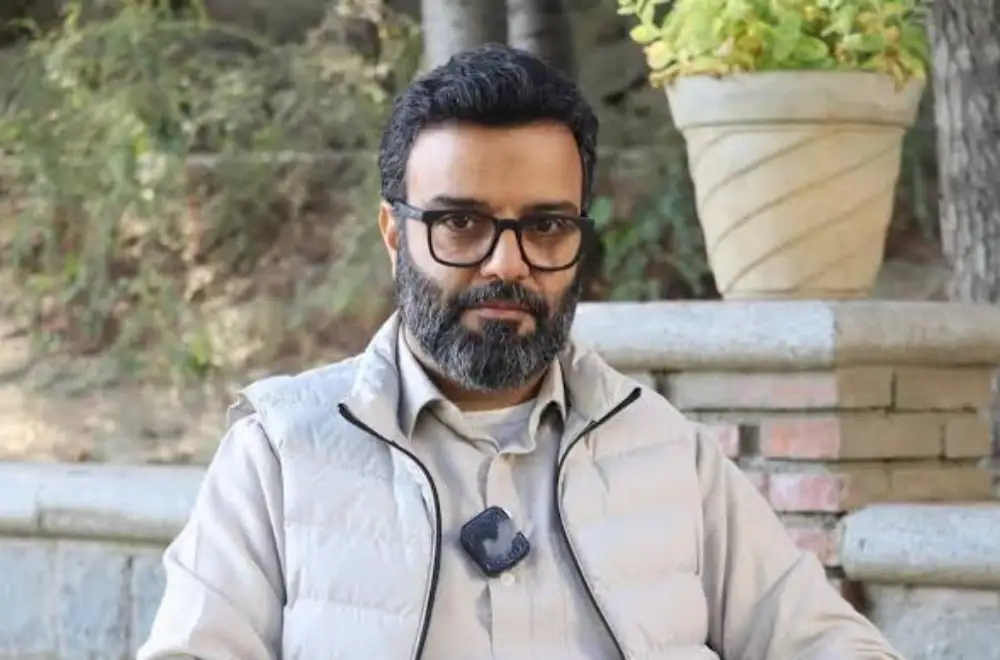
An Accidental Politician
“I am an accidental politician,” he said, referring to his entry into politics.
He was four months into a medical science degree at Aligarh, Uttar Pradesh. On November 3, 2000, his father, Aga Syed Mehdi, the Shia cleric and Congress politician whose following ran across Budgam, was killed by an improvised explosive device on the Kanihama-Magam road, on his way to a majlis. He was 41. Three security personnel and two of his supporters died with him. The funeral was held under curfew. His son came home and did not go back.
“When tragedies like that happen, elders at home have a say,” he said. “The followers of my father and my grandfather pushed me into this. The decision was not mine alone. Out of love and affection for my father, they asked me to fill his shoes.”
He never resumed medicine. He took a political science degree privately, around a career that had already begun, and put his learning down to the house rather than the university.
Soon elections took place. Dr Abdullah visited him and got him into the fold. He won Budgam in 2002 (many say as a minor), 2008 and 2014, and sat in the cabinet from January 2009 to October 2014 with Science and Technology and Animal Husbandry. He became the party’s chief spokesperson in 2015 and gave up the post in July 2020, 11 months after the undoing of Article 370. By his own account, the change came after the third win.
“I stopped thinking of myself as a kid among big politicians. My principles found a footing. When I started, I had this in mind that I had to take care of my father’s followers and my grandfather’s followers. Then I saw a larger reality.
Tufail’s Father
Tufail Mattoo’s father, Afzal Mattoo, came to see him in 2025; he said, suo moto. Before the conversation began, his concern was not what the visitor wanted to know, but what the visitor thought of him. “Anyone who was part of that cabinet is equally part of that crime. That is the general perception now. I asked myself, does he feel the same about me?”
Mattoo began by saying he saw some hope in him but that the system had exhausted him. He wanted his son’s killing raised in Parliament. Before agreeing, Ruhullah recalled, he asked whether Mattoo held him responsible. His position was that law and order rested with the Chief Minister. When the killings began, the cabinet had sought an assurance from Omar Abdullah, who promised that cases would be registered and no one spared.
“He told me I had no role in the killing in any manner. The state is something else and the cabinet is something else.” Aga recalled Mattoo crying. “I told him, you have vindicated me and liberated me from a moral burden and given wings to me. I promised him, let the whole state and the whole of India go against me, I promise you the whole Parliament will hear your son’s name.”
He raised the case in the Lok Sabha. When the resignation date was announced, word came back that Mattoo wanted to attend and did not know how to get there. Ruhullah said he invited him properly, and that Mattoo asked to speak. “His demanding justice from the stage that was set for me is a bigger achievement for me than the stage.”
In 2010 itself, he is careful rather than contrite. “I would handle that situation differently if I were of this age. Reduce 16 years from my age and imagine my understanding of things in 2010.” What that concedes is a failure of understanding rather than a failure of nerve.

A Notice
The most serious charge against a man who resigns on principle is that the principle arrived late and conveniently. On the timing, he has a record.
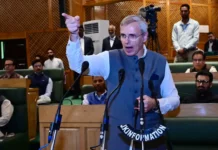
During the 2024 assembly campaign, he stood on the roof of a car at Bijbehara, hemmed in by party flags, campaigning for Bashir Ahmad Veeri in Srigufwara-Bijbehara. In the middle of that speech, he turned and addressed the leadership standing behind him.
“If any person is trapped in any misunderstanding that, God forbid, you (National Conference) fail to live up to the expectations of the people, our paths will separate. I will not stand with you. I will stand with the people of Kashmir.”
He remembers saying it again once the party was in office. On November 6, 2024, the assembly passed the resolution the manifesto had promised. It reaffirmed the importance of special status, expressed concern over its unilateral removal, and called on the Government of India to open a dialogue. It named neither Article 370, nor 35A, nor the Reorganisation Act, nor August 5, he pointed out. Mehbooba Mufti called it half-hearted.
Nine days later, Ruhullah insisted on the record that it meant restoration of all guarantees as they stood before 1953, Article 370 and 35A included, and that anyone who read it otherwise, including within his own party, would be pushed by the people into a corner of irrelevance.
He said he was warning his own side a month into the government’s life. The question is whether he accepted a text vague enough to let the party retreat behind it, and then spent two years insisting on a reading the text did not require.
The two years are not thin. On December 23, 2024, he led a march to his own chief minister’s residence with open-merit students who said the reservation policy had closed the door on them, and sat on the road outside it. A year later, when the students called another protest, he and the PDP’s Waheed Parra were put under house arrest to keep them away, and Farooq Abdullah defended the detentions publicly. He raised the detention of the Aam Aadmi Party MLA Mehraj Malik under the Public Safety Act when Doda was not his constituency, and Malik was not his party. The High Court quashed it in April 2026 as an impermissible shortcut.
The Arithmetic
Since the resignation, old footage of him defending his party has been circulating. The argument underneath each repost is never stated because it does not have to be. A man is what he was, and the tape is the verdict.
Hannah Arendt spent a chapter of The Human Condition contesting exactly that. Action is irreversible, she wrote, and without a remedy every person would stay permanently trapped inside the consequences of a single deed. The remedy was forgiveness, paired with promising. Politics is possible only because both faculties exist. If the standard being applied to Ruhullah this week were applied generally, who in Kashmir would remain eligible to lead it? And what is the torn banner at the bus stand, the one that says a promise is greater than the chair, if not the second of Arendt’s faculties nailed to a gateway?
Men are forgiven their pasts when they name the wrong in public and leave the judgement to the people it was done to. Ruhullah has done that once, in the hardest case available to him, when he asked a bereaved father whether he held him guilty before offering him anything. He has not done it about anything else. His account of the rest is not repentance but growth.
His own account of 2010 concedes the same structure. A minister in that cabinet, he said, had no purchase on law and order because law and order belonged elsewhere. If that held in 2010 under a government with full statehood, it holds more tightly in 2026 in a Union Territory where the police answer to Delhi. The ceiling is described precisely in one case and left out of the account in the other.
This was Cicero’s complaint about Cato, and it was never an allegation of bad faith. Cato was right on every refusal he made, and the refusals drove three men who detested one another into the arrangement that finished the republic he was defending. The question is not whether Ruhullah meant it. It is whether two years of accurate fire at the wrong target has left the right one untouched.
Then there is the seat. Burke told the electors of Bristol that their representative owed them his judgement and betrayed them rather than served them if he surrendered it to their opinion. Now Ruhullah can claim that line. But the judgment Burke defended was to be exercised inside the chamber, on their behalf. A representative may defy the people who elected him. Whether he may hand back what they gave him is another question, and 3,56,866 of them are owed an answer.

The Woman
In one of the videos from those days, a crowd of women surrounds his vehicle. An old woman is crying as she reaches him. “Meri zindagi aap pe fida, mere bachon ki zindagi aapke qadmon pe fida” (My life be sacrificed for you. My children’s lives be sacrificed for you).
Fida is not an ordinary word. It belongs to the vocabulary of devotion, the register in which Shia Kashmir speaks of the house of the Prophet and of Karbala. An old woman in Budgam was using it about a living politician.
Asked where a man goes after being met like that, he described an exercise. “I am going to begin an exercise soon. It will be the foundation of this whole movement, which has just begun. The exercise will be about finding the genuine people. I really want to find genuine people who can replace the whole political system here, who are rooted in principles.”
There is no structure in it, no money, no timeline, and no name. He has described a disposition. By the time he said it, he had no seat, no party, no committee and no immunity.
Back at the bus stand, the Sumos were still filling for Srinagar under a torn red banner that says a promise is greater than the chair. He has proved he believes it. What he leaves behind is the question Cicero never settled about Cato: whether a man who refuses to deal in the sewer of Romulus can change anything in it, or whether his idealism is the most honourable way there is of losing.