Historic graves erased, burial grounds encroached upon, garbage dumped at their gates and packs of dogs roaming inside. Kashmir’s graveyards are losing space, upkeep and dignity. In Srinagar, even a burial plot is becoming as expensive as land for a house, reports Asrar Syeed
On February 4, 2026, Mushtaq Ahmed waited for the clouds to clear so he could visit his ancestral graveyard in Soura. Around 3 pm, he finally stepped out of his home and set off. All the way, his eyes were moist as he remembered the long conversations he used to have with his mother, Fatima Begum.
He reached the graveyard at about 4. What he saw inside has not let him sleep for months.
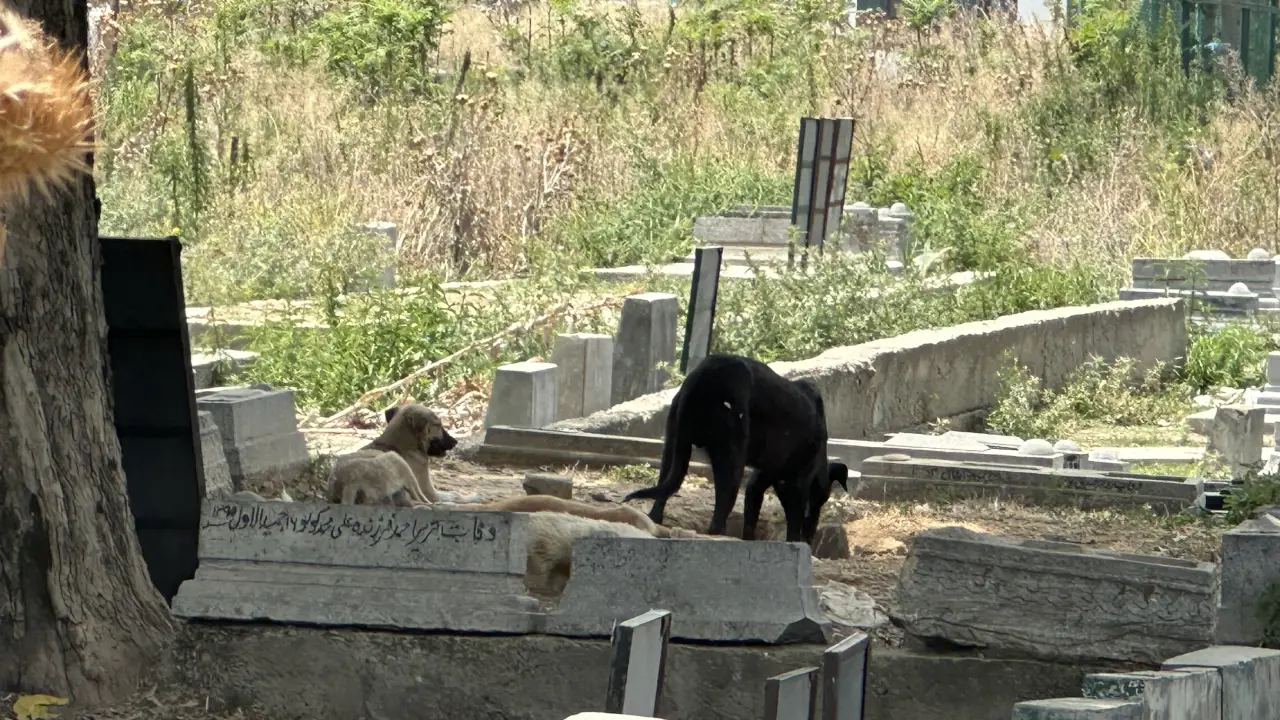
“When I entered, I followed the Islamic tradition of greeting the dead and praying for their peace, and then went to the spot where my parents are buried,” he said. “While praying, I noticed a very foul smell. When I looked around, I found a dead dog lying behind my father’s grave. It was almost decomposed.”
With a few people from the locality, he got the spot cleaned. The question has stayed with him. “I wonder how much we, as a community, have forgotten our dead,” he said. “I think we must reconsider occupying large pieces of land and calling them the final resting place of our loved ones, when they have become a resting place for dead dogs.”
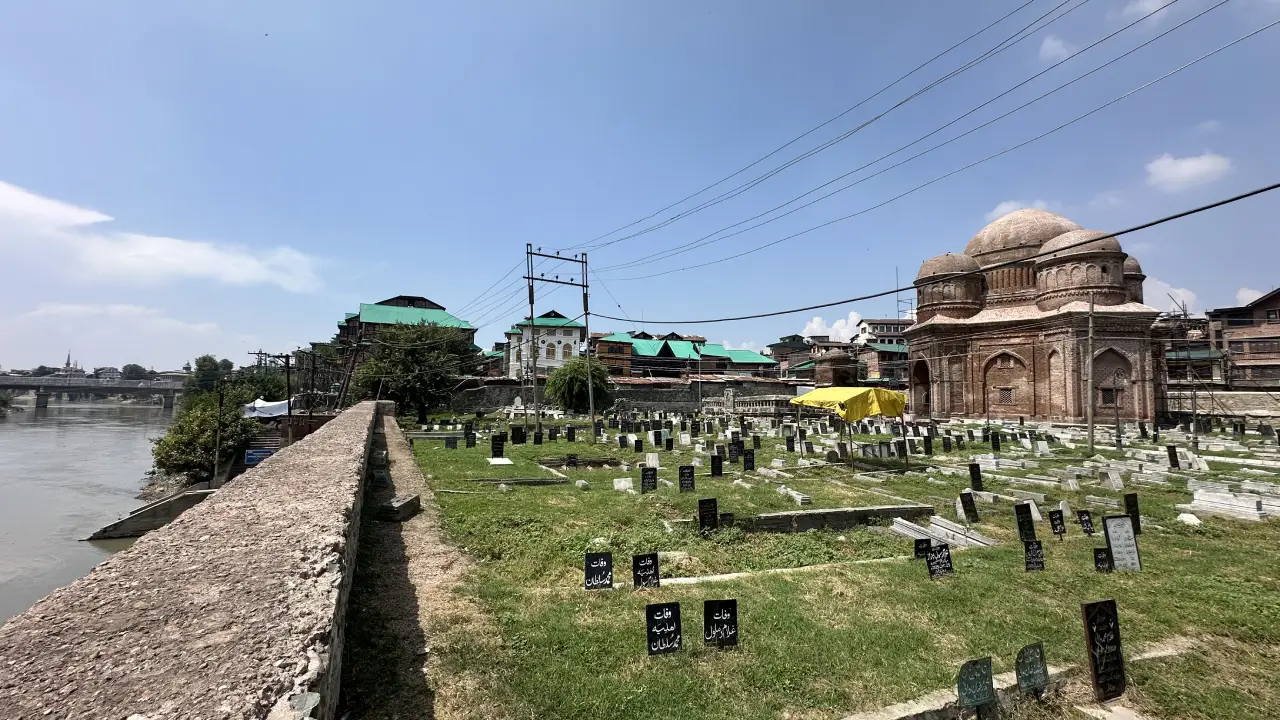
Kashmir has countless graveyards. Many sit on the banks of the Jhelum, some under high-voltage power lines. Many have disappeared with time, and houses have come up over others. Inside many more, families complain of encroachment.
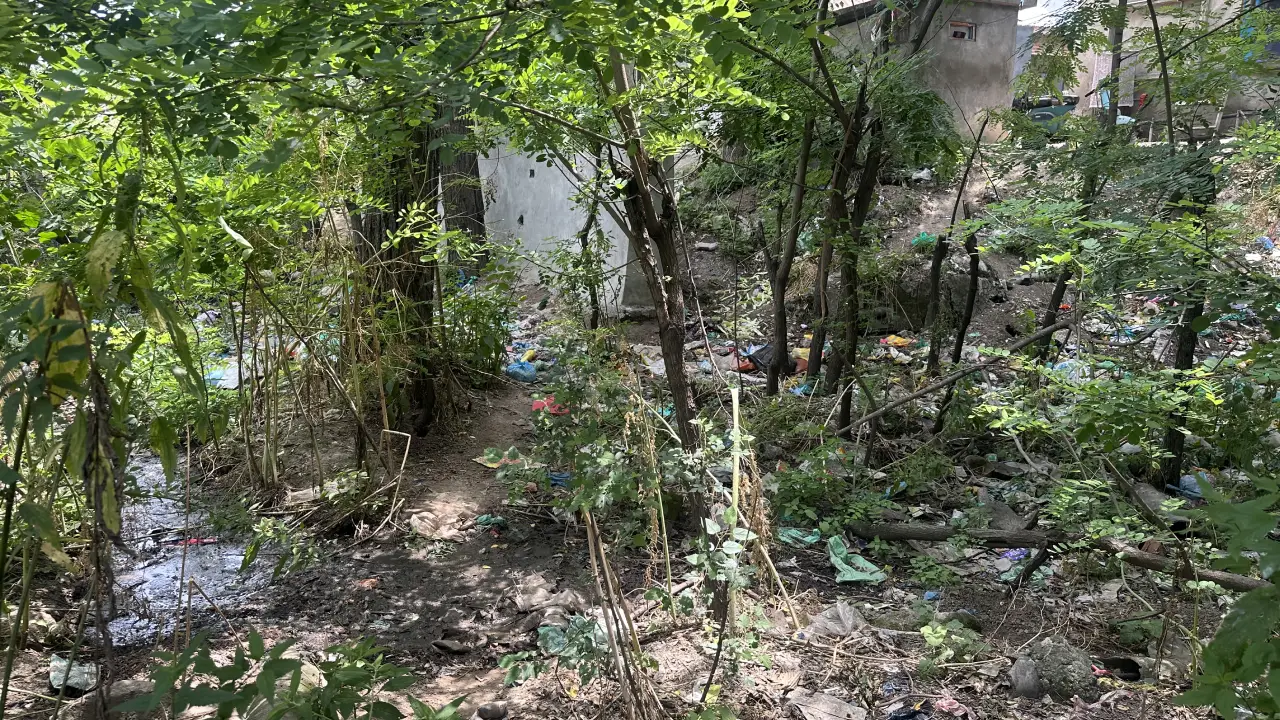
Garbage piles up outside their walls and, in places, inside them, drawing dogs that threaten the few visitors who come to pay their respects. In the evenings, drug addicts find the quiet corners.
The valley is also running out of burial space. The turbulent 1990s filled many graveyards beyond capacity, and a plot in one of the newer ones costs lakhs of rupees.
In the older graveyards, the gap between graves has narrowed so much that mourners struggle to find room to stand and offer Fateha.
Historical Graveyards
Walk through the congested Gagribal, now an extension of city’s tourist circuit, a large graveyard comes into view from the road, behind Takht-i-Sulaiman. This is Mazar-e-Shoura, the graveyard of poets. It dates to the reign of the Mughal emperor Akbar, whose forces annexed Kashmir in 1586, and was set aside for the poets and men of letters of the Mughal court.
Historical records suggest that five poets and a few men of letters were buried here, in a spot chosen for its silence and its view over the Dal.
In his book City of Kashmir, historian Sameer Hamdani writes: “Of the great Persian poets buried in the Mazar we have names such as Shah Abul Fateh (d. 1587) and Kalim Kashani (d. 1651).” Today, nothing marks their graves.
Ghulam Rasool, 86, a native of the Dal, stands quietly in a corner of the cemetery, looking for a path through the grass that grows thick here every year. He first came in 1982, when his father buried his grandfather.
Asked about the poets, he sits down on a cement block and pauses. “The condition of this graveyard reflects how much we as a community care about our past and our dead ancestors,” he said. “This was a cemetery kept for noble poets, but today there is no sign of their graves. Where did they go?”
Rasool points to the dogs wandering among the graves and to the garbage heaped at the gate. “How can we call this a final resting place for our dead when we have turned this respected place into a dumping site?”
One early evening, he said, he walked in to find 12 dogs watching him. “They were waiting for me to take a few more steps. I tried to run away, and they still came after me. Had a few youngsters not rushed to my rescue, I might have lost my life.”
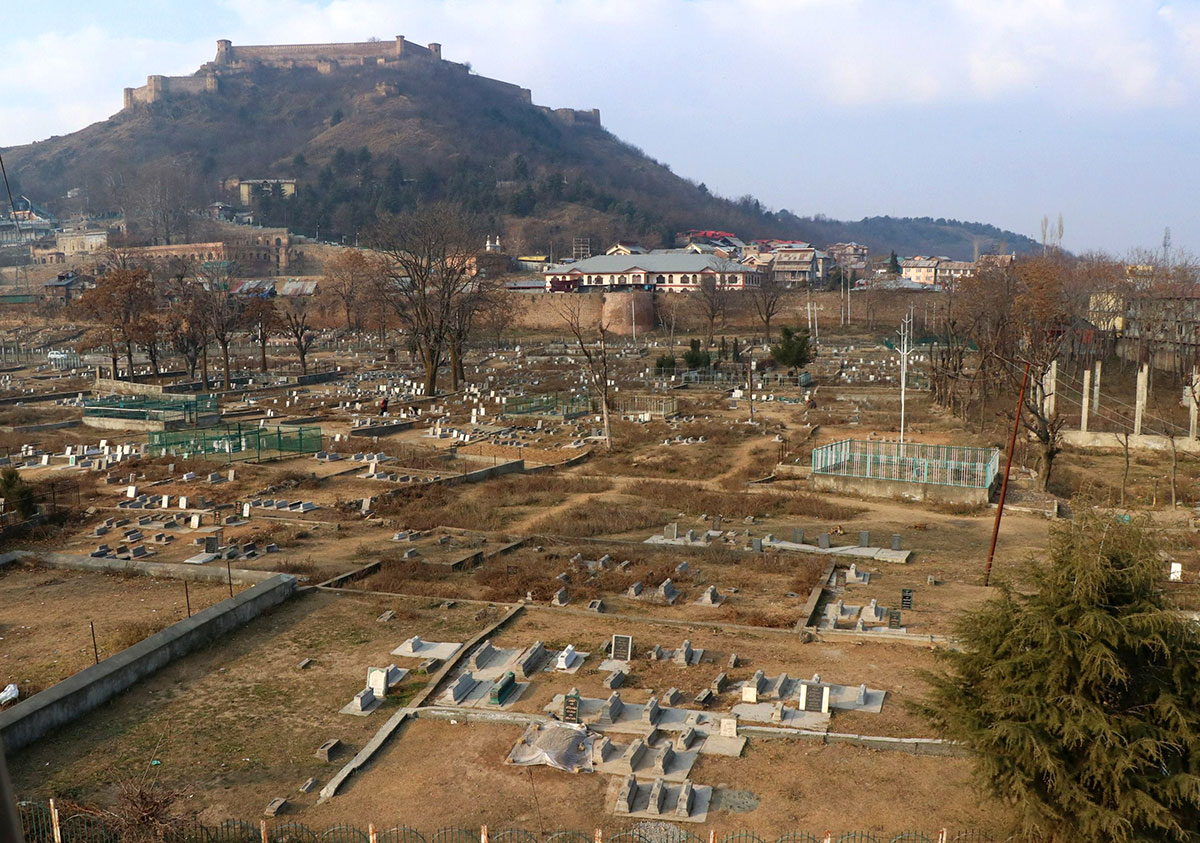
In the middle of the graveyard, Manzoor Mir, a resident of Old Srinagar city, is busy cleaning. His white shirt has turned brown. Mir’s ancestors are buried here too, and on a recent visit he found his family’s portion overrun with dirt, garbage and grass.
“I have been visiting this graveyard since 1994. My entire line of ancestors is buried here,” he said. “Over the years, I have watched it become a mess rather than a resting place for the dead. Dogs breed here, garbage is thrown around, and in the evenings it becomes a spot for drug addicts.”
He blames official neglect. “Given its history, the government should have taken a keen interest in this graveyard. It should have had signboards and monthly maintenance, so that not only locals but outsiders too could see that Kashmir once had a cemetery dedicated to poets.”
Hamdani says many of Kashmir’s historic graves have been lost, for one reason or another. “We had a ruler, the most famous Muslim conqueror of medieval Kashmir, Sultan Shahab-ud-Din. It is said his grave was in a domed mausoleum at Maharaj Gunj, much like a Dumath, on which the Dogras constructed a post office,” he said.
“Similarly, the tombstones of the Chak sultans existed on the qibla side of Jamia Masjid till the early 20th century. Today there is no trace of that graveyard either. We had three poet laureates, malik-ush-shuara, of the Mughal court buried at Mazar-e-Shoura. No trace of their graves exists today. There are many such examples in Kashmir.”
Hamdani points to the hard times Kashmiris lived through under Sikh and Dogra rule, when protecting graves was among their least concerns. “During the Sikh and Dogra regimes, there was a break with past cultural practices. People didn’t even have enough resources for their own well-being. How could they have preserved or protected the graves of individuals who serve as markers of Kashmiri culture and identity?”
In Zaina Kadal, in the heart of Downtown Srinagar, a narrow lane lined with copper shops leads to the historic graveyard of the Shahmiri dynasty. It is known as Mazar-e-Salatin, the graveyard of the sultans of Kashmir.
Above it rises Budshah’s Dumath, the red, multi-domed tomb visible from much of the old city. Sultan Zain-ul-Abidin’s mother was buried inside it centuries ago.
Beside the tomb, the royal graveyard stands raised above the ground. It is entered through an old wooden door. Inside are around 39 graves of the Shahmiri family, among them those of Sultan Zain-ul-Abidin and Sultan Sikandar, along with saints such as Allama Mir Baba Dawood Dawarki and Syed Ahmed Andrabi.
In his book, Kashmir: From Ancient to Present, historian MJ Aslam writes: “Zainul Abidin died in 1470 AD at the age of 69. He, his family and his ministers are buried just beside Budshah’s mother’s tomb.”
Over the years, the lawns outside the royal enclosure filled with the graves of people from across the city. The site is now protected by the Archaeological Survey of India. Yet a visitor could easily take it for an ordinary cemetery until reading the few ASI signboards at the entrance.
The ASI has stationed a few men inside to watch over the graveyard. Over the years, they say, they have grown tired of people who claim it as their ancestral graveyard when it is not.
“This graveyard should have been taken over by the government decades ago. It was reserved for the royal family of Kashmir. It’s not that they were above the common people, but you can see how congested it has become,” said one of the caretakers, who did not want to be named. “If we don’t stay here as guards, there are people who wouldn’t mind entering the Mazar-e-Salatin and burying their dead inside.”
An older caretaker, sipping tea, cut in to describe what the group is up against. “Recently we started renovation work on the dome. One day a stone fell from a height and broke one of the tombstones below. One afternoon a man came and started arguing that we had disrespected his ancestor’s grave. When we asked him how someone came to be buried so close to the Dumath, he started making irrelevant arguments.”
Aslam blames a lack of “historical consciousness” for the decline. “So many of our noblemen and Sufi saints are buried in Mazar-e-Salatin. It holds great historical significance, but unfortunately that is not how it looks today,” he said. “It had large lawns outside, which have been encroached over the years. Who allowed that to happen? Such things lead to the erasure of a community’s identity. Without identity, nothing is left.”
Such sites must be protected whatever faith they belong to, he says. “One can show an outsider that here lies a ruler under whom such and such cultural, social and religious transformations took place.”
Shrinking Space
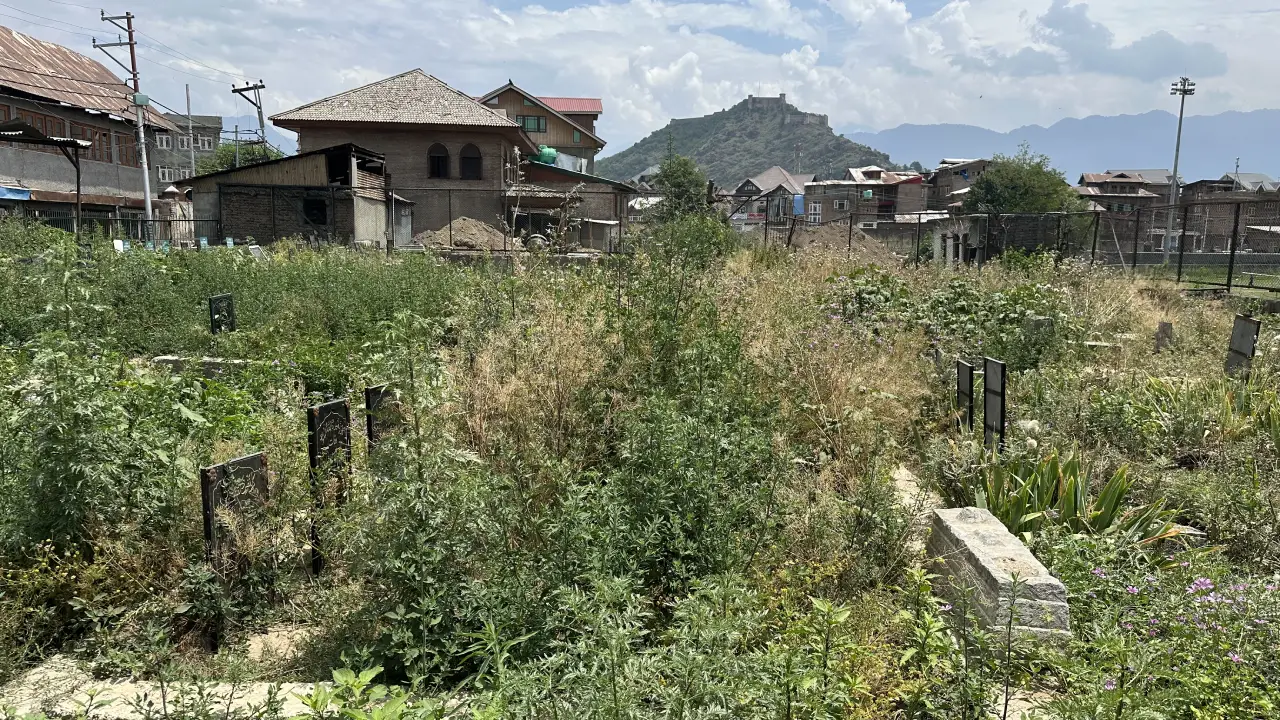
Old Srinagar is among the city’s earliest settlements, and it holds some of its oldest graveyards. Here the shrinking space, the garbage, the dogs and the addicts are all worse than in the graveyards of uptown.
At the foothills of Hari Parbat in Nowhatta, below the shrine of the Sufi saint Sheikh Hamza Makhdoom, thousands of people lie buried in Malkhah. When Mir Syed Ali Hamdani came to Kashmir in the 14th century, he is believed to have bought a vast stretch of land below the fort and given it for public welfare. It became a public graveyard, where burials went on at every hour of the day.
In those early days, the land is believed to have measured about 1,400 kanals. Residents allege it has shrunk to between 600 and 700 kanals.
In one of Malkhah’s congested lanes, Mohammad Shafi, around 70, spends his days behind a wooden table. His face is lined with wrinkles and framed by a white beard.
More than a decade ago, Shafi was a malkhaesh, as the gravediggers of Malkhah are called. Then he switched to chiseling stones into tombstones. “I left that work as I grew old, and also because people blamed us for the mess this graveyard has become,” he said. “It was painful to hear those accusations, after waking up in the middle of winter nights, with temperatures below zero, to dig graves.”
Today, Malkhah is among the most congested graveyards in Srinagar, with barely any space to walk between the graves.
Asked about it, Shafi lights a cigarette, and his beard disappears in smoke. “I remember my teenage days, when there were only 15 to 20 houses in this entire area, all belonging to the malkhaesh community. The rest of the land was graveyard,” he said. “Over the years, houses have been built where people were once buried. Human greed has taken over our society.”
Shafi also explains how a public graveyard slowly turned private. As families found their portions encroached upon, they began fencing them or building small cement borders around them.
“It all starts with one bad fish in the pond,” he said. “When a few families found people who were not their kin buried next to their ancestors, a fear spread, and everyone started fencing their portion or building cement blocks around it. This was the biggest mistake. It turned a public graveyard into private property.”
A few meters from Shafi’s shop, Irshad Ahmed watches closely as a labourer pours cement around the grave of his wife, Shabnum. Asked whether his family ever faced encroachment, he pauses.
“We buried our first family member here in Malkhah in 1957, and another in 1972. After that, by God’s grace, no one in our family died for a long time,” he said. “That gap was a disadvantage for us and an advantage for those malkhaesh who used to sell unattended portions of the graveyard.”
“Everyone has to leave this world, and it doesn’t suit anyone to fight over land where the dead lie. But in some cases, this encroachment cost families their entire portion, even though they had enough space. Our family had six marlas here. Had we not taken serious steps, we might have been one of them.”
Shafi rejects the charge and blames the government for never taking charge of the graveyard. “Framing the malkhaesh community with such allegations isn’t right. Why don’t these people go and ask the government how this graveyard became such a mess?”
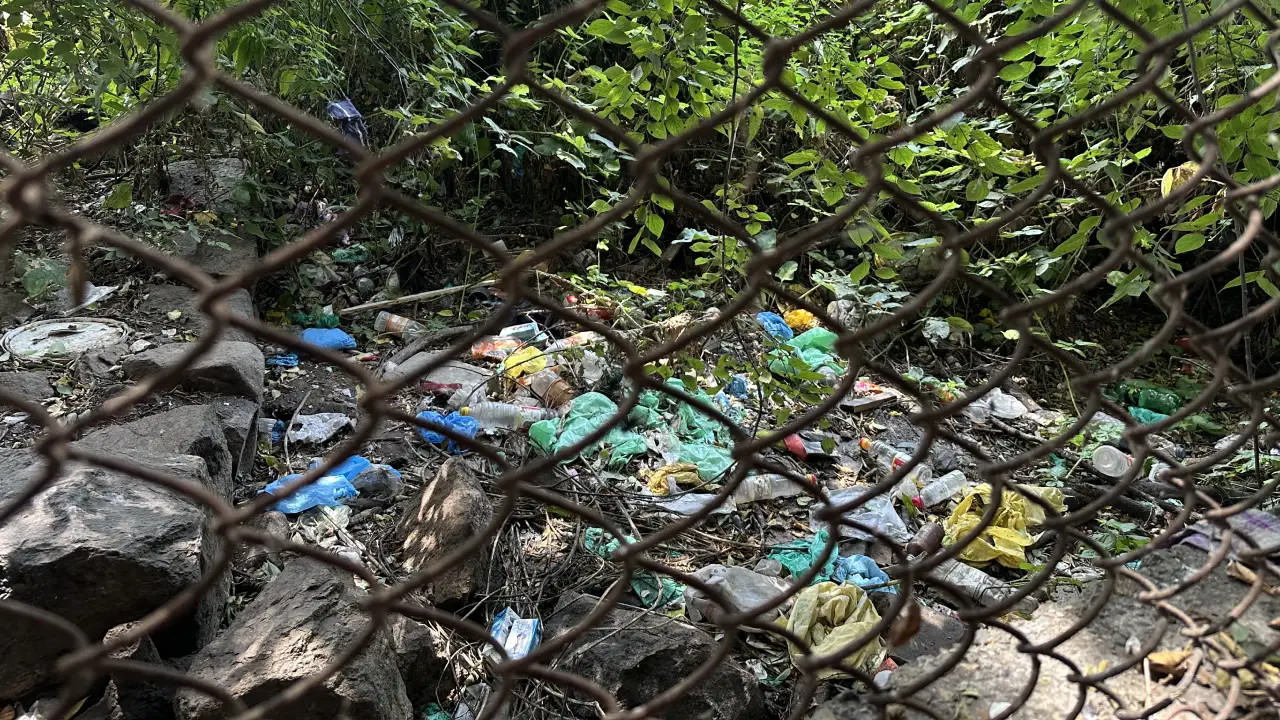
The dog menace is worst around Malkhah. Because the graveyard spans such a large area, garbage spots have come up all along its edges, and the dog population has exploded.
“We once rescued an old man who had come to offer Fateha for his family. The dogs were about to bite him,” said a resident who lives near the graveyard. He said some corners of the graveyard have become a favourite spot for addicts. “In the evenings, many come into the graveyard to use drugs or even to buy them.”
Wantpora in Rajouri Kadal holds some of the oldest graveyards of Downtown Srinagar. In one of them, a black tombstone sums up death and the world. In golden calligraphy it reads: “Hue namvar be-nishan kaise kaise, zameen kha gayi aasman kaise kaise.” Oh, how time erases names once glorious and grand; oh, how the earth swallows skies where they once did stand. The grave belongs to Ishfaq Ahmed, who died in 2012 at the age of 24.
Inside the graveyard, many old tombstones lean against the side walls. They belong to people buried decades ago. As their foundations crumbled and the graveyard filled up, they were removed and the ground refilled with fresh sand to make room for new burials.
Outside, at a shopfront, an old man is talking loudly with a few residents. He is Ghulam Nabi, one of the caretakers of a graveyard in Wantpora.
“The graveyards of Downtown Srinagar have run out of burial space. Most of them have been used far beyond their capacity. People can’t even walk between the graves, that’s how congested they are,” he said. Many graveyards have removed tombstones that are a few decades old and refilled the ground with fresh sand, he said, which Islamic ruling allows once enough time has passed.
“Had the government paid attention and rolled out a proper policy banning people from turning graveyards into private property, and set up an institution to monitor them, issues like congestion, encroachment and the dog menace could have been avoided,” Nabi said, rising for Zuhr prayers. “We could also have followed many Muslim countries, where graveyards are refilled with fresh sand every 20 to 25 years to make space for new burials.”
Across Downtown, many graveyards are in a miserable state: grass taller than a man, broken tombstones, dog filth on the graves, and fencing so weak, or so completely gone, that dogs walk in freely. In one, a garbage dump has come up a few metres from the graves, and families are now afraid to go in alone.
Rising Costs
In 2015, tired of the growing congestion of the old city, Shabir Hussain’s family moved from Downtown to Buchpora, on Srinagar’s northern outskirts. Early one Friday morning in May 2024, his mother died.
“After shifting, I had planned to buy a small plot in one of the graveyards near the new house. I tried for months, but the prices around the area were very high, so I thought I would wait,” he said. “That Friday, I regretted the decision a lot.”
The move out of the old city picked up sharply after 2010. Colonies came up in areas people had avoided after dark only a few years earlier. As the houses multiplied, graveyards could not keep pace with the population. Demand pushed up the price of land, and the price of graves rose with it. In many uptown areas, a marla in a graveyard now costs as much as a marla of residential land.
That morning, Hussain called a cousin about burying her in their ancestral graveyard. The family’s portion was full, but she had asked to be buried beside her husband.
“It was my mother’s wish to be buried next to her husband, and I had made her a promise while she was alive, though I had also told her there was no space left,” he said. “But her moist eyes as she passed away didn’t allow me to go back on it. It was a great struggle to arrange the space. That day I realised that buying a plot in a graveyard matters more than buying a plot for a house.”
In the February session of the Jammu and Kashmir Assembly 2026, a ruling National Conference MLA raised the issue of a severe shortage of burial space. He said successive administrations had failed to add graveyards despite rapid urbanisation and population growth.
The market has already priced that shortage in. “If you have to buy even a small piece of land in Srinagar’s newer graveyards today, it will cost you at least Rs 3 to 4 lakh, depending on the location. In some places, a marla inside a graveyard can touch Rs 7 to 8 lakh,” said Mohammed Fayaz, a real estate agent. “The rate moves largely in line with residential plots.”
“We cannot blame people who converted their prime land into graveyards. People should be thankful to them for creating burial space,” Fayaz said. “But many graveyards in these new areas have problems. A few have come up under high-voltage lines, and a few on government land. Overall, the situation needs the government’s immediate attention.”
Back in Malkhah, a few steps from Shafi’s shop, a small pile of garbage is burning inside the graveyard, and the smoke brings tears to his eyes. “Look at this. Its smell is so harmful for an old man like me. I have been sneezing since morning. I tried to sprinkle water over it, but the smell stays in the air for hours,” he said.
“At times it seems that those who are buried are not really dead. It is the living who should be declared dead.”