Madrasa Abdullah in Pulwama, the first institution of its kind in Kashmir’s seminary network, provides free education to blind and deaf boys, teaching them the Quran and mainstream school subjects through Braille and Indian Sign Language. In an inspiring environment of mutual care, its students also support and guide one another in their daily lives, reports Maleeha Sofi.
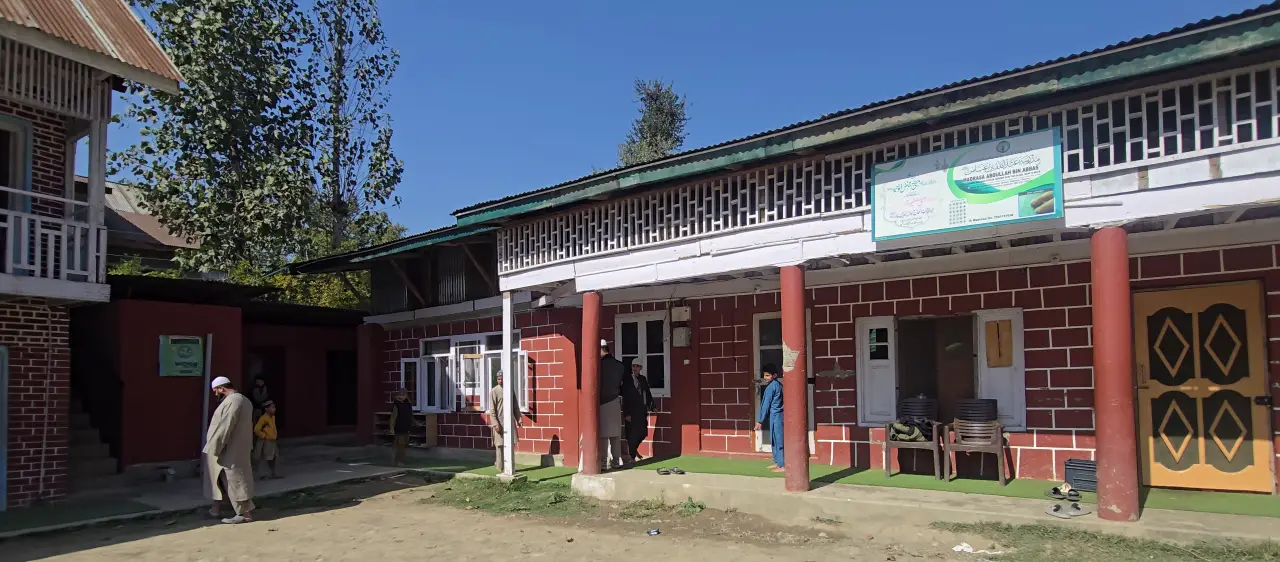
At a time when every small achievement makes huge noise, a group of students is gaining knowledge silently, quite literally. Madrasa Abdullah in Chersoo (Awantipora), has been running for the past year with a goal to educate specially abled children in Jammu and Kashmir. Nineteen students are on its rolls. They come from eight districts, from Poonch and Kupwara to Ramban, Pulwama, Baramulla and Srinagar.
Inside the quiet rooms of this residential institution, eight of the children cannot see. Another eight can neither speak nor hear. The remaining three are able-bodied students, close relatives or companions, who share the boarding space to assist the visually impaired boys as they move through corridors and courtyards. In a society where physical impairment is frequently met with polite neglect or reduced to domestic charity, the seminary offers an alternative: a space where sensory loss is treated neither as a tragedy nor as an excuse for quiet resignation.
Touch Literacy
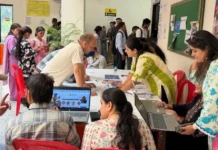
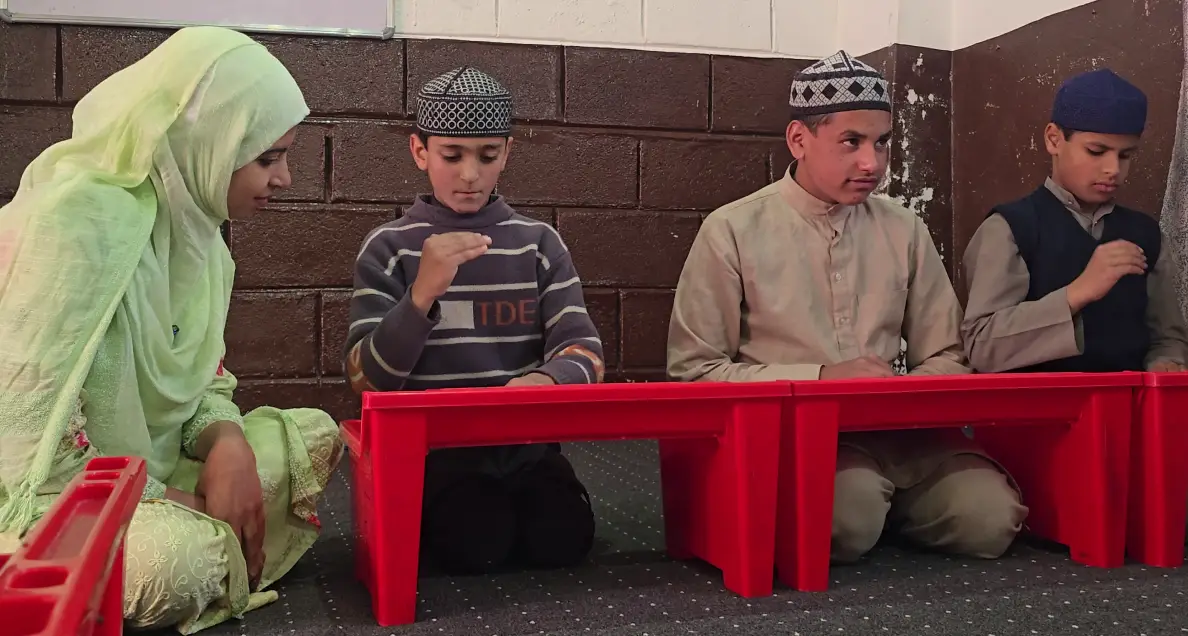
Aman, a young visually impaired boy from Pulwama, sits with his hand held firmly by his instructor, Maulana Muhammad Maktoomi.Himself visually impaired, Maktoomi is the madrasa’s specialist in Braille across Arabic, English and mathematics. He guides the boy’s index finger across a thick, perforated metal slate.
“When this child first arrived, his tactile sense was very faint because his fingertips were thick and rough,” Maktoomi explains softly, pressing the boy’s thumb and forefinger to demonstrate. “When fingertips are calloused, a child cannot feel the subtle relief of the dots. But there is a technique. We gently rub the surface of the fingertip day after day, smoothing down the thick skin until the nerve endings awaken. Once that sensitivity is born, the dots begin to speak to them.”
Every concept is governed by a fundamental matrix of six raised dots, arranged in two vertical columns of three. For those who navigate the world through touch, these six coordinates contain the entire universe of language.
“Whenever the language changes, we have to alert the child verbally,” Maktoomi said. “We say, ‘Now we are switching to English,’ and immediately their mind reframes the touch. The finger feels the same point, but their consciousness reads a different alphabet.”
A few feet away sits Wajid Iqbal, the son of Mohammed Kabir from Poonch. Wajid was the second student admitted when the madrasa opened on June 25, 2025. Today, he is one of its most advanced scholars. At his teacher’s bidding, Wajid traces his fingertips over an embossed volume of the Holy Quran.
Peg Mathematics
For mathematics, the seminary turns to a different device: a metal grid drilled with hundreds of octagonal apertures, accompanied by small brass pegs known locally as keele. Maktoomi pulls out a handful of the cold metal pins to explain their geometry. Each hole has four distinct corners and four flat edges. Turn the peg toward the top left, and it registers as the number one. Turn it clockwise to the centre, and it becomes two; shift it further, and it reads three, four, five, through eight. Turn the pin completely upside down, where two tactile dots are carved onto its base, and those same positions register nine, zero, or the signs for addition, subtraction, multiplication and division.
Watching Wajid work out sums on the slate shows how human perception surpasses physical conditions. Asked to set down the numbers 521 through 525, his fingers move rhythmically across the grid, pressing pins into their designated orientations without an errant motion, translating numerical values purely through directional geometry.
Language Silence
On the opposite side of the hall, the auditory landscape changes completely. There are no spoken vowels, no clicks of metal styluses against paper, and no rhythmic recitations. In this corner, the students dwell in total, unbroken silence.
Maulana Ubaidullah Ishaati, the Nazim of the seminary and a trained Indian Sign Language (ISL) specialist, travelled from Pune to establish the curriculum. He communicates with his students through hands, eyes and expressions. A native of Maharashtra, Ishaati spent nearly seven years surveying districts of Jammu and Kashmir, assessing the acute lack of formal education for children with sensory impairments.
“People often suggested that we take these children back with us to Pune or other major centres where established institutions exist,” Ishaati said, leaning forward on his chair. “But taking a child with severe disabilities thousands of kilometres away from home is deeply traumatic for poor families. The climate is different, the food is different, and the environment is alien. When the regional Muftis and local elders sat together, we decided that the school must be established here, right on this soil, so that the children remain rooted among their own people.”
The first child to walk through the madrasa’s gates in June 2025 was Muhammad Imtiyaz Akhon, a deaf and mute boy from Srinagar. Seven other non-verbal boys have since joined him. Among them is Mudassir, an alert fourth standard student whose father, Sher Ali, enrolled him in the hope that his son might one day learn to read and write his own name.
When Ishaati raises his hands before the class, Mudassir fixes his gaze on his instructor’s fingers, following every movement intently. Rapidly, his small hands begin to articulate the English alphabet, framing each letter cleanly against the air, from A through Z, before spelling out the names of fruits. The students in this section communicate with one another in sign language. They giggle, crack jokes and learn, all while being silent.
“People ask how we teach an abstract word like ‘stand’ or ‘sit’ to someone who has never heard language,” he remarked. “What they do not realise is that Sign Language is not a crude set of gestures; it is an organic mother tongue. Just as Kashmiri is a native tongue of many people, Sign Language is the natural, God-given language of these children. If you or I try to sign for an hour, our shoulders will ache, and our arms will grow exhausted because we are forcing an unnatural medium. But these boys can converse through their hands from morning until night without the slightest fatigue. It is woven into their physical being.”
Mutual Reliance
Perhaps the most compelling dynamic within Madrasa Abdullah is the unscripted bond between the blind boys and their deaf peers. On paper, their worlds seem incompatible: one group experiences reality through sound and touch, the other entirely through visual cues. Yet within the boarding rooms, isolation has collapsed into mutual reliance.
The deaf children, blessed with sharp vision and mobility, serve as physical guides for their blind classmates. If a visually impaired boy drops his prayer cap, misplaces his towel, or needs to walk across the compound toward the ablution block, a deaf classmate steps forward, takes him gently by the elbow, and walks alongside him. In exchange, the blind boys assist their non-verbal peers with vocal mediation and auditory awareness.
To facilitate this everyday intimacy, the children have fashioned an informal, tactile sign vocabulary. The blind boys have memorised the hand shapes of the alphabet, feeling their classmates’ fingers to identify who is speaking. Every resident also has an individual “sign name” based on an observable personal trait or initial. A boy named Rizwan is signalled by the shape of the letter R. A boy named Ayaan is identified by a gentle touch near a distinct mark on his cheek. Maulana Ishaati himself is known by the signed letter U, followed by a downward gesture at the chin tracing his beard, signifying a spiritual guide.
“Allah takes away one faculty, but He compensates with gifts that ordinary people never experience,” Ishaati said quietly. “A blind person’s power of touch, their auditory memory, their sense of smell, these faculties become remarkably acute. If you spend time with one of these boys today and return a month later, they will recognise you from across the room the moment you speak a single syllable. They smell the distinct presence of people entering the room. Their minds hold on to lessons with exceptional retention.”
Daily Rhythm
The madrasa runs on a rigorous, double shift timetable designed to ensure that neither secular nor religious education is compromised. The boys wake before first light for the Fajr prayer, followed by Quranic revision and breakfast. From 7 am to 11:15 am, the deaf students sit for formal academic classes in English, mathematics and environmental studies, while the blind students occupy the religious study hall.
At 2 pm, after the midday meal and a brief respite, the classrooms invert. The visually impaired boys take up their academic subjects, while the deaf students move to Islamic studies, practical ethics and writing exercises. Evenings are reserved for sports, hot tea and communal camaraderie, followed by prep sessions after the Maghrib and Isha prayers, where four specialised teachers supervise homework.
Community Support
The madrasa does not operate in an administrative vacuum. To ensure students receive recognised academic credentials, the seminary works in direct collaboration with the Zaiba Aapa Institute, an institution for special education in Bijbehara.
It does not charge a single rupee in tuition, boarding or examination fees. Three daily meals, uniforms, stationery, Braille paper and continuous medical oversight are underwritten entirely by local donors across the Kashmir valley: traders, orchard owners and ordinary citizens who contribute quietly to keep the kitchen fires burning. The land on which the seminary stands was itself donated by a resident.
“When a disabled child stays home without schooling, they are often pushed into the corner of a room,” the teacher regretted. “At first, the family loves them out of pity. But as the child grows older, unable to care for their basic hygiene, spilling food across the floor, demanding attention, they gradually become perceived as a burden. Eventually, neglected children are driven toward the margins of society, you see them begging at bus stands, sitting outside railway stations, vulnerable to exploitation and despair.”
“Education alters that trajectory completely,” Ishaati concluded. “It transforms an individual from a helpless dependent into a self-reliant human being endowed with dignity. When our boys go home for their weekend leaves, their parents are astonished. They see their sons sit with poise, wash their own clothes, read from books, and carry themselves with pride. These children do not need our pity. What they need is an open door, a patient guide, and the fundamental right to discover that the human mind is never confined by the limits of the body.”
Shared Prayer
Five times a day, the seminary gathers for prayer in a ritual that captures the quiet harmony of the house. The Azaan is called out by a visually impaired student for those who can hear, while a deaf student delivers the call simultaneously in sign language, ensuring the summons reaches everyone across the halls. Ahead of prayer, the deaf boys gently guide their visually impaired companions by the hand to the ablution area, then walk alongside them back to the prayer mats, where all stand shoulder to shoulder in congregation.