Jammu and Kashmir has opened dozens of new degree colleges, yet students struggle to stay enrolled. Fees, scholarship gaps, difficult paperwork and doubtful income certificates push many towards quitting, reports Afreen Ashraf
Rahila, 21, is on her way to an interview for a cashier’s job at a departmental store in Nowshehra, Srinagar. Until last year, she was a student pursuing a degree in education. She wanted to continue, but the cost of staying in college became too much for her family.
“When I joined college, I had to pay the admission fee and complete some other formalities,” she said. “We managed that money and thought I would be able to arrange a similar amount the next year. But with every passing semester, the expenses kept adding up. I had to pay examination fees every semester, apart from the admission fee for the second year.”
Her father is a labourer with medical issues and needs dialysis. Her younger sibling had yet to complete class 12.
“I had to submit around Rs 8,000 for the second year, plus some university fees. Asking Abu to arrange money would have added more burdens on a family that was already struggling to meet its needs,” she admitted. “These were the events. I had to drop out. Now I am looking for part time work so that I can contribute to my family expenses. I also heard about government posts that I can apply for with only a class 12 qualification. I am waiting for those recruitments.”
For Rahila, giving up college was not a choice. It was a decision shaped by her family’s finances.
Expanding Colleges
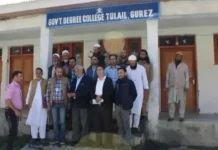
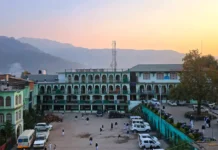
Jammu and Kashmir has expanded its higher education infrastructure in recent years. It now has 145 government degree colleges.
But a nearby college does not mean a student can afford to attend it, or to stay long enough to finish a degree.
The Gross Enrolment Ratio (GER) of Jammu and Kashmir stood at 21.5 per cent in 2023-24. The national average is 30 per cent, according to data tabled in the Jammu and Kashmir assembly. The number of undergraduates graduating from government degree colleges in the Union Territory has fallen from 23,655 in 2023-24 to 18,312 in 2025-26. That is a decline of around 22.6 per cent.
The higher education department recorded an overall rise in college admissions in 2026-27, but the growth was uneven. Official figures showed that 100 of 142 government degree colleges had fewer than 100 admissions each after two rounds. Two colleges had no active enrolment. Fourteen had fewer than 50 students each.
These figures raise questions about both access to higher education and students’ ability to pursue it. On their own, they do not explain why enrolment remains low in some institutions or why fewer students are graduating. Individual experiences offer a glimpse of what aggregate figures cannot capture.
For many students like Rahila, the obstacle is not getting into college. It is finding the money to stay. She is not the only one. Financial difficulties have forced some to leave. Others keep up with their studies while managing the pressure of fees and other expenses.

Sudden Shocks
Hurmat, a political science student, comes from a middle class family that had generally met its financial commitments. Paying her fees on time had never been a problem, and she believed it never would be. Last year a family member fell ill, and the household diverted money towards medical expenses. Fees that were once manageable suddenly became hard to arrange.
After several failed attempts to clear her dues, Hurmat confided in one of her teachers. The teacher raised money to cover her fees and kept Hurmat’s identity anonymous. She was able to submit her fees. Her experience explains how quickly circumstances can change, even in households not ordinarily struggling to meet their expenses.
Constant Anxiety
Yerfa, a third semester student, faces another kind of uncertainty. Her family can afford her fees. “My father never refused to pay my fees or said he simply can’t afford it,” she confided. But her father is an auto rickshaw driver, and she is conscious of what a large expense means for a family that depends on his earnings. “As my exams were coming to an end, I would start feeling anxious. As soon as the exams finished, the admission process would begin, and I would have to ask my father for the fees.”
She is certain her father will pay. What troubles her is that whenever an expense exceeds Rs 10,000, she can sense that he has to think it through, check his balance and work out how to manage it before handing over the amount. “This uncertainty troubles me. I start worrying even before the fees portal is opened,” she said. The end of exams, a relief for most students, brings anxiety for her.
Living Away
Costs can be higher for students who leave home. Hussain, from Baramulla, lives in Srinagar to complete his education while preparing for competitive examinations. Alongside college fees, he pays tuition for civil service exam preparation, travel, accommodation and daily living expenses.
His father is a retired officer with five dependents. Hussain is the only one studying outside the district. His siblings are still completing high school in their village. With only a pension, the family finds it somewhat difficult to meet its demands.
“I feel the fees are too much,” he said. “I tried taking part time jobs in the evening to ease the burden. But balancing work with both tuitions and college proved difficult.” Work could help him meet his expenses, but it could also take time from the education he hopes will improve his prospects.

Available Schemes
Amid these struggles, a scholarship can make the difference between continuing and quitting. Several government schemes are available to students in Jammu and Kashmir.
The PM USP Central Sector Scheme offers financial assistance to meritorious students from families meeting the prescribed income criteria. Post matric scholarships help eligible Scheduled Tribe students meet the costs of continuing their education.
Other schemes focus on specific barriers. Pragati supports eligible girls pursuing technical education. Saksham is meant for students with disabilities enrolled in approved technical courses. Swanath assists eligible students facing particular hardships, including orphans and children of armed forces personnel killed in action.
For undergraduates who want to study outside Jammu and Kashmir, the Prime Minister’s Special Scholarship Scheme (PMSSS) can be especially important. It helps eligible students meet the cost of studying at institutions outside Jammu and Kashmir. It covers academic fees and provides maintenance assistance within the scheme’s prescribed limits. For several students, this support has made studying outside possible without worrying about money.
Tahora Shakeel, who studies at Aligarh Muslim University under PMSSS, said the scheme has helped her pay college and hostel fees. “I receive a yearly stipend as well, which helps me manage my personal expenses on my own. PMSSS has made me financially independent to an extent and made it easier for me to study and live away from home,” she said.
Awareness Gap
Not every student shares Tahora’s experience. Emaan secured admission to the University of Delhi but did not apply through PMSSS. “I didn’t know such a scheme is available for students of Jammu and Kashmir outside the territory,” he said. He questions why he never learnt of such assistance, and so could not explore the scheme or its benefits.
Arooj, a student of Cluster University, said she knew little about scholarships before joining college. She knew some assistance was available. She did not know enough about the schemes, their eligibility criteria or how to apply. She also complains that the college failed to communicate scholarship information in time.
“I think the main reason is lack of information. Many students don’t know which scholarships are available or whether they are eligible for them,” she said.
Lost Confidence
Rahila, who left college because her family could not meet the costs, was sceptical when asked why she had not applied for a scholarship. “It is mostly a waste of time. Almost nobody gets it. They just make you fill out form after form,” she said. She doubts the way the government distinguishes between people. Her response reflected not only a lack of information but also a distance between official schemes and the confidence some students have in the system.
Aijaz Ahmed, a student activist, says he has repeatedly met students unaware of the scholarships available to them. Last summer, he received complaints from Cluster University students that the fees had increased compared with the previous year. Aijaz said he and others tried to raise the matter with the university. According to him, students were given so little time to pay that many eventually submitted the fees. He said he has often encouraged students to apply for scholarships, only to find that many are unfamiliar with the schemes.
Hussain tried to obtain a scholarship in his first year but missed the deadline because he could not get information on time. By his third semester, a senior told him about a scholarship the college was offering and said he had tried applying himself. That left Hussain doubtful about whether the effort would pay off.
Paperwork Hurdles
Students who do know about the schemes face another problem: unfamiliarity with government procedures. “It was not only about filling a form. Every document needed something else. I did not know whom to ask,” Tahora said.
“I had to wait for certificates, and the online portals were not working properly. I spent almost a month trying to complete the requirements. Even when I needed help, the officials were not very cooperative,” she explained.
Such experiences make a process that looks straightforward on paper much harder. A missing document, a delayed certificate or a lack of guidance can hold up an application. For students already struggling to pay fees, the process becomes another burden.
Certificate Concerns
There is a more troubling concern. Are the documents used to establish eligibility always verified properly?
One scholarship beneficiary, who requested anonymity, described an alleged arrangement involving an intermediary who offered to help obtain income certificates. The student said the scholarship had a prescribed annual family income limit, but his father’s earnings exceeded it.
“I told him that the family income should be shown as Rs 2 lakh to meet the scholarship’s eligibility criteria. He agreed to arrange the certificate for Rs 500, but after negotiating, he agreed to Rs 200 each. He promised to provide three certificates for Rs 600, which I was supposed to collect from Eidgah,” the student said. “When I went there, I was shocked to see several other people sitting with laptops and files, offering similar services. I had thought he was the only one doing this, but there were many others.”
This account raises serious questions about the verification of income certificates. It also raises the possibility that ineligible applicants obtain documents that let them qualify for assistance.
Way Forward
The accounts of these students point to a problem beyond the availability of scholarships. Some do not know assistance exists. Others discover it too late, struggle with the application process or lose confidence that applying will help. Allegations of irregularities in income certificates raise further questions about whether eligibility is verified fairly.
The higher education system of Jammu and Kashmir is expanding, but more colleges do not make higher education accessible to everyone. For students like Rahila, the difficulty is not getting into college alone. It is finding the money to continue.
For financial assistance to make a real difference, students must know about it, receive guidance on how to apply and be able to trust the process. Scholarship information needs to reach classrooms. Otherwise, students will keep facing a difficult choice. They will give up their education, not because they lack the desire to study, but because they cannot afford to carry on.