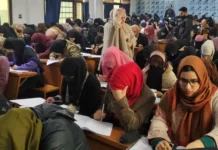
A generation armed with more information than ever still finds itself adrift, not from indifference, but from the weight of everything at once, writes Lilac Ali

The problem is not that this generation is not ambitious enough. The crisis is that there is just too much noise.
“I know it is hurting me. I just cannot put it down,” said Haleem, 18. He believes that while social media is certainly not without its advantages, only a thin minority of students genuinely benefit from it. “The rest are caught in it”.
The noise comes from everywhere at once: college rankings and career counsellors telling them to specialise, to pick a lane and stay in it, before they have even had the chance to explore. It comes from parents who have made sacrifices and quietly pray it will be worth it. And it comes from a future that feels unstable. In an age where automation is replacing jobs that did not even exist a decade ago, teenagers are expected to build career plans around a world nobody can predict.
Zainab, a 12th grader, feels this closely. “It feels like everything I do have to convert into something meaningful that will help me secure my future,” she said. “The feeling is so common now that I am indifferent to it.”
Social Media
Social media sits at the centre of this condition. Studies show that 95 per cent of young people aged 13 to 17 use social media, with research consistently linking heavy use to rising rates of anxiety, sleep deprivation, and diminished self-worth. Yet even those who recognise the damage find it difficult to disengage.
The to-do list tells the whole story. Study, code, read, paint, exercise, journal, learn a new language, solve 50 questions, clean the room, start a YouTube channel — too many things to do, too little time. Yet the determination is genuine. The work is real. The distraction, though, is never far: one notification, and hours dissolve. The regret that follows is its own particular weight, not dramatic, just quiet and familiar, arriving at dusk when the list stares back mostly untouched. Not because intention was lacking, but clarity.
A quick scroll at breakfast pushes individuals to compare themselves with hundreds of highlight reel characters. The anxiety does not ease through the day. Conversations with peers reveal that despite apparently different struggles, the anxieties beneath them are eerily alike: a shared fear of the future, of failure, of career uncertainty, and of the weight of parental and societal expectations.
There is a shared awkward junction, stepping into the adult world, yet not quite being an adult. One moment expected to make life-altering choices about specialisation and stability; the next, told they are still too young to understand how the world really works. Ambitious, pulled in too many directions at once, eager to make an impact, yet frustrated by the same lack of opportunities and the same flaws in the education system.
Pressure Burnouts
This pressure finds particular expression in the competitive exam culture of the subcontinent. Students attend coaching centres for hours, return home to self-study late into the night, and repeat the cycle with an indefatigable discipline that would impress anyone who witnessed it from the outside. But the cost is real. Burnout is common and often left unaddressed.
“It just piles up,” Zainab admitted. “You finish one task and another pops up. There is no respite.”
What suffers most, beyond health and sleep, is the ability to explore: to try the painting, the language, the YouTube channel that sits at the bottom of every ambitious to-do list, perpetually delayed.
This generation is driven by a hunger for meaningful impact. Statistically, 70 per cent prioritise purpose in their work and lives, yet fewer than one in four can see a clear path towards it.
Taibah, 28, sees this from a slight distance: “We did not carry this much in our heads at your age. I am not sure if that is growth or a burden.”
Perhaps it is both. The self-awareness this generation carries is real and hard-won, but awareness without outlet, without a system that meets them where they are, can become its own kind of exhaustion.
East West Divide
It is worth noting, however, that this particular shape of stress is not universal. Hussain, 18, who attended an international summer programme, observed that students from the West carried entirely different burdens: concerns about climate uncertainty, gender inequity, and systemic injustice.
“These problems are rarely spoken of here, let alone thought of,” he said. “Students there have other things to worry about, worry being the only constant.” He is quick to add that this is not a competition of suffering; the situation and environment are enormously different, and the struggles, while real on both sides, are not the same. What it does suggest, though, is that anxiety among young people is not a personal failing. It is a response to context.
Research also shows that they are the most self-aware generation to ever exist, they know the names of their triggers and the roots of their trauma, and yet they are still drowning in the very anxieties they have learned to name. They have all the information in the world, but little direction. They are not lost because they do not care. They are lost because they care about everything simultaneously, and the world has not yet built a map to navigate that.
By dusk, the conversations have faded. The world is quieter, but the questions louder. How much was promised this morning? How much is expected? The emotions are hard to name – somewhere between nervous and hopeful, dedicated yet tired. And yet, beneath all of it, the day was not wasted. Something was attempted. Something, however small, was tried.
This is the modern paradox.
And still, beneath all the apprehensions, the stubborn decision to do better tomorrow remains. They choose to try again.