From a Rajasthan jail cell to the bombed cities of Iran, Kashmiri students are paying the price of a valley that has never invested enough in its own young, reports Maleeha Sofi
On a warm winter Sunday, a group of young men noticed a middle-aged man in Srinagar’s Pratap Park wandering restlessly from one bench to another. He looked visibly distressed, his hair was unkempt, his beard scruffy, and at times it seemed as if he was speaking to himself.
Curious and concerned, one of the youths finally approached him. To his surprise, the man was not mentally unwell. He was simply overwhelmed with anxiety. His son was studying at a medical college in Iran, and he had been desperately trying to learn about the situation there.
“My wife keeps urging me to find out what is happening in Iran and make sure our son returns home safely,” the man told the group. “I have no answers for her. So I leave the house and spend the day here in the park, waiting and worrying.”
Newsy Lot
In Kashmir, the student is always in the news. Conflict anywhere on the planet and Kashmiri students find themselves on the front pages, evacuated, stranded, roughed up, or simply abandoned by a system that sent them far from home in the first place. The pattern is so reliable that it has ceased to surprise anyone except the students themselves, who keep discovering with fresh shock that the promises made to them at the point of departure were not worth the paper they were printed on.
The deeper structural problem is one that Kashmir’s leadership has never squarely confronted. In neighbouring states, even confectioners own professional colleges. In Kashmir, the private sector has poured money into elementary schooling but almost nothing into higher and professional education. The result is a demand-supply gap so extreme that state-owned institutions cannot absorb the load. Every year, tens of thousands of young Kashmiris fan out across the country, to nursing colleges in Rajasthan, medical schools in Karnataka and China, pharmacy courses in Punjab, and thousands more cross borders into Iran, Bangladesh, Ukraine and the Gulf. They leave because there is nowhere to stay. And when things go wrong, they are largely on their own.
Right now, two crises are unfolding at the same time on the streets of Srinagar. Almost 600 Kashmiri students are stranded in Iran as the conflict between Israel, the United States and Tehran enters a dangerous new phase.
Simultaneously, a group of nursing students who travelled to Mewar University in Rajasthan under a government scholarship scheme have spent much of their four-year course in a cycle of protests, false assurances and, eventually, a night in the district jail, not because they broke the law, but because they asked for a degree that would actually allow them to work as nurses.
A Scholarship, A Promise, A Detour
The story of the Mewar University nursing students begins in early 2022, when approximately 45 young people from Jammu and Kashmir applied under the Jammu and Kashmir Special Scholarship Scheme (JKSSS), a programme funded by the government to help students from underprivileged backgrounds access professional education. The army supported batch was drawn from Kupwara, Baramulla, Bandipora, Budgam and Pulwama. Most came through local consultancies in their home districts. One student, Sahil Tantary from Pattan, paid Rs 1 lakh to the consultancy that arranged his admission. Twenty of the 45 students were from various districts of the Kashmir Valley.
After appearing for entrance exams in June 2022 and receiving results in July, the students received confirmation letters from colleges in Punjab, Guru Hargobind College, Malwa College and MLM Group of Colleges, among them. They arrived in Punjab in October, only to find that the colleges named in their letters would not take them. A rift over fees between the consultancy and the colleges had apparently left the nursing students without a place. A separate batch of pharmacy students was redistributed to various Punjab institutions. The nursing students were taken instead to Mewar University in Rajasthan, where classes finally began in November 2022, four months behind schedule.
The Boards Come Down
Sarfaraz Hassan, another student in the batch, remembers walking into the campus that first time and noticing the signboards prominently displaying INC/RNC Registered: the Indian Nursing Council and the Rajasthan Nursing Council being the two bodies that govern nursing education and practice across the country and the state, respectively. The presence of those credentials on the university’s hoardings was reassuring. The students had no reason to doubt them.
Their doubts began in 2023, during an inspection visit. The university quietly removed the INC/RNC Registered boards before the inspectors arrived. Students noticed. They checked the RNC’s official website and found Mewar University absent from the list of registered institutions. The first protest followed. The university responded with assurances that registration was being processed, and when a registration announcement was eventually made, the students celebrated. A cake was cut.
By September 2024, when the RNC published its updated list of registered colleges, Mewar University was missing again, even as the university’s own website continued to display the INC/RNC Registered claim. Students protested continuously for 20 days and nights. This time, the assurance was more formal: the university told the court it would complete all necessary documentation within two months, or it would migrate the nursing students to registered colleges. The semester ended. Everyone went home. When students returned in 2025, the university was still unregistered. A series of ten-day extensions followed, each as empty as the last.
Pahalgam Massacre
In April 2025, 26 tourists were massacred in Pahalgam, triggering a wave of anti-Kashmiri violence across India. Kashmiri students enrolled in various colleges across the country were beaten, threatened and forced to return home. The Mewar nursing batch was no exception. They left Rajasthan and remained in Kashmir for three to four months, their protest and their unresolved crisis temporarily suspended by circumstances entirely outside their control.
When they eventually returned to campus, the group had scattered. It was difficult to reassemble. Some of the students, meanwhile, had gone directly to the Rajasthan Nursing Council’s offices to inquire about the university’s status. The answer they received there was more definitive than any they had been given before: there was no file from Mewar University with the RNC No pending application. No registration process in progress. Nothing.
Confined In A Jail
The year 2026 began with continuous protests. In February 2026, 36 students were suspended after an alleged scuffle with police during a sit-in. The suspensions did nothing to resolve the underlying issue. On March 9, students gathered on campus to seek a meeting with the university’s Chairman. The situation deteriorated. According to Sahil, a student in desperation attempted suicide to draw attention to their plight. Seventeen students were detained.
They were asked to sign an apology letter, and did so. Then they were informed that an FIR had been registered against them, and they were transferred to the district jail.
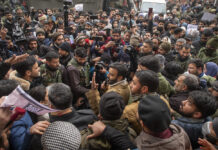
“We were kept along with criminals accused of murder and theft,” Sahil said. He alleged that jail officials subjected them to humiliating treatment, made them clean washrooms and mop floors, and that a police officer abused them and called them terrorists. They were granted bail on the evening of March 10, with help from female batch-mates (who had not been detained) and residents. On March 12, the families of the detained students protested in Srinagar.
Mewar University’s Registrar, CD Kumawat, maintained in a statement to ETV Bharat that the university had shared all relevant information with students and had the necessary approvals when the nursing programme was launched in the 2022-23 session. He said the court had directed that a No Objection Certificate be issued to the university, and that because the government neither re-inspected the campus within the stipulated 30 days nor issued the NOC, the approval should be treated as deemed granted.
Besides, he added that in 2025 the university had complied with a government directive requiring nursing institutions to reapply for NOCs, and that the matter remained pending. The students’ version and the university’s version of events remain unreconciled, and no authority has yet stepped in to adjudicate between them.
Students in a War Zone
While the Rajasthan drama unfolded, a separate and more immediately dangerous situation was developing in Iran. According to Nasir Khuehami, a student activist, more than one lakh Kashmiri students are studying across India’s mainland at any given time; abroad, roughly 2,000 are enrolled in Iran, 4,000 in Bangladesh, 300 in Ukraine, and over 10,000 in the Gulf and wider West Asia. These students have already lived through the Bangladesh unrest and the Russia-Ukraine war. Now Iran is the flashpoint.
As tensions escalated in February 2026, around 900 Kashmiri students returned from Iran, as around 1200 stayed back because they had to appear in their examinations. On March 1, following confirmation of the killing of Iran’s Supreme Leader Ayatollah Khamenei in an Israeli-American strike, communication links between Iran and Kashmir were severed. Parents in Kashmir were left in deep panic, unable to reach their children.
Many days later, students enrolled in MBBS programmes at various Iranian medical colleges were relocated to the city of Qom, Iran’s sacred town, considered a safer location.
All Indian students in Iran are scheduled to be repatriated in phases via Armenia and Azerbaijan. The cost of each flight is over Rs 1 lakh, and students are expected to bear this themselves. For families in Kupwara or Bandipora who scraped together funds to send a child to medical school, this is an additional blow, arriving at the worst possible moment.
The Structural Failure
In Kashmir, each crisis, the Mewar University fraud, the Iran evacuation, and the earlier CT University’s Ramzan incident, where a Vice-Chancellor was eventually removed for abusing Kashmiri students over an Iftar request, is being treated as a one-off event.
All these issues emanate from a single root. Kashmir has not built the higher education infrastructure its young people need. The private sector, which elsewhere in India has flooded the professional education market, has not entered the Kashmir space in any meaningful way. Government institutions are overwhelmed. The students who leave are not adventurers; they are refugees from a policy failure, driven outward by the absence of options at home.
Until that structural gap is addressed, until Kashmir has accredited nursing colleges, medical schools and professional institutions that can absorb its own students, the crises will keep coming. The names and locations will change: Rajasthan this year, Iran last year, Ukraine the year before. The students stranded, jailed, beaten or grieving will keep changing. The underlying cause will not.