Jammu and Kashmir is undergoing its most ambitious road-building drive ever, with Rs 1.22 lakh crore invested across 2,500 km of highways, tunnels and strategic corridors, reports Humaira Nabi
Jammu and Kashmir has approximately Rs 1.22 lakh crore in active and pipeline highway investment, spread across more than 2,500 km of roads, which is nearly half of the erstwhile state’s SGDP. More than 80 road projects are currently under construction or in advanced planning stages. Four-lane expressways, high-altitude tunnels, urban ring roads and strategic border corridors are being built simultaneously, stretching from Kathua to Kupwara.
NHAI alone has 19 active projects covering 361 km, valued at Rs 23,227 crore, while 17 already-completed projects cover another 320 km. When new projects currently awaiting sanction are added, the committed investment crosses Rs 1.22 lakh crore, a figure that dwarfs anything previously spent on roads in the region.
It is, by any measure, the largest road-building effort ever attempted in the region and one of the most complex infrastructure programmes currently underway anywhere in India.
Multiple Agencies
The programme is being executed by a complex mix of agencies, each responsible for different types of roads. The National Highways Authority of India (NHAI) is leading the construction of expressways and major four-lane corridors, including the Delhi-Amritsar-Katra Expressway and key segments of the Jammu–Srinagar highway.
The National Highways and Infrastructure Development Corporation (NHIDCL) is focused largely on difficult mountain corridors and tunnel-heavy projects such as Zojila and the NH-244 route through the Chenab Valley.
Strategic border roads are being built by the Border Roads Organisation (BRO) through its Project Sampark and Project Beacon units, particularly along corridors close to the Line of Control, including the Akhnoor-Poonch and Srinagar-Uri highways.
The Jammu and Kashmir Public Works Department (PWD) is responsible for urban bypasses, flyovers and city-level infrastructure such as Srinagar’s Sanat Nagar flyover and several town bypasses across the valley.
Tunnels
Tunnel construction has become the defining engineering feature of Jammu and Kashmir’s road programme, as authorities attempt to move critical highways off landslide-prone mountain slopes. Among the most significant is the 30.8-km Zojila Tunnel on the Kashmir-Ladakh (NH-1) highway, being implemented by NHIDCL for Rs 6,809 crore. Designed to ensure year-round connectivity between Srinagar and Ladakh by bypassing the snowbound Zojila Pass at 11,575 feet, construction began in October 2020 and has reached 63.9 per cent physical progress and 58.8 per cent financial progress. Completion is now targeted for February 2028, nearly 17 months beyond the original deadline.
Along the Jammu-Srinagar corridor, a series of tunnels are being built to stabilise the hazardous Ramban stretch of National Highway 44. These include the 8.8-km Marog-Digdol Tunnel (Rs 1,031 crore), currently at 12.4 per cent progress.
A four-lane twin-tube tunnel between Digdol and Panthyal is nearing completion, offering a safer bypass to the landslide-prone Ramban stretch. The 6.5-km Digdol-Khuni Nallah tunnel, built for Rs 866 crore using the New Austrian Tunnelling Method (NATM), is designed to bypass the hazardous Khooni Nallah section, an area historically prone to landslides, falling rocks and frequent traffic disruptions.
On the Jammu Ring Road, two tunnels with a combined length of about 3.2 km, within a Rs 2,967-crore project, have faced geological complications after ground settlement was detected around the bore, forcing a temporary suspension of tunnelling while experts from IIT Roorkee and the Geological Survey of India evaluated cavity treatment measures.
The 1.57-km Khellani Bypass Tunnel (Rs 431 crore) on NH-244 was completed in March 2025, marking a key milestone in improving connectivity to the Chenab valley.
Collectively, these tunnel projects reflect a broader shift in Himalayan highway design: replacing vulnerable cliff-side roads with underground alignments capable of maintaining traffic even during landslides, heavy snowfall and extreme weather.
Various other tunnel projects are being sought and talked about within and outside the power corridors. These include a tunnel access to Tangdar to skip the perilous Sadha Top and another tunnel for Gurez to avoid the challenging ascent to the Razdan Pass. Reports suggest the BRO is seriously working on both projects, and these are at the initial stage of survey and tendering.
Twin Ring Road
Authorities have invested massively in two ring roads that would offer better connectivity around the two main cities of Srinagar and Jammu. Most of it is ready.
The government recently said it has disbursed Rs 1,695 crore as compensation for land acquired for the twin Ring Road projects, though nearly 1,400 cases remain pending due to litigation and related issues.
Of the total Rs 2,106.70 crore awarded as compensation, Rs 1,784.45 crore has been released and Rs 1,695.37 crore disbursed, with Rs 89.08 crore yet to be paid and Rs 322.25 crore still to be received.
In the Jammu division, Rs 322.21 crore has been awarded, of which Rs 244.43 crore has been disbursed, while in the Kashmir division, Rs 1,784.49 crore has been awarded and Rs 1,450.94 crore disbursed. The compensation is shared between the Centre and the J&K government in a 90:10 ratio. A total of 1,398 cases are pending, 150 in the Jammu division and 1,248 in Kashmir, mainly due to funding delays, court cases, and land disputes.
= The Srinagar Ring Road, a 60.84-km semi-ring corridor, is emerging as one of the most significant urban infrastructure projects in Kashmir, aimed at decongesting Srinagar’s crowded city centre and streamlining traffic movement across five districts.
The project forms part of a 79-km, four-lane corridor estimated at Rs 4,786 crore, though several stretches are being developed with six-lane capacity and multiple flyovers to accommodate future traffic growth. Construction has progressed in phases.
The 42-km stretch from Galander (Pulwama) to Narbal (Budgam) is around 90 per cent complete and is expected to open by May 2026, while the remaining 18.84-km section extending to Ganderbal is targeted for December 2026.
In the next stage, Phase II, the Sumbal (Bandipora) to Wayul (Ganderbal) stretch spanning 24.7 km and costing Rs 1,038 crore is currently about 18.3 per cent complete, with a June 2026 completion target.
Phase IIA, covering 12 km from Manigam to Pandach in Ganderbal district for Rs 290 crore, has also been taken up as part of the expanding network. Meanwhile, Phase III, a 25.6-km corridor from Lasjan (Srinagar) to Pandach via Hazratbal and NIT, estimated at Rs 2,875 crore, remains at the Detailed Project Report (DPR) stage, indicating that while the initial stretches of the ring road are nearing completion, significant portions of the broader network are still in the planning pipeline.
The Jammu Ring Road project, now nearing completion at an escalated cost of around Rs 2,967 crore, is a nearly 58-km access-controlled corridor linking Raya Morh in Samba to National Highway-44 near Jagti.
Also initiated in 2018 with a three-year deadline, the project has faced delays due to land acquisition hurdles, COVID-related disruptions, and technical challenges in tunnelling through weak geological strata, particularly along a 3.1-km stretch comprising four tunnels (two each of roughly 780 metres and 700 metres). While the main carriageway is over 95 per cent complete, finishing work remains on a small segment near Jagti and on tunnel approaches, with full completion expected by late 2026.
The corridor incorporates a mix of four- and six-lane sections and is being equipped with an Automatic Traffic Management System to regulate speed and monitor violations, positioning it as a high-capacity bypass expected to divert 60-65 per cent of through-traffic, including freight and pilgrimage-bound vehicles, thereby significantly decongesting urban roads.
Highways
Highway expansion across Jammu and Kashmir is being driven by a coordinated programme involving all three agencies, with more than 361 km of national highways under active construction across 19 projects valued at Rs 23,227 crore, while another 320 km across 17 projects worth Rs 12,111 crore have already been completed.
The largest single highway project underway is the Delhi-Amritsar-Katra Expressway, a 635-km greenfield corridor linking northern India to the Vaishno Devi Shrine at Katra. Of this, 144 km lies within Jammu and Kashmir, carrying a cost of Rs 11,221 crore. The expressway’s J&K segment is divided into five packages: Package 14 (44.6 km, Rs 3,044 crore) connecting Balsua to Hiranagar, at 74 per cent completion; Package 15 (35.15 km, Rs 2,715 crore) between Hiranagar and Raya Morh, at 85.8 per cent; and Package 16 (20.4 km, Rs 1,917 crore) from Samba to Kunjwani, at 84.6 per cent.
However, the 28.9-km Package 17 from Kunjwani to Katra (Rs 2,570 crore) remains only 40 per cent complete due to land compensation disputes linked to earlier highway widening, while Package 18 (15.3 km, Rs 845 crore) connecting Sidhra to Domel is at 38.8 per cent.
Parallel to the expressway, the four-laning of the 325-km Jammu-Srinagar highway corridor continues under an Rs 17,000-crore programme, with multiple viaducts and tunnels being built to replace hazardous sections along the Chenab valley cliffs. Once completed, travel time between Jammu and Srinagar is expected to drop significantly, transforming logistics, tourism and inter-regional connectivity.

Strategic Roads
Beyond expressways and national highways, a large portion of road investment in Jammu and Kashmir is concentrated on strategic corridors close to the Line of Control and in remote mountainous districts, where roads serve both civilian and military purposes. The most prominent is the 168-km Akhnoor-Poonch highway (NH-144A), being upgraded by the BRO under Project Sampark at an estimated cost of Rs 3,553 crore across eight construction packages.
The corridor begins with Package I (16.5 km, Rs 244 crore) from Akhnoor to Chowki Choura, which includes the Kandi tunnel and is approximately 87 per cent complete. Package II (9.35 km, Rs 797 crore) from Chowki Choura to Bhamla, featuring the 2.79-km Sungal tunnel, has crossed 88 per cent progress. Package III (18.55 km, Rs 153 crore) covering the Bhamla–Bakhar stretch is over 81 per cent complete, while Package IV (15.8 km, Rs 124 crore) between Bakhar and Nowshera is nearly finished at over 99 per cent.
Further ahead, Package V (26.83 km, Rs 642 crore) from Nowshera to Kallar, including the 700-metre Naushera tunnel, is about 96 per cent complete. Package VI (29.72 km, Rs 395 crore) from Kallar to Dhari Dhara, incorporating the Manjakote bypass, has reached roughly 75 per cent. The most technically demanding stretch is Package VII (16.1 km, Rs 735 crore) between Dhari Dhara and Bhatadhurian, involving the Bhimber Gali tunnel, currently only around 10 per cent complete due to difficult terrain. The corridor concludes with Package VIII (35.45 km, Rs 562 crore) from Bhatadhurian to Poonch town, with work at about 46 per cent.
Further north, along the Jhelum valley corridor, multiple road upgrades are underway under Project Beacon: the Narbal-Baramulla highway (22.7 km, Rs 823 crore) is at 62 per cent completion; the Pattan Bypass (10.9 km, Rs 980 crore) is at 24 per cent; and the Baramulla Bypass (14.2 km, Rs 992 crore) remains at just 10.9 per cent.
The 43.76-km Baramulla-Uri highway (Rs 702 crore), a key route running parallel to the Line of Control, is only 14 per cent complete, largely due to unresolved demolition of structures built on land acquired as far back as 2012.

Environmental Costs
The scale of road construction unfolding across Jammu and Kashmir is unprecedented, and so are the ecological consequences. Multiple highway projects have required large-scale forest diversion.
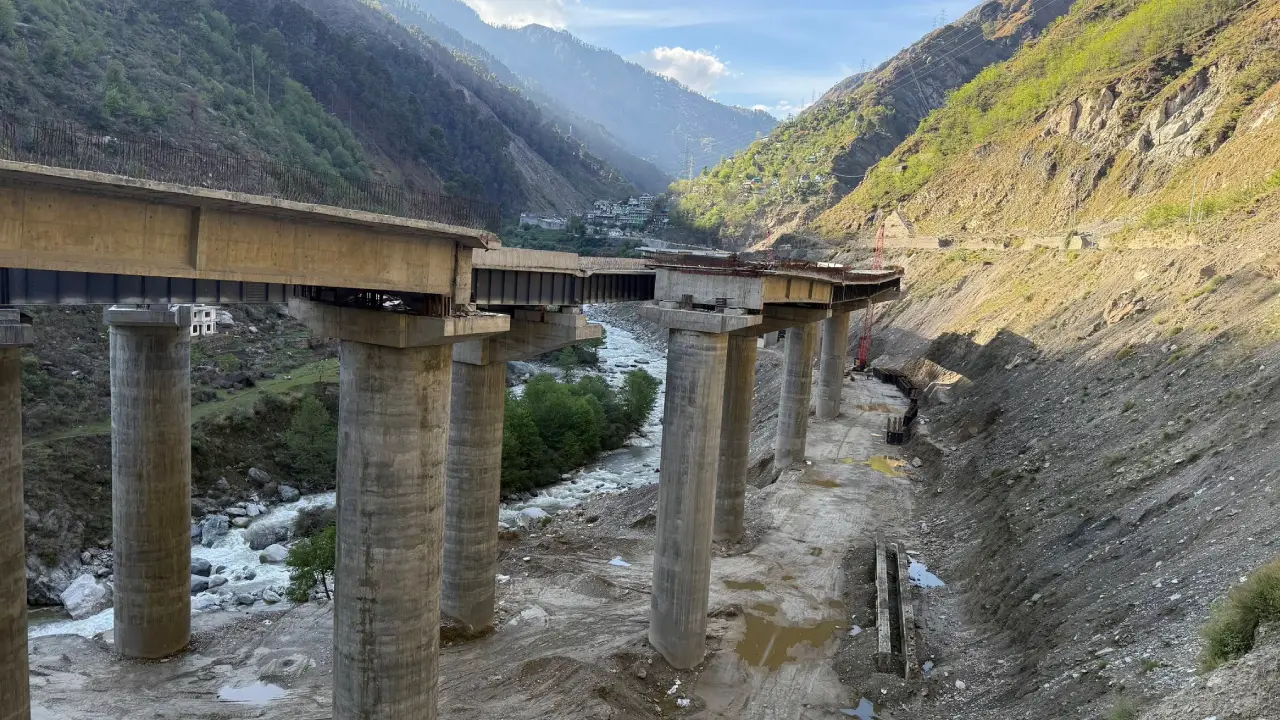
In managing the slide-prone gorges in the crisis-prone Banihal-Ramban stretch, the highway builders found no space on either of the two foothills and they used the fast-flowing river. Connecting Nachalana and Hingni, these piers are using the riverbed of Nachalana Nallah, a tributary of the Chenab and a ferocious rivulet during the monsoon. Now, for many kilometres, there are giant piers on which the traffic will move in a few months. It is not immediately known if the ecological consequences of this stretch have been fairly evaluated.
In mountainous districts such as Kupwara, Ramban, Doda and Kishtwar, where steep terrain leaves few alternative alignments, road construction frequently requires blasting slopes and clearing dense forest corridors. The resulting fragmentation not only removes tree cover but also breaks continuous forest habitats into narrow strips, accelerating erosion and destabilising fragile Himalayan slopes.

Data from the Jammu and Kashmir Forest Department reveals the scale of forest diversion linked to strategic road construction by the BRO. The data covers 50 projects requiring forest clearance, of which 28 have already received final diversion orders, six have in-principle approvals, six are under process, and four remain pending. Recent approvals include the Dat Bridge on Keran Road (8.824 hectares), the Budhal–Mahore–Gul project (2.02 hectares) and the Asha–Cheema–Gurdaligali–Aphrawat road in Tangmarg, which alone requires 68 hectares of forest land. Additional proposals under processing include the Baghbella–Toli–Nagina road (32.45 ha), the Beripattan–Jhalas road Package I (25.61 ha) and the Kalarus–Sonapindi Gali road (49.55 ha).
The National Green Tribunal (NGT) is scrutinising large-scale environmental violations in Jammu and Kashmir, after the Union Territory government disclosed in a compliance report that over 82,000 trees were felled across 145-154 infrastructure projects without fulfilling mandatory compensatory afforestation requirements under the Forest (Conservation) Act, 1980.

Already, the destruction of the Sukhnag River in Budgam is being investigated by the NGT. Authorities had given permission to a road construction company that was building the Ring Road for river bed mining. After years of over-exploitation, the river started behaving badly and impacting the livelihoods around it. The case was taken up with the NGT.
The primary investigations by the NGT experts have suggested serious compromises that have impacted almost everything the Sukhnag was all about. Only last week, a team visited the impacted water body and is making assessments. Once the final report comes, the impact of over-exploitation will be formally known. The NGT, most likely, will impose costs on the contractor and the government functionaries for their lackadaisical behaviour. But the penalty is unlikely to help the river regain its pre-2019 life.
Even the Jammu Ring Road is not tension-free. Since it moves through a geologically fragile zone, the large-scale excavation, tunnelling, and slope cutting have disturbed the natural stability of the terrain, making it highly vulnerable to subsidence and landslides. Homes are watching the impact helplessly. Continuous vibrations from construction activity appear to have weakened already fragile rock formations, altering sub-surface structures and disrupting natural drainage patterns, which in turn intensified the impact of heavy rainfall.