A court order freed an MLA. Another gave an MP a week with his dying father. Kashmir’s jailed lawmakers made headlines for all the right reasons, reports Babra Wani
There is a particular cruelty in imprisoning a politician. Their constituency does not pause. Roads still crack, hospitals still close, and, in certain cases, children still go without teachers. Life accumulates grievances, but the person elected to carry them forward is behind a door that only a court can open.
In the first week of May 2026, Kashmir watched two of those doors move, one swung open, one barely ajar. Mehraj Din Malik, MLA from Doda and president of the Aam Aadmi Party’s Jammu and Kashmir unit, walked free after eight months of detention under the Public Safety Act. And Sheikh Abdul Rasheed, better known as Engineer Rashid, the Baramulla MP who has been lodged in Tihar Jail since August 2019, was granted a single week’s interim bail, to sit beside a critically ill father at SMHS Hospital in Srinagar.
The Breaking of Locks
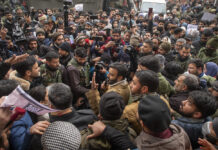
On April 27, the High Court of Jammu and Kashmir and Ladakh quashed the PSA detention of Malik. By the following morning, he was out. What followed in Doda was the kind of scene that cameras love, and administrations dread: garlands, sweets distributed in the streets, slogans rising above the crowd.
“Jail ke taale toot gaye, Mehraj Sahab choot gaye” (the prison locks have been broken, and Mehraj Sahib has been released) rang through the town. People who had watched his arrest in September 2025 with anxiety now wept with relief. “Mehraj bhai is our aan, baan, shaan,” said one resident, using the Urdu phrase for pride and honour. “His release is our victory. He is our heart, our lion.”
It was an emotional homecoming. But it was also a legal verdict with sharp edges, a High Court ruling that cut through the reasoning of an entire administration and found it wanting.
What Courts Found?
The District Magistrate of Doda had ordered Malik’s detention on September 8, 2025, citing activities allegedly prejudicial to the maintenance of public order. Against him stood a formidable-looking file: 18 FIRs and 16 Daily Diary Reports (DDR) accumulated between 2014 and 2025. Among the specific allegations was a particularly striking incident, the accused’s forcible seizure of medical equipment from a health facility, including life-saving drugs, and the obstruction of officials in the course of their duties. Authorities treated this not as an isolated event but as evidence of a deliberate and sustained pattern of defiance.
The High Court examined all of this carefully and then dismantled it, piece by piece.
The central flaw, the Court found, was that the authorities had failed to establish a genuine threat to public order, which is a legally distinct and far higher threshold than mere law and order. Individual confrontations with officials, however serious, do not automatically threaten the community at large. The distinction is not semantic. Public order speaks to the broad fabric of civil life; law and order concern individual acts and their consequences. The PSA, a preventive detention law meant for imminent, large-scale threats, had, in the Court’s assessment, been deployed for the wrong category of problem, the court observed.
The Court also found no “live and proximate link” between the incidents on record and the threat that supposedly necessitated preventive detention in September 2025. Many of the FIRs were old. The DDRs, being preliminary police entries rather than formal cases, could not alone justify invoking a law as severe as PSA. The administration, the Court concluded, had used preventive detention as a convenient substitute for ordinary criminal proceedings, investigation, trial, and bail, which is, the judgment made clear, impermissible in law.
Then came the procedural findings. The detaining authority had not applied its mind adequately: the material relied upon did not logically justify the conclusion reached. Worse, certain videos cited in the grounds of detention had never been supplied to Malik himself, denying him the ability to make an effective representation against his own imprisonment. That is a constitutional violation, and the Court treated it as one.
Taken together, the defects were fatal to the detention order. The Court quashed it.

The Man Who Walked Out
When Mehraj Malik addressed the media on his release, he did not speak the language of triumph. He spoke the language of someone who has spent eight months thinking.
“This is not merely about imprisoning a person,” he said. “This is the imprisonment of time itself.”
He reflected on the thousands he said remain behind bars, people whose families do not even know their status, who receive no visitors, who are forgotten by a system too busy to remember them. “I am deeply concerned,” he said. “When an ordinary person enters politics with the intention to serve, it unsettles those in power.”
On the youth of Jammu and Kashmir, he was blunt. Parents sacrifice to educate their children. Those children study, strive, and graduate into a valley that offers them no opportunity. “Unemployment has reached such levels that both the youth and their families are anxious,” he said. “The truly capable and intelligent people remain at home, while those who try to step forward are discouraged or labelled as unstable.”
He entered prison in one set of clothes, he noted, and came out in the same. “What difference does it make? Food is available inside the prison and outside as well. The real issue is the mindset; we must free ourselves from mental slavery.”
And then, characteristically, he turned to the cost of speaking: “When someone like me enters politics, jail becomes inevitable. That is the price of speaking out. But this fight must continue, for the people, for justice. Ideas cannot be imprisoned.”
A Verdict and a Rebuke
Chief Minister Omar Abdullah did not mince words after the High Court’s ruling. He said Malik should never have been detained under the PSA, “in fact, he should never have been detained at all.” He called the detention a “gross misuse” of the law and expressed the hope that those responsible for it would reflect on the High Court’s decision.
“I hope the people responsible for this detention learn a valuable lesson from the decision of the Hon’ble High Court and reflect on the way these laws are being abused in J&K,” Abdullah said.
It was a remarkable statement, a sitting Chief Minister publicly rebuking a detention carried out by his own administration. It signals, perhaps, that the PSA conversation in Jammu and Kashmir is not over, and that the courts may not be the only institution willing to push back.
The Other Door
If Mehraj Malik’s story is about a door opening, Engineer Rasheed’s is about a door opening only slightly, and only for the most human of reasons.
Rasheed has been in Tihar Jail since August 2019. He was arrested by the National Investigation Agency under the Unlawful Activities (Prevention) Act in connection with an alleged 2017 terror funding case. That case has wound through the courts for years. In the interim, Rasheed, heading the Awami Ittehad Party from behind bars, ran for Parliament in 2024 and won. He became the MP for Baramulla while still an undertrial prisoner.
Under special court orders, he has been permitted to attend Lok Sabha sessions, making him one of the rare parliamentarians in Indian history to exercise his legislative duties under the conditions of custody. His presence in Lok Sabha, however, “intermittent and constrained”, has been a symbol of the democratic process, of the unanswered question of his guilt or innocence, and of the strange limbo in which he exists.
This week, the Delhi High Court granted him a week’s interim bail for a purpose altogether apart from politics. His father is critically ill, undergoing treatment at SMHS Hospital in Srinagar. Senior Advocate N Hariharan, appearing for Rasheed, told the Court: “He seems to be in his last leg. He was hospitalised for a medical procedure. We never expected his father to fall ill in this fashion.”
The Court was moved. The bail was granted.
When Rasheed landed in Srinagar, he went directly from the airport to the hospital. People gathered along the route. Reports appearing in the media suggest the reunion between father and son was emotional. Rasheed did not address the media. He did not hold a press conference. His party spokesperson, Inam Un Nabi, appealed to supporters to maintain restraint: this was a humanitarian visit, not a political one.
For a man who has spent nearly seven years fighting a serious criminal case, trying to represent a constituency from inside a jail cell, and navigating the competing demands of law, politics, and family, a week at a father’s bedside is both everything and not enough.
A Valley’s Reckoning
What is interesting is that the stories of two lawmakers arrived in Kashmir, the same week. Nobody knows if it has any coincidence.
What these stories, however, explain is that the courts remain a credible check on executive power, that habeas corpus petitions are heard, that PSA orders can be examined and found wanting, and that constitutional safeguards have not entirely lost their teeth. That is not a small thing.
They also explain that the laws enabling preventive detention are still here, still being invoked, and still capable of holding elected representatives for months before courts intervene. Malik spent eight months in jail before the High Court acted. Rashid has spent nearly seven years as an undertrial. The machinery grinds slowly and unevenly.
These stories also detail that entering public life has costs. As was bluntly put by Malik: “When someone like me enters politics, jail becomes inevitable.”
Engineer Rasheed, for now, is not speaking at all. He is sitting with his father.