Omar Abdullah’s Jantar Mantar protest for statehood restoration draws criticism over timing, absent allies and an auto-rickshaw controversy, reports Babra Wani
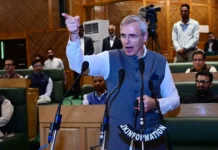
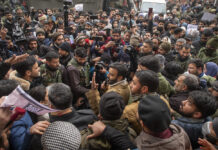
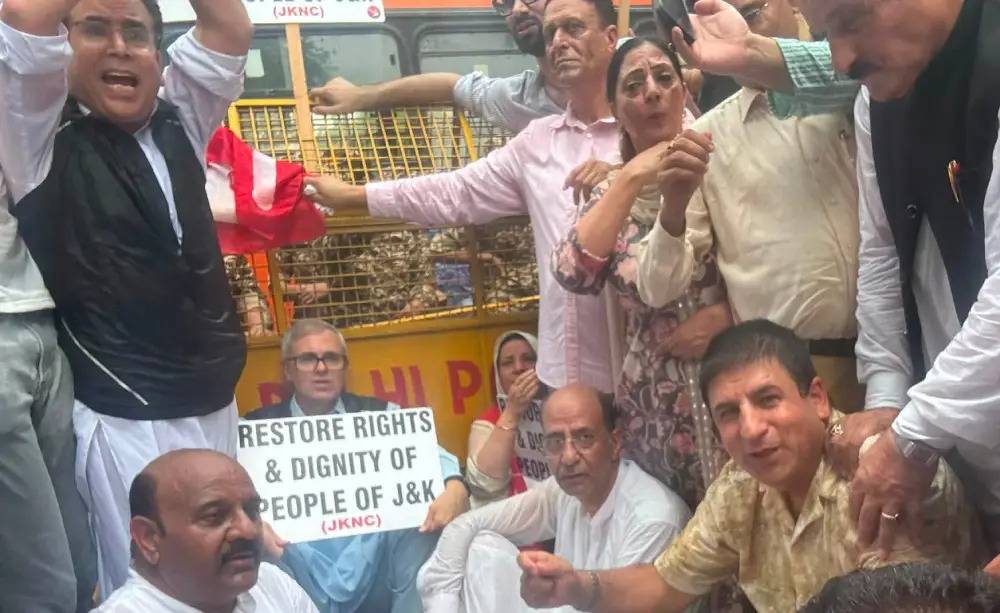
On July 20, the opening day of Parliament’s Monsoon Session, people across Jammu and Kashmir woke up to news of their leaders protesting in Delhi. The demand was the restoration of statehood. Newsrooms were already busy breaking updates by mid-morning, and through the day they closely tracked developments as photographs and videos circulated on social media showing Chief Minister Omar Abdullah, former Chief Minister Dr Farooq Abdullah, 90, Omar’s sons Zameer and Zaheer, and other ‘ruling’ National Conference leaders staging a sit-in outside Jantar Mantar.
Omar, his council of ministers, the MLAs who had accompanied him and members of the party’s women’s wing all took part, holding placards and banners through the demonstration.
Stopped, Not Silenced
At one point, the group was stopped from reaching the site altogether. Abdullah wrote about the moment on social media: “We were stopped from getting to Jantar Mantar & stopped from protesting peacefully for what is rightfully ours, but we were not silenced. This is only the beginning of our struggle for statehood, our rights, our dignity and everything that was taken away from us.”
He was later seen, along with his sons and their placards, climbing into a green-and-yellow auto-rickshaw. He shared the video himself, smiling throughout, with the caption: “My walk from Jantar Mantar was about to turn into another procession so we grabbed the first available means of transport.”
The clip spread quickly and drew its share of claims, chief among them that Omar Abdullah had travelled to Jantar Mantar itself by auto-rickshaw. A journalist present at the scene said this was inaccurate. According to this account, Abdullah boarded the auto only while leaving the protest, after members of the Cockroach Janta Party, mistaking him for their own demonstration’s leader, began raising slogans alongside him. To distance himself from that group, Abdullah stepped into the rickshaw and returned to Jammu and Kashmir House.
Abdullah himself later told reporters he had not wanted his presence associated with anything beyond his own party’s motive, and that leaving the spot had seemed the better option.
A Convenient Coincidence
The JKNC demonstration landed on a day when New Delhi was already seeing a wave of protests from opposition parties and civil society groups, adding one more mobilisation to a crowded field on the capital’s streets. Several political analysts and observers suggested Omar had used the moment to his own advantage. One observer put the question bluntly: “Why did he not protest in Srinagar? Why did he go to New Delhi?”
A day later, Omar addressed this directly at a press conference in Srinagar, insisting the party’s programme had been finalised before the Cockroach Janta Party’s Jantar Mantar protest was even announced. “Our protest for the restoration of statehood was announced well before the “Had we postponed or changed the date, the very people criticising us today would have accused us of backing down or finding an excuse to avoid the protest. That is why we decided to go ahead as scheduled,” he said.
Statehood Before 370
Abdullah also faced criticism for confining his remarks to statehood while skipping Article 370. He suggested the absence of several regional parties from the protest reflected their own political calculations. He maintained that restoring statehood had to come first, arguing that Article 370 had been designed for a state, not a Union Territory. “There is no point talking about Article 370 without first restoring statehood,” he said, adding that Article 371 had done nothing for Ladakh, where new Hill Councils had only diluted the powers of the ones already in place. He said he would not mislead the people by promising the restoration of Article 370 from the very government that had revoked it.
Asked about his pre-election promise to fight for Article 370’s return, Abdullah said the political reality had shifted, since the Centre had not restored even statehood despite repeated assurances. Regaining statehood, he said, had to remain the first objective before any further constitutional or political demand could be pursued. On why national parties had largely stayed away, he said several opposition leaders had in fact extended support: members of Akhilesh Yadav’s party, he claimed, had wanted to join but could not reach the venue because of restrictions imposed in Delhi that day, and other leaders had conveyed solidarity through separate channels.
Mufti’s Rebuttal
A day after Omar’s presser, Mehbooba Mufti held her own media interaction. She said that while restoring statehood mattered, Jammu and Kashmir’s problems went well beyond that single issue. The people, she argued, had not elected Omar solely to secure statehood but to address the region’s wider political, economic and governance concerns. She said she had urged the Chief Minister to convene an all-party meeting so that every political party could jointly decide on a shared strategy for pressing the statehood demand. “Had we all decided collectively, it would have been better,” she said.
Mufti also criticised Omar for suggesting that Article 370’s restoration was no longer realistic, accusing the party of normalising the changes of 2019. “Sheikh Mohammad Abdullah in 1975 compromised on certain things and became the chief minister, forgetting about everything,” Mehbooba said. “Now, when I see Omar Abdullah going to Jantar Mantar to protest for statehood and only talk about statehood, not even uttering a word for 370 and now claiming that bringing back Article 370 is impossible, all of this I feel he is also normalising the post-2019 situation, something what BJP also does.”
A Symbolic Protest
Eventually the event was more symbolic rather than consequential. Some of the party participants were confused that they had no clear idea that the venue would be busy and in a mess. “We had no idea,” one insider said.
JKNC lawmaker Altaf Ahmad Wani, however, said the party was aware that another protest was under way in Delhi but chose to hold its own demonstration separately. After the sit-in, the plan was to move to the Constitution Club, though barricades and restrictions kept many supporters from reaching it.
Around 500 to 600 people had been expected at the Constitution Club, but only about 100 managed to get through the roadblocks, even as some 500 protesters were present at Jantar Mantar itself. A journalist covering the event noted that Omar Abdullah could not make it to the Constitution Club either, and that only two leaders from the Communist Party of India (Marxist) were present there, with no representation from any other party.
A party functionary said that when they failed to reach the Constitution Club, they continued sitting at the venue and this helped them have interactions with the student protesters from different states. “One protester asked me who I am and why I am there and I explained things to him,” the party functionary said. “After listening to me, he took my party flag and started a protest, and his group joined us.”
Wani said the entire trip had been self-funded by the participants. All party lawmakers attended except two; one was abroad, while Aga Ruhullah Mehdi was also absent. Police barricades, he said, prevented the group from moving further, though he maintained their protest was distinct from a separate students’ demonstration happening nearby, adding, “even though their demands are genuine too.”
Wani described the significance of the protest as lying simply in demonstrating in the national capital and reminding the Centre of its unfulfilled promise. “It was a matter of shame,” he said, that the assurance had still not been honoured. Responding to criticism that an all-party delegation should have been formed instead, he said the JKNC had invited every party, and that “those who did not participate were not genuinely interested in the restoration of statehood.” He added that the party had not abandoned its demand for Article 370 and Article 35A, only that statehood needed to come first.
The Road Ahead
Wani said the party would continue its campaign if statehood was not restored and announced plans to expand the agitation through peaceful protests across districts, constituencies and local areas in Jammu and Kashmir. “We will even go to other states if we have to, to tell them about what is happening with us,” he said.
He said the protest itself had been under consideration for months before finally taking shape, with the decision made collectively at the party’s Dachigam meeting. “We wanted to work on it slowly. It was then decided in our Dachigam meet. In one voice we decided to protest for the restoration of the statehood,” he said.
A separate insider said they had to struggle in finding suitable lodging for the participants. The erstwhile Kashmir House, now Ladakh Bhawan, could accommodate a few lawmakers, however.
While most JKNC leaders, lawmakers and members accompanied the Chief Minister to Delhi, several party workers, including some lawmakers, registered their own protests in Srinagar at party headquarters. Demonstrations were held at Nawa-i-Subah, the party headquarters, as well as at district offices and other locations across the Kashmir valley, where workers raised slogans in support of statehood’s restoration.
Standing Alone
A political observer offered a blunt assessment of Abdullah’s position: “Nobody supported him.” The observer recalled that when Abdullah announced late last year that he intended to turn the demand for restoring Jammu and Kashmir’s rights into a mass movement, travelling to every district and town to build public support, the plan never materialised. That outreach, the observer said, would have laid the foundations of his mass contact on the issue.
“Today, Omar does not have the support of most political parties. Instead, many of them are opposed to his politics and his approach, including some of his elected people,” the observer said. “The National Congress skipped participation, unlike the party’s Jammu and Kashmir unit. They might have also skipped, but the party’s Jammu and Kashmir unit exists in the assembly because of JKNC. It is already rooted out in Jammu.