Kashmir’s deepest lake, Manasbal, faces severe bacterial contamination, a new CPCB report reveals, threatening drinking water for thousands and the livelihoods of shikara operators and fishermen dependent on its waters, Asrar Syeed reports
For 21-year-old Irfan Ahmed, mornings began early on the shores of Manasbal Lake in Central Kashmir. Irfan watched his father, Ghulam Ahmed, row a shikara through the lake since childhood, ferrying tourists to spots framed by greenery and silence.
“I did not know one day my life would be the same as my father,” Ahmed said. After finishing school in the 8th standard, family responsibilities grew. Irfan left his studies and took up his father’s trade. “Amid this silence, countless struggles are buried; everyone you see here has a story.”
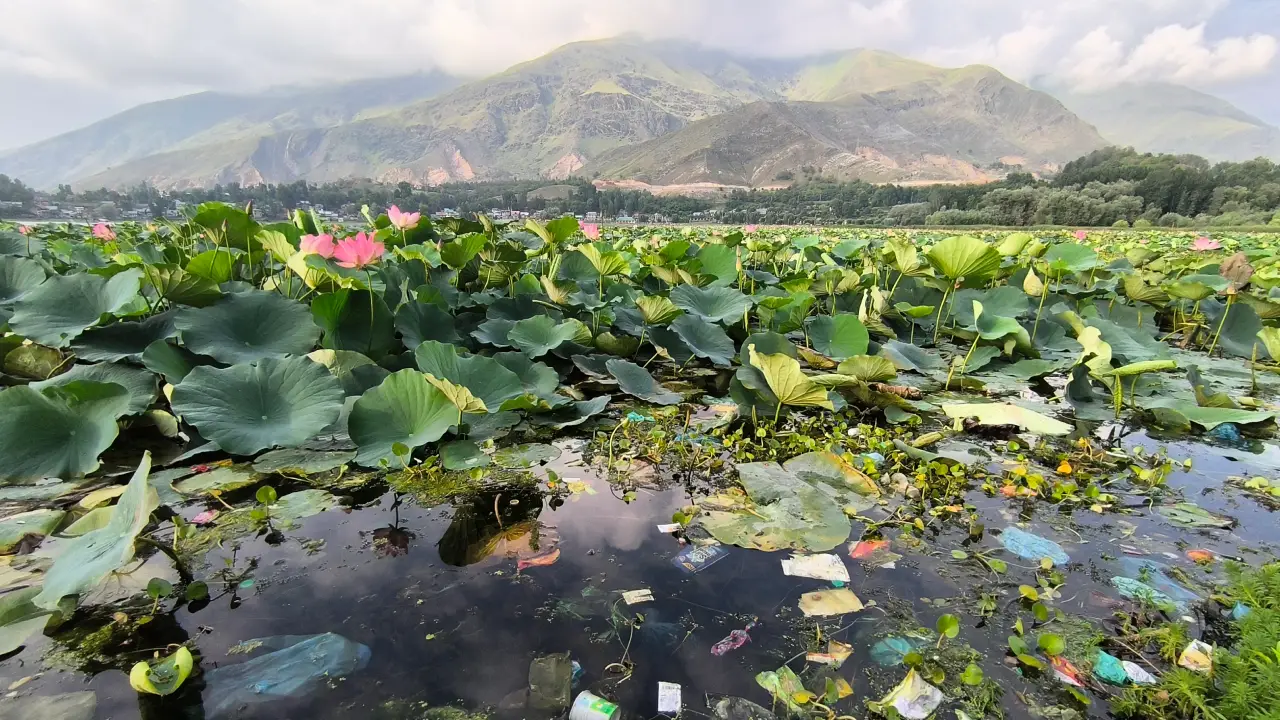
Almost 30 km away from Srinagar, Manasbal Lake is Kashmir’s deepest lake, with depths reaching 35 to 40 feet in places. The road towards Safapora in Ganderbal district reveals the lake slowly, wide and picturesque, ringed by green cover and mighty mountains. Residents said Manasbal’s waters remain clearer than those of Dal Lake and Wullar Lake, Kashmir’s other well-known water bodies. But recent headlines tell a different story. A new report from the Central Pollution Control Board has revealed widespread contamination.
Report Findings
The Central Pollution Control Board sampled the lake on April 4, 2026, acting on directions from the National Green Tribunal. The tribunal’s order followed a case filed by Kashmir’s environmentalist, Dr Raja Muzaffar Bhat. CPCB scientists then inspected Manasbal alongside officials from the Jammu and Kashmir Pollution Control Committee and the Manasbal Development Authority. Seven samples were drawn from four points in the lake, two natural springs along its edge, and the Lar Canal, which flows directly into the water.
The results were stark. The water was found highly contaminated, with significant microbiological presence. Of the seven samples, four from the lake itself and one from the Lar Canal fell into Class D, fit only for wildlife and fisheries under the CPCB’s Designated Best Use criteria. One sample reached Class C, still unsafe even for outdoor bathing. The last sample fell outside any recognised class.
Faecal coliform and total coliform readings, both markers of contamination, told a troubling tale. Faecal coliform bacteria live largely in the intestines of humans and warm-blooded animals. Total coliforms form a broader bacterial group, found across the wider environment. Near Kondabal, faecal coliform reached 780 MPN and total coliform hit 35,000 MPN per 100ml. At the Lar Canal, faecal coliform stood at 2,200 and total coliform at 22,000 MPN per 100ml. The temple spring recorded 1,100 faecal coliform and 1,700 total coliform per 100ml. A second spring showed 400 faecal coliform and 1,700 total coliform. Only the municipal extraction point recorded lower figures: 45 faecal coliform and 380 total coliform per 100ml.
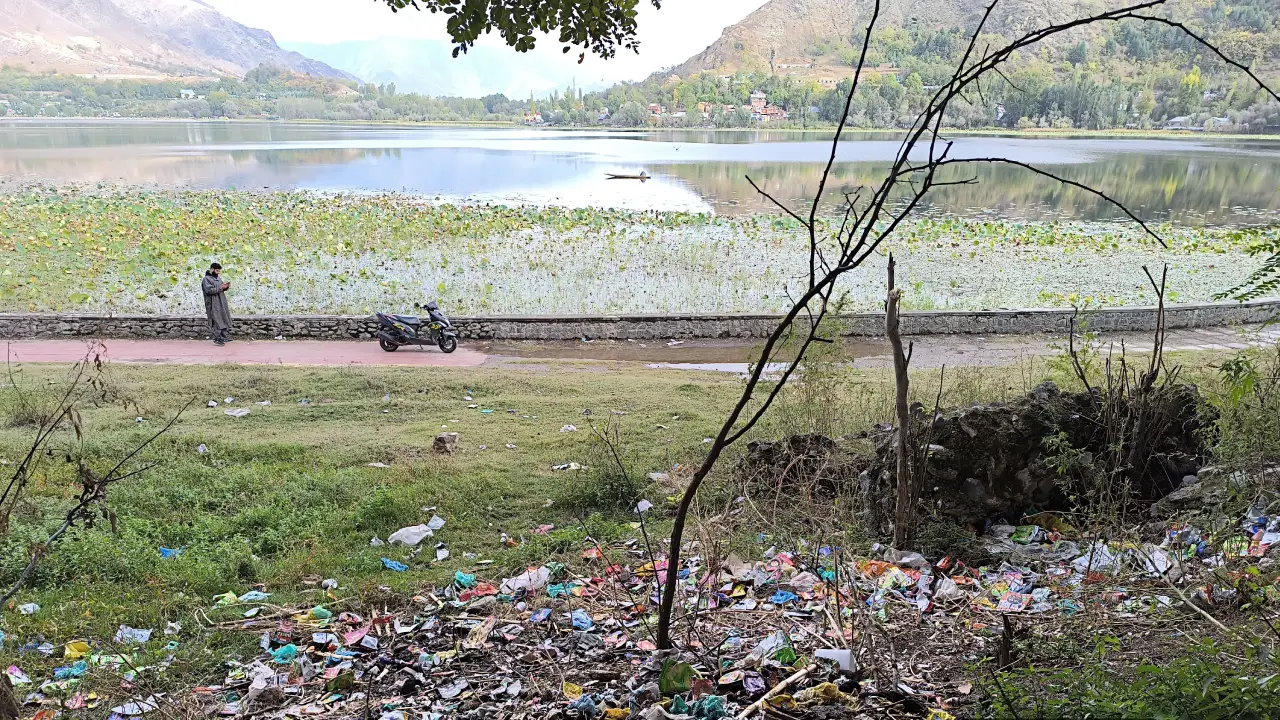
These numbers, according to the CPCB, point to clear microbiological contamination. During the inspection, the team also found plastic waste and municipal rubbish dumped directly at the lake site. Suhail Khan, a resident from Safapora who has spent years highlighting the lake’s pollution, agrees. “Grey water, agricultural runoff, and plastic materials harm the water quality and the lake to a great extent,” he said.
Photographs obtained by Kashmir Life show plastic floating on the surface, small dumping sites along the shores, and waste pipes flowing straight into the lake. “Since 2018, our group has been trying to create awareness regarding the rising pollution in Manasbal lake. We submitted photographs depicting the sources of pollution in the High Court, the National Green Tribunal or even at the awareness programs, but things haven’t improved to that extent,” Khan informed. “If I talk about our area, which is Safapora, it has become an epicentre of Cancer disease. People in Safapora mostly secure their drinking water from this lake, and I personally believe this polluted water is one of the reasons for these rising cancer rates.”
Water quality is judged on physical, chemical and biological grounds. Physical checks cover turbidity, odour, colour and floating matter. Chemical tests measure dissolved oxygen, nutrient overload and pH levels. Biological checks examine indicator bacteria and harmful algal blooms.
According to the report, high faecal and total coliform levels carry a clear meaning. Total coliform points to surface runoff and outside contaminants breaching the lake. Faecal coliform confirms raw sewage and animal waste reaching the water.
Dr Raja Muzaffar Bhat explained the scale of the problem. “Manasbal’s water is supplied to almost 30 to 40 thousand people outside of Manasbal; drains and garbage flow directly into the Manasbal water,” he said. “Contaminated water is being supplied to common people. Although the water supply management applies bleaching powder and pigmentation to this water, how effective can both be against the pollution levels shown in the CPCB report? Even using bleaching powder excessively on the water can also prove to be harmful at times.” Bhat called the situation “alarming”.
Pollution Sources
Suhail and Irfan both point to the Lar Canal as a major source of the problem. The canal irrigates agricultural land across Safapora and Asham, part of Sonawari. Residents allege it carries untreated sewage, household greywater and solid waste straight into the lake.
“This Lar canal, which flows through Bourusa and later through Koutar Mohalla, irrigates the agricultural area from Asham and a few parts of Sonawari area; one of its escape channels directly flows into Manasbal Lake at two points,” a resident explained. “This escape channel washes down with it medicinal bottles, plastic, and garbage in unlimited amounts, and all this directly flows into the Lake. Besides, organic matter like pesticides and fertilisers used in the agricultural lands flows along with it.”
Irfan and other residents, most dependent on the lake for their livelihood, agree the canal has become a major pollution source, alongside areas such as Kondbal, Hanji Mohalla and Rather Mohalla.
“Household grey water, sewage water and municipal waste flowing from these nearby areas have definitely polluted both the lake and water quality, but overall, Manasbal Lake, in comparison to Dal Lake and Wullar Lake, isn’t that much polluted; it still can be saved,” Irfan said.
Government Response
The Wullar Manasbal Development Authority told the CPCB it had taken steps to protect the lake. Dredging resumed after a gap of 12 years, covering nearly 70,000 square feet. By March 2026, 1.60 lakh square metres of surface area had been cleared. Weed removal cost Rs 22 lakh during 2025 to 26.
Residents said these steps have made little visible difference. Pollution along the lake’s edges keeps rising, they say, and plastic waste inside the water keeps growing.
Sajjad Naqshbandi heads the Social Concern Group Manasbal, which has raised awareness about the lake’s pollution for 15 years. His frustration runs deep. “We have visited so many government offices and requested the officials concerned with the management and development of the lake to take serious measures to stop this pollution and implement a proper mechanism of waste management around the Lake,” he said. “Unfortunately, not much has been done; government negligence is completely visible on the ground.”. He fears Manasbal could soon suffer the fate of Dal Lake and Wullar.
“The Lar Canal, which flows directly into Manasbal lake, is full of plastic materials, sewage, silt and household greywater; all this pollutes the Manasbal waters excessively, and later the same water is supplied as drinking water to so many areas, no matter what purification processes are carried out before supplying the water, but to what extent would those processes purify water which is polluted with so many pollutants,” Naqshbandi added. “CEO WMDA Ehsan Sahab is someone who has been highly cooperative and has given so many assurances, but in the end the responsibility falls on the government, who seem to be sleeping until Manasbal smells like Dal Lake.”
A study published in Taylor and Francis, Water Quality Assessment of Manasbal Lake in Kashmir, backs these concerns. It found that pollution from human activity is linked to several factors. Kondabal and Hanji Mohalla emerged as the most disturbed sites, owing to nearby human settlement. The study also flagged illegal encroachment and a shrinking lake area as pressing concerns.
Livelihood Crisis
Ghulam Rasool Kalloo, aged 65, has watched Manasbal turn into a silent lake over the decades. He fears the pollution reports will only worsen local livelihoods.
“Most of the residents living in the nearby areas are completely dependent on this lake for their livelihood,” Kalloo said. “Earlier, it used to sustain their livelihood by fishing, but over the years, when the nearby park was constructed and the beautification of the lake was done by the government, many people thought this could be an opportunity to switch towards tourism-related business activities, but all of such thoughts have been proven wrong. This lake is the least promoted tourist destination,” he said.
Most of the people had fishing as their main occupation, and when the catch dwindled, they tried their luck with tourism-related things. Now they regret that it is also in decline.
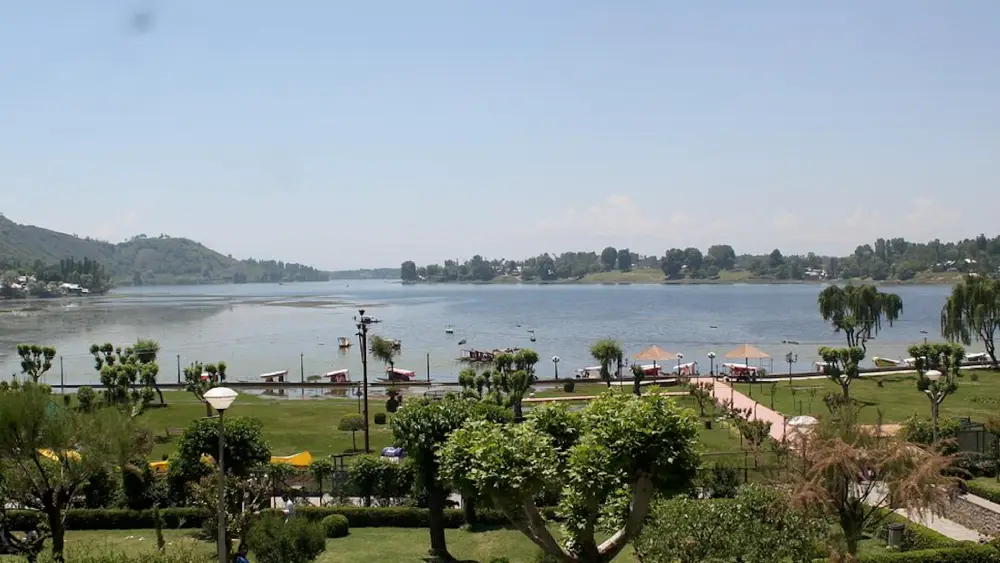
The lake is framed by green mountains, trekking routes and the Mughal-era Jharoka Bagh garden nearby. It also offers shikara rides. Yet operators report very low visitor numbers. Mostly locals visit at weekends. Many young men in the surrounding villages, who once left school under family pressure, bought shikaras hoping for a livelihood. Now they report thin earnings, most of it spent on maintaining the boats.
The shikara operators at Manasbal have built a system of shared earnings to survive. “Here at this Shikara Ghat in Manasbal Lake we have a unique system of sharing our earnings in the evening,” said Abdul Salam, 70, a native of Manasbal, who spends his days waiting for customers on the ghat. “In the evening, when all of us start closing down the ghat, all of us hand over our daily earnings to the head of our group and no matter the amount, it is distributed among all of the Shikara Walas. Mostly, the earnings are from 3 to 4 Shikara Wala’s because, due to low tourist footfall, not everyone gets their turn.”
Irfan Ahmed carries deep regret over leaving school, and worries for his family’s future given the low earnings. “My father had grown old, and also sometimes he used to fall sick due to old age, so after seeing all of that I decided to leave studies and join him on the Ghat,” he said. “I rented a Shikara from a neighbour and started spending my days on this ghat waiting for customers, but none arrived on most of the days. Last week the tourist footfall was the lowest; after calculating everything such as rent and maintenance, I made a profit of Rs 20; it isn’t enough for a cup of tea.”
The Jharoka Bagh garden, just metres from the main ghat, stands mostly empty despite its upkeep. “We spend hours maintaining this garden; even you can see right now, in this scorching heat, our staff members are busy with garden work,” said a low-ranking official mandated to maintain the space. “It seems the government is not very interested in the promotion of this lake.”