Newer hotels are swallowing Pahalgam’s riverbanks and mountains, and residents allege politics is shielding violators from a Master Plan meant to protect the hill station, reports Babra Wani
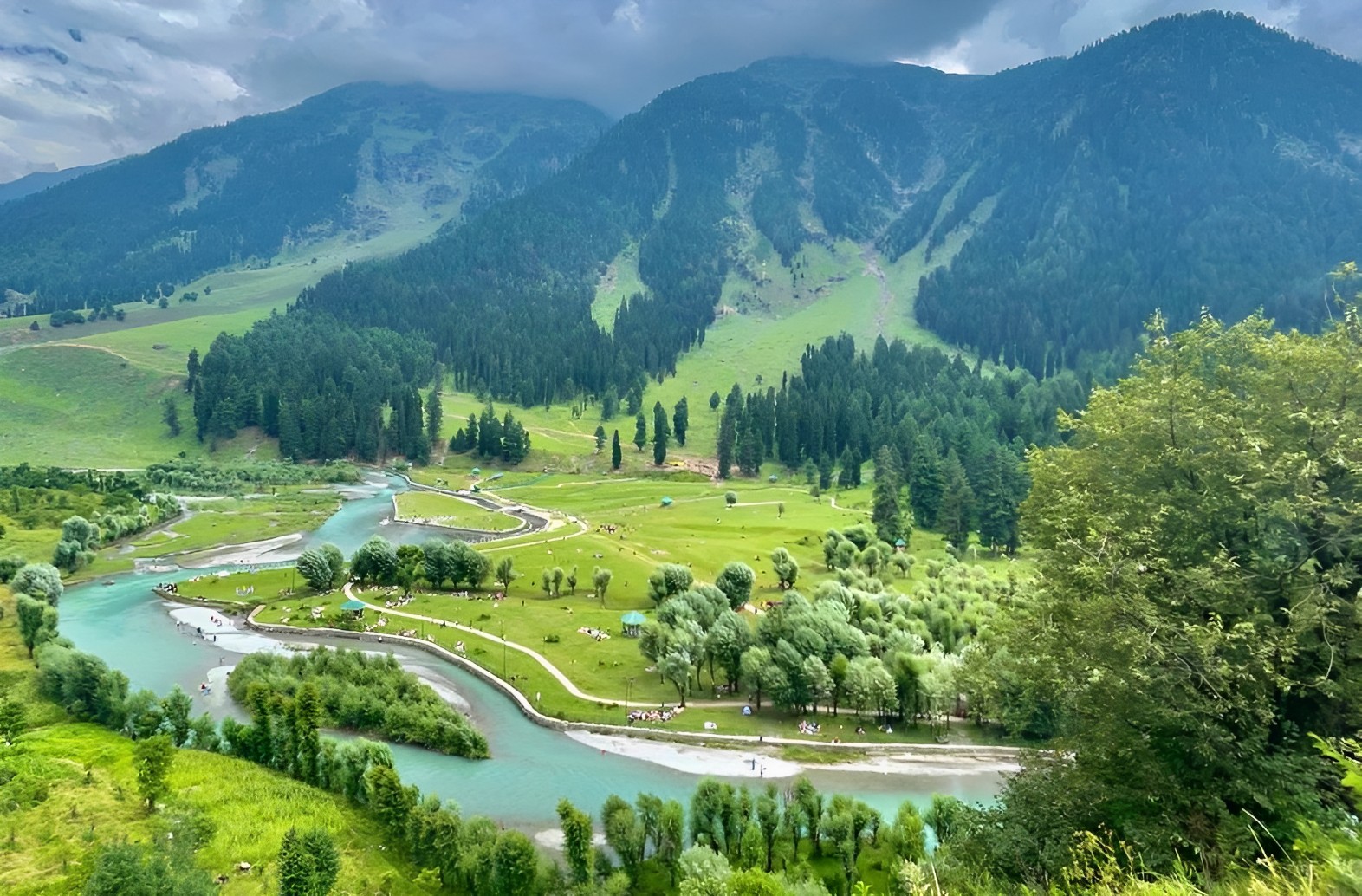
Saima, a Pahalgam resident, was travelling back to her native village after being away for four years. During the drive, childhood memories returned. She recalled how, as a child, she used to look at the two banks of the Lidder and announce to schoolmates, “right side se mera nanihaal hai aur left side mera dadihaal hai“, (my paternal home is on the left bank, my maternal home is on the right).
“I remember whenever we used to go on a picnic in Pahalgam, I always told my schoolmates this,” said Saima, who has lived and studied in Srinagar. “But this journey is different. There are constructions on both sides of the river that I do not recall from my childhood. And I just realised most of them must be illegal. It is sad, seeing Pahalgam, my home, turn into concrete.”
Anger Rises
Angst, anger, desperation and helplessness. These are the emotions hotel owners and residents of Pahalgam describe. The reason, they say, is simple: illegal construction of hotels and huts is marring one of Kashmir’s most famous tourist destinations.
Since the April 2025 attack, Pahalgam has been on the road to recovery. But some stakeholders believe illegal constructions are damaging their livelihoods. “Many people who have political connections have constructed hotels, even though they require proper permissions, and that is affecting our hotel businesses,” said a local hotel owner, speaking on condition of anonymity.
Pointing at his own under-construction house, he said he had not been able to get permission to complete it. “While most of these people who are constructing their hotels illegally here are not even residents,” he said, his voice full of anger. Gesturing at a nearby white hotel in the Laripora area, he added: “That hotel over there has been constructed by a man who is related to a big man, and this is illegally constructed. He has only permission to construct 3,200 square feet, but he has constructed more than five floors, even though it does not have permission at all. And he has even cut down the mountain, which is not permissible under the Master Plan.”
He alleged the hotel owner had used every contact available to build it. “The Master Plan has seen phases of environmental impact assessments; there have been expert committees, and just because he has connections in high places, he can do anything. There are other constructions carried out by some political agents. A man has constructed a hotel on the bank of the river. If there is a Master Plan in place, why are they not adhering to it?”
He questioned the silence of the authorities. “If there is violation in the Master Plan, why are the authorities not reacting?” Residents believe that if the authorities were honest, illegal construction would not happen.
Sold Permissions
Another hotel, he said, was built by a local resident and then sold to a man from Srinagar. “The permission was granted to the resident, and he sold it to someone else.” Even the remotest villages have not been spared, he added. “There are illegal hotel constructions in Aethnadan, Rangward and other villages.”
Stakeholders say tourists often end up staying at these illegally constructed hotels because their prices are lower. “Tourists prefer staying in these hotels rather than coming to Pahalgam.”
The hotels, lodges and cottages have also kept residents on watch. “Many of them have placed CCTV cameras to monitor who is visiting the area, just to keep a watch on the people, because they know they are wrong. Overall, Pahalgam is suffering, especially the stakeholders.”
A sumo driver from the area echoed the hotel owners, saying construction in the upper villages of Pahalgam has limited activity in the main Pahalgam area.
Many hotels, another local resident said, are built where nature is harmed. “They cut the mountains. They construct on the banks of the river. It impacts the hotel owners who have genuinely sought permission for the constructions. And environmentally, it is harming a lot. Most of these hotel owners are from Srinagar.”
Back in 2010, locals filed a Public Interest Litigation in the Jammu and Kashmir High Court. The court ordered a complete ban on the construction of all commercial and residential buildings. “Even repairing was banned.”
Plan Violated
The violations of the Master Plan include cutting down mountains to make space for construction, building in plantation zones, and building on riverbanks. The Master Plan prohibits construction in non-permissible areas.
“The Master Plan bans illegal construction. Construction is permissible only in the areas designated for it, but they have carried out construction in non-permissible areas,” a local activist said.
He pointed to the Environmental Impact Assessment, which he said had identified restrictions on construction in certain areas. “The Environment Impact Assessment has been done on this. According to the Assessment, they have not been given permission, but they have got illegal construction done,” he alleged.
He stressed that the central issue was violation of the Master Plan. “The Master Plan means to preserve the hill station,” he said, explaining that the planning framework had gone through several stages. “The Master Plan was made in 2005. It was revised after that. The High Court took cognisance of it. Then a new Master Plan was made on the direction of the High Court.”
The revised plan was prepared around 2010 and finalised in 2016 or 2017. But he identified the absence of subsequent zonal plans as a major technical and administrative problem. According to him, this gap created space for construction permissions to be issued without a detailed planning framework in place.
He also pointed to the carrying capacity of Pahalgam, saying existing assessments indicated the hill station had already reached its limit. He linked excessive construction to inadequate infrastructure, particularly sewage management. “There is no STP,” he alleged, saying the absence of adequate sewage treatment was contributing to pollution.
“There is pollution everywhere. Hotels’ sewage goes into the river,” he alleged, adding that the government was not treating the hill station appropriately given its ecological vulnerability.
“But even if we go to complain to the authorities, no one will hear us. We are literally living in despair. The Pahalgam attack had already affected our businesses, and now these hotels are doing the same.”
Green Zone Breached
The Pahalgam belt, comprising all villages of Pahalgam and nearby settlements — Langalbal, Batakote, Ganeshbal, Lidroo, Sarbal, Gujraani Batakote, Mawoora, Yannar, Srechan, Ganeshpora, Jaibal, Aamad-Wagad, Veersaran, Hardi-Kichro, Khealan and others — falls under the “green zone,” meaning any construction requires permission.
According to various media reports, there are approximately 300 constructed structures in Pahalgam, including hotels, lodges and cottages. Many are built on the banks of the river Lidder and by cutting down mountains.
Malik, a resident of Batakote, alleged that large-scale constructions near water bodies and riverbanks were being carried out. He pointed to a resort in the Dachhnipora area, which he said was being built on the banks of a river in an ecologically sensitive location.
River Diverted
The construction, Malik said, had affected the natural flow of the river. “The flow of the river is diverted towards Batakote.” He claimed the river had been slightly diverted towards Batkot to protect the property. “That is also illegal. It is completely illegal,” he said, questioning why such construction was permitted in the first place.
Referring to recent cloudbursts and flash floods in the area, he alleged that encroachment and illegal construction had contributed to the flooding. “Most of the streams have been occupied by the locals. They have made roads for vehicles. That is why only half of the streams are left.” He explained that the reduction of natural channels meant floodwater no longer had sufficient space to flow through its original course.
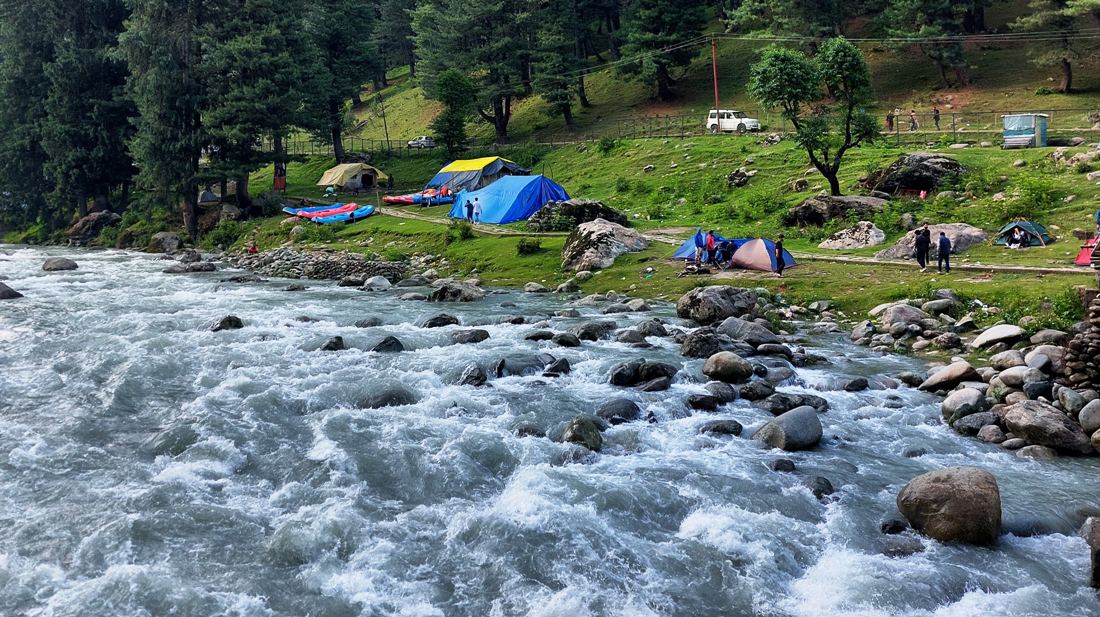
Malik alleged that construction around the rafting point and in Mawoora was illegal. “It is happening on the rafting point. It is illegal. There are so many buildings being built. Some even have seven or eight floors.”
He further alleged that the scale of construction around Overa had changed the character of the area. “There are so many complexes. The hotels look like complexes,” he said, claiming the development had damaged the surrounding landscape.
Referring to Veersaran, he said numerous buildings were coming up there too. “There are so many buildings being built. There are 50 hotels there. Who gave them permission?” He warned of the geological consequences. “If the soil erosion happens, it will all come down.”
An Explanation
According to M Saleem Beg, former Director General of Tourism in Jammu and Kashmir, not all areas of Pahalgam fall under the Master Plan. “Some of the areas do, and there you cannot construct any hotels without the permission.”
Explaining how violations are determined, he said: “The Pahalgam Development Authority, which is the authority controlling building permissions, has to follow the approved Master Plan. The construction zones as well as the non-construction zones are delineated throughout the area, and the authority has to follow them.”
Violations are recorded in the authority’s records and can result in demolition action. “If someone has constructed a building in a non-construction zone after it was declared as such, that is a violation of the Master Plan,” he said.
Beg emphasised the legal standing of the document. “The Master Plan is a legally protected document. It is a legally protected instrument which has to be followed by the authority at the site. This is the position of the law.”
On the purpose of non-construction zones, he said: “The basic principle is that the open spaces available should be preserved so that the natural attributes of the site are not affected. Normally, construction is discouraged in these areas.” Ecological considerations, he said, were central to the Master Plan. “Ecology is the most important thing. The amount of green space required is also one of the determining factors.”
Beg added that construction affecting natural features amounted to a violation. “Cutting down mountains is a violation. Constructing on a river bank is also a violation,” he said, noting that other laws also restricted construction near riverbanks. “There are other laws that prevent construction on river banks. In fact, I think the decision is that construction cannot be carried out within 50 metres of a river bank.”
He said designated plantation areas were protected from construction, and the relevant maps clearly identified such zones. “The map is completely delineated. In fact, they have a digitised map.”
On penalties, Beg said the first step is removal of the unauthorised construction. “The first punishment is demolition, and then there are other punishments in accordance with the law.”
When this reporter asked the officials to respond to the allegation by the residents and stakeholders, they sought details about the constructions. When photographs were sent, they refused to take calls.