Srinagar Development Authority auctioned two long-idle land parcels at Sangarmal and Batamaloo in Srinagar for Rs 726.75 crore, unlocking major hotel, retail and housing developments across the city, reports Masood Hussain
In recent history, no two parcels of government land have fetched such a price through such a transparent mechanism. Within three days in late August, the Srinagar Development Authority (SDA) closed two auctions that together generated more money for the government than any land transaction in Jammu and Kashmir’s history.
One parcel was at Sangarmal, where a shopping complex already stood but its second-phase land lay vacant. The other was at Batamaloo, once the main hub of the state’s transport sector, deserted since its buses were moved out years ago.
Together, the two auctions brought in a combined premium of Rs 726.75 crore against combined reserve prices of just Rs 220 crore. Total receipts to the Authority, premium plus recurring lease rent, are projected at around Rs 3932 crore over the life of the leases. Officials said these two deals became a landmark given the fact that the Jammu and Kashmir government leased out 150 kanals of land for Rs 23 crore at Sempora and another 160 kanals for Rs 14 crore at Gund Rakh Aksha.
The Sangarmal-Batamaloo transactions have been structured as Public Private Partnerships (PPP) requiring no Viability Gap Funding or government guarantee, and were conducted wholly online in three stages: documentary qualification, a pass-or-fail Vision and Concept presentation carrying no marks or subjective scoring, and a forward e-auction in which price alone decided the winner. Officials describe the combined outcome as the highest revenue per kanal generated by any department in Jammu and Kashmir ever.
Insiders in the government say the money could not have come at a better time. The SDA has been going through a difficult phase in its balance sheet, unable to generate the funds needed for its annual requirements. Staff strength has fallen from 382 to 140, making it harder to monitor land parcels that have long attracted the attention of land grabbers. Officials said the twin auctions will help the Authority manage its finances and its depleted staff.
Sangarmal Sale
Bidding for the 45.70 kanal Sangarmal parcel opened at 11 am on August 25, and ran through the night before finally closing at 1:48 am on August 26. The winning offer, Rs 421.75 crore, was more than 3.3 times the reserve price of Rs 125 crore, and more than double the roughly Rs 200 crore valuation officials had expected going in.
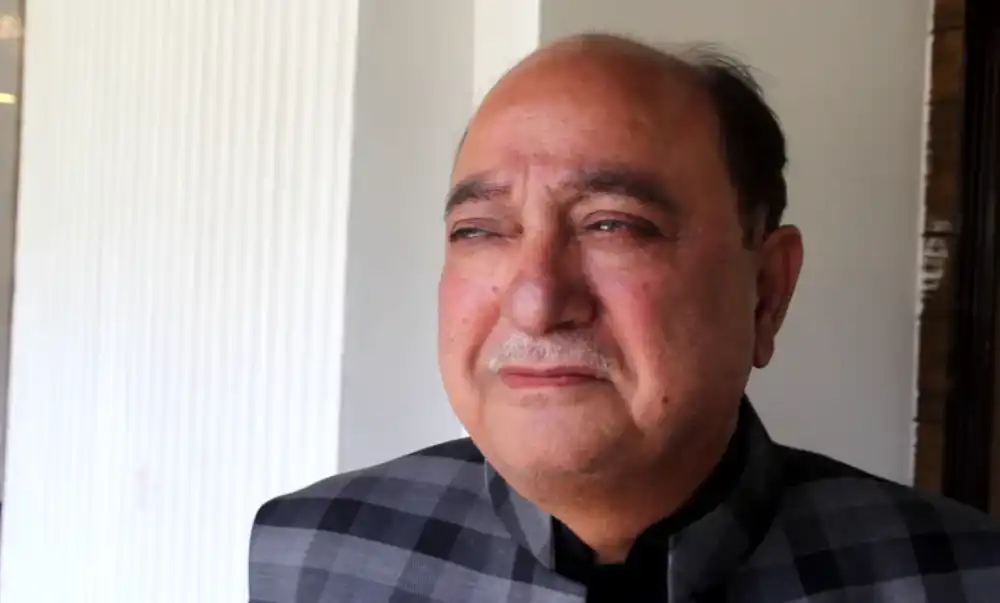
“Come what may, I had made up my mind that I would bid for it. I was ready to go for the bid at any cost,” hotelier Mushtaq Ahmad Chaya told reporters. “At around 2 am on August 26, we finally closed the bid, and we won it.” One official overseeing the auction described watching the price climb through the night as tense and said the result could signal renewed investor interest in Jammu and Kashmir. The successful bidder is Parmesh Construction Company Ltd, leading a consortium with Pahalgam Green Hotels and Bhutani Infra Ltd, with Chaya backing the project and driving its development vision.
The successful bidder is Parmesh Construction Company Ltd, leading a consortium with Pahalgam Green Hotels and Bhutani Infra Ltd, with Chaya backing the project and driving its development vision.
The 45 kanal property, offered on a full lease basis, comprises land in front of and behind the existing Sangarmal City Centre. It sits a few hundred metres behind the Kashmir Golf Course, opposite Polo View, and around a kilometre from Lal Chowk. Dal Lake is also roughly a kilometre away, while one end of the property touches Chunt Khul.
The Sangarmal project dates back to 2015, when then Chief Minister Mufti Mohammad Sayeed announced a modern commercial centre for the city. It was built with 62 shops in its main commercial module, 38 spaces in a Craft Bazaar, 11 kiosks, two food courts, a restaurant and 11 office spaces, alongside landscaped areas, fountains, parking, lifts and escalators. The expected rush of shoppers and businesses never came. Many shops stayed shut even after being allotted or purchased, and weeds gradually took over parts of the complex.
Chaya has run the Mushtaq Group of Hotels since the mid-1980s, building a presence across Jammu and Kashmir and Delhi in association with international hotel brands, and has held leadership positions in the Jammu and Kashmir Hoteliers Club. One of his key properties is just a stone’s throw from Sangarmal.
His plan for Sangarmal centres on an integrated commercial and hospitality development: a hotel, shopping spaces, banquet facilities, exclusive retail, entertainment and leisure. “My idea is to create something big for Kashmir. It should have a hotel, shops, banquets and exclusive retail spaces. I want it to be a blend of international malls and international facilities, but with the Kashmir touch,” he said.
The overall investment is expected to reach around Rs 1,000 crore, combining the Rs 421.75 crore bid with approximately Rs 650 crore in construction and development, including parking for around 5,000 vehicles.
“We want to create a destination. People should come there not only for shopping but also to spend time, eat, stay and experience something different. We want international standards, but we also want the project to reflect Kashmir,” Chaya said. He estimates the project could generate around 10,000 direct and indirect jobs. “I aim to create more jobs. We have seen years of peace, and now people should get its dividends. Investment should ultimately benefit the people of Kashmir,” he said.
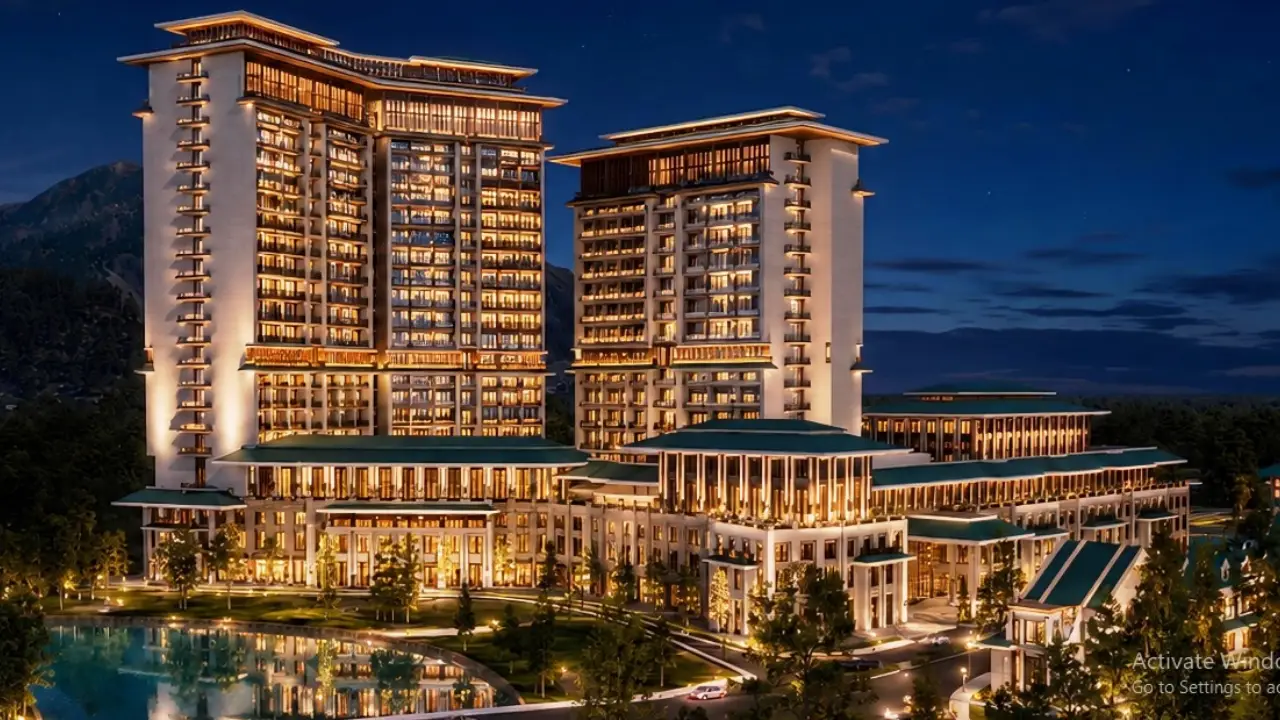
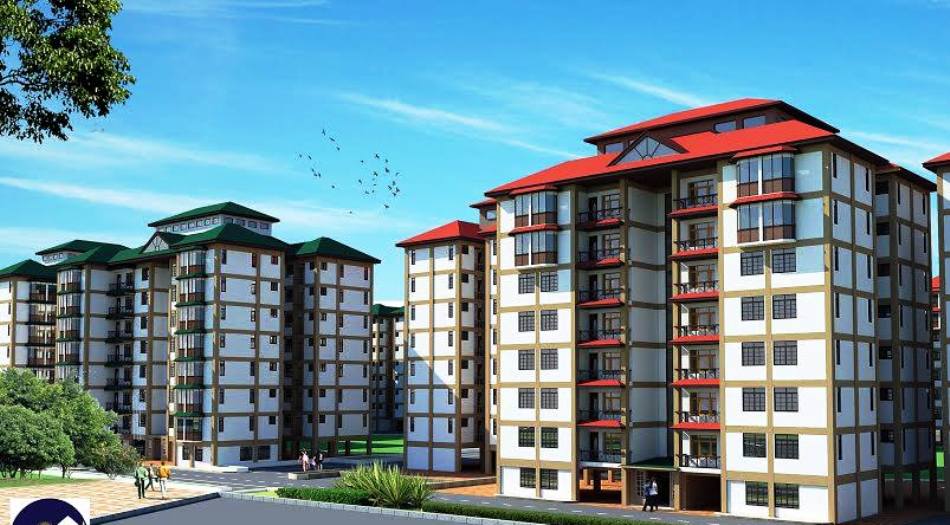
The Sangarmal parcel comprises three adjoining SDA plots: Site A (32 kanal), Site B (6.5 kanal) and Site C (7.2 kanal). The JV plans to fuse the three sites into a single mixed-use precinct called Sangarmal rather than treat them as separate schemes. Site A becomes a luxury retail and entertainment mall with a multiplex, food court and a 250+ key four-star hotel plus a 120-unit hotel suites tower.
Site B is proposed as residential apartments with stilt parking, a banquet hall and rooftop clubs, offered in two FAR options (one using only Site B’s own entitlement, the other importing surplus FAR transferred from Site C).
Site C becomes an open-air high street retail and food and beverage strip, styled as a night bazaar. Combined built-up area runs to roughly 11.8 to 12.3 lakh square metres depending on the option chosen, with basements handling most of the required parking.
Beyond built form, the proposal frames the land as an economic and civic asset for the SDA: monetising public land, creating a tourism landmark that reflects Kashmiri identity, generating an estimated 5,000-plus jobs, and building inclusive public realm. Design language draws on Mughal garden traditions: terraced gardens, water channels and chadar cascades, which are reinterpreted through a contemporary architectural vocabulary. It also targets IGBC Gold or GRIHA four-star sustainability, covering passive design, rainwater harvesting and EV readiness.
The developers also seek relaxations from SDA bye laws (higher ground coverage, reduced setbacks, FAR up to 5) and propose pedestrian underpasses and walkways linking the three sites, with delivery pitched at roughly 21 months from design approval through construction, backed by the joint venture’s completed Noida projects as a delivery record.
Batamaloo Sale
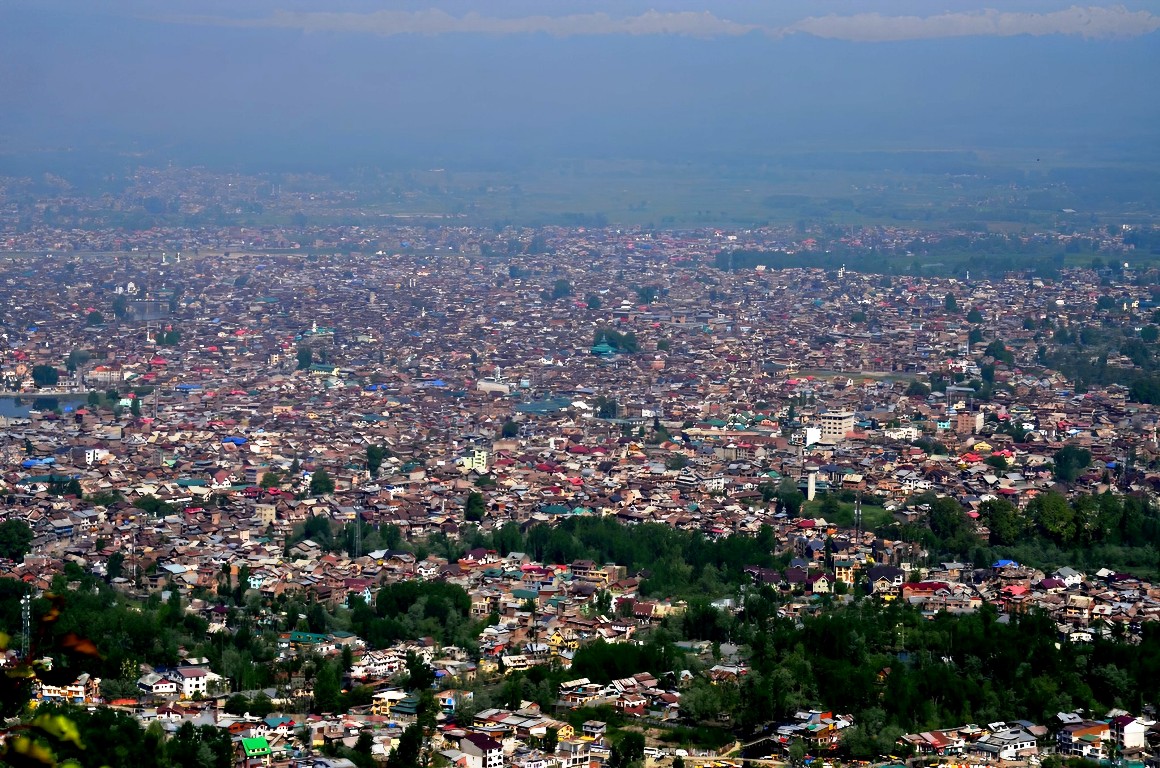
Around six kilometres from Sangarmal lies Batamaloo, once the state’s busiest bus terminal. After its southern services moved to Pantha Chowk and its northern services to Parimpora, the huge built-up space fell empty. Rights over parts of it were arbitrarily handed to roadside vendors in recent years, but a large stretch of nearly 70 kanals, about 8.75 acres, remained unused and increasingly encroached upon.
Bidding for the Batamaloo parcel opened at Rs 95 crore on August 27, and, by evening, had climbed to Rs 305 crore. The winning bidders are Manzoor & Shariq Apartments LLP, as lead member, in joint venture with Construction Engineers. The two are separate groups that came together for this bid alone. Construction Engineers is a longstanding Kashmir building company, mostly engaged in civilian construction, and has built the JK Bank headquarters among other buildings in Srinagar.
Manzoor Ahmad began as a trader before building the Residency Mall on Residency Road, where most of Srinagar’s major banks now operate, along with a hotel on the same site. He later built the City Mall on MA Road, considered one of the city’s best upmarket malls, which also houses a Sarovar Portico hotel that he runs. He has since built numerous housing towers across Srinagar uptown with nearly 200 families living in them. “My personal requirements are too modest,” Manzoor said of his decision to bid. “As this opportunity emerged, my friends came and told me to work and use my experience to help the city, so I did.” He said the Batamaloo project, together with Sangarmal, should help create around 5,000 jobs within five years and change the landscape of the city.
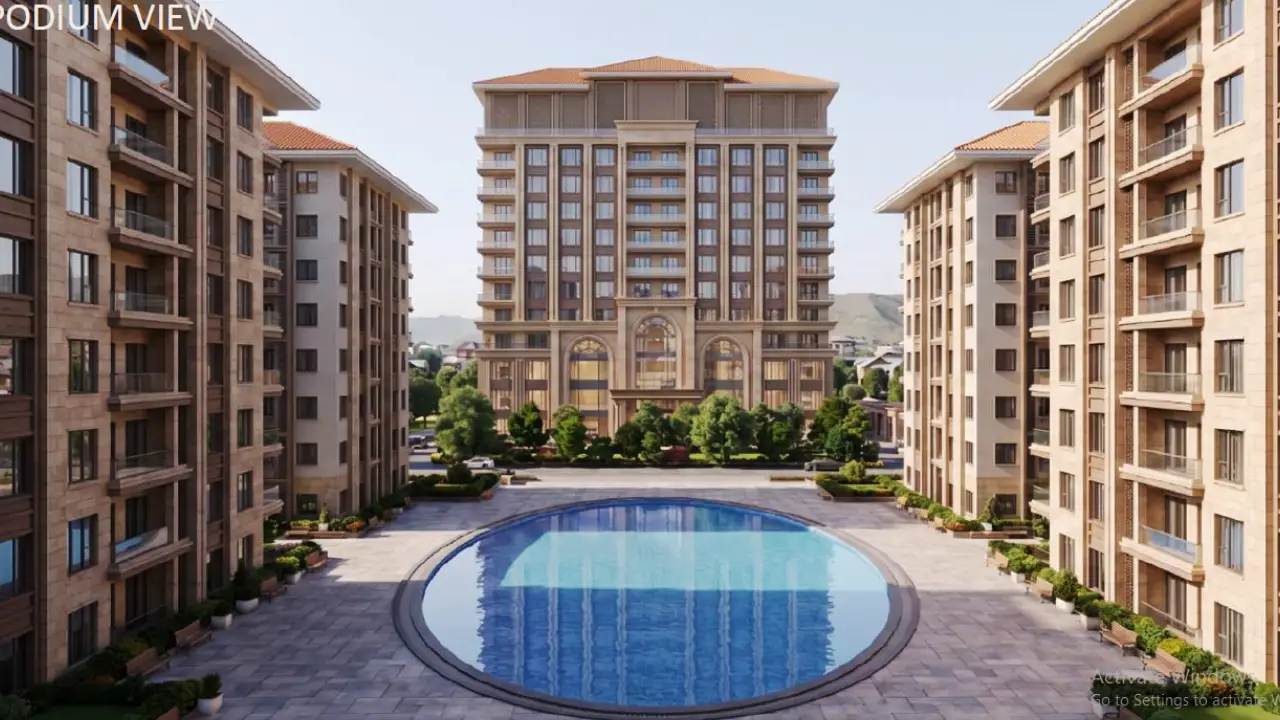
An architectural concept prepared for the site’s frontage block sets out what that change could look like. A single deliberate front block resolves the street edge, twelve storeys, roughly 60 metres by 34 metres, carrying the mixed-use programme: retail at grade, offices on the lower floors and a hotel above. A double-height atrium anchors the mall levels, with sixteen shops spread across three upper floors, escalators looping a central void, and separate lobbies for the office and hotel wings. The office floors are laid out as open-plan space with manager cabins along the facade, several meeting rooms, a boardroom and a pantry. Hotel rooms are designed around king bed layouts with full-height glazing framing mountain and valley views, alongside a separate wing of one-bedroom serviced apartments with compact kitchenettes.
Behind the frontage block, two residential towers of eight storeys each rise on a shared podium, arranged around a central oval pool and courtyard. Unit plans include three- and four-bedroom apartments, each with wide balconies, a study nook and a dresser space off the master bedroom. A two-storey club beside the pool houses a dining hall, a kids’ zone with a climbing wall and screens, and a multipurpose hall laid out for conferences or banquets. A separate twelve-storey block on the site’s secondary edge is earmarked for economically weaker section housing, described by the designers as an integrated, dignified housing volume rather than a set-apart annexe. Two basement levels provide parking, with the food court on the lower ground floor beneath the mall entrance, and a nine metre internal road runs through the site for servicing and access.
People aware of the deal said the project may witness changes as the construction starts. “What I personally believe is that it will change the landscape,” one official said. “It will be upmarket construction that will get more business to the area than it has.”
The vendors operating in the belt said they are facing a massive downturn in their earnings as the bus stand shifting triggered massive footfalls to the otherwise crowded and busy area.
Manzoor has his own vision for the spot. “If you remember, we had a wholesale market in Maharaj Gunj; it lost its significance with the passage of time,” Manzoor said. “Now, I want to create a new and modern Maharaj Gunj which will essentially be a wholesale hub on the pattern of China’s Yiwu. Ours will not be as huge, but the pattern will be the same. It will have parking for 3000 cars and spaces enough for wholesale of all kinds.” Lease money apart, Manzoor anticipates an investment of around Rs 900 crore in the project.
Deal Structure
Both leases follow the same Build Own Operate Transfer model, granted for 99 years under the Jammu and Kashmir Land Grants Act, 1960. Officials say the long tenure is necessary to make the projects bankable, allowing developers to secure financing, amortise their capital investment, and match the tenure typically adopted for large-scale infrastructure projects elsewhere.
Ten per cent of each premium is payable within 90 days of the lease deed, with the remaining 90 per cent spread across 14 equal annual instalments. The first instalment is due on the third anniversary of possession and the last on the sixteenth. The two year construction moratorium defers, but does not reduce, the amount owed, and late payment attracts interest at two per cent above the SBI MCLR.
Annual lease rent, pegged to the winning bid rather than the reserve price, begins at about Rs 4.22 crore for Sangarmal and Rs 3.05 crore for Batamaloo, escalating 15 per cent every five years and totalling an estimated Rs 1,860 crore and Rs 1,345 crore respectively over the full term, subject to a rent moratorium during construction of up to four years.
The reserve prices themselves, Rs 125 crore for Sangarmal and Rs 95 crore for Batamaloo, were set using applicable circle rates, officials associated with the exercise said. All consortia that qualified for the Sangarmal parcel took part in its final auction, with server time-stamped bid logs preserved on the portal as an audit trail.
Each selected bidder must now incorporate a Special Purpose Vehicle under the Companies Act, 2013, to execute the lease and manage the project. The transactions are secured by a performance guarantee worth five per cent of the premium, a lock-in on the lead consortium member, and default consequences under which arrears are recoverable as land revenue, with audit oversight that includes the Comptroller and Auditor General. All construction, financing and operating risk rests with the developers, while ownership of both parcels remains with the Authority throughout.
Two earlier attempts to monetise the same land, including Batamaloo and Sangarmal among six parcels identified in December 2024 and again in January and February 2025, yielded no results. This time, officials said, the structure has worked, unlocking the value of two of the city’s most visible idle properties and setting both on course for redevelopment within the decade.