After Nepal’s August 26 flash flood along the Bhote Koshi River, survivors in Kathmandu shelters mourn missing kin, await DNA confirmation, and rebuild through grief counselling, mass burials, and quiet hope, reports Bishnu Pokharel
On September 5, 2026, small groups of five people gathered near the front gate of a Buddhist monastery named Mustang Gumba in the foothills of Kathmandu’s famous Buddhist temple, Swayambhu Nath. They sat on plastic chairs in front of a light-yellow plastic table, donated by some kind-hearted people. For five days, Mustang Gumba became their shelter, where they started a discussion about a stamp.
Most of them wanted to put the phrase Himali Tsunami on their organisation’s stamp, but one person was a bit hesitant. He argued that since Tsunami refers to the sea or ocean, and the Himalayan range has neither, it would not fit.
“People may not understand what we are going to talk about since there is not a popular phrase as such,” he tried to convince his comrades. But others tried to convince him, saying, “This catastrophic occurrence amounts to the word Tsunami, and with this word we can draw the attention of the world.”
After discussing for a while, they decided to put this phrase in their organisation’s name and stamp. They formed an organisation and named it Himali Tsunami and Flood Victims Management Committee.
At midday, as they decided on the organisation and its stamp, they seemed normal, like any ordinary people. But they were not. They were the Himalayan flood victims from the Rasuwa district of Nepal, which borders Tibet, a Chinese autonomous region. After the devastating flash flood on August 26, 2026, all participants in this discussion lost at least one close family member, lost their home, and almost everything they had earned in their lives.
In a state of grief, mourning, and an uncertain future, they were trying to unite all the victims of their village and rebuild it again with the hope of a better future. “I am still in the bereavement phase and could not believe yet that my mother is not with us,” Chhesang Thokra from the Gosaikunda Rural Village Municipality said, who was reluctant to put Himali Tsunami on the organisation’s letterhead and stamp. “But due to social responsibility and for the wider common cause, we are doing our best here.” When he talked about his misery and sorrow, the group had already decided that he would be the secretary of the committee.
It was a bit cloudy midday in the valley; in front of their table stood the Mustang monastery’s main hall, where almost 300 flood victims like Thokra were sheltered. To the left of their table was a small hut where some youths were helping the survivors and visitors. Next to that hut, a small room was dedicated to prayers, where the victims’ families used to go and light a lamp, remembering their loved ones. Further on the same side, a couple of chairs were kept for the victims and visitors under a tent, and in front of that, another tent was dedicated to the victims’ primary health check-ups.
It was the 11th day of the devastating flood in the Bhote Koshi River, which had almost washed away main cities on the banks of the Trisuli River up to hundreds of kilometres away, and the search and rescue effort was ongoing. Thousands of security forces were deployed in the field, and they were recovering dead bodies from the mud and rubble of the flood. Surprisingly, a miracle was happening: on the same day, two people, one from inside a hydropower tunnel in Rasuwa district and another from a house under mud in Betravati village of Nuwakot, were found by security forces.
Orphaned Children
In the temporary shelter home, the Mustang Monastery, many children were playing soccer with the volunteers. It was almost impossible to keep them out of the frame when videos and photos of elderly victims were taken. As a universal practice, consent from their parents is needed since they were under 18. When asked about parents, volunteers explained the situation: “They are among those who lost all their elderly family members, including both parents.”
During the flash flood, they were at the nearby school or in the capital city, Kathmandu, in boarding school hostels as resident students. “In this shelter, there are a total of 27 children who do not have parents, and they are between 4 and 18 years old,” Tchheten Dolma Gale, a volunteer coordinator who is also from the same village and whose parents are among the victims, said. “Since they don’t have parents, now we have to take care of them as their parents,” she explained.
When the Himali Tsunami discussion wrapped up, the newly appointed vice chairperson, Dorje Tamang, started calling a lawyer for the formality of registering the organisation. The lawyer couldn’t be reached, and meanwhile a health worker came and handed him her mobile phone. Somebody was on the call, and he asked her, in sign language, who was on the call. She replied, “An official from the health ministry.” Dorje explained that they needed a dedicated physician for the shelter home, since survivors and victims were traumatised and people were falling sick time and again.
While he was on the phone, two people waited for his answer on how they could donate for flood-affected people in the shelter home. “Now we don’t need more food, water, and clothes, but we need support for the rehabilitation,” he politely replied.
Losing Father
On August 26, Dorje was at his house in Gosaikunda Village Municipality-2, Timure, in Rasuwa district of Nepal. He was enjoying breakfast in the morning sun. Suddenly, neighbours started shouting and running towards the upper hill from the village. His father was also with him, but his mother had gone to the neighbour’s home. When he realised a flood was coming, he and his father started running too. Somehow, he managed to climb the mountain and reached a safe place a few hundred metres high, but his father could not make it.
“In front of my eyes, my father was washed away,” he recalls with tears in his eyes. He was unaware of his mother’s whereabouts, but later on he discovered that she somehow managed to reach the safe place with neighbours. Immediately after the flood, he and his neighbours started searching for the villagers, including his father. A couple of hundred metres away, they found his father’s dead body.
“The next day I cremated my father’s body and waited for rescue from there,” he recalls. They spent almost 24 hours under the sky in the jungle, and the next day the army helicopter rescued him. The helicopter dropped them at Bidur, the capital of Nuwakot, a southern district of Rasuwa that was also heavily affected by the flood. “After that, we got a microbus and came to Kathmandu Valley. I could not find any place to live, so other rescued villagers and I called some known people in the Gumbas, they offered shelter, and we went there.”
First, they were kept at Yellow Gumba and later shifted to the Mustang Gumba. But after losing his father, house, and land, he has been active in voluntary work since the beginning. “I am in pain, but others are also in pain, so I decided to help everybody,” he said. Even in deep sorrow and grief, he considers himself lucky among so many others. “At least we found our father’s dead body, and we could cremate him properly, but 197 people from our village are still missing; nobody hopes they are alive, but family members could not even find the dead body.”
Awaiting Confirmation
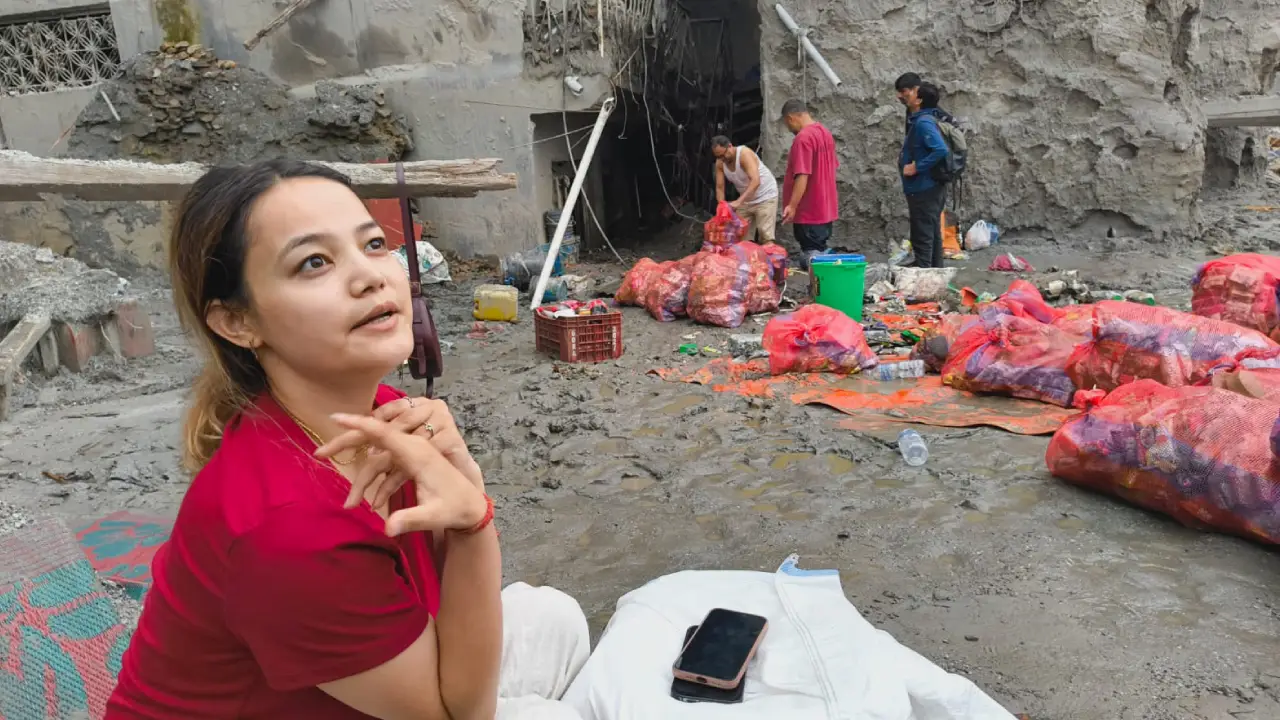
Chhesang also belongs to the same place, but he was in the capital city, Kathmandu, when the flood came. His mother and elder sisters were there, and they are still missing. “One of my friends called me and gave me information regarding the flood. I was too panicked and tried to call my mother and sister; the network was not reachable,” he recalls that day. “After a while, I saw a viral video on social media, where I saw that my own house was drowned by the mud and water. I realised nothing was left, not my mother, not my property.”
He wanted to go to the village and be involved in the search for his mother. He, along with some friends, decided to go to the village by chartered helicopter. Since all helicopters were busy with rescue and search operations, and the government was not allowing helicopter operations without prior permission, they could not make it.
With the information from villagers and local government officials, he was convinced that his mother was not alive and they had already started their mourning rituals according to the Buddhist religious practices. “It is an unimaginable situation; we are bound to grieve and mourn and follow rituals without getting the dead body of our loved ones,” he said with tears in his eyes. “This is the responsibility of the government; they have to give information about the deceased person to their relatives at their doorsteps.”
He has seen news that DNA of unidentified dead bodies has been collected and preserved, so he still hopes that he will find out the actual condition of his mother. “I hope one day the government will call us to match our DNA,” he said, growing hopeful.
When dead bodies from flood-affected areas and downstream areas decayed, the Nepal government decided to bury all the unidentified bodies, keeping a tracking system and securing the DNA. Government officials argued that they decided to do that due to the risk of a pandemic in the areas where dead bodies were collected, since hospitals and mortuaries were out of capacity.
Bomb Blast
When the flood happened, Pema Dorje Ghale was sweeping his courtyard at his house in Timure village, Rasuwa. He is an elected village municipal member of Gosaikunda village municipality. “I heard something in the sky; it was like a cloudburst, and within seconds it was like multiple bomb blasts altogether,” he recalls that morning. When he realised it was a flood, many villagers ran and shouted. He also joined them and went to a higher place on the mountain.
“Earlier, floods used to come on the ground; this time it was coming from the sky. It was totally beyond imagination,” Pema explained the intensity and the uncommon nature of the flood. His wife used to be with him in the village, but this time she was in the capital city, Kathmandu, with two daughters and a son. “My son was not feeling well, so she was here in Kathmandu,” he said. Now, he feels that maybe luck has given them mercy, and his son fell sick at that time.
Pema was also rescued by the helicopter and came to Kathmandu. Since he lost everything, he doesn’t know how to survive in the future, but he is volunteering in the shelter home as a manager and the main point of contact for his villagers, since he is the only survivor in his community among elected members.
Uncertain Future
Survivors in the shelter home worry more about tomorrow than today. “We are in a dilemma now; we are here with the confusion, so much confusion. We may remain here for one or two months; what will we do afterwards?” Pema questioned. But he does not want to blame anyone, since the flood is catastrophic and unimaginable; still, he is not fully satisfied with the central government’s efforts in rescue, search, and relief. “Our future is uncertain; the whole village has gone. Where to live? Where to settle? Nobody knows,” and his voice broke.
Chhesang has more concerns to worry about. He had a business in Timure, the main transit point of China-Nepal trade and the last point to enter China for the Kailash Mansarovar pilgrimages. Every year, thousands of Hindu devotees used to cross this border to go to Kailash Mansarovar, situated in Tibet.
After the devastating earthquake hit Nepal in 2015, another major border crossing from Nepal to China, Tatopani, was not functioning properly, so most business and mobility shifted to this traditional border crossing. That has boosted the business in Timure, the Nepal-side bazaar, which was now totally washed away along with his family members. “Although many family members, basically young students, were living here in Kathmandu for study, they mostly depended upon the business over there (Timure),” he explains.
With a long breath, Chhesang said, “Many people established businesses there with heavy bank loans; now they have gone, businesses have gone, only children remain. How will they survive?” He is worried about even bank loans; if the bank blacklists the family members, basically the survivor, who cannot pay off and lift themselves from that list. “If this scenario occurs, even small children will have to carry the load of unpayable debt on their shoulders,” he said.
Mass Mourning
On August 28, the third day of devastating floods, survivors from Devighat, a small town in Nuwakot district, were gathered at a slightly higher place. They looked into the Trisuli River when authorities issued an alarm about another flood. There were almost a hundred people gathered there; they were talking to each other, expressing sympathy to each other, and some of them were showing the video to their friends and relatives too.
But it was not a normal afternoon. Almost all people had lost their smiles. They kept scrolling the news, but the poor network wasn’t working properly. Among them, Devaki Dahal was also standing in front of her neighbours near a roadside resting spot beneath banyan and peepal trees. Two days ago, she was a homeowner with a small shop on the bank of the Trisuli River; now she has no extra clothes to change into.
“When the flood came, I was at my shop. After getting flood information, we fled from the site without taking anything; nothing left. We can’t go to our place now; it’s impossible to go there. The river is flooding over our home and shop,” she said. She said that she felt a deep “bereavement” over somebody’s loss in the family, though she had lost only her home and property. “It is too painful; I am worried about my family and me. How will we survive now?” she said, expressing her sorrow, showing the temporary shelter home just 500 metres away from where she was standing.
Next to Devaki, Dipendra Neupane from Devighat stood with his family, watching the Trisuli River from the high ground. “Everything is gone. Now, the river is running over my house,” Dipendra said. Even though he was with his family members, they were not talking to each other. They were trying to express their emotions but couldn’t do it properly. “I am not getting any words; how to explain my pain, our family’s misery,” he said, before breaking down and ending the interview. He was working with a local cooperative, and they were running a small shop in their own house near the bank of the Trisuli River. The flood washed away their house, shop, and everything they earned in their whole life. The same day and the following days, dozens of survivors in the Devighat and Dhunge Bazaar area tried to express their loss but could not.
Gateless Guardians
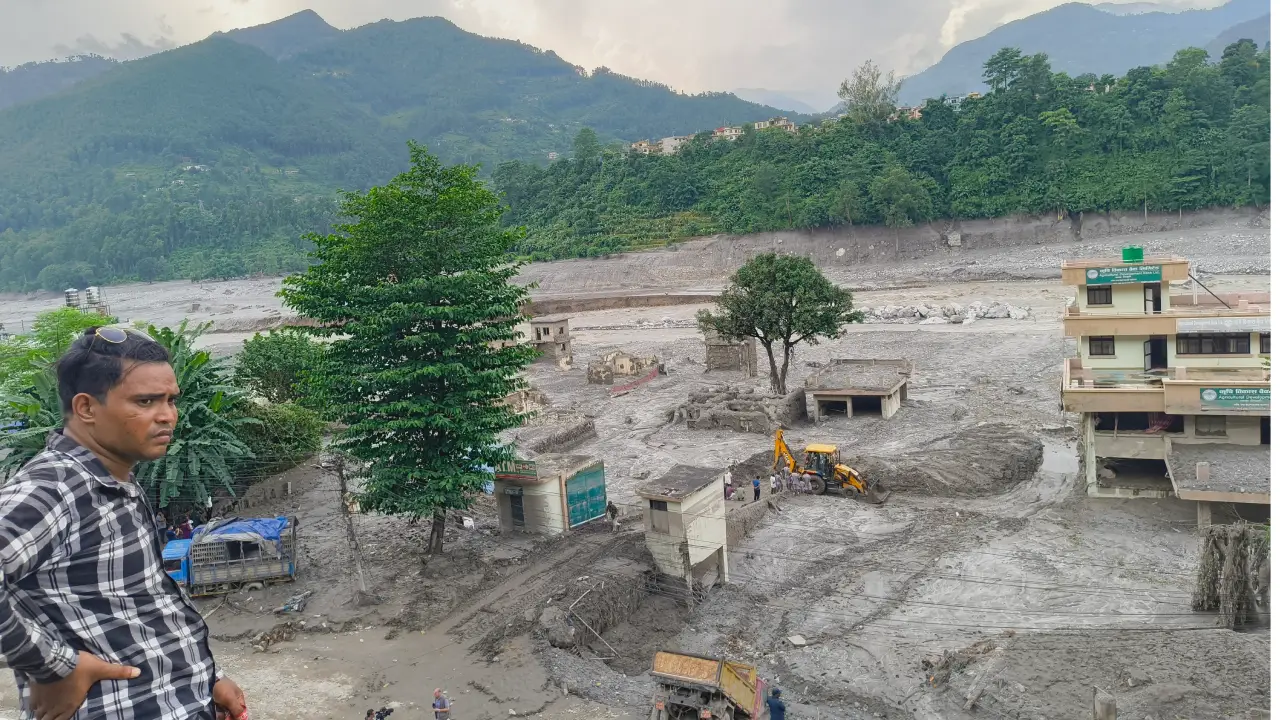
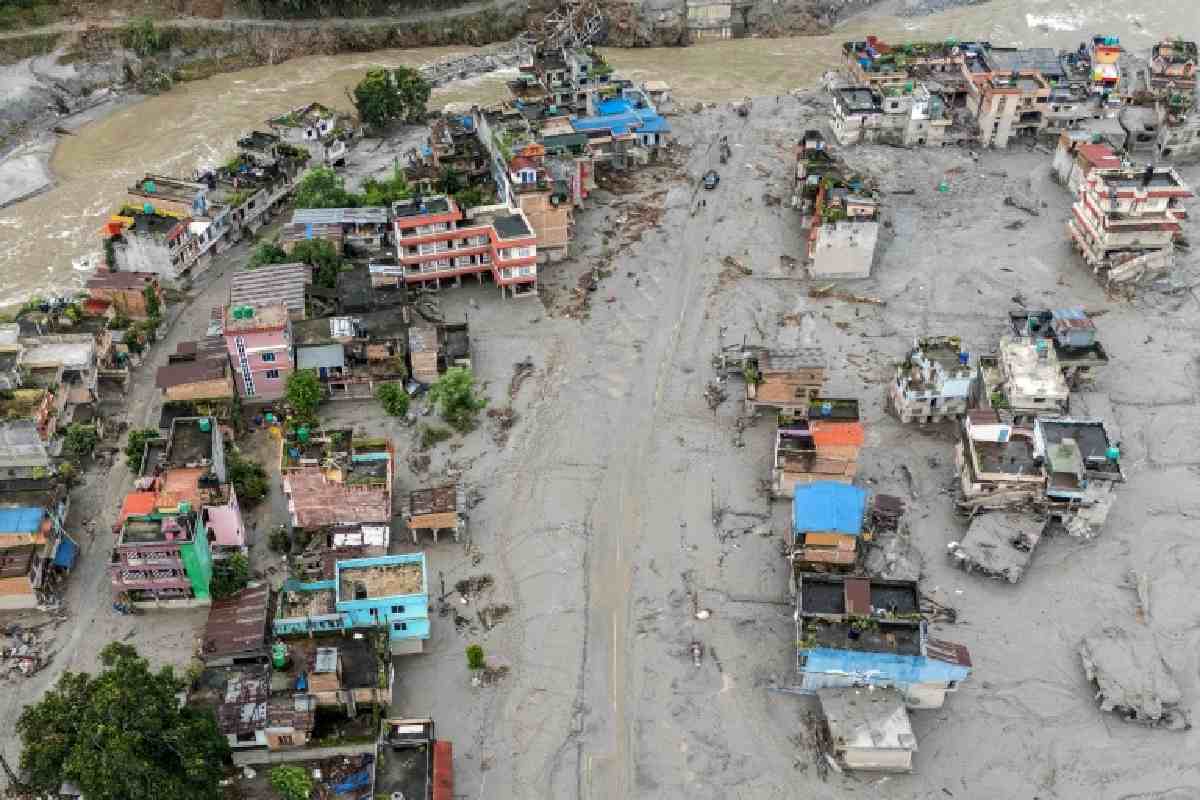
When villagers were gathered at the high point of the hill, a search and rescue team from the Armed Police Force (APF) with two dogs were busy finding the dead bodies 200 metres away from there. Only two days ago, Devighat was a vibrant bazaar situated on the slightly sloping terrain at the bank of the Trisuli, flooded with thick mud left behind by the flood.
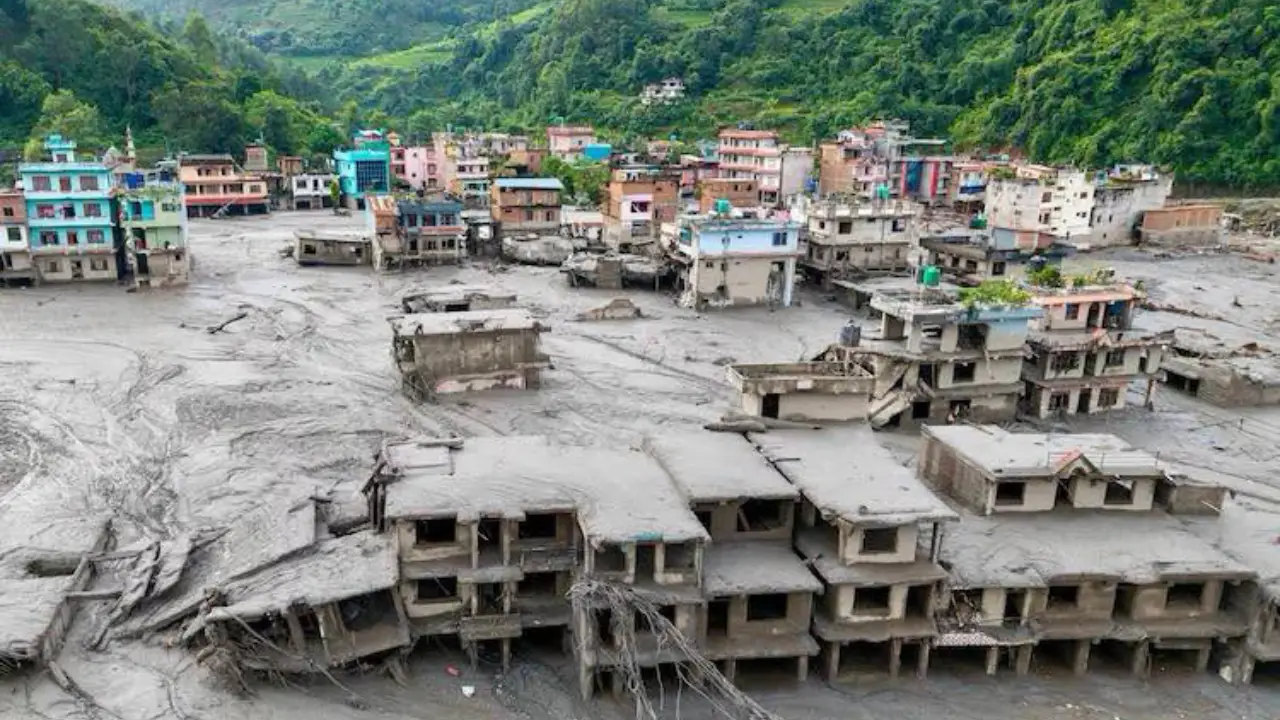
The rescue team could not enter the roadside, and the road had been cleared only a couple of hundred metres. Rescue dogs were getting stuck in the mud and could not come out. The APF rescue team said they didn’t have any equipment to find missing people in the mud and debris. The debris itself was unprecedented because it had submerged even a five-storey building. The whole area was stinking with the smell of the decay of dead bodies, since thick mud mixed with the decomposed human and animal bodies along with the food grains.
The bazaar was gone; however, it had been submerged by the sludge, and some dogs were still waiting for their owners. They stared at the debris continuously and struggled to run over the sludge. The owners had either left before the flood or were missing, but they somehow survived and were still guarding the home without a house. Even these dogs showed abnormal behaviour, but they no longer barked. When two rescue dogs tried to bite a black one, he struggled to flee through the sludge, but again came back to the same place and started staring at the debris.
Salvaging Hope
On August 29, residents and shopkeepers of Dhunge Bazaar, Trisuli, gathered nearby, hoping to reach their homes and shops, many of which were under the rubble of the flood. Santi Lamichhane is among them.
“We were five family members inside the home when the flood came. We left everything there, and we could not even close the shop,” she said briefly. She waited for the equipment to clear the road so she could reach her half-destroyed home, check the condition, and, if it was salvageable, collect it. She waited there until evening, but rescue workers could not clear the road, so she returned to her relative’s home without getting into her half-survived home.
In Dhunge Bazaar, some government offices were also drowned in mud and water, and a government bank was there. Rescue workers, along with Bank Manager Upendra Bhatta, tried to enter the bank building, which was still standing but covered in heavy mud and debris. Bhatta hoped that at least the locker inside the bank was safe, so they could bring it out and keep it in a safe place. Luckily, the next day they recovered the bank locker, successfully securing some depositors’ assets.
On September 4, ten days after the devastation, Dhunge Bazaar had changed a little bit since rescue workers were already able to remove the mud from the road and able to connect the two sides of it. But survivors were still searching for their valuables in their dismantled houses as well as in the mud, in the hope of recovering something.
Prem Nath Lamichhane stood in front of his almost-destroyed house. His wife was cleaning some metal products from his hardware shop in the hope that they could at least save some valuable products and could sell them again. “We did not think the flood could reach here,” he said, “since our house is on the upper side of the road and at a bit of a height.” His house is situated at the foothills of the small mountain next to the bank of the Trisuli River.
Lamichhane worked hard day and night to save money and bought that house some months ago. He wanted to move to that house, and he was reconstructing it accordingly. “But the flood came, and my dream has perished along with the flood,” he said. According to his assessment, he lost almost seven million rupees’ worth of products and properties. He used to give hardware material on credit to the retailers; now almost all retailers also lost their shops and houses. “It is impossible to get money back in this situation, and the bank’s interest will remain as it is,” he said, expressing his future hardship. Still, he is hopeful that the government may give some relief to the flood victims.
Uncountable Loss
Flood victims and survivors lost their dear ones, shelters, properties, land, and so on, and everybody is talking about it. But for Akanksha Pandey, standing in front of her devastated house in Dhunge Bazar, the haunting and triggering thing is different. On 4th September, she was moving here and there, panicking inside herself. She was murmuring to herself. “Here everything stinks, such a disgusting smell,” she said, “who knows, there can be a dead body beneath us.”
As she talked, her father, Rajesh Pandey, and maternal uncle, Ramsaran Thapa, were collecting cans of energy drinks left in the store, full of stinks, hoping that, after cleaning, they would be consumable or sellable. But she was not joining them to help. She was pressing her forehead with her fingers time and again, taking deep breaths.
“I am still panicking; it is not going from my mind,” Pandey, herself a nurse, said. “The flood was unimaginable.” She had two pet dogs named Brownie and Kookie. After the flood, Kookie survived in the remains of the house, but Brownie was missing. “This is nothing if we compare it with the human loss, but I cannot forget Brownie, and it haunts me every time; it is too overwhelming for me,” she said. For others, this is an uncountable loss, but for her it is unforgettable; it haunts her every night.
Missing Walls
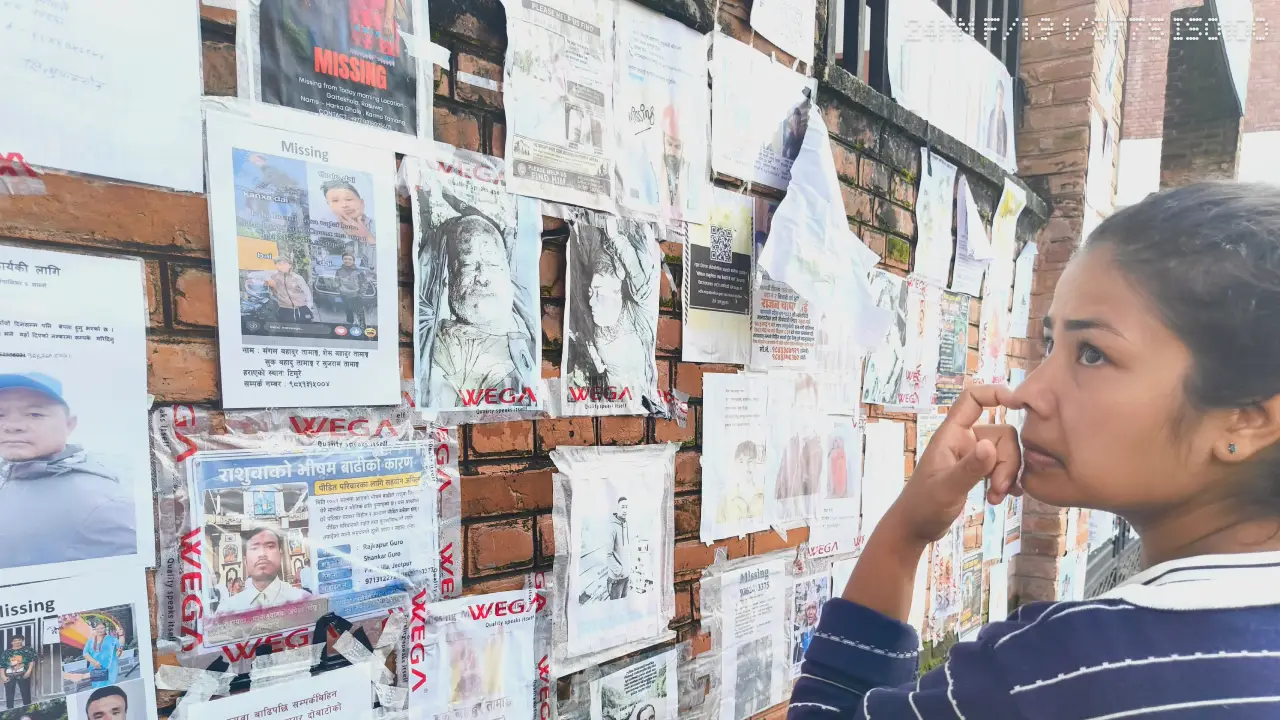
Smiley-face portraits were attached to the walls, pillars, and closed windows. But these faces were not alone; they also had words and numbers. All these faces were attached with the word “missing,” and the numbers were like a post box to reach out to the nearest one. People came and scanned the posters with smiley faces; some came with a poster and put it on the wall.
Some posters included explanations of the body signs, while others listed details of the missing person’s date, place and time. Some included multiple contact numbers, and others included details of their dress. The wall of the Tribhuvan University Teaching Hospital at the heart of Kathmandu turned into the “missing wall.”
On August 30, Bimala Biswakarma from Rasuwa was standing with the poster of her husband Tilak and brother-in-law Dil Bahadur in front of this wall. She and her relatives tried to find a place to put the poster. They wanted to post it somewhere in the middle of the wall where people could easily see it, but they could not find a place. They went to the right corner of the wall and posted the poster of Tilak, Dil Bahadur, along with their transport vehicles.
“My husband and brother-in-law, both of them are transport vehicle drivers,” she said in a broken voice, “they went to Timure and almost entered the other side of the border, China.” Her husband contacted her at 7:33 on 26 August, when the flood happened. “After that we could not contact him or the brother-in-law,” she explained. Both used to go to the customs yard in Kerung, on the Chinese side of the border, to load goods. That day, they were also moving towards the customs yard, which was also washed away by the flood.
Bimala lives in Kathmandu with three children. Six days ago, her husband left Kathmandu for his transport service. He used to come to Kathmandu every week or every ten days. “I was unaware of the flood. My sister-in-law (my brother-in-law’s wife), who lives in the village, called me that day. She said that my husband and brother-in-law were both of them unreachable. I also tried to call them; they never replied,” Bimala recalled that day.
She had already lost hope that they were alive. But she could not accept that they would not come home again. She was thinking about her three children and her brother-in-law’s two children, their future, and all their livelihoods. Bimala said with tears in her eyes, “Still, we are not getting any information. We do not have any hope for life, but we want to get at least the body.” She and her sister-in-law are housemakers only. They relied on their husband’s earnings. “Now, how to sustain? How to give a better future to our children? Our life will be hell.” When she said this, she broke down.
On September 9, Bimala’s brother Ram Krishna Biswakarma said over a phone call that she is still waiting for confirmation about her husband’s death. “Without the body, we could not even process the funeral rituals; my sister is still waiting for the confirmation about the death of my brother-in-law,” he said. According to him, in Bimala’s village, seven family members are waiting for the confirmation of the death of their dear one, who is missing from Timure, and all of them went there for the transport services.
From the wall where the missing person’s relatives put the posters, the hospital’s main gate is just 50 metres away. Taking a right turn from the main gate, within a couple of hundred steps, a narrow street comes, and a little ahead, the Kanti Children’s Hospital’s main gate is there. After crossing the main gate of the Kanti Children’s Hospital, hundreds of posters hung on threads with numbers on the compound wall of Kanti.
All the posters have pictures of human dead bodies which are swollen, disfigured, unnatural, and horrifying after being submerged in the water and mud. Even a normal person may break down at this harrowing scene, where all human beings have become dead bodies, and they do not have an identity, only the numbers given by the authorities.
On September 2, Devdhari Raya from the Bagmati Municipality, Sarlahi was scanning all these horrifying posters on the wall. He was shaking his head and murmuring to himself. He could not find any familiar face among the posters. Meanwhile, his brother and grandson went to the mortuary of the teaching hospital, which is just in front of that wall. “My son is a carpenter. He works for a sawmill in Devighat at Nuwakot. He has been missing since the 26th of August, when the flood came,” he said, with shaking lips and tears in his eyes.
His son Ram Praves, known as a Sikindar Mistri in Devighat, is among the thousands missing in the flood. He did not hope his son was still alive. But he wanted to see his face once and say a final goodbye. “I want to see him once, but maybe his body has been washed away.” As he said this, he broke down. He started searching for his son since the flood day and reached every mortuary in the hospitals. But he could not find him anywhere.
Devdhari has given a DNA sample to match with bodies found in different parts of the riverbanks. But authorities have yet to identify any as his son. “He is still waiting for the confirmation and has not done any mourning rituals,” his brother Dinesh, from his hometown in Sarlahi, said over a phone call on September 9. “Even if DNA does not match, we will start our mourning rituals assuming that my nephew is no more; there is no other way to move forward,” he said, sharing his thoughts.
When Devdhari was sharing his sorrows, a group of people from Dhading district of Nepal came and started scanning the posters of the dead bodies. Among them, a man identified a body and said to his companions, “She is my mother.” He broke down along with his sisters. Many cameras were following them. Nobody answered. They were struggling to talk. A person explained that the lady was going to the Gosaikunda pilgrimage site for the Hindu festival Janai Purnima, popularly known as Rakhi in South Asia. She was among those people who were stranded with the bus at Betravati village in Nuwakot.
Sacred Burial
On August 29, the government of Nepal decided that unidentified and unclaimed dead bodies would go for mass burial, which sparked a row on social media. Critics were saying that this was undignified as well as the act of victimising the victims more, mainly those who are searching for their loved ones. But authorities have given a warning of another disaster due to the decayed bodies in different hospitals in Nepal.
The government amended the Unidentified and Unclaimed Bodies Management Directive and assured that DNA should be collected and proper identifiers should be put in the burial ground for disaster-recovered unidentified or unclaimed bodies. After the amendments to the directives, they started burying hundreds of bodies from different places, including the capital, Kathmandu. When the government decided to bury unidentified bodies, relatives also started death rituals for their family members without getting their bodies.
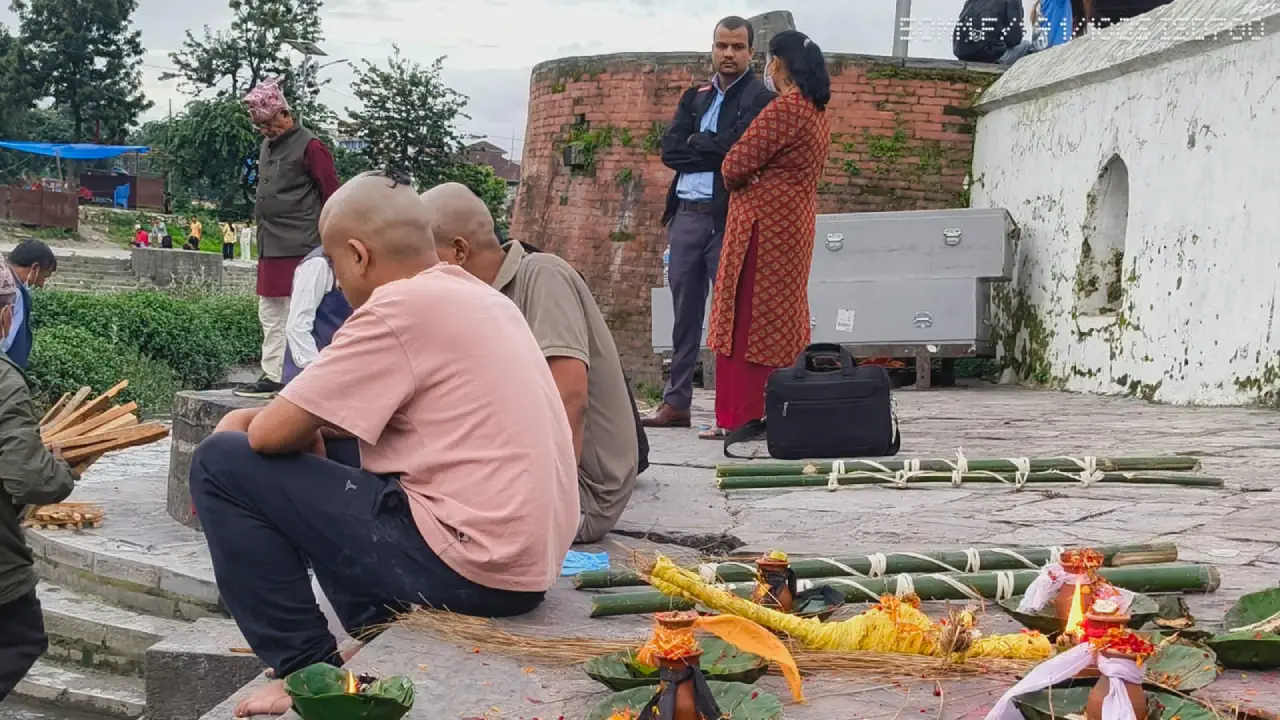
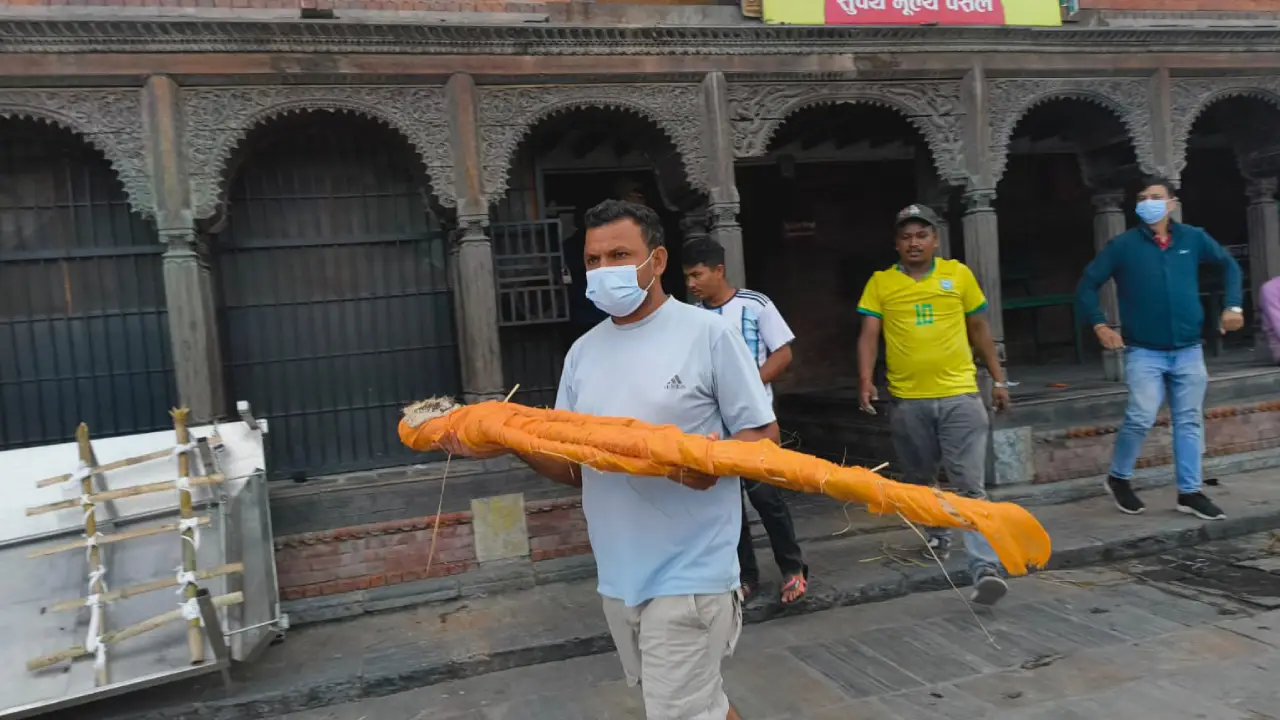
On September 2, Pasupati Aarya Ghat, the main cremation place of the Kathmandu Valley, was filled with symbolic cremations. For that, relatives of the lost one gather at Arya Ghat, and they make a symbolic dead body of Hindu sacred grass called Kusha and finish the final rituals. Among hundreds of symbolic dead bodies of sacred grass, Basu Rijal and Binita Devi Rijal’s bodies were also there.
“They were at the home in Sole Bazaar, Nuwakot, when the flood came,” Madav Bhandari, a nephew of Basu and Binita, said, “their sons and their family members were not in the village, so they survived.” When Madav was talking, Basu and Binita’s sons Swadesh and Babin were preparing for the final rituals. First, they prepared two symbolic dead bodies and followed the priest’s instructions. According to the crematorium management officials at Pasupati Nath, the Rijal family was among almost 400 symbolic dead bodies cremated that day at the Arya Ghat. “It’s very painful, but we have to follow the rituals and wish for their peace in heaven,” Madav said.
The Devastation
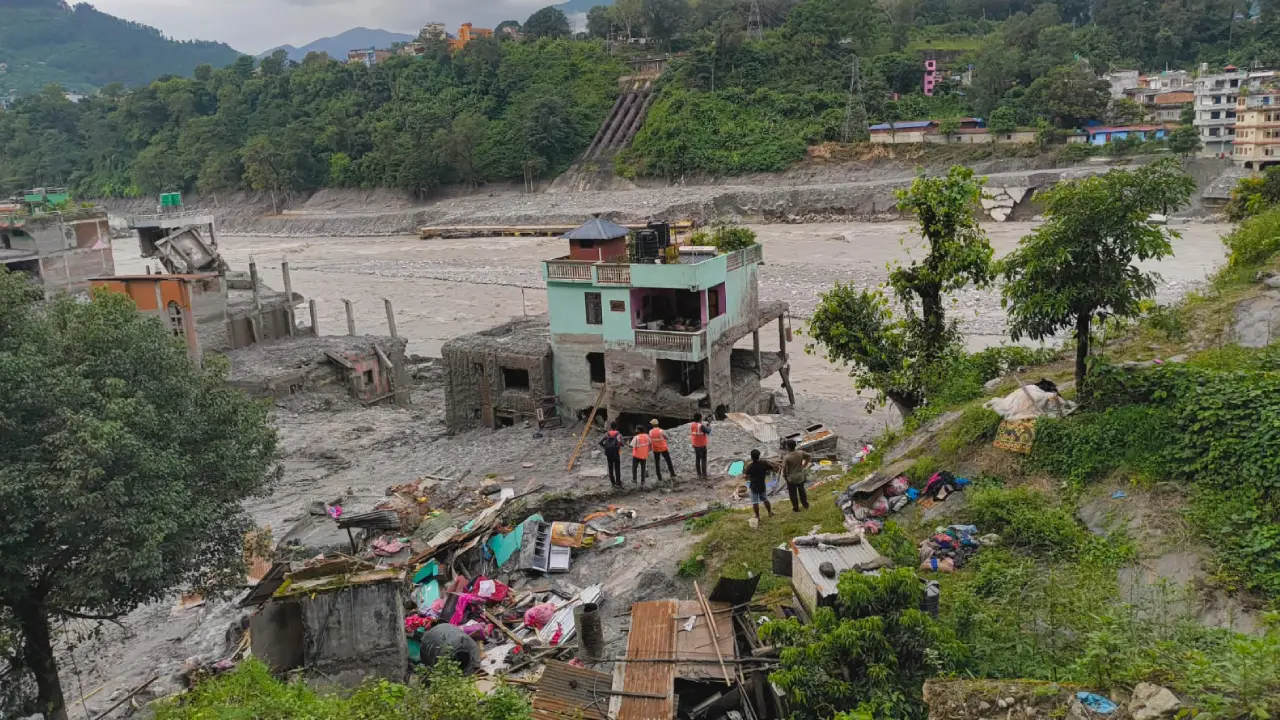
On August 26, at 8:40 AM, a devastating flood emerged from the Bhote Koshi River in Rasuwa District, Nepal. It caused heavy loss of life and property on both sides of the border between Nepal and Tibet. According to the Nepal government’s official disaster relief appeal, “the flood severely impacted riverbank areas in Rasuwa, Nuwakot, Dhading, and Gorkha districts.” It further says, “Moving survivors to safe places is urgent, and arranging their long-term rehabilitation is just as critical.”
Multiple conflicting versions of the flood’s causes exist, but officials from Nepal and China, along with organisations focused on cryosphere research and advocacy, largely agree that a collapsed, melted ice rock triggered it. The trigger caused a huge landslide that entered the Lende Khola.
International Centre for Integrated Mountain Development (ICIMOD) said, “Preliminary assessment based on video footage and information from affected areas suggests that a large volume of ice and rock debris may have entered the Lende Khola, a tributary of the Bhote Koshi River.” It further explains, “Researchers say the event could have generated a sudden surge that carried water, sediment and large boulders downstream.” Scientists worldwide and officials from Nepal and China are focusing on further research into the cause of this flood. Advocacy groups and Nepali leaders say climate change is the cause, even though Nepal contributes less than one per cent of global carbon emissions. They are demanding climate justice compensation for Nepal, which became a global discussion after the flood.
According to the National Disaster Risk Reduction & Management Authority (NDRRM), more than five thousand people are missing, and the search and rescue team recovered almost one thousand four hundred bodies. Of the missing, almost 600 are foreign citizens. Almost 14 thousand people have been rescued so far.
Grief Management
On August 30, a team of psychiatrists and psychologists visited shelter homes in Nuwakot district and met the survivors. Dr Suraj Tiwari, the chief psychiatrist consultant of Nepal’s major mental hospital, was among them. When they reached the shelter homes, survivors were stressed, frightened, and zoned out. When they approached some of them, they were repeatedly talking about the flood and their loss. These losses were not only human losses; they took different forms. Some of them shared their losses in front of the psychologists, but many remained silent.
“What we found was that many of them were in bereavement-related stress and anxiety; some of them lost their hope and faith in life too,” he said, sharing his experience. When he approached an elderly man in a shelter, he had totally lost his hope about everything since he lost a family member and his house. “He told me, ‘I don’t want to live anymore,’ and we counselled him. So many people have lost their hope; they are going through suicidal thoughts,” Tiwari said, expressing concern.
According to him, due to unexpected occurrences and multiple losses, people are carrying different types of grief altogether, which is a unique situation. Survivors are facing acute stress reaction, acute stress disorder, post-traumatic stress disorder, and bereavement-related stress disorder now. “This is a cross-cutting issue, and multi-stakeholders must unite together, so we have to focus on that coordination; otherwise, multiple grief will impact the survivor for a long period,” he added. Ministry of Health records show that more than 150 health personnel are deployed in the affected area for psychological counselling only.
Future Hope
On September 5, at the same place in Mustang Gumba, sitting on the same chair, Dorje and Chhesang were sharing their story of sorrow and misery; Pema was busy with paperwork and formalities since he belongs to the local government. Before returning to the paperwork, he said, “Our villagers, including me, lost family members, property, houses, and our pets, but we still have not lost hope. We have to focus on rebuilding our village.”
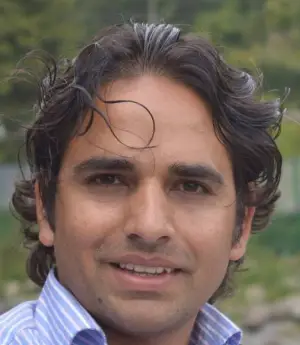
After some time, Chhesang also became busy helping and managing things for the fellow survivors. Dorje stood up and started showing up at the shelter home. In this shelter, all the survivors live in a big hall on the ground floor, while prayers and daily activities take place on the first floor. An outside stair goes up to the first floor, the prayer room, where Dorje also entered. Before entering the prayer room, he took off his shoes outside the door.
Inside the prayer room, a group of women chanted Buddhist mantras and offered prayers. Their devotion was uninterrupted even by an outsider’s entry into that place. Returning from the prayer room, on the stairs, Dorje said, “They are offering prayers for those who lost their lives in this flood.” Does he still believe in prayers after this catastrophic flood? He looked towards children who were busy playing football on the ground and said, “We survived with hope. Now, for them, even my children are exactly like them; we must keep hope in our prayers. Though we lost everything but hope, the future remains forever.”
(This is a web-only special report. Bishnu Pokharel is a Kathmandu-based independent journalist, writer, and researcher.)